Maths4UBETA

Probability scales, single events and complements

Locate a probability on the zero-to-one scale, count equally likely outcomes and find the chance that an event does not happen.

Try the quick check →
Lesson 1 of 9

Section 1 of 3 · Core · about 5 min

Where can a probability sit?

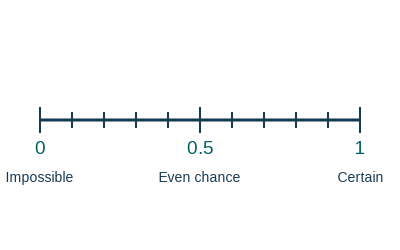
A probability scale from zero, impossible, to one, certain, via one half, an even chance.

Zero is impossible. One half separates events less and more likely than not. One is certain.

Practise the method

Check the outcome described before judging its chance. The same probability can be written in different ways, such as 14=0.25=25%\frac{1}{4}=0.25=25\%.

Worked example

Connect a chance to a point on the scale

A machine assigns integers from 1 to 6, each equally likely. Consider the event that the selected number is at most 6. Which description matches the event?

  1. Certain
  2. Impossible
  3. Unlikely, but possible
  4. Equally likely to happen or not happen
  1. Every possible outcome meets the event.

  2. Its position on the scale is 11. This means certain.

Your turn

A folder contains 7 green labels and 7 silver labels. One label is selected at random. Consider the event that it is green. Which description matches the event?

Choose one answer

Worked example

Count favourable and total outcomes

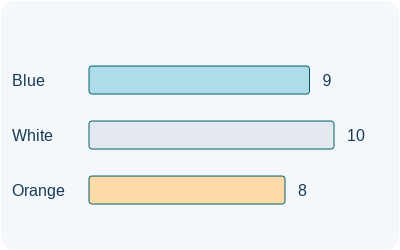
A packet has 9 blue markers, 10 white markers and 8 orange markers. One marker is chosen at random. Find the probability it is blue. Give an exact fraction or decimal.

Blue: 9; White: 10; Orange: 8

Try it on paper first.

  1. There are 27 markers altogether. Each separate marker is equally likely to be chosen.

  2. The favourable count is 9 blue markers, so use 927\frac{9}{27}.

  3. The answer is 13\frac{1}{3}.

Your turn

A packet has 10 blue markers, 11 white markers and 9 orange markers. One marker is chosen at random. Find the probability it is blue. Give your answer as an exact fraction.

Blue: 10; White: 11; Orange: 9

Enter a probability such as 1/4, 0.25 or 25%.

Section 2 of 3 · Core · about 6 min

What goes in the denominator?

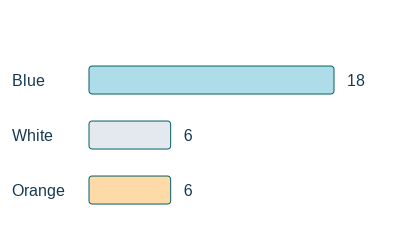
Blue: 18; White: 6; Orange: 6

The blue bar gives part of the collection. The denominator includes every bar.

Practise the method

Count everything that might be chosen. Then count the items that match the event. Read each relevant row of a frequency table.

Worked example

Count favourable and total outcomes

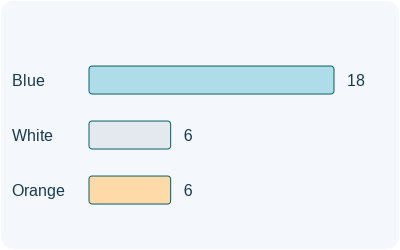
A packet has 18 blue markers, 6 white markers and 6 orange markers. One marker is chosen at random. Find the probability it is blue. Give an exact fraction or decimal.

Blue: 18; White: 6; Orange: 6

  1. There are 30 markers altogether. Each separate marker is equally likely to be chosen.

  2. The favourable count is 18 blue markers, so use 1830\frac{18}{30}.

  3. The answer is 35\frac{3}{5}.

Your turn

A packet has 19 blue markers, 7 white markers and 7 orange markers. One marker is chosen at random. Find the probability it is blue. Give your answer as an exact fraction.

Blue: 19; White: 7; Orange: 7

Enter a probability such as 1/4, 0.25 or 25%.

Worked example

Read a probability from a frequency table

One parcel from the table is selected at random. Find the probability that it does not go to the library. Give an exact fraction or decimal.

Number of parcels by destination
DestinationParcels
Library10
Studio15
Sports hall4

Try it on paper first.

  1. Use 19 parcels from the studio and sports hall together. There are 29 parcels in all.

  2. The answer is 1929\frac{19}{29}.

Your turn

One parcel from the table is selected at random. Find the probability that it does not go to the library. Give an exact fraction or decimal.

Number of parcels by destination
DestinationParcels
Library11
Studio16
Sports hall5

Use a fraction, a percentage or a decimal rounded to at least 3 significant figures.

Section 3 of 3 · Core · about 6 min

How can I find the chance of the opposite?

Practise the method

Find the chance of the easier event, then subtract it from 1 where the question asks for its complement. If a table of distinct outcomes has one missing probability, subtract all the given probabilities from 1.

Worked example

Find the complement of an event

During one check the probability that a reading is acceptable is 79\frac{7}{9}. Find the probability that it is not acceptable. Give an exact fraction or decimal.

  1. The event and its complement cover every result, so their probabilities add to 1.

  2. Subtract the given probability from 1. In a common denominator the result is 836\frac{8}{36}.

  3. The answer is 29\frac{2}{9}.

Your turn

During one check the probability that a reading is acceptable is 2937\frac{29}{37}. Find the probability that it is not acceptable. Give your answer as an exact fraction.

Enter a probability such as 1/4, 0.25 or 25%.

Worked example

Find the missing chance in an unequal probability model

Each repaired part is classified as good, adjustment needed or rejected, with no other classification. The chance of needing adjustment is 6%. The chance of rejection is 16%. Find the probability that a part is classified as good. Give an exact fraction or decimal.

Try it on paper first.

  1. The three classifications cover all outcomes, so their chances add to 100%.

  2. Subtract 6% and 16% from 100%. This gives 78%, which is 78100\frac{78}{100}.

  3. The answer is 3950\frac{39}{50}.

Your turn

Each repaired part is classified as good, adjustment needed or rejected, with no other classification. The chance of needing adjustment is 7%. The chance of rejection is 17%. Find the probability that a part is classified as good. Give an exact fraction or decimal.

Use a fraction, a percentage or a decimal rounded to at least 3 significant figures.

Worked examples

Practise the method

Core practice

Question 1 of 5

0 / 5 checked in this collection

Question list

Core practice

Fresh variants

Exam-style

Connect a chance to a point on the scale

1 mark

A machine assigns integers from 1 to 16, each equally likely. It cannot assign 17. Which description matches the event?

Choose one answer

Choose one option. Explain your reasoning on paper.

Review the method

Progress stays in this browser. Create an account to save it or sign in.

Extra practice from this lesson

Connect a chance to a point on the scale

A machine assigns integers from 1 to 11, each equally likely. It cannot assign 12. Which description matches the event?

Choose one answer

Count favourable and total outcomes

A packet has 15 blue markers, 16 white markers and 3 orange markers. One marker is chosen at random. Find the probability it is blue. Give your answer as an exact fraction.

Blue: 15; White: 16; Orange: 3

Enter a probability such as 1/4, 0.25 or 25%.

Count favourable and total outcomes

A packet has 6 blue markers, 11 white markers and 11 orange markers. One marker is chosen at random. Find the probability it is blue. Give your answer as an exact fraction.

Blue: 6; White: 11; Orange: 11

Enter a probability such as 1/4, 0.25 or 25%.

Read a probability from a frequency table

One parcel from the table is selected at random. Find the probability that it does not go to the library. Give your answer as an exact fraction.

Number of parcels by destination
DestinationParcels
Library16
Studio8
Sports hall10

Enter a probability such as 1/4, 0.25 or 25%.

Find the complement of an event

During one check the probability that a reading is acceptable is 12\frac{1}{2}. Find the probability that it is not acceptable. Give an exact fraction or decimal.

Use a fraction, a percentage or a decimal rounded to at least 3 significant figures.

Find the missing chance in an unequal probability model

Each repaired part is classified as good, adjustment needed or rejected, with no other classification. The chance of needing adjustment is 12%. The chance of rejection is 22%. Find the probability that a part is classified as good. Give an exact fraction or decimal.

Use a fraction, a percentage or a decimal rounded to at least 3 significant figures.

Apply it · original exam-style problems

Show your working on paper and compare it with the worked solution and marking guidance.

Come back to what needs practice

Quick revision sheet (A4)

Your review plan starts after your first check.