Cambridge IGCSE Mathematics (0580) · Probability · Quick revision
Probability scales, single events and complements
Where can a probability sit?
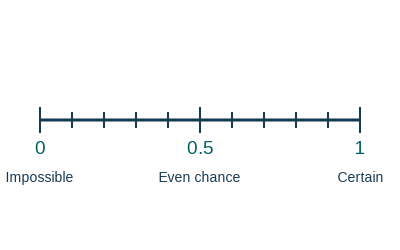
A probability measures how likely one named event is. A value of 0 means impossible, means an even chance, and 1 means certain.
Check the outcome described before judging its chance. The same probability can be written in different ways, such as .
What goes in the denominator?
When the individual outcomes are equally likely, use .
Count everything that might be chosen. Then count the items that match the event. Read each relevant row of a frequency table.
How can I find the chance of the opposite?
An event and its complement cover every outcome. Their probabilities add to 1.
Find the chance of the easier event, then subtract it from 1 where the question asks for its complement. If a table of distinct outcomes has one missing probability, subtract all the given probabilities from 1.
Quick worked example
A machine assigns integers from 1 to 6, each equally likely. Consider the event that the selected number is at most 6. Which description matches the event?
- Certain
- Impossible
- Unlikely, but possible
- Equally likely to happen or not happen
Every possible outcome meets the event.
Its position on the scale is . This means certain.