Maths4UBETA

Extended: conditional probability from Venn diagrams and tables

Restrict a random selection to a given group and find the probability of a further characteristic within that group.

Try the quick check →
Lesson 8 of 9

Section 1 of 3 · Extension · about 6 min

How does known information change the total?

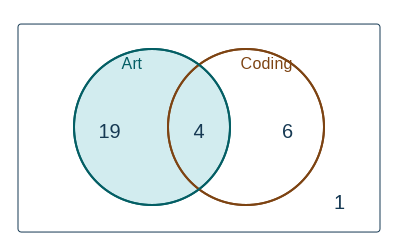
Art only 19; both 4; Coding only 6; neither 1. The Art circle is highlighted.

The highlighted circle is the given group. The overlap satisfies both descriptions.

Practise the method

In a Venn diagram, keep the whole circle for the given group. Count the qualifying region inside that circle.

Worked example

Change the denominator in a Venn diagram

A group has 30 students. 23 attend Art, 10 attend Coding and 4 attend both. One student is chosen at random from the group. It is known that this student attends Art. Find the probability the student also attends Coding. Give an exact fraction or decimal.
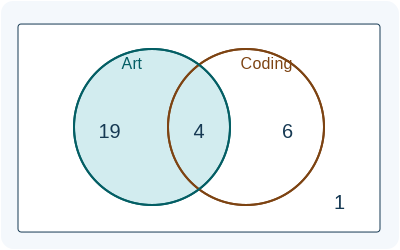
  1. Art only 19; both 4; Coding only 6; neither 1. The Art circle is highlighted.

  2. Keep only the Art circle. It has 23 possible students.

  3. Within that circle, 4 attend Coding as well.

  4. The answer is 423\frac{4}{23}.

Your turn

A group has 17 students. 8 attend Art, 12 attend Coding and 5 attend both. One student is chosen at random from the group. It is known that this student attends Coding. Find the probability the student also attends Art. Give your answer as an exact fraction.

Enter a probability such as 1/4, 0.25 or 25%.

Worked example

Use a complement as the condition

In a group of 37, 25 attend Art, 20 attend Coding and 11 attend both. Someone is chosen at random. They do not attend Art. Find the probability they attend neither club. Give an exact fraction or decimal.

Try it on paper first.

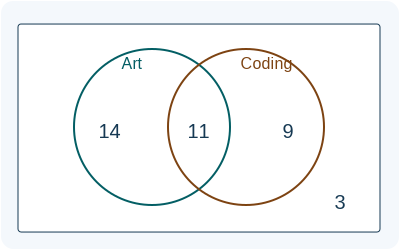
  1. Art only 14; both 11; Coding only 9; neither 3.

  2. Exclude the Art circle first. That leaves 9 members of Coding only and 3 people in neither club.

  3. Of the 12 allowed people, use only the 3 outside both circles.

  4. The answer is 14\frac{1}{4}.

Your turn

In a group of 41, 27 attend Art, 22 attend Coding and 12 attend both. Someone is chosen at random. They do not attend Art. Find the probability they attend neither club. Give your answer as an exact fraction.

Enter a probability such as 1/4, 0.25 or 25%.

Section 2 of 3 · Extension · about 6 min

Which row or column becomes the new sample space?

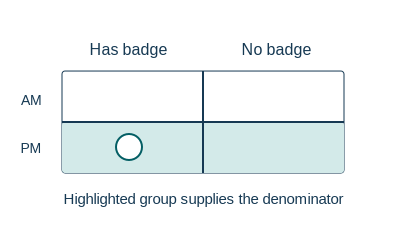
The Afternoon row is highlighted. The lower left cell satisfies both descriptions.

The highlighted row supplies the total. The circled cell meets both descriptions.

Practise the method

Underline the information already known. Follow its row or column to the margin, then read the shared cell.

Worked example

Restrict a two-way table to the given group

A person from the table is chosen at random. The person chosen attends the afternoon session. Find the probability they have a badge. Give an exact fraction or decimal.

Club sessions and badges
SessionHas badgeNo badgeTotal
Morning17825
Afternoon8715
Total251540
  1. Keep the Afternoon row. The whole row contains everyone who meets the condition.

  2. The requested cell is 8. The correct subtotal is 15.

  3. The answer is 815\frac{8}{15}.

Your turn

A person from the table is chosen at random. The person chosen attends the afternoon session. Find the probability they have a badge. Give your answer as an exact fraction.

Club sessions and badges
SessionHas badgeNo badgeTotal
Morning18927
Afternoon9817
Total271744

Enter a probability such as 1/4, 0.25 or 25%.

Worked example

Restrict a two-way table to the given group

A person from the table is chosen at random. The person chosen has a badge. Find the probability they attend the afternoon session. Give an exact fraction or decimal.

Club sessions and badges
SessionHas badgeNo badgeTotal
Morning191029
Afternoon10919
Total291948

Try it on paper first.

  1. Keep the Has badge column. Its total contains every person who meets the condition.

  2. The requested cell is 10. The correct subtotal is 29.

  3. The answer is 1029\frac{10}{29}.

Your turn

A person from the table is chosen at random. The person chosen has a badge. Find the probability they attend the afternoon session. Give your answer as an exact fraction.

Club sessions and badges
SessionHas badgeNo badgeTotal
Morning31114
Afternoon11112
Total141226

Enter a probability such as 1/4, 0.25 or 25%.

Section 3 of 3 · Extension · about 6 min

What if the condition says ‘not’?

Practise the method

Trace or list the regions that survive the condition. Within that list, count only the regions answering the question.

Worked example

Use a complement as the condition

In a group of 47, 26 attend Art, 25 attend Coding and 9 attend both. Someone is chosen at random. They do not attend Art. Find the probability they attend neither club. Give an exact fraction or decimal.

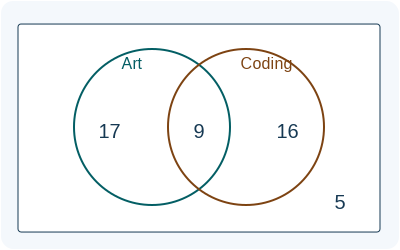
  1. Art only 17; both 9; Coding only 16; neither 5.

  2. Exclude the Art circle first. That leaves 16 members of Coding only and 5 people in neither club.

  3. Of the 21 allowed people, use only the 5 outside both circles.

  4. The answer is 521\frac{5}{21}.

Your turn

In a group of 38, 28 attend Art, 14 attend Coding and 10 attend both. Someone is chosen at random. They do not attend Art. Find the probability they attend neither club. Give an exact fraction or decimal.

Use a fraction, a percentage or a decimal rounded to at least 3 significant figures.

Worked example

Change the denominator in a Venn diagram

A group has 26 students. 15 attend Art, 10 attend Coding and 6 attend both. One student is chosen at random from the group. It is known that this student attends Art. Find the probability the student also attends Coding. Give an exact fraction or decimal.

Try it on paper first.

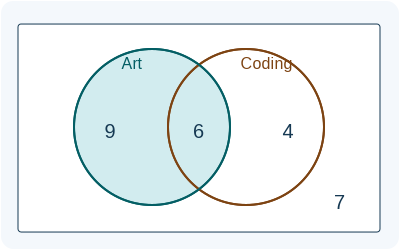
  1. Art only 9; both 6; Coding only 4; neither 7. The Art circle is highlighted.

  2. Keep only the Art circle. It has 15 possible students.

  3. Within that circle, 6 attend Coding as well.

  4. The answer is 25\frac{2}{5}.

Your turn

A group has 30 students. 17 attend Art, 12 attend Coding and 7 attend both. One student is chosen at random from the group. It is known that this student attends Coding. Find the probability the student also attends Art. Give your answer as an exact fraction.

Enter a probability such as 1/4, 0.25 or 25%.

Worked examples

Practise the method

Core practice

Question 1 of 5

0 / 5 checked in this collection

Question list

Core practice

Fresh variants

Exam-style

Change the denominator in a Venn diagram

1 mark

A group has 25 students. 14 attend Art, 13 attend Coding and 9 attend both. One student is chosen at random from the group. It is known that this student attends Art. Find the probability the student also attends Coding. Give an exact fraction or decimal.

Art only 5; both 9; Coding only 4; neither 7. The Art circle is highlighted.

Use a fraction, a percentage or a decimal rounded to at least 3 significant figures.

Full answer-format guide

Exact numbers: 3/2, sqrt(5), 2-sqrt(3), pi/6, 3*pi/2. Sets: {1,4}. Intervals: (3,5]; a round bracket excludes the endpoint. Infinity: inf; union: U; no solutions: empty. Separate coordinate pairs or triples with semicolons. Expressions: 2x^2+3x-1; equations: x^2=3x+1 or the polynomial equal to zero. Factors: x-1 ; x+2. Parameter fraction: numerator ; denominator. List integer answers individually.

Review the method

Progress stays in this browser. Create an account to save it or sign in.

Extra practice from this lesson

Change the denominator in a Venn diagram

A group has 33 students. 16 attend Art, 20 attend Coding and 9 attend both. One student is chosen at random from the group. It is known that this student attends Coding. Find the probability the student also attends Art. Give an exact fraction or decimal.

Use a fraction, a percentage or a decimal rounded to at least 3 significant figures.

Use a complement as the condition

In a group of 33, 9 attend Art, 21 attend Coding and 6 attend both. Someone is chosen at random. They do not attend Art. Find the probability they attend neither club. Give an exact fraction or decimal.

Use a fraction, a percentage or a decimal rounded to at least 3 significant figures.

Restrict a two-way table to the given group

A person from the table is chosen at random. The person chosen attends the afternoon session. Find the probability they have a badge. Give an exact fraction or decimal.

Club sessions and badges
SessionHas badgeNo badgeTotal
Morning527
Afternoon13316
Total18523

Use a fraction, a percentage or a decimal rounded to at least 3 significant figures.

Restrict a two-way table to the given group

A person from the table is chosen at random. The person chosen has a badge. Find the probability they attend the afternoon session. Give your answer as an exact fraction.

Club sessions and badges
SessionHas badgeNo badgeTotal
Morning8513
Afternoon16622
Total241135

Enter a probability such as 1/4, 0.25 or 25%.

Use a complement as the condition

In a group of 17, 8 attend Art, 11 attend Coding and 3 attend both. Someone is chosen at random. They do not attend Art. Find the probability they attend neither club. Give your answer as an exact fraction.

Enter a probability such as 1/4, 0.25 or 25%.

Change the denominator in a Venn diagram

A group has 41 students. 27 attend Art, 22 attend Coding and 12 attend both. One student is chosen at random from the group. It is known that this student attends Art. Find the probability the student also attends Coding. Give your answer as an exact fraction.

Enter a probability such as 1/4, 0.25 or 25%.

Apply it · original exam-style problems

Show your working on paper and compare it with the worked solution and marking guidance.

Come back to what needs practice

Quick revision sheet (A4)

Your review plan starts after your first check.