Maths4UBETA

Probability from two-set Venn diagrams

Use the overlap, single-set and outside regions to calculate probabilities for one randomly selected person or item.

Try the quick check →
Lesson 4 of 9

Section 1 of 3 · Core · about 6 min

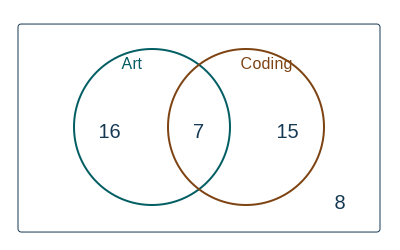
What belongs in each of the four regions?

Art only 16; both 7; Coding only 15; neither 8.

The two circles share one region. The rectangle includes people outside both circles.

Practise the method

Put the given shared count in the overlap first. Subtract it from each full set total to get the two single-set regions.

Worked example

Read the required regions of two overlapping sets

At a school, 23 students attend Art, 22 attend Coding and 7 attend both clubs. There are 46 students altogether. One is chosen at random. Find the probability that this student attends at least one of these clubs. Give an exact fraction or decimal.
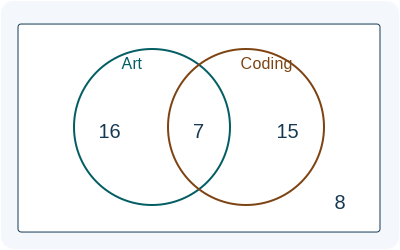
  1. Art only 16; both 7; Coding only 15; neither 8.

  2. Adding the two group totals counts the 7 students in both groups twice. Subtract their overlap once.

  3. Use 38 students who attend at least one club out of 46.

  4. The answer is 1923\frac{19}{23}.

Your turn

At a school, 25 students attend Art, 24 attend Coding and 8 attend both clubs. There are 50 students altogether. One is chosen at random. Find the probability that this student attends at least one of these clubs. Give an exact fraction or decimal.

Use a fraction, a percentage or a decimal rounded to at least 3 significant figures.

Worked example

Read the required regions of two overlapping sets

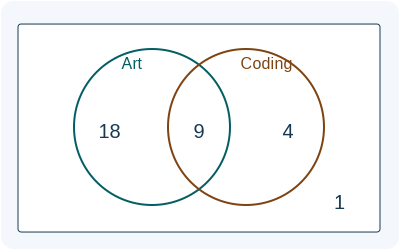
At a school, 27 students attend Art, 13 attend Coding and 9 attend both clubs. There are 32 students altogether. One is chosen at random. Find the probability that this student attends both clubs. Give an exact fraction or decimal.

Try it on paper first.

  1. Art only 18; both 9; Coding only 4; neither 1.

  2. The overlap is the group of 9 students who attend both clubs.

  3. The selection comes from all 32 students.

  4. The answer is 932\frac{9}{32}.

Your turn

At a school, 29 students attend Art, 15 attend Coding and 10 attend both clubs. There are 36 students altogether. One is chosen at random. Find the probability that this student attends both clubs. Give your answer as an exact fraction.

Enter a probability such as 1/4, 0.25 or 25%.

Section 2 of 3 · Core · about 6 min

Where does ‘neither’ go?

Practise the method

Count all three occupied circle regions once each. Subtract their combined number from the survey total.

Worked example

Read the required regions of two overlapping sets

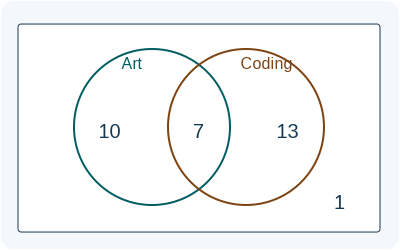
At a school, 17 students attend Art, 20 attend Coding and 7 attend both clubs. There are 31 students altogether. One is chosen at random. Find the probability that this student attends neither club. Give an exact fraction or decimal.

  1. Art only 10; both 7; Coding only 13; neither 1.

  2. The number in at least one club is 17+20−7. Subtract this from 31.

  3. There are 1 students outside both sets.

  4. The answer is 131\frac{1}{31}.

Your turn

At a school, 19 students attend Art, 22 attend Coding and 8 attend both clubs. There are 35 students altogether. One is chosen at random. Find the probability that this student attends neither club. Give your answer as an exact fraction.

Enter a probability such as 1/4, 0.25 or 25%.

Worked example

Read the required regions of two overlapping sets

At a school, 21 students attend Art, 24 attend Coding and 9 attend both clubs. There are 39 students altogether. One is chosen at random. Find the probability that this student attends at least one of these clubs. Give an exact fraction or decimal.

Try it on paper first.

  1. Art only 12; both 9; Coding only 15; neither 3.

  2. Adding the two group totals counts the 9 students in both groups twice. Subtract their overlap once.

  3. Use 36 students who attend at least one club out of 39.

  4. The answer is 1213\frac{12}{13}.

Your turn

At a school, 23 students attend Art, 26 attend Coding and 10 attend both clubs. There are 43 students altogether. One is chosen at random. Find the probability that this student attends at least one of these clubs. Give your answer as an exact fraction.

Enter a probability such as 1/4, 0.25 or 25%.

Section 3 of 3 · Core · about 6 min

How is exactly one different from at least one?

Practise the method

Mark every qualifying region first, then add its counts and use the total population as the denominator.

Worked example

Read the required regions of two overlapping sets

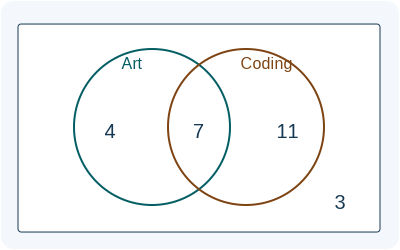
At a school, 11 students attend Art, 18 attend Coding and 7 attend both clubs. There are 25 students altogether. One is chosen at random. Find the probability that this student attends exactly one of these clubs. Give an exact fraction or decimal.

  1. Art only 4; both 7; Coding only 11; neither 3.

  2. Remove those in both clubs from each club's total, leaving 4 in Art only and 11 in Coding only.

  3. Exactly one includes those two single-club groups.

  4. The answer is 35\frac{3}{5}.

Your turn

At a school, 13 students attend Art, 20 attend Coding and 8 attend both clubs. There are 29 students altogether. One is chosen at random. Find the probability that this student attends exactly one of these clubs. Give your answer as an exact fraction.

Enter a probability such as 1/4, 0.25 or 25%.

Worked example

Read the required regions of two overlapping sets

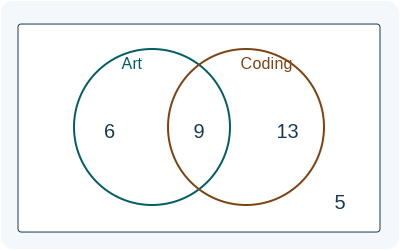
At a school, 15 students attend Art, 22 attend Coding and 9 attend both clubs. There are 33 students altogether. One is chosen at random. Find the probability that this student attends at least one of these clubs. Give an exact fraction or decimal.

Try it on paper first.

  1. Art only 6; both 9; Coding only 13; neither 5.

  2. Adding the two group totals counts the 9 students in both groups twice. Subtract their overlap once.

  3. Use 28 students who attend at least one club out of 33.

  4. The answer is 2833\frac{28}{33}.

Your turn

At a school, 17 students attend Art, 24 attend Coding and 10 attend both clubs. There are 37 students altogether. One is chosen at random. Find the probability that this student attends at least one of these clubs. Give your answer as an exact fraction.

Enter a probability such as 1/4, 0.25 or 25%.

Worked examples

Practise the method

Core practice

Question 1 of 5

0 / 5 checked in this collection

Question list

Core practice

Fresh variants

Exam-style

Read the required regions of two overlapping sets

1 mark

At a school, 28 students attend Art, 28 attend Coding and 12 attend both clubs. There are 51 students altogether. One is chosen at random. Find the probability that this student attends at least one of these clubs. Give an exact fraction or decimal.

Art only 16; both 12; Coding only 16; neither 7.

Use a fraction, a percentage or a decimal rounded to at least 3 significant figures.

Full answer-format guide

Exact numbers: 3/2, sqrt(5), 2-sqrt(3), pi/6, 3*pi/2. Sets: {1,4}. Intervals: (3,5]; a round bracket excludes the endpoint. Infinity: inf; union: U; no solutions: empty. Separate coordinate pairs or triples with semicolons. Expressions: 2x^2+3x-1; equations: x^2=3x+1 or the polynomial equal to zero. Factors: x-1 ; x+2. Parameter fraction: numerator ; denominator. List integer answers individually.

Review the method

Progress stays in this browser. Create an account to save it or sign in.

Extra practice from this lesson

Read the required regions of two overlapping sets

At a school, 16 students attend Art, 19 attend Coding and 12 attend both clubs. There are 27 students altogether. One is chosen at random. Find the probability that this student attends at least one of these clubs. Give your answer as an exact fraction.

Enter a probability such as 1/4, 0.25 or 25%.

Read the required regions of two overlapping sets

At a school, 11 students attend Art, 14 attend Coding and 4 attend both clubs. There are 28 students altogether. One is chosen at random. Find the probability that this student attends both clubs. Give your answer as an exact fraction.

Enter a probability such as 1/4, 0.25 or 25%.

Read the required regions of two overlapping sets

At a school, 27 students attend Art, 17 attend Coding and 12 attend both clubs. There are 38 students altogether. One is chosen at random. Find the probability that this student attends neither club. Give your answer as an exact fraction.

Enter a probability such as 1/4, 0.25 or 25%.

Read the required regions of two overlapping sets

At a school, 22 students attend Art, 12 attend Coding and 4 attend both clubs. There are 39 students altogether. One is chosen at random. Find the probability that this student attends at least one of these clubs. Give your answer as an exact fraction.

Enter a probability such as 1/4, 0.25 or 25%.

Read the required regions of two overlapping sets

At a school, 21 students attend Art, 28 attend Coding and 12 attend both clubs. There are 45 students altogether. One is chosen at random. Find the probability that this student attends exactly one of these clubs. Give your answer as an exact fraction.

Enter a probability such as 1/4, 0.25 or 25%.

Read the required regions of two overlapping sets

At a school, 16 students attend Art, 10 attend Coding and 4 attend both clubs. There are 24 students altogether. One is chosen at random. Find the probability that this student attends at least one of these clubs. Give your answer as an exact fraction.

Enter a probability such as 1/4, 0.25 or 25%.

Apply it · original exam-style problems

Show your working on paper and compare it with the worked solution and marking guidance.

Come back to what needs practice

Quick revision sheet (A4)

Your review plan starts after your first check.