Maths4UBETA

Extended: event notation and three-set Venn diagrams

Interpret intersection, union and complement probabilities, and combine correctly separated regions of three sets.

Try the quick check →
Lesson 6 of 9

Section 1 of 3 · Extension · about 6 min

How do the symbols tell me which regions to use?

Practise the method

Read the symbol as words, select the regions, then divide their counts by everyone in the universal set.

Worked example

Read intersection, union or complement notation

Of 39 people, 5 are in A only, 10 are in both A and B, and 15 are in B only. The rest are in neither. Find P(A∩B)P(A\cap B) for one person selected at random. Give an exact fraction or decimal.
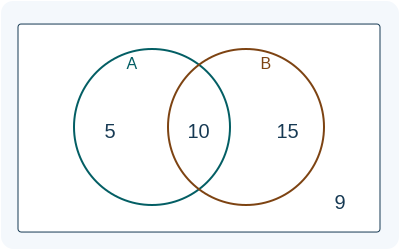
  1. A only 5; both 10; B only 15; neither 9.

  2. The intersection contains only people in both sets.

  3. There are 10 people in the requested region or regions. Divide by the full total 39.

  4. The answer is 1039\frac{10}{39}.

Your turn

Of 34 people, 6 are in A only, 11 are in both A and B, and 16 are in B only. The rest are in neither. Find P(A∪B)P(A\cup B) for one person selected at random. Give your answer as an exact fraction.

Enter a probability such as 1/4, 0.25 or 25%.

Worked example

Read the required regions of two overlapping sets

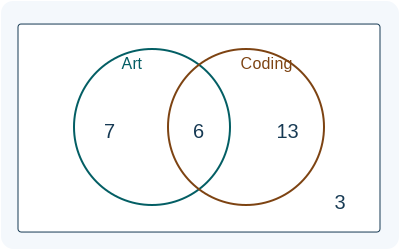
At a school, 13 students attend Art, 19 attend Coding and 6 attend both clubs. There are 29 students altogether. One is chosen at random. Find the probability that this student attends neither club. Give an exact fraction or decimal.

Try it on paper first.

  1. Art only 7; both 6; Coding only 13; neither 3.

  2. The number in at least one club is 13+19−6. Subtract this from 29.

  3. There are 3 students outside both sets.

  4. The answer is 329\frac{3}{29}.

Your turn

At a school, 15 students attend Art, 21 attend Coding and 7 attend both clubs. There are 33 students altogether. One is chosen at random. Find the probability that this student attends neither club. Give your answer as an exact fraction.

Enter a probability such as 1/4, 0.25 or 25%.

Section 2 of 3 · Extension · about 7 min

How do I read an overlap when there are three sets?

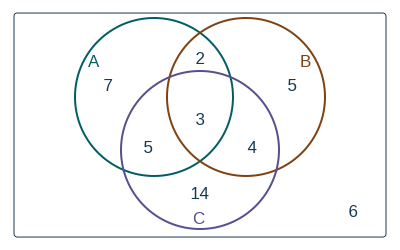
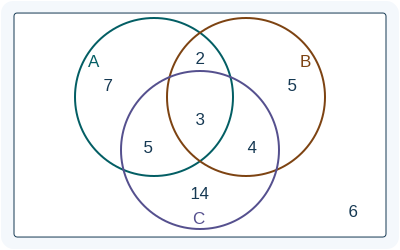
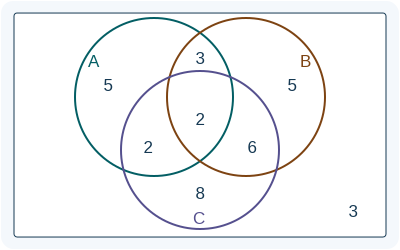
None: 6; A only: 7; B only: 5; C only: 14; A and B only: 2; A and C only: 5; B and C only: 4; All three: 3

The A-and-B intersection contains the A-and-B-only region and the central region.

Practise the method

Trace both requested boundaries. Every part inside both circles is included unless the question adds ‘only’.

Worked example

Interpret combined events in three sets

One person is selected at random from the groups in the table. Find P(A∩B)P(A\cap B). Give an exact fraction or decimal.

Numbers in the separate regions
RegionPeople
None6
A only7
B only5
C only14
A and B only2
A and C only5
B and C only4
All three3
  1. None: 6; A only: 7; B only: 5; C only: 14; A and B only: 2; A and C only: 5; B and C only: 4; All three: 3

  2. Everyone in both A and B also includes those in all three sets. Add the two relevant regions.

  3. There are 5 people in the stated event out of 46.

  4. The answer is 546\frac{5}{46}.

Your turn

One person is selected at random from the groups in the table. Find P(A∩B)P(A\cap B). Give your answer as an exact fraction.

Numbers in the separate regions
RegionPeople
None7
A only8
B only6
C only15
A and B only3
A and C only6
B and C only5
All three1

Enter a probability such as 1/4, 0.25 or 25%.

Worked example

Interpret combined events in three sets

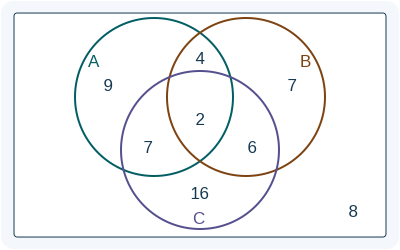
One person is selected at random from the groups in the table. Find P(A∪C)P(A\cup C). Give an exact fraction or decimal.

Numbers in the separate regions
RegionPeople
None8
A only9
B only7
C only16
A and B only4
A and C only7
B and C only6
All three2

Try it on paper first.

  1. None: 8; A only: 9; B only: 7; C only: 16; A and B only: 4; A and C only: 7; B and C only: 6; All three: 2

  2. Use every region belonging to A or C. Only the outside region and the B-only region are left out.

  3. There are 44 people in the stated event out of 59.

  4. The answer is 4459\frac{44}{59}.

Your turn

One person is selected at random from the groups in the table. Find P(A∪C)P(A\cup C). Give your answer as an exact fraction.

Numbers in the separate regions
RegionPeople
None2
A only10
B only8
C only17
A and B only5
A and C only1
B and C only7
All three3

Enter a probability such as 1/4, 0.25 or 25%.

Section 3 of 3 · Extension · about 7 min

Which regions meet a longer event description?

Practise the method

Translate the description into a list of qualifying regions before adding. Exactly one keeps three single-set regions.

Worked example

Interpret combined events in three sets

One person is selected at random from the groups in the table. Find the probability that the person is in exactly one set. Give an exact fraction or decimal.

Numbers in the separate regions
RegionPeople
None3
A only5
B only5
C only8
A and B only3
A and C only2
B and C only6
All three2
  1. None: 3; A only: 5; B only: 5; C only: 8; A and B only: 3; A and C only: 2; B and C only: 6; All three: 2

  2. Use the three regions labelled A only, B only or C only. Do not include any overlap.

  3. There are 18 people in the stated event out of 34.

  4. The answer is 917\frac{9}{17}.

Your turn

One person is selected at random from the groups in the table. Find the probability that the person is in exactly one set. Give an exact fraction or decimal.

Numbers in the separate regions
RegionPeople
None4
A only6
B only6
C only9
A and B only4
A and C only3
B and C only7
All three3

Use a fraction, a percentage or a decimal rounded to at least 3 significant figures.

Worked example

Interpret combined events in three sets

One person is selected at random from the groups in the table. Find P(A∪C)P(A\cup C). Give an exact fraction or decimal.

Numbers in the separate regions
RegionPeople
None5
A only7
B only7
C only10
A and B only5
A and C only4
B and C only8
All three1

Try it on paper first.

  1. None: 5; A only: 7; B only: 7; C only: 10; A and B only: 5; A and C only: 4; B and C only: 8; All three: 1

  2. Use every region belonging to A or C. Only the outside region and the B-only region are left out.

  3. There are 35 people in the stated event out of 47.

  4. The answer is 3547\frac{35}{47}.

Your turn

One person is selected at random from the groups in the table. Find P(A∪C)P(A\cup C). Give your answer as an exact fraction.

Numbers in the separate regions
RegionPeople
None6
A only8
B only8
C only11
A and B only6
A and C only5
B and C only9
All three2

Enter a probability such as 1/4, 0.25 or 25%.

Worked examples

Practise the method

Core practice

Question 1 of 5

0 / 5 checked in this collection

Question list

Core practice

Fresh variants

Exam-style

Read intersection, union or complement notation

1 mark

Of 34 people, 15 are in A only, 4 are in both A and B, and 8 are in B only. The rest are in neither. Find P(A∪B)P(A\cup B) for one person selected at random. Give an exact fraction or decimal.

A only 15; both 4; B only 8; neither 7.

Use a fraction, a percentage or a decimal rounded to at least 3 significant figures.

Full answer-format guide

Exact numbers: 3/2, sqrt(5), 2-sqrt(3), pi/6, 3*pi/2. Sets: {1,4}. Intervals: (3,5]; a round bracket excludes the endpoint. Infinity: inf; union: U; no solutions: empty. Separate coordinate pairs or triples with semicolons. Expressions: 2x^2+3x-1; equations: x^2=3x+1 or the polynomial equal to zero. Factors: x-1 ; x+2. Parameter fraction: numerator ; denominator. List integer answers individually.

Review the method

Progress stays in this browser. Create an account to save it or sign in.

Extra practice from this lesson

Read intersection, union or complement notation

Of 26 people, 10 are in A only, 4 are in both A and B, and 7 are in B only. The rest are in neither. Find P(A′)P(A') for one person selected at random. Give your answer as an exact fraction.

Enter a probability such as 1/4, 0.25 or 25%.

Read the required regions of two overlapping sets

At a school, 25 students attend Art, 18 attend Coding and 12 attend both clubs. There are 40 students altogether. One is chosen at random. Find the probability that this student attends neither club. Give an exact fraction or decimal.

Use a fraction, a percentage or a decimal rounded to at least 3 significant figures.

Interpret combined events in three sets

One person is selected at random from the groups in the table. Find P(A∩B)P(A\cap B). Give your answer as an exact fraction.

Numbers in the separate regions
RegionPeople
None4
A only12
B only10
C only2
A and B only2
A and C only3
B and C only9
All three2

Enter a probability such as 1/4, 0.25 or 25%.

Interpret combined events in three sets

One person is selected at random from the groups in the table. Find P(A∪C)P(A\cup C). Give your answer as an exact fraction.

Numbers in the separate regions
RegionPeople
None7
A only2
B only13
C only5
A and B only5
A and C only6
B and C only3
All three2

Enter a probability such as 1/4, 0.25 or 25%.

Interpret combined events in three sets

One person is selected at random from the groups in the table. Find the probability that the person is in exactly one set. Give your answer as an exact fraction.

Numbers in the separate regions
RegionPeople
None8
A only10
B only10
C only13
A and B only3
A and C only7
B and C only2
All three1

Enter a probability such as 1/4, 0.25 or 25%.

Interpret combined events in three sets

One person is selected at random from the groups in the table. Find P(A∪C)P(A\cup C). Give your answer as an exact fraction.

Numbers in the separate regions
RegionPeople
None4
A only13
B only13
C only16
A and B only6
A and C only3
B and C only5
All three1

Enter a probability such as 1/4, 0.25 or 25%.

Apply it · original exam-style problems

Show your working on paper and compare it with the worked solution and marking guidance.

Come back to what needs practice

Quick revision sheet (A4)

Your review plan starts after your first check.