Maths4UBETA

Relative frequency, expected frequency and fairness

Use trial results to estimate a probability, predict a future count and interpret random variation, fairness and bias.

Try the quick check →
Lesson 2 of 9

Section 1 of 3 · Core · about 6 min

How do the results estimate probability?

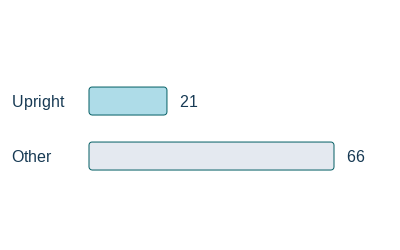
Upright: 21; Other: 66

The total includes outcomes that did and did not meet the event.

Practise the method

Divide the observed success count by the number of trials. To pool comparable results, add the successes and add the trial totals before dividing.

Worked example

Estimate probability from repeated observations

A paper propeller lands upright in 21 of 87 trials. Use relative frequency to estimate the probability of an upright landing. Give an exact fraction or decimal.
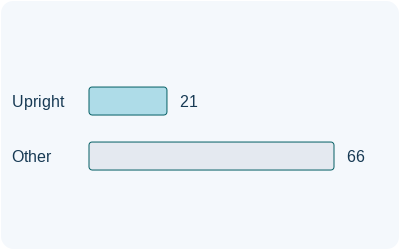
Upright: 21; Other: 66

  1. Use the observed results. Divide upright landings by the total number of trials, including unsuccessful landings.

  2. This estimates the chance in similar trials. Repeating the experiment may give a different observed relative frequency.

  3. The answer is 729\frac{7}{29}.

Your turn

A paper propeller lands upright in 22 of 88 trials. Use relative frequency to estimate the probability of an upright landing. Give an exact fraction or decimal.

Upright: 22; Other: 66

Use a fraction, a percentage or a decimal rounded to at least 3 significant figures.

Worked example

Combine trial results before estimating

Both runs use the same method. Use all the trials in the table to estimate the probability of success. Give an exact fraction or decimal.

Two runs of the same test
RunSuccessesTrials
Morning1341
Afternoon2865

Try it on paper first.

  1. Add the success counts to get 41. Add the trial counts to get 106.

  2. Divide total successes by total trials. The two runs have different sizes.

  3. The answer is 41106\frac{41}{106}.

Your turn

Both runs use the same method. Use all the trials in the table to estimate the probability of success. Give your answer as an exact fraction.

Two runs of the same test
RunSuccessesTrials
Morning342
Afternoon2966

Enter a probability such as 1/4, 0.25 or 25%.

Section 2 of 3 · Core · about 6 min

How do I turn a chance into an expected count?

Practise the method

Identify the event, check which trials are being predicted, then multiply the future trial count by the chance per trial.

Worked example

Predict an expected number of outcomes

A calibration test fails with probability 12\frac{1}{2} on each trial. For 60 similar trials, find the expected number of failures.

  1. Multiply the number of future trials by the probability on one trial. Use 60×1260\times \frac{1}{2}.

  2. This is an expected count, rather than a guarantee of how many failures will occur.

  3. The answer is 3030.

Your turn

A calibration test fails with probability 25\frac{2}{5} on each trial. For 80 similar trials, find the expected number of failures.

Enter the whole-number count.

Worked example

Estimate probability from repeated observations

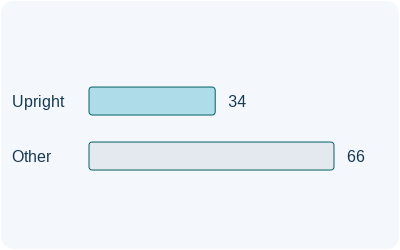
A paper propeller lands upright in 34 of 100 trials. Use relative frequency to estimate the probability of an upright landing. Give an exact fraction or decimal.

Upright: 34; Other: 66

Try it on paper first.

  1. Use the observed results. Divide upright landings by the total number of trials, including unsuccessful landings.

  2. This estimates the chance in similar trials. Repeating the experiment may give a different observed relative frequency.

  3. The answer is 1750\frac{17}{50}.

Your turn

A paper propeller lands upright in 35 of 101 trials. Use relative frequency to estimate the probability of an upright landing. Give your answer as an exact fraction.

Upright: 35; Other: 66

Enter a probability such as 1/4, 0.25 or 25%.

Section 3 of 3 · Core · about 6 min

Do unequal counts prove a process is biased?

Practise the method

Use randomly chosen trials under consistent conditions. Collect comparable evidence before concluding that one outcome is favoured.

Worked example

Distinguish random variation from evidence of bias

A counter-making test has two possible results. The supplier claims the results are equally likely. In one run there are 47 red results and 56 black results. Which conclusion is justified from this single run?

  1. The different counts prove the supplier is wrong.
  2. The red result has no chance of occurring again.
  3. Each future run must have the same counts as this one.
  4. Different observed counts can occur even when the two chances are equal.
  1. Fair means equal probabilities for the two outcomes, not fixed observed counts.

  2. A single nonmatching count does not prove bias. More comparable trials can improve an estimate.

Your turn

A counter-making test has two possible results. The supplier claims the results are equally likely. In one run there are 48 red results and 58 black results. Which conclusion is justified from this single run?

Choose one answer

Worked example

Combine trial results before estimating

Both runs use the same method. Use all the trials in the table to estimate the probability of success. Give an exact fraction or decimal.

Two runs of the same test
RunSuccessesTrials
Morning1334
Afternoon3356

Try it on paper first.

  1. Add the success counts to get 46. Add the trial counts to get 90.

  2. Divide total successes by total trials. The two runs have different sizes.

  3. The answer is 2345\frac{23}{45}.

Your turn

Both runs use the same method. Use all the trials in the table to estimate the probability of success. Give your answer as an exact fraction.

Two runs of the same test
RunSuccessesTrials
Morning335
Afternoon3457

Enter a probability such as 1/4, 0.25 or 25%.

Worked examples

Practise the method

Core practice

Question 1 of 5

0 / 5 checked in this collection

Question list

Core practice

Fresh variants

Exam-style

Estimate probability from repeated observations

1 mark

A paper propeller lands upright in 23 of 47 trials. Use relative frequency to estimate the probability of an upright landing. Give an exact fraction or decimal.

Upright: 23; Other: 24

Use a fraction, a percentage or a decimal rounded to at least 3 significant figures.

Full answer-format guide

Exact numbers: 3/2, sqrt(5), 2-sqrt(3), pi/6, 3*pi/2. Sets: {1,4}. Intervals: (3,5]; a round bracket excludes the endpoint. Infinity: inf; union: U; no solutions: empty. Separate coordinate pairs or triples with semicolons. Expressions: 2x^2+3x-1; equations: x^2=3x+1 or the polynomial equal to zero. Factors: x-1 ; x+2. Parameter fraction: numerator ; denominator. List integer answers individually.

Review the method

Progress stays in this browser. Create an account to save it or sign in.

Extra practice from this lesson

Estimate probability from repeated observations

A paper propeller lands upright in 26 of 92 trials. Use relative frequency to estimate the probability of an upright landing. Give your answer as an exact fraction.

Upright: 26; Other: 66

Enter a probability such as 1/4, 0.25 or 25%.

Combine trial results before estimating

Both runs use the same method. Use all the trials in the table to estimate the probability of success. Give your answer as an exact fraction.

Two runs of the same test
RunSuccessesTrials
Morning847
Afternoon3471

Enter a probability such as 1/4, 0.25 or 25%.

Predict an expected number of outcomes

A calibration test fails with probability 29\frac{2}{9} on each trial. For 180 similar trials, find the expected number of failures.

Enter the whole-number count.

Estimate probability from repeated observations

A paper propeller lands upright in 40 of 106 trials. Use relative frequency to estimate the probability of an upright landing. Give your answer as an exact fraction.

Upright: 40; Other: 66

Enter a probability such as 1/4, 0.25 or 25%.

Distinguish random variation from evidence of bias

A counter-making test has two possible results. The supplier claims the results are equally likely. In one run there are 52 red results and 55 black results. Which conclusion is justified from this single run?

Choose one answer

Combine trial results before estimating

Both runs use the same method. Use all the trials in the table to estimate the probability of success. Give your answer as an exact fraction.

Two runs of the same test
RunSuccessesTrials
Morning840
Afternoon2262

Enter a probability such as 1/4, 0.25 or 25%.

Apply it · original exam-style problems

Show your working on paper and compare it with the worked solution and marking guidance.

Come back to what needs practice

Quick revision sheet (A4)

Your review plan starts after your first check.