Maths4UBETA

Possibility diagrams and ordered outcomes

List every ordered outcome once, read a possibility diagram and count results meeting a condition.

Try the quick check →
Lesson 3 of 9

Section 1 of 3 · Core · about 6 min

How do I make a sample-space grid?

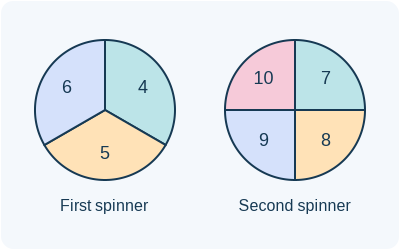
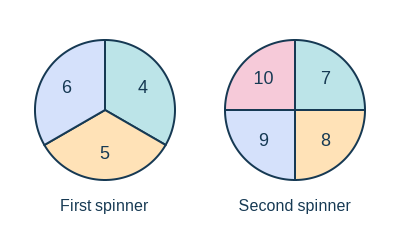
Two fair spinners. First: 4, 5, 6. Second: 7, 8, 9, 10.

Each sector on one spinner can be paired with every sector on the other.

Practise the method

Enter the sum or product in every cell if the question asks for one. When the pairs have equal chances, count matching cells and divide by all cells.

Worked example

Count equal outcomes in an ordered sample space

A fair spinner is numbered 4 to 6. A second fair spinner is numbered 7 to 10. The spins are independent. Find the probability that the two numbers add to 14. Give an exact fraction or decimal.

Totals from the two spinners
First / second78910
411121314
512131415
613141516

Two fair spinners. First: 4, 5, 6. Second: 7, 8, 9, 10.

  1. There are 3 choices for the first spinner and 4 for the second, giving 12 equally likely pairs.

  2. Exactly 3 ordered pairs give the required total. Count those cells in the grid.

  3. The answer is 14\frac{1}{4}.

Your turn

A fair spinner is numbered 5 to 7. A second fair spinner is numbered 8 to 11. The spins are independent. Find the probability that the two numbers add to 17. Give your answer as an exact fraction.

Totals from the two spinners
First / second891011
513141516
614151617
715161718

Two fair spinners. First: 5, 6, 7. Second: 8, 9, 10, 11.

Enter a probability such as 1/4, 0.25 or 25%.

Worked example

Use a strict condition on a sample-space grid

The numbers 1 to 3 are equally likely on one spinner. The numbers 6 to 9 are equally likely on another. Spin each once independently. Find the probability that the product is greater than 14. Give an exact fraction or decimal.

Try it on paper first.

  1. List the 12 possible pairs. Multiply the numbers in each pair.

  2. Count only products greater than 14. There are 6 successful pairs.

  3. The answer is 12\frac{1}{2}.

Your turn

The numbers 2 to 4 are equally likely on one spinner. The numbers 7 to 10 are equally likely on another. Spin each once independently. Find the probability that the product is greater than 24. Give an exact fraction or decimal.

Use a fraction, a percentage or a decimal rounded to at least 3 significant figures.

Section 2 of 3 · Core · about 6 min

Which outcomes meet the wording?

Practise the method

Mark all satisfying cells before counting. Leave unmatched cells in the total number of outcomes.

Worked example

Use a strict condition on a sample-space grid

The numbers 5 to 7 are equally likely on one spinner. The numbers 7 to 10 are equally likely on another. Spin each once independently. Find the probability that the product is greater than 48. Give an exact fraction or decimal.

  1. List the 12 possible pairs. Multiply the numbers in each pair.

  2. Count only products greater than 48. There are 7 successful pairs.

  3. The answer is 712\frac{7}{12}.

Your turn

The numbers 1 to 3 are equally likely on one spinner. The numbers 8 to 11 are equally likely on another. Spin each once independently. Find the probability that the product is greater than 18. Give an exact fraction or decimal.

Use a fraction, a percentage or a decimal rounded to at least 3 significant figures.

Worked example

Count equal outcomes in an ordered sample space

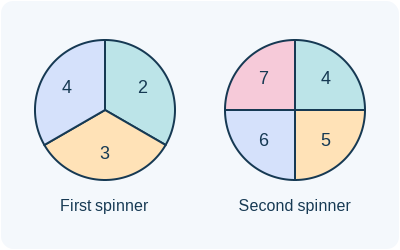
A fair spinner is numbered 2 to 4. A second fair spinner is numbered 4 to 7. The spins are independent. Find the probability that the two numbers add to 10. Give an exact fraction or decimal.

Totals from the two spinners
First / second4567
26789
378910
4891011

Two fair spinners. First: 2, 3, 4. Second: 4, 5, 6, 7.

Try it on paper first.

  1. There are 3 choices for the first spinner and 4 for the second, giving 12 equally likely pairs.

  2. Exactly 2 ordered pairs give the required total. Count those cells in the grid.

  3. The answer is 16\frac{1}{6}.

Your turn

A fair spinner is numbered 3 to 5. A second fair spinner is numbered 5 to 8. The spins are independent. Find the probability that the two numbers add to 9. Give your answer as an exact fraction.

Totals from the two spinners
First / second5678
3891011
49101112
510111213

Two fair spinners. First: 3, 4, 5. Second: 5, 6, 7, 8.

Enter a probability such as 1/4, 0.25 or 25%.

Section 3 of 3 · Core · about 6 min

Can the same label occur twice?

Practise the method

List the same choices for both draws. Include the diagonal of equal labels when suitable, then test the condition.

Worked example

List outcomes from two draws with replacement

Three chips numbered 11, 12 and 13 are equally likely on each draw. A chip is drawn and replaced before a second draw. Find the probability that the sum is at least 23. Give an exact fraction or decimal.

  1. There are three choices for each draw because the first chip is returned. Draw a row and column for each number.

  2. Mark the 8 pairs that meet the condition, including pairs with a repeated number if their sum qualifies.

  3. The answer is 89\frac{8}{9}.

Your turn

Three chips numbered 12, 13 and 14 are equally likely on each draw. A chip is drawn and replaced before a second draw. Find the probability that the sum is at least 26. Give your answer as an exact fraction.

Enter a probability such as 1/4, 0.25 or 25%.

Worked example

Count equal outcomes in an ordered sample space

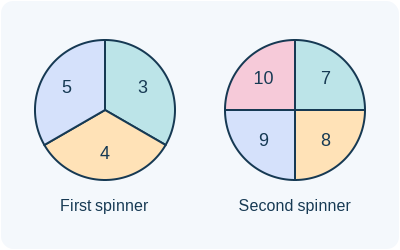
A fair spinner is numbered 3 to 5. A second fair spinner is numbered 7 to 10. The spins are independent. Find the probability that the two numbers add to 13. Give an exact fraction or decimal.

Totals from the two spinners
First / second78910
310111213
411121314
512131415

Two fair spinners. First: 3, 4, 5. Second: 7, 8, 9, 10.

Try it on paper first.

  1. There are 3 choices for the first spinner and 4 for the second, giving 12 equally likely pairs.

  2. Exactly 3 ordered pairs give the required total. Count those cells in the grid.

  3. The answer is 14\frac{1}{4}.

Your turn

A fair spinner is numbered 4 to 6. A second fair spinner is numbered 8 to 11. The spins are independent. Find the probability that the two numbers add to 16. Give your answer as an exact fraction.

Totals from the two spinners
First / second891011
412131415
513141516
614151617

Two fair spinners. First: 4, 5, 6. Second: 8, 9, 10, 11.

Enter a probability such as 1/4, 0.25 or 25%.

Worked examples

Practise the method

Core practice

Question 1 of 5

0 / 5 checked in this collection

Question list

Core practice

Fresh variants

Exam-style

Count equal outcomes in an ordered sample space

1 mark

A fair spinner is numbered 2 to 4. A second fair spinner is numbered 3 to 6. The spins are independent. Find the probability that the two numbers add to 8. Give an exact fraction or decimal.

Totals from the two spinners
First / second3456
25678
36789
478910

Two fair spinners. First: 2, 3, 4. Second: 3, 4, 5, 6.

Use a fraction, a percentage or a decimal rounded to at least 3 significant figures.

Full answer-format guide

Exact numbers: 3/2, sqrt(5), 2-sqrt(3), pi/6, 3*pi/2. Sets: {1,4}. Intervals: (3,5]; a round bracket excludes the endpoint. Infinity: inf; union: U; no solutions: empty. Separate coordinate pairs or triples with semicolons. Expressions: 2x^2+3x-1; equations: x^2=3x+1 or the polynomial equal to zero. Factors: x-1 ; x+2. Parameter fraction: numerator ; denominator. List integer answers individually.

Review the method

Progress stays in this browser. Create an account to save it or sign in.

Extra practice from this lesson

Count equal outcomes in an ordered sample space

A fair spinner is numbered 4 to 6. A second fair spinner is numbered 4 to 7. The spins are independent. Find the probability that the two numbers add to 12. Give your answer as an exact fraction.

Totals from the two spinners
First / second4567
4891011
59101112
610111213

Two fair spinners. First: 4, 5, 6. Second: 4, 5, 6, 7.

Enter a probability such as 1/4, 0.25 or 25%.

Use a strict condition on a sample-space grid

The numbers 2 to 4 are equally likely on one spinner. The numbers 4 to 7 are equally likely on another. Spin each once independently. Find the probability that the product is greater than 15. Give an exact fraction or decimal.

Use a fraction, a percentage or a decimal rounded to at least 3 significant figures.

Use a strict condition on a sample-space grid

The numbers 5 to 7 are equally likely on one spinner. The numbers 4 to 7 are equally likely on another. Spin each once independently. Find the probability that the product is greater than 30. Give an exact fraction or decimal.

Use a fraction, a percentage or a decimal rounded to at least 3 significant figures.

Count equal outcomes in an ordered sample space

A fair spinner is numbered 3 to 5. A second fair spinner is numbered 2 to 5. The spins are independent. Find the probability that the two numbers add to 7. Give an exact fraction or decimal.

Totals from the two spinners
First / second2345
35678
46789
578910

Two fair spinners. First: 3, 4, 5. Second: 2, 3, 4, 5.

Use a fraction, a percentage or a decimal rounded to at least 3 significant figures.

List outcomes from two draws with replacement

Three chips numbered 3, 4 and 5 are equally likely on each draw. A chip is drawn and replaced before a second draw. Find the probability that the sum is at least 8. Give your answer as an exact fraction.

Enter a probability such as 1/4, 0.25 or 25%.

Count equal outcomes in an ordered sample space

A fair spinner is numbered 4 to 6. A second fair spinner is numbered 5 to 8. The spins are independent. Find the probability that the two numbers add to 10. Give your answer as an exact fraction.

Totals from the two spinners
First / second5678
49101112
510111213
611121314

Two fair spinners. First: 4, 5, 6. Second: 5, 6, 7, 8.

Enter a probability such as 1/4, 0.25 or 25%.

Apply it · original exam-style problems

Show your working on paper and compare it with the worked solution and marking guidance.

Come back to what needs practice

Quick revision sheet (A4)

Your review plan starts after your first check.