Cambridge IGCSE Mathematics (0580) · Probability · Quick revision
Possibility diagrams and ordered outcomes
How do I make a sample-space grid?
Write first outcomes down the side and second outcomes across the top. Each cell represents one ordered pair.
Enter the sum or product in every cell if the question asks for one. When the pairs have equal chances, count matching cells and divide by all cells.
Which outcomes meet the wording?
‘Greater than’ leaves out equality. ‘At least’ includes equality.
Mark all satisfying cells before counting. Leave unmatched cells in the total number of outcomes.
Can the same label occur twice?
Replacing the first item makes it available again for the second draw.
List the same choices for both draws. Include the diagonal of equal labels when suitable, then test the condition.
Quick worked example
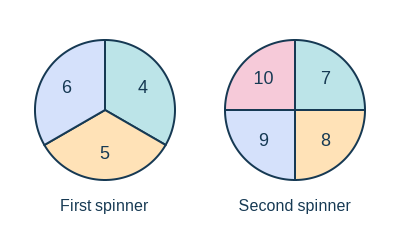
A fair spinner is numbered 4 to 6. A second fair spinner is numbered 7 to 10. The spins are independent. Find the probability that the two numbers add to 14. Give an exact fraction or decimal.
| First / second | 7 | 8 | 9 | 10 |
|---|---|---|---|---|
| 4 | 11 | 12 | 13 | 14 |
| 5 | 12 | 13 | 14 | 15 |
| 6 | 13 | 14 | 15 | 16 |
There are 3 choices for the first spinner and 4 for the second, giving 12 equally likely pairs.
Exactly 3 ordered pairs give the required total. Count those cells in the grid.
The answer is .