Cambridge IGCSE Mathematics (0580) · Probability · Quick revision
Extended: conditional probability from Venn diagrams and tables
How does known information change the total?
‘It is known that’ gives information about the selected person. Restrict the possible outcomes to everyone who meets that information.
In a Venn diagram, keep the whole circle for the given group. Count the qualifying region inside that circle.
Which row or column becomes the new sample space?
One cell of a two-way table meets both a row description and a column description. The margin of the given group is the denominator.
Underline the information already known. Follow its row or column to the margin, then read the shared cell.
What if the condition says ‘not’?
The new total can comprise more than one region. Given ‘not in Art’, every region outside Art remains possible.
Trace or list the regions that survive the condition. Within that list, count only the regions answering the question.
Quick worked example
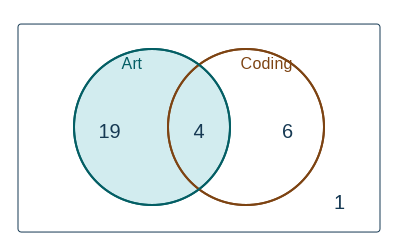
A group has 30 students. 23 attend Art, 10 attend Coding and 4 attend both. One student is chosen at random from the group. It is known that this student attends Art. Find the probability the student also attends Coding. Give an exact fraction or decimal.
Keep only the Art circle. It has 23 possible students.
Within that circle, 4 attend Coding as well.
The answer is .