Maths4UBETA

Trees, total probability and reverse conditioning

Weight every route through a mixture and distinguish independence within a group from independence after mixing.

Try the quick check →
Lesson 4 of 5

Section 1 of 5 · Core · about 7 min

What does a branch probability actually mean?

A branch describes the next result given the history leading to its node. For example, the probability of passing a review after passing screening is a conditional probability. It is not automatically the overall chance of passing review.

Multiply the reached branch labels to obtain a complete route’s joint probability. The conditionals in this three-event formula require positive-probability histories: P(E1)>0P(E_1)>0 and P(E1∩E2)>0P(E_1\cap E_2)>0.

P(E1∩E2∩E3)=P(E1)P(E2∣E1)P(E3∣E1∩E2).P(E_1\cap E_2\cap E_3)=P(E_1)P(E_2\mid E_1)P(E_3\mid E_1\cap E_2).

This rule does not require independence. Independence is the extra condition that allows a later conditional label to be replaced by its unconditional probability. A route with an unreachable prefix has probability zero; do not calculate an observed conditional on that zero-probability history.

Worked example

Multiply the conditional labels on a three-stage route

A request passes screening with probability 35\frac{3}{5}. Given that it passes screening, it passes review with probability 12\frac{1}{2}. Given that it passes both stages, it passes the final check with probability 45\frac{4}{5}. It is rejected as soon as a stage fails. Find the acceptance probability and check that the complete terminal probabilities sum to one.

  1. Let S, R and F mean passing screening, review and the final check. The acceptance route uses all three reached probabilities:

    P(S∩R∩F)=35⋅12⋅45=625.P(S\cap R\cap F)=\frac{3}{5}\cdot\frac{1}{2}\cdot\frac{4}{5}=\frac{6}{25}.
  2. The first two rejection routes have weights

    P(S′)=25,P(S∩R′)=35⋅12=310.P(S^{\prime})=\frac{2}{5},\qquad P(S\cap R^{\prime})=\frac{3}{5}\cdot\frac{1}{2}=\frac{3}{10}.
  3. Rejection at the final check requires reaching it first:

    P(S∩R∩F′)=35⋅12⋅15=350.P(S\cap R\cap F^{\prime})=\frac{3}{5}\cdot\frac{1}{2}\cdot\frac{1}{5}=\frac{3}{50}.
  4. 625+25+310+350=1.\frac{6}{25}+\frac{2}{5}+\frac{3}{10}+\frac{3}{50}=1.

    Each route ends at its first rejection or final acceptance. The multiplication is valid because the later probabilities are conditional on their reached histories.
Your turn

A request is accepted immediately with probability 14\frac{1}{4}. Otherwise it is reviewed: its chance of passing review is 23\frac{2}{3}. Given that it reaches the final check, its chance of passing that check is 34\frac{3}{4}. A request that fails either check is rejected. Find the total acceptance probability and the probability of rejection specifically at the final check. Do these calculations require the stages to be independent?

Enter an exact value or round to 3 significant figures.

Enter an exact value or round to 3 significant figures.

Is independence required here?

Section 2 of 5 · Core · about 7 min

How do I combine routes from different sources?

Suppose exactly one of sources A and B is selected. Let their selection probabilities be ww and 1−w1-w, and their marked-item rates be aa and bb. The marked event D can be reached through two disjoint routes:

P(D)=wa+(1−w)b.P(D)=wa+(1-w)b.

This is total probability: add every source’s joint contribution to the same observation. Do not take an unweighted average unless the source weights justify it.

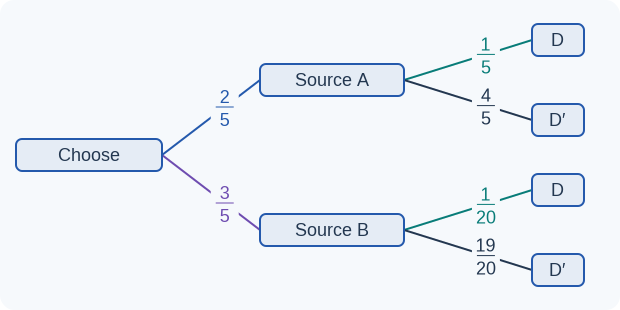
Choose A with probability two fifths or B with three fifths. Within A the marked probability is one fifth. Within B it is one twentieth.

Let D mean marked. Each row below multiplies its source chance by the chance of the final outcome within that source.

RouteJoint probability
A∩DA\cap D25⋅15=8100\frac25\cdot\frac15=\frac8{100}
A∩D′A\cap D^{\prime}25⋅45=32100\frac25\cdot\frac45=\frac{32}{100}
B∩DB\cap D35⋅120=3100\frac35\cdot\frac1{20}=\frac3{100}
B∩D′B\cap D^{\prime}35⋅1920=57100\frac35\cdot\frac{19}{20}=\frac{57}{100}
P(D)=8100+3100=11100,P(A∣D)=810011100=811.P(D)=\frac8{100}+\frac3{100}=\frac{11}{100},\quad P(A\mid D)=\frac{\frac8{100}}{\frac{11}{100}}=\frac8{11}.

Multiply the source choice by the rate within that source. The marked branches contribute eight and three hundredths to the same observation.

Worked example

Combine unequal source contributions

Source A is selected with probability 25\frac{2}{5}, and source B with probability 35\frac{3}{5}. Their marked-item rates are 15\frac{1}{5} and 120\frac{1}{20}. One source is selected and one item obtained from it. Find all four joint route probabilities and the total probability that the item is marked.

  1. Let D mean “marked”. The A routes are

    P(A∩D)=25⋅15=8100,P(A∩D′)=25⋅45=32100.P(A\cap D)=\frac{2}{5}\cdot\frac{1}{5}=\frac{8}{100},\qquad P(A\cap D^{\prime})=\frac{2}{5}\cdot\frac{4}{5}=\frac{32}{100}.
  2. The B routes are

    P(B∩D)=35⋅120=3100,P(B∩D′)=35⋅1920=57100.P(B\cap D)=\frac{3}{5}\cdot\frac{1}{20}=\frac{3}{100},\qquad P(B\cap D^{\prime})=\frac{3}{5}\cdot\frac{19}{20}=\frac{57}{100}.
  3. P(D)=P(A∩D)+P(B∩D)=8100+3100=11100.P(D)=P(A\cap D)+P(B\cap D)=\frac{8}{100}+\frac{3}{100}=\frac{11}{100}.
  4. The unmarked total is 89100\frac{89}{100}. The four joint weights sum to one, and the two routes from A sum to 25\frac{2}{5}, while the two from B sum to 35\frac{3}{5}.

For three disjoint sources covering all possibilities, use weights w1+w2+w3=1w_1+w_2+w_3=1 and source rates a1,a2,a3a_1,a_2,a_3:

P(D)=w1a1+w2a2+w3a3.P(D)=w_1a_1+w_2a_2+w_3a_3.

Each source contributes once. The same method works for a guaranteed-success source with rate one or a source that never succeeds with rate zero.

Your turn

Sources A, B and C are selected with probabilities 12\frac{1}{2}, 13\frac{1}{3} and 16\frac{1}{6}. Their marked-item rates are 14\frac{1}{4}, 12\frac{1}{2} and 34\frac{3}{4}, respectively. One source is selected, then one item is obtained from it. Find the probabilities of a marked and an unmarked item. Which source contributes the largest probability of a marked item?

Enter an exact value or round to 3 significant figures.

Enter an exact value or round to 3 significant figures.

Largest marked-item contribution

Section 3 of 5 · Core · about 7 min

How do I work backwards from an observed result?

To find the source given an observation, first calculate all routes that could produce that observation. Their total becomes the denominator. The chosen source’s route is the numerator:

P(A∣D)=P(A∩D)P(D)=wawa+(1−w)b,P(D)>0.P(A\mid D)=\frac{P(A\cap D)}{P(D)}=\frac{wa}{wa+(1-w)b},\qquad P(D)>0.

For an unmarked observation, use the unmarked routes instead:

P(A∣D′)=w(1−a)w(1−a)+(1−w)(1−b),P(D′)>0.P(A\mid D^{\prime})=\frac{w(1-a)}{w(1-a)+(1-w)(1-b)},\qquad P(D^{\prime})>0.

Worked example

Find the source after observing the item

Source A has selection probability 25\frac{2}{5} and marked rate 15\frac{1}{5}. Source B has selection probability 35\frac{3}{5} and marked rate 120\frac{1}{20}. Given that the selected item is marked, find the probability that it came from A.

  1. Keep both marked routes because either source can produce the observation:

    P(A∩D)=8100,P(B∩D)=3100,P(D)=11100.P(A\cap D)=\frac{8}{100},\qquad P(B\cap D)=\frac{3}{100},\qquad P(D)=\frac{11}{100}.
  2. P(A∣D)=P(A∩D)P(D)=810011100=811.P(A\mid D)=\frac{P(A\cap D)}{P(D)}=\frac{\frac{8}{100}}{\frac{11}{100}}=\frac{8}{11}.
  3. The alternative source has conditional probability 311\frac{3}{11}, and the two conditional source probabilities sum to one. The original source probability 25\frac{2}{5}, the within-source rate 15\frac{1}{5}, and the reverse conditional 811\frac{8}{11} answer different questions.

Your turn

Source A is selected with probability 34\frac{3}{4}, and source B with probability 14\frac{1}{4}. The marked-item rates are 110\frac{1}{10} for A and 35\frac{3}{5} for B. Let D mean that the selected item is marked. Find P(D)P(D), P(B∣D)P(B\mid D), and P(A∣D′)P(A\mid D^{\prime}).

Enter an exact value or round to 3 significant figures.

Enter an exact value or round to 3 significant figures.

Enter an exact value or round to 3 significant figures.

Section 4 of 5 · Core · about 10 min

How do I recover an unknown probability or source weight?

Write the total-probability equation first, keeping the source weights and within-source rates separate. Solve it, then check every probability and complementary branch lies in [0,1][0,1]. Recheck the original total; if a reverse conditional is specified, its observation must also have positive probability.

Worked example

Recover an unknown branch rate

Source A is selected with probability 13\frac{1}{3} and has marked rate 35\frac{3}{5}. Source B is selected otherwise and has unknown marked rate qq. The overall marked probability is 25\frac{2}{5}. Find qq.

  1. Use both disjoint routes:

    13⋅35+23q=25.\frac{1}{3}\cdot\frac{3}{5}+\frac{2}{3}q=\frac{2}{5}.
  2. 15+23q=25⟹q=310.\frac{1}{5}+\frac{2}{3}q=\frac{2}{5}\quad\Longrightarrow\quad q=\frac{3}{10}.
  3. The answer is between zero and one, its complementary B branch is 710\frac{7}{10}, and substitution gives

    15+23⋅310=25.\frac{1}{5}+\frac{2}{3}\cdot\frac{3}{10}=\frac{2}{5}.

For a known overall probability mm,

m=wa+(1−w)b=b+w(a−b).m=wa+(1-w)b=b+w(a-b).

If a≠ba\ne b, an unknown source weight is

w=m−ba−b.w=\frac{m-b}{a-b}.

Require 0≤w≤10\le w\le1. Equivalently, mm must lie between the two source rates. If a=ba=b, every valid ww gives that same overall rate: matching data leave ww undetermined; a different stated rate is impossible.

An unknown branch rate can be recovered only when its source has positive weight. For B,

b=m−wa1−w,w<1.b=\frac{m-wa}{1-w},\qquad w<1.

If B is never selected, m=am=a regardless of B’s rate. Consistent data then leave B’s rate free within [0,1][0,1]; inconsistent data have no solution.

Worked example

Keep both valid probability branches

Source A is selected with probability pp, otherwise B is selected. The marked rate is pp in A and 1−p1-p in B. The total marked probability is 1325\frac{13}{25}. Find every valid pp and its corresponding P(A∣D)P(A\mid D). Then select the pair if A is chosen less often than B.

  1. All weights and branch rates are valid exactly when 0≤p≤10\le p\le1. The two marked routes give

    p2+(1−p)2=1325.p^2+(1-p)^2=\frac{13}{25}.
  2. 25p2−25p+6=(5p−2)(5p−3)=0.25p^2-25p+6=(5p-2)(5p-3)=0.

    Thus p=25p=\frac{2}{5} or p=35p=\frac{3}{5}. Both lie in the allowed interval and both reproduce the stated positive marked probability.

  3. P(A∣D)=p21325.P(A\mid D)=\frac{p^2}{\frac{13}{25}}.

    Keep the answers paired:

    (p,P(A∣D))=(25,413)or(35,913).\left(p,P(A\mid D)\right)=\left(\frac{2}{5},\frac{4}{13}\right)\quad\text{or}\quad\left(\frac{3}{5},\frac{9}{13}\right).
  4. A is chosen less often than B when p<1−pp<1-p, or p<12p<\frac{1}{2}. This selects (25,413)\left(\frac{2}{5},\frac{4}{13}\right).

Your turn

The marked-item rates of sources A and B are 23\frac{2}{3} and 16\frac{1}{6}. Source A is selected with probability ww. The overall marked probability is 13\frac{1}{3}. Find ww. Could the same two rates produce an overall probability of 34\frac{3}{4}? Separately, if both rates were 25\frac{2}{5} and the overall rate were 25\frac{2}{5}, would the overall rate identify ww?

Enter an exact value or round to 3 significant figures.

Could the original rates produce an overall probability of three quarters?
What happens with two equal rates?

Section 5 of 5 · Core · about 9 min

Are repeated outcomes independent if they share a source?

There are two different experiments. In one, the source is selected once and used for both items. In the other, each item gets an independently selected source. State which experiment is being used before multiplying probabilities.

Suppose the item results are independent given their common source, with marked rates a,ba,b and source-A weight ww. Let DiD_i mean item ii is marked. With one shared source,

P(D1∩D2)=wa2+(1−w)b2.P(D_1\cap D_2)=wa^2+(1-w)b^2.

With independently reselected sources and independent item-generating experiments,

P(D1∩D2)=(wa+(1−w)b)2.P(D_1\cap D_2)=\bigl(wa+(1-w)b\bigr)^2.

Write D1D_1 and D2D_2 for the two mark events. Use the same source priors and within-source rates for the two models.

SourcePriorItem 1 mark rateItem 2 mark rate
A25\frac{2}{5}15\frac{1}{5}15\frac{1}{5}
B35\frac{3}{5}120\frac{1}{20}120\frac{1}{20}

One common source

P(D1∩D2)=25(15)2+35(120)2=7400.P(D_1\cap D_2)=\frac25\left(\frac15\right)^2+\frac35\left(\frac1{20}\right)^2=\frac7{400}.P(D2∣D1)=740011100=744.P(D_2\mid D_1)=\frac{\frac7{400}}{\frac{11}{100}}=\frac7{44}.

Fresh independent source for each item

P(D1∩D2)=(11100)2=12110000.P(D_1\cap D_2)=\left(\frac{11}{100}\right)^2=\frac{121}{10000}.P(D2∣D1)=P(D2)=11100.P(D_2\mid D_1)=P(D_2)=\frac{11}{100}.

Keeping one hidden source and choosing a new source for each item give different joint probabilities, even though each single-item marked probability is unchanged.

Worked example

Compare a shared source with independent reselection

Source A is selected with probability 25\frac{2}{5}, source B with probability 35\frac{3}{5}. Their marked rates are 15\frac{1}{5} and 120\frac{1}{20}. Scheme I chooses the source once for two items, whose marks are independent given that source. Scheme II independently chooses a fresh source for each item, with independent item-generating experiments. Find the probability of two marked items under each scheme and the chance of a marked second item given a marked first item under Scheme I.

  1. Under Scheme I, both items use the same source. Multiply the two conditional item rates before adding source routes:

    PI(D1∩D2)=25(15)2+35(120)2=7400.P_{\mathrm{I}}(D_1\cap D_2)=\frac{2}{5}\left(\frac{1}{5}\right)^2+\frac{3}{5}\left(\frac{1}{20}\right)^2=\frac{7}{400}.
  2. Either single item has marked probability 11100\frac{11}{100}. Under Scheme II, the complete one-item experiments are independent:

    PII(D1∩D2)=(11100)2=12110000.P_{\mathrm{II}}(D_1\cap D_2)=\left(\frac{11}{100}\right)^2=\frac{121}{10000}.
  3. For Scheme I, condition using its own joint weight:

    PI(D2∣D1)=740011100=744.P_{\mathrm{I}}(D_2\mid D_1)=\frac{\frac{7}{400}}{\frac{11}{100}}=\frac{7}{44}.
  4. The first marked item makes source A more likely: its conditional source probability is 811\frac{8}{11}. Weighting the second-item rates by these updated source probabilities confirms

    811⋅15+311⋅120=744.\frac{8}{11}\cdot\frac{1}{5}+\frac{3}{11}\cdot\frac{1}{20}=\frac{7}{44}.

    This exceeds 11100\frac{11}{100}, so conditional independence within a source has not produced independence when the shared source is unknown.

Your turn

Sources A and B are selected with equal probability. Their marked-item rates are 14\frac{1}{4} and 34\frac{3}{4}. In Scheme I, choose a source once and obtain two items whose marks are independent given that source. In Scheme II, choose a fresh source independently for each item, with the two item-generating experiments independent. Let DiD_i mean that item ii is marked. Find the single-item marked probability, the probability that both are marked under each scheme, and P(D2∣D1)P(D_2\mid D_1) under Scheme I.

Enter an exact value or round to 3 significant figures.

Enter an exact value or round to 3 significant figures.

Enter an exact value or round to 3 significant figures.

Enter an exact value or round to 3 significant figures.

In the model below, vary the source-A weight while keeping its marked rate at 15\frac{1}{5} and B’s at 120\frac{1}{20}. Follow the joint routes and reverse conditional, then open the two-item comparison. Both marked and unmarked observations remain possible at either source-weight endpoint, so their reverse conditionals are defined there.

Worked examples

Practise the method

Core practice

Question 1 of 4

0 / 4 checked in this collection

Question list

Core practice

Fresh variants

Exam-style

All success routes belong in the denominator

3 marks

Choose group A with probability 13\frac{1}{3}, B otherwise. Success chances are 34\frac{3}{4} on A and 25\frac{2}{5} on B. Find the A-and-success joint, total success probability and P(A given success).

Enter an exact value or round to 3 significant figures.

Enter an exact value or round to 3 significant figures.

Enter an exact value or round to 3 significant figures.

Full answer-format guide

Exact numbers: 3/2, sqrt(5), 2-sqrt(3), pi/6, 3*pi/2. Sets: {1,4}. Intervals: (3,5]; a round bracket excludes the endpoint. Infinity: inf; union: U; no solutions: empty. Separate coordinate pairs or triples with semicolons. Expressions: 2x^2+3x-1; equations: x^2=3x+1 or the polynomial equal to zero. Factors: x-1 ; x+2. Parameter fraction: numerator ; denominator. List integer answers individually.

Review the method

Progress stays in this browser. Create an account to save it or sign in.

Extra practice from this lesson

Include direct and reworked routes

An order uses process A with probability 25\frac{2}{5}, and B otherwise. Its direct success probability is 34\frac{3}{4} on A and 12\frac{1}{2} on B. After a direct failure, exactly one rework is attempted: its conditional success probability is 23\frac{2}{3} on A and 45\frac{4}{5} on B. The order is accepted after either a direct or a rework success; otherwise it is rejected. Find the four requested probabilities.

Enter an exact value or round to 3 significant figures.

Enter an exact value or round to 3 significant figures.

Enter an exact value or round to 3 significant figures.

Enter an exact value or round to 3 significant figures.

Keep all three sources in the denominator

One source is selected: A with probability 12\frac{1}{2}, B with 13\frac{1}{3}, and C with 16\frac{1}{6}. Their respective success probabilities are 15\frac{1}{5}, 35\frac{3}{5}, and 910\frac{9}{10}. Let S denote success. Find P(A∩S)P(A\cap S), P(S)P(S), P(C∣S)P(C\mid S), and P(A∣S′)P(A\mid S^{\prime}).

Enter an exact value or round to 3 significant figures.

Enter an exact value or round to 3 significant figures.

Enter an exact value or round to 3 significant figures.

Enter an exact value or round to 3 significant figures.

A guaranteed branch and an impossible observation

Route G is chosen with probability 310\frac{3}{10} and always succeeds. The other route succeeds with probability 17\frac{1}{7}. Find P(S)P(S), P(G∣S)P(G\mid S), and P(G∣S′)P(G\mid S^{\prime}).

Separately, change the other route so that it also always succeeds. In this changed model, is P(G∣S′)P(G\mid S^{\prime}) zero, one, or undefined?

Enter an exact value or round to 3 significant figures.

Enter an exact value or round to 3 significant figures.

Enter an exact number, for example 3/2 or 2-sqrt(3).

Changed model: G given failure

Recover a branch and respect the feasible range

Route A is chosen with probability 37\frac{3}{7} and succeeds with probability 56\frac{5}{6}. Route B is chosen otherwise and has success probability q. Overall success is 1321\frac{13}{21}. Find q and the largest possible overall success probability with these source weights and the same A success rate. Could the overall probability instead be 1920\frac{19}{20}?

Separately, suppose A is always selected and overall success is 56\frac{5}{6}. What can that observation determine about the success chance q of the unselected route B?

Enter an exact value or round to 3 significant figures.

Enter an exact value or round to 3 significant figures.

Can the total be 1920\frac{19}{20}?
The unselected route

Recover the source weight, or recognise missing information

Source A has success chance 78\frac{7}{8}, source B has success chance 14\frac{1}{4}, and the overall success chance is 12\frac{1}{2}. Find the source-A weight w and P(A∣S)P(A\mid S).

In a separate mixture, both source-specific success chances are 12\frac{1}{2}. Does an overall chance of 12\frac{1}{2} determine a unique source weight? Could the overall chance in that separate mixture be 35\frac{3}{5}?

Enter an exact value or round to 3 significant figures.

Enter an exact value or round to 3 significant figures.

Equal rates and total one half
Equal rates but total 35\frac{3}{5}

Apply it · original exam-style problems

Show your working on paper and compare it with the worked solution and marking guidance.

Start after this lesson

Retain both admissible roots before using extra information 7 marks

Route A is selected with probability p, and route B otherwise, where 0≤p≤10\le p\le1. On route A the success chance is 1−p1-p; on B it is 14\frac{1}{4}. Overall success has probability 38\frac{3}{8}. Find all possible values of p.

You are then told that the joint probability of A and success is strictly greater than the joint probability of B and success. Select the correct p, then find P(A∣S)P(A\mid S) and P(B∣S′)P(B\mid S^{\prime}) for this selected model.

Hint

Weight both success branches before solving the quadratic. Compare joint contributions, not the two source-specific success rates. Apply the strict extra inequality only after retaining all feasible roots.

Worked solution
  1. p(1−p)+(1−p)14=38⟹8p2−6p+1=0.p(1-p)+(1-p)\frac{1}{4}=\frac{3}{8}\quad\Longrightarrow\quad8p^2-6p+1=0.
  2. (4p−1)(2p−1)=0⟹p=14 or p=12.(4p-1)(2p-1)=0\quad\Longrightarrow\quad p=\frac{1}{4}\ \text{or}\ p=\frac{1}{2}.

    Both give valid branch probabilities and the specified total.

  3. At p=14p=\frac{1}{4}, both source-and-success contributions equal 316\frac{3}{16}, so the strict inequality fails. At p=12p=\frac{1}{2}, the contributions are 14\frac{1}{4} and 18\frac{1}{8}, so the inequality holds. Therefore choose p=12p=\frac{1}{2}.

  4. P(A∣S)=1438=23.P(A\mid S)=\frac{\frac{1}{4}}{\frac{3}{8}}=\frac{2}{3}.
  5. P(B∩S′)=12⋅34=38,P(S′)=58.P(B\cap S^{\prime})=\frac{1}{2}\cdot\frac{3}{4}=\frac{3}{8},\quad P(S^{\prime})=\frac{5}{8}.
  6. P(B∣S′)=3858=35.P(B\mid S^{\prime})=\frac{\frac{3}{8}}{\frac{5}{8}}=\frac{3}{5}.
Marking guidance
  • 1 mark: form the weighted total-probability equation.
  • 1 mark: obtain and factor a correct quadratic.
  • 1 mark: retain and check both admissible roots.
  • 1 mark: compare joint contributions and select the root satisfying the strict extra inequality.
  • 1 mark: calculate A given success.
  • 1 mark: calculate the B-and-failure joint and total failure probability.
  • 1 mark: calculate B given failure using the selected model.
A shared hidden source links two trials 8 marks

One source is selected, A with probability 23\frac{2}{3} and B otherwise. Two trials then use that same source. Given the source, the trial results are independent, each with success probability 34\frac{3}{4} on A or 14\frac{1}{4} on B. Let S1,S2S_1,S_2 be success on the first and second trials.

Find P(S1∩S2)P(S_1\cap S_2), decide whether the successes are independent before the source is known, and find P(S2∣S1)P(S_2\mid S_1) and P(A∣S1∩S2)P(A\mid S_1\cap S_2). Finally, change the experiment: select a fresh source independently with the same weights before each trial, and generate the results independently within those choices. Find the new probability of two successes.

Hint

In the original experiment, multiply the two success chances within a source, then apply its weight once. In the changed experiment, each complete trial has a new independent source choice.

Worked solution
  1. P(S1)=P(S2)=23⋅34+13⋅14=712.P(S_1)=P(S_2)=\frac{2}{3}\cdot\frac{3}{4}+\frac{1}{3}\cdot\frac{1}{4}=\frac{7}{12}.
  2. P(S1∩S2)=23(34)2+13(14)2=38+148=1948.P(S_1\cap S_2)=\frac{2}{3}\left(\frac{3}{4}\right)^2+\frac{1}{3}\left(\frac{1}{4}\right)^2=\frac{3}{8}+\frac{1}{48}=\frac{19}{48}.
  3. P(S1)P(S2)=49144≠57144=P(S1∩S2).P(S_1)P(S_2)=\frac{49}{144}\ne\frac{57}{144}=P(S_1\cap S_2).

    The shared-source successes are dependent overall.

  4. P(S2∣S1)=1948712=1928.P(S_2\mid S_1)=\frac{\frac{19}{48}}{\frac{7}{12}}=\frac{19}{28}.
  5. P(A∣S1∩S2)=23(34)21948=1819.P(A\mid S_1\cap S_2)=\frac{\frac{2}{3}\left(\frac{3}{4}\right)^2}{\frac{19}{48}}=\frac{18}{19}.
  6. After independent source reselection, each complete trial still has success chance 712\frac{7}{12}, but now the two trials are independent:

    P(two successes)=(712)2=49144.P(\text{two successes})=\left(\frac{7}{12}\right)^2=\frac{49}{144}.
Marking guidance
  • 1 mark: obtain the common marginal success probability.
  • 1 mark: weight each same-source two-success path once.
  • 1 mark: calculate the shared-source joint probability.
  • 1 mark: compare it with the product and conclude dependence.
  • 1 mark: calculate the second-success conditional.
  • 1 mark: calculate the A-and-two-successes joint.
  • 1 mark: obtain the reverse source probability.
  • 1 mark: use independent complete trials for the changed experiment.

Come back to what needs practice

Quick revision sheet (A4)

Your review plan starts after your first check.

Question bank and saved work