Maths4UBETA

Conditional and multi-stage binomial models

Combine groups and batches correctly, retain shared causes and condition on the actual count event.

Try the quick check →
Lesson 3 of 5

Section 1 of 5 · Core · about 11 min

Which outcomes satisfy both the event and the condition?

A binomial model supplies the original count probabilities. Conditioning on an observed count event changes which outcomes remain and how their weights are normalised. For an event FF of positive probability,

P(A∣F)=P(A∩F)P(F).P(A\mid F)=\frac{P(A\cap F)}{P(F)}.

First identify the integer count values satisfying both events. Only their probabilities belong in the numerator. If AA already implies FF, the numerator simplifies to P(A)P(A); otherwise it does not.

Worked example

Intersect the count events before dividing

Let X∼B(5,13)X\sim\mathrm{B}(5,\frac{1}{3}). Given that at least one success occurred, find the probability of exactly two successes and the probability of at most two successes.

  1. The condition is F={X≥1}F=\{X\ge1\}, with probability

    P(F)=1−(23)5=211243.P(F)=1-\left(\frac{2}{3}\right)^5=\frac{211}{243}.
  2. Exactly two successes already satisfy the condition. The numerator is therefore

    P(X=2)=(52)(13)2(23)3=80243.P(X=2)=\binom{5}{2}\left(\frac{1}{3}\right)^2\left(\frac{2}{3}\right)^3=\frac{80}{243}.

    Hence

    P(X=2∣X≥1)=80243211243=80211.P(X=2\mid X\ge1)=\frac{\frac{80}{243}}{\frac{211}{243}}=\frac{80}{211}.
  3. For at most two, the intersection with the condition is 1≤X≤21\le X\le2, not X≤2X\le2. The additional allowed value has probability

    P(X=1)=5⋅13(23)4=80243.P(X=1)=5\cdot\frac{1}{3}\left(\frac{2}{3}\right)^4=\frac{80}{243}.
  4. P(X≤2∣X≥1)=P(X=1)+P(X=2)P(X≥1)=160211.P(X\le2\mid X\ge1)=\frac{P(X=1)+P(X=2)}{P(X\ge1)}=\frac{160}{211}.

    The count zero must not be included in this conditional numerator.
Your turn

Let X∼B(4,12)X\sim\mathrm{B}(4,\frac{1}{2}). Given X≥2X\ge2, find the probability that X≤3X\le3. First choose the counts that belong in the numerator.

Which counts satisfy both events?

Enter an exact value or round to 3 significant figures.

The conditional count distribution need not itself be binomial with a new success probability. For example, conditioning on at least one success removes zero while retaining several positive counts. Work from the original table and normalise the retained probabilities unless a separate argument establishes another model.

Section 2 of 5 · Core · about 11 min

What is one trial when the experiment is repeated in batches?

One experiment can contain several elementary trials, yet the whole experiment can become one trial of a second count model. Calculate a batch’s qualifying probability qq first. If mm batches are independent and have this same probability, their qualifying count is

Y∼B(m,q).Y\sim\mathrm{B}(m,q).

The outer trial count is the number of batches, and the outer success probability is the probability that a whole batch qualifies.

Worked example

Treat a complete independent batch as one outer trial

A batch consists of three independent fair-coin tosses. A batch qualifies if it contains exactly two heads. Four batches use separate tosses, and all twelve tosses are independent. Let YY count qualifying batches. Find its distribution, the probability of exactly two qualifying batches, and the probability of at least one.

  1. First calculate the probability that one batch qualifies:

    q=(32)(12)3=38.q=\binom{3}{2}\left(\frac{1}{2}\right)^3=\frac{3}{8}.
  2. At the outer level, one trial is one whole batch. There are four independent batches with the same qualifying probability, so

    Y∼B(4,38).Y\sim\mathrm{B}\left(4,\frac{3}{8}\right).
  3. Exactly two qualifying batches have probability

    P(Y=2)=(42)(38)2(58)2=6752048.P(Y=2)=\binom{4}{2}\left(\frac{3}{8}\right)^2\left(\frac{5}{8}\right)^2=\frac{675}{2048}.
  4. The complement of at least one qualifying batch is that all four fail to qualify:

    P(Y≥1)=1−(58)4=34714096.P(Y\ge1)=1-\left(\frac{5}{8}\right)^4=\frac{3471}{4096}.
  5. Counting heads across all twelve tosses is a different variable. A group with three heads does not qualify, while a group with exactly two does. The outer binomial probability is the qualifying probability of a batch, not the head probability of one toss.

Your turn

A batch consists of two independent fair-coin tosses and qualifies if it has exactly one head. Three batches use separate independent tosses. Find the qualifying probability of one batch, the probability that exactly two batches qualify, and the probability that none qualifies.

Enter an exact value or round to 3 significant figures.

Enter an exact value or round to 3 significant figures.

Enter an exact value or round to 3 significant figures.

A condition on one batch can also change the relevant probability. If only batches satisfying a screening condition are retained, calculate their conditional qualifying probability and specify how the retained batches are sampled before using it in an outer model.

Section 3 of 5 · Core · about 11 min

Is the type chosen afresh for every independent trial?

Suppose each trial independently chooses type A with probability ww, or type B with probability 1−w1-w. Their success probabilities are pAp_A and pBp_B. The unconditional success probability of one trial is

q=wpA+(1−w)pB.q=wp_A+(1-w)p_B.

If both the type choices and outcome-generating randomness are independent across trials, the success indicators are independent with this same qq. A fixed count over nn such trials is then B(n,q)\mathrm{B}(n,q).

Worked example

A fresh independent type choice can produce an ordinary binomial count

On each of three trials, choose a fresh type: A with probability 13\frac{1}{3}, or B with probability 23\frac{2}{3}. A trial of type A succeeds with probability 14\frac{1}{4}; a trial of type B succeeds with probability 34\frac{3}{4}. Type choices and the outcome-generating random draws are independent across trials. Let FF count successes. Find its distribution and the probability of three successes.

  1. The two type branches give the one-trial success probability

    q=13⋅14+23⋅34=712.q=\frac{1}{3}\cdot\frac{1}{4}+\frac{2}{3}\cdot\frac{3}{4}=\frac{7}{12}.
  2. The full type-and-outcome experiment is independently repeated on every trial. Thus the three success indicators are independent with the same probability qq, giving

    F∼B(3,712).F\sim\mathrm{B}\left(3,\frac{7}{12}\right).
  3. P(F=3)=(712)3=3431728.P(F=3)=\left(\frac{7}{12}\right)^3=\frac{343}{1728}.
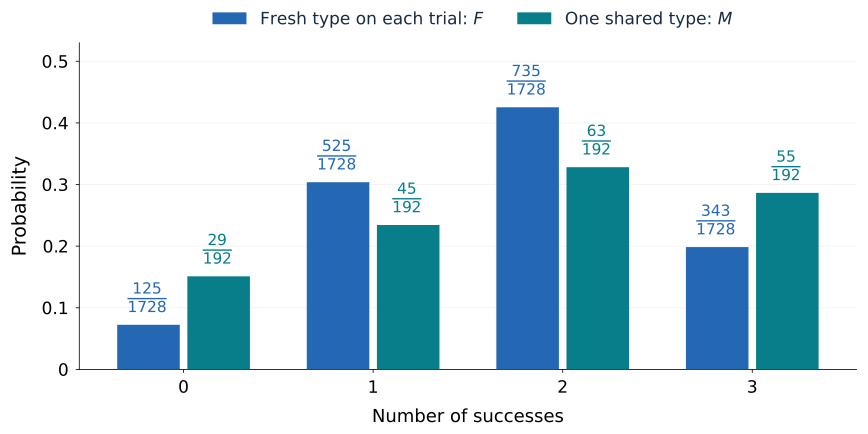
  4. The complete table, useful for later comparison, is

    ff00112233
    P(F=f)P(F=f)1251728\frac{125}{1728}5251728\frac{525}{1728}7351728\frac{735}{1728}3431728\frac{343}{1728}
  5. The probabilities total one. It is the fresh independent repetition of the whole selection procedure that justifies using the averaged one-trial probability in a binomial model.

Your turn

On each of four trials, independently choose type A with probability 34\frac{3}{4} or B with probability 14\frac{1}{4}. Success probabilities are 15\frac{1}{5} for A and 35\frac{3}{5} for B. All outcome-generating draws are also independent across trials. Find the unconditional success probability of one trial and the probability that all four trials succeed.

Enter an exact value or round to 3 significant figures.

Enter an exact value or round to 3 significant figures.

Section 4 of 5 · Core · about 17 min

Is one selected type shared by the entire batch?

Now choose one type and retain it for all nn trials. Conditional on A, the success count is B(n,pA)\mathrm{B}(n,p_A); conditional on B, it is B(n,pB)\mathrm{B}(n,p_B). Weight the two complete count distributions:

P(M=r)=w(nr)pAr(1−pA)n−r+(1−w)(nr)pBr(1−pB)n−r.P(M=r)=w\binom{n}{r}p_A^r(1-p_A)^{n-r}+(1-w)\binom{n}{r}p_B^r(1-p_B)^{n-r}.

The original choice weight is applied once per batch. An observation of the count can then update the probability of which type was selected.

Worked example

One shared type requires a weighted mixture and a posterior update

Choose type A once with probability 13\frac{1}{3}, or type B once with probability 23\frac{2}{3}, and retain that type for all three trials. Conditional on the selected type, the trial outcomes are independent. Success probabilities are 14\frac{1}{4} for A and 34\frac{3}{4} for B. Let MM count successes. Construct its distribution and find the probability that B was selected given three successes.

  1. Within each fixed type, the count is binomial. The conditional distributions are

    mm00112233
    P(M=m∣A)P(M=m\mid A)2764\frac{27}{64}2764\frac{27}{64}964\frac{9}{64}164\frac{1}{64}
    mm00112233
    P(M=m∣B)P(M=m\mid B)164\frac{1}{64}964\frac{9}{64}2764\frac{27}{64}2764\frac{27}{64}
  2. Weight each complete table by its initial type probability, then add matching counts. For example,

    P(M=2)=13⋅964+23⋅2764=63192.P(M=2)=\frac{1}{3}\cdot\frac{9}{64}+\frac{2}{3}\cdot\frac{27}{64}=\frac{63}{192}.

    The full mixture is

    mm00112233
    P(M=m)P(M=m)29192\frac{29}{192}45192\frac{45}{192}63192\frac{63}{192}55192\frac{55}{192}
  3. Three successes arise through A with joint weight 1192\frac{1}{192} and through B with joint weight 54192\frac{54}{192}. Therefore

    P(B∣M=3)=5419255192=5455.P(B\mid M=3)=\frac{\frac{54}{192}}{\frac{55}{192}}=\frac{54}{55}.
  4. The prior probability of B was 23\frac{2}{3}, but three successes favour the type with the larger success probability. The posterior must use the total probability of three successes in the denominator.

  5. Each individual trial still has success probability 712\frac{7}{12}, but the outcomes share the same selected type. Their unconditional independence is not justified. In particular,

    P(M=3)=55192≠(712)3.P(M=3)=\frac{55}{192}\ne\left(\frac{7}{12}\right)^3.

Your turn

Choose A once with probability 34\frac{3}{4}, or B once with probability 14\frac{1}{4}. Retain it for two trials, independent conditional on the selected type. Success probabilities are 15\frac{1}{5} for A and 35\frac{3}{5} for B. Find the probability of two successes and the posterior probability of B given two successes. Then find the two-success probability if a fresh type were instead independently chosen on each trial.

Enter an exact value or round to 3 significant figures.

Enter an exact value or round to 3 significant figures.

Enter an exact value or round to 3 significant figures.

Worked example

Compare moments using the two complete count tables

Compare the fresh-type count FF from Worked example 3 with the shared-type count MM from Worked example 4. In both experiments, A has selection probability 13\frac{1}{3} and success probability 14\frac{1}{4}, while B has selection probability 23\frac{2}{3} and success probability 34\frac{3}{4}. Use their complete three-trial count tables to calculate each mean and variance.

  1. The two distributions, with each probability attached to the same count value, are

    ff00112233
    P(F=f)P(F=f)1251728\frac{125}{1728}5251728\frac{525}{1728}7351728\frac{735}{1728}3431728\frac{343}{1728}
    mm00112233
    P(M=m)P(M=m)29192\frac{29}{192}45192\frac{45}{192}63192\frac{63}{192}55192\frac{55}{192}
  2. For the fresh-type model, direct weighted sums give

    E(F)=525+2⋅735+3⋅3431728=74,E(F)=\frac{525+2\cdot735+3\cdot343}{1728}=\frac{7}{4},E(F2)=525+4⋅735+9⋅3431728=9124,E(F^2)=\frac{525+4\cdot735+9\cdot343}{1728}=\frac{91}{24},Var⁡(F)=9124−(74)2=3548.\operatorname{Var}(F)=\frac{91}{24}-\left(\frac{7}{4}\right)^2=\frac{35}{48}.
  3. For the shared-type model, use its own table throughout:

    E(M)=45+2⋅63+3⋅55192=74,E(M)=\frac{45+2\cdot63+3\cdot55}{192}=\frac{7}{4},E(M2)=45+4⋅63+9⋅55192=338,E(M^2)=\frac{45+4\cdot63+9\cdot55}{192}=\frac{33}{8},Var⁡(M)=338−(74)2=1716.\operatorname{Var}(M)=\frac{33}{8}-\left(\frac{7}{4}\right)^2=\frac{17}{16}.
  4. The means match, but the shared-type count has the larger variance: 1716>3548\frac{17}{16}>\frac{35}{48}. Selecting a high- or low-success type once makes the entire batch more likely to contain many or few successes.

  5. A binomial count over three trials with mean 74\frac{7}{4} would have success probability 712\frac{7}{12}, and variance 3548\frac{35}{48}. It cannot reproduce the shared-type table’s variance 1716\frac{17}{16}. Matching a one-trial probability or a mean alone does not establish the binomial count model.

Type A is selected with probability one third and has success probability one quarter; B is selected with probability two thirds and has success probability three quarters. With fresh independent type choices on each of three trials, the count probabilities at zero one two and three are one hundred twenty-five five hundred twenty-five seven hundred thirty-five and three hundred forty-three over one thousand seven hundred twenty-eight. With one type retained for all trials, the probabilities are twenty-nine forty-five sixty-three and fifty-five over one hundred ninety-two. Both means are seven quarters. Fresh-choice variance is thirty-five forty-eighths, while shared-choice variance is seventeen sixteenths.

Both counts have mean 74\frac74. The shared-type count has more mass at the extremes and larger variance, 1716\frac{17}{16} compared with 3548\frac{35}{48}.

Fresh choices and one shared choice have the same one-trial success probability and count mean in this example. Their full count distributions and variances differ because a shared type links the outcomes within a batch.

Your turn

A type is selected once with equal probabilities. Its success probability is either 14\frac{1}{4} or 34\frac{3}{4}, and two trials are independent conditional on that type. The resulting count MM has probabilities 516,38,516\frac{5}{16},\frac{3}{8},\frac{5}{16} at zero, one and two. Find its mean and variance, then compare its tail masses with B(2,12)\mathrm{B}(2,\frac{1}{2}).

Enter an exact number, for example 3/2 or 2-sqrt(3).

Enter an exact value or round to 3 significant figures.

Which comparison is correct?

The distinction need not produce different count distributions in every boundary case. If both types have the same success probability, or only one type can be selected, the two constructions agree. A batch of one trial also has the same one-trial distribution under either procedure. Check the actual structure and parameters rather than assuming every mixture must differ.

Section 5 of 5 · Core · about 15 min

Which underlying trials do the two counts share?

To use a product of two count probabilities, justify independence of the counts themselves. Counts based on disjoint groups of mutually independent trials are independent. Counts that reuse trials or share a selected type need a joint model; their separate marginal binomial distributions are not enough.

Worked example

Disjoint groups of independent trials give independent counts

Five fair-coin tosses are independent. Let UU count heads in the first three tosses and VV count heads in the last two. Find P(U=2,V≥1)P(U=2,V\ge1) and P(U+V=3)P(U+V=3).

  1. The two counts use disjoint groups of the independent tosses. Hence U∼B(3,12)U\sim\mathrm{B}(3,\frac{1}{2}) and V∼B(2,12)V\sim\mathrm{B}(2,\frac{1}{2}), and these counts are independent.

  2. For the first event, multiply the two count-event probabilities:

    P(U=2,V≥1)=38⋅(1−14)=932.P(U=2,V\ge1)=\frac{3}{8}\cdot\left(1-\frac{1}{4}\right)=\frac{9}{32}.
  3. For a total of three heads, the possible count pairs are (1,2),(2,1),(3,0)(1,2),(2,1),(3,0). These joint cases are disjoint:

    P(U+V=3)=38⋅14+38⋅12+18⋅14=516.P(U+V=3)=\frac{3}{8}\cdot\frac{1}{4}+\frac{3}{8}\cdot\frac{1}{2}+\frac{1}{8}\cdot\frac{1}{4}=\frac{5}{16}.
  4. There is also a direct check: U+VU+V counts heads across all five independent fair tosses, so its distribution is B(5,12)\mathrm{B}(5,\frac{1}{2}). Thus

    P(U+V=3)=(53)(12)5=516.P(U+V=3)=\binom{5}{3}\left(\frac{1}{2}\right)^5=\frac{5}{16}.

    This direct binomial model is justified by the underlying five trials, all with the same success probability.

Worked example

A shared trial can make two binomial counts dependent

Three fair-coin tosses are independent. Let UU count heads in tosses one and two, and let VV count heads in tosses two and three. Find their joint distribution, P(U=0,V=0)P(U=0,V=0) and P(V=0∣U=0)P(V=0\mid U=0). Decide whether the counts are independent.

  1. Each marginal count has distribution B(2,12)\mathrm{B}(2,\frac{1}{2}), but both include toss two. Enumerate the eight equally likely three-toss strings and map each string to its pair (U,V)(U,V).

  2. The strings TTT, TTH, THT, THH, HTT, HTH, HHT and HHH produce pairs (0,0),(0,1),(1,1),(1,2),(1,0),(1,1),(2,1),(2,2)(0,0),(0,1),(1,1),(1,2),(1,0),(1,1),(2,1),(2,2). Combining repeated pairs gives

    P(U=u,V=v)P(U=u,V=v)v=0v=0v=1v=1v=2v=2Row total
    u=0u=018\frac{1}{8}18\frac{1}{8}0014\frac{1}{4}
    u=1u=118\frac{1}{8}14\frac{1}{4}18\frac{1}{8}12\frac{1}{2}
    u=2u=20018\frac{1}{8}18\frac{1}{8}14\frac{1}{4}
    Column total14\frac{1}{4}12\frac{1}{2}14\frac{1}{4}11
  3. Both counts equal zero exactly when all three tosses are tails:

    P(U=0,V=0)=18.P(U=0,V=0)=\frac{1}{8}.

    But the product of the marginal probabilities is

    P(U=0)P(V=0)=14⋅14=116.P(U=0)P(V=0)=\frac{1}{4}\cdot\frac{1}{4}=\frac{1}{16}.

    These differ, so the counts are not independent.

  4. Condition within the row U=0U=0:

    P(V=0∣U=0)=1814=12.P(V=0\mid U=0)=\frac{\frac{1}{8}}{\frac{1}{4}}=\frac{1}{2}.

    Knowing U=0U=0 already tells us that toss two was tails. Only the third toss then decides whether V=0V=0.

  5. Some individual pairs can happen to satisfy a product equality. For example, P(U=1,V=1)=14P(U=1,V=1)=\frac{1}{4} equals P(U=1)P(V=1)P(U=1)P(V=1), but that single agreement does not establish independence. Independence must hold for every joint pair.

Two overlapping head counts

In three independent fair tosses, UU counts the heads in tosses 1 and 2 and VV counts the heads in tosses 2 and 3. Each inner cell gives the joint probability for its pair of counts.

Count UUV=0V=0V=1V=1V=2V=2Row total
U=0U=018\tfrac1818\tfrac180014\tfrac14
U=1U=118\tfrac1828\tfrac2818\tfrac1812\tfrac12
U=2U=20018\tfrac1818\tfrac1814\tfrac14
Column total14\tfrac1412\tfrac1214\tfrac1411

The row U=0U=0 gives P(V=0∣U=0)=1814=12P(V=0\mid U=0)=\dfrac{\frac{1}{8}}{\frac{1}{4}}=\dfrac12.

The joint probability 18\frac18 differs from the product 14×14=116\frac14\times\frac14=\frac1{16}, so the two counts are dependent. Each count individually follows B(2,12)\mathrm{B}(2,\frac12).

Both counts have binomial marginal distributions, but the middle toss belongs to both. The joint table exposes the dependence and provides the correct row total for conditioning.

Your turn

Four fair-die rolls are independent. Let RR count ones and SS count twos in those same four rolls. Find P(R=0,S=0)P(R=0,S=0) and P(R=1,S=1)P(R=1,S=1), then decide whether the two counts are independent.

Enter an exact value or round to 3 significant figures.

Enter an exact value or round to 3 significant figures.

Are the counts independent?

Even for independent counts, different success probabilities can prevent the combined total from having a single standard binomial model. You can always sum disjoint joint cases when independence is justified, but combining the totals into one binomial count also needs a common success probability across the underlying trials.

Worked examples

Practise the method

Core practice

Question 1 of 4

0 / 4 checked in this collection

Question list

Core practice

Fresh variants

Exam-style

One success overall has two disjoint routes

3 marks

Group A has 2 trials with success probability 12\frac{1}{2}; group B has 2 trials with probability 13\frac{1}{3}. All trials are independent. Find the probabilities of no successes overall, exactly one overall, and that the unique success came from A given exactly one overall.

Enter an exact value or round to 3 significant figures.

Enter an exact value or round to 3 significant figures.

Enter an exact value or round to 3 significant figures.

Full answer-format guide

Exact numbers: 3/2, sqrt(5), 2-sqrt(3), pi/6, 3*pi/2. Sets: {1,4}. Intervals: (3,5]; a round bracket excludes the endpoint. Infinity: inf; union: U; no solutions: empty. Separate coordinate pairs or triples with semicolons. Expressions: 2x^2+3x-1; equations: x^2=3x+1 or the polynomial equal to zero. Factors: x-1 ; x+2. Parameter fraction: numerator ; denominator. List integer answers individually.

Review the method

Progress stays in this browser. Create an account to save it or sign in.

Extra practice from this lesson

Condition on at least one success

Let X∼B(4,13)X\sim\mathrm{B}\left(4,\frac{1}{3}\right). Find P(X≥1)P(X\ge1), P(X=2∣X≥1)P(X=2\mid X\ge1) and P(X≥3∣X≥1)P(X\ge3\mid X\ge1). Give exact answers.

Enter an exact number, for example 3/2 or 2-sqrt(3).

Enter an exact number, for example 3/2 or 2-sqrt(3).

Enter an exact number, for example 3/2 or 2-sqrt(3).

A whole batch becomes one outer success

A batch contains three devices. Each independently fails inspection with probability 0.10.1. A batch is labelled bad if at least one device fails. Five batches are inspected, with all device outcomes independent across and within batches. Find the probability that one batch is bad, the trial total in the binomial model for the number of bad batches, and the probability that exactly two of the five batches are bad. Give the final probability to four decimal places.

Enter an exact value or round to 3 significant figures.

Enter the value on its own or write n = … . Fractions and exact square roots are accepted.

Give your answer to 4 decimal places.

Fresh type choices and one shared choice are different models

Type A has success probability 0.80.8; type B has success probability 0.20.2. Types are chosen with equal probabilities. In the fresh-choice experiment, a new type is chosen independently before each of four trials, and all trial generation is independent. In the shared-choice experiment, one type is chosen once and used for all four trials, whose outcomes are independent conditional on that type. Is the fresh-choice success count B(4,12)\mathrm{B}\left(4,\frac{1}{2}\right)? Find the probability of four successes in each experiment. Is the shared-choice count also B(4,12)\mathrm{B}\left(4,\frac{1}{2}\right)?

Fresh-choice count has the stated binomial model

Enter an exact value or round to 3 significant figures.

Enter an exact value or round to 3 significant figures.

Shared-choice count has the stated binomial model

A posterior needs the full observed-event denominator

Choose coin A with probability 35\frac{3}{5}, otherwise choose coin B. Their head probabilities are respectively 14\frac{1}{4} and 34\frac{3}{4}. Toss the chosen coin three times independently conditional on the choice. Let XX be the number of heads. Find P(X=2)P(X=2), P(B∣X=2)P(B\mid X=2), P(X≥1)P(X\ge1) and P(B∣X≥1)P(B\mid X\ge1).

Enter an exact value or round to 3 significant figures.

Enter an exact value or round to 3 significant figures.

Enter an exact value or round to 3 significant figures.

Enter an exact value or round to 3 significant figures.

A sum of independent counts is an event over count pairs

Independent random variables satisfy X∼B(3,12)X\sim\mathrm{B}\left(3,\frac{1}{2}\right) and Y∼B(4,14)Y\sim\mathrm{B}\left(4,\frac{1}{4}\right). Find P(X=1,Y=2)P(X=1,Y=2), P(X+Y=2)P(X+Y=2) and the probability that both counts are positive.

Enter an exact value or round to 3 significant figures.

Enter an exact value or round to 3 significant figures.

Enter an exact value or round to 3 significant figures.

Add the routes for one success

Two independent attempts have success probabilities 13\frac13 and 14\frac14. Find the probability of exactly one success.

Enter an exact value or round to 3 significant figures.

Condition on the shared machine

Choose A or B with equal probability, then use that machine for both trials. The trials are independent given the machine, with success probability 12\frac12 on A and 14\frac14 on B. Find the probability both trials succeed.

Enter an exact value or round to 3 significant figures.

Choose the batch success event

Two independent devices each fail with probability 14\frac14. A batch fails when either device fails. Find the batch failure probability.

Enter an exact value or round to 3 significant figures.

Condition on a nonzero count

Let X∼B(2,14)X\sim\mathrm B(2,\frac14). Find P(X=2∣X>0)\mathrm P(X=2\mid X>0).

Enter an exact value or round to 3 significant figures.

Apply it · original exam-style problems

Show your working on paper and compare it with the worked solution and marking guidance.

Start after this lesson

A batch event becomes an outer model and an inner condition 10 marks

Each batch contains four independent trials, each successful with probability 0.20.2. A batch qualifies if it contains exactly two successes. Eight batches are run, with all trial outcomes independent across batches. Let YY be the number of qualifying batches. Find the exact qualification probability for one batch and E(Y)E(Y). Find P(Y=1)P(Y=1) and P(Y≥2)P(Y\ge2), each to four decimal places. For one specified batch, given that it qualifies, find the probability that its first trial succeeded.

Hint

Use a four-trial binomial calculation to obtain one qualification probability, then an eight-trial binomial count of qualifying batches. For the final conditional question, return to one batch and count its success-position patterns.

Worked solution
  1. q=(42)⋅0.22⋅0.82=0.1536=96625.q=\binom{4}{2}\cdot0.2^2\cdot0.8^2=0.1536=\frac{96}{625}.

    The independent batches have a common qualification probability, so Y∼B(8,96625)Y\sim\mathrm{B}\left(8,\frac{96}{625}\right).

  2. E(Y)=8⋅96625=768625.E(Y)=8\cdot\frac{96}{625}=\frac{768}{625}.
  3. P(Y=1)=8⋅0.1536⋅0.84647≈0.3824(4 d.p.),P(Y=1)=8\cdot0.1536\cdot0.8464^7\approx0.3824\quad\text{(4 d.p.)},P(Y≥2)=1−0.84648−8⋅0.1536⋅0.84647≈0.3542(4 d.p.).P(Y\ge2)=1-0.8464^8-8\cdot0.1536\cdot0.8464^7\approx0.3542\quad\text{(4 d.p.)}.
  4. Within a qualifying batch, the six choices of two success positions are equally likely. Exactly three include the first position:

    P(first trial succeeds∣exactly two successes)=(31)(42)=12.P(\text{first trial succeeds}\mid\text{exactly two successes})=\frac{\binom{3}{1}}{\binom{4}{2}}=\frac{1}{2}.
  5. The original trial probability 0.20.2 is not the probability after learning that this particular four-trial batch contains exactly two successes.

Marking guidance
  • 1 mark: compute the one-batch qualification probability with the correct position factor.
  • 1 mark: give its exact value.
  • 1 mark: identify the outer count of eight independent batch indicators.
  • 1 mark: obtain the outer expectation.
  • 1 mark: calculate exactly one qualifying batch.
  • 1 mark: include both zero and one in the complement for at least two.
  • 1 mark: obtain the second event probability at the requested accuracy.
  • 1 mark: identify the six success-position patterns within a qualifying batch.
  • 1 mark: count the three patterns containing the first position.
  • 1 mark: obtain the conditional probability and distinguish it from the original trial probability.
The same one-trial success rate does not fix the joint model 10 marks

Machine A produces a successful result with probability 0.90.9; machine B does so with probability 0.60.6. A machine choice selects A with probability 25\frac{2}{5} and B with probability 35\frac{3}{5}. Compare two procedures for three trials. In procedure F, a new machine is independently chosen before each trial and all trial generation is independent. In procedure S, one machine is chosen once for all three trials, which are independent conditional on the machine. Find the common marginal success probability on one trial. Find the probability of exactly two successes under F and under S, each to four decimal places. Under S, find the exact probability that A was chosen given exactly two successes.

Hint

Procedure F has independent fresh choices and therefore a binomial count using the marginal probability. Procedure S needs two separately weighted binomial branches. Its posterior numerator is the A-branch joint probability.

Worked solution
  1. p=25⋅0.9+35⋅0.6=0.72=1825.p=\frac{2}{5}\cdot0.9+\frac{3}{5}\cdot0.6=0.72=\frac{18}{25}.
  2. Under F, XF∼B(3,0.72)X_F\sim\mathrm{B}(3,0.72), so

    P(XF=2)=(32)⋅0.722⋅0.28≈0.4355(4 d.p.).P(X_F=2)=\binom{3}{2}\cdot0.72^2\cdot0.28\approx0.4355\quad\text{(4 d.p.)}.
  3. Under S, the joint contributions are

    P(A and XS=2)=25⋅(32)⋅0.92⋅0.1=0.0972,P(A\text{ and }X_S=2)=\frac{2}{5}\cdot\binom{3}{2}\cdot0.9^2\cdot0.1=0.0972,P(B and XS=2)=35⋅(32)⋅0.62⋅0.4=0.2592.P(B\text{ and }X_S=2)=\frac{3}{5}\cdot\binom{3}{2}\cdot0.6^2\cdot0.4=0.2592.

    Adding them gives P(XS=2)=0.3564P(X_S=2)=0.3564.

  4. P(A∣XS=2)=0.0972÷0.3564=311.P(A\mid X_S=2)=0.0972\div0.3564=\frac{3}{11}.
  5. Both procedures have the same one-trial marginal probability, but their three-trial distributions differ. Averaging success probabilities before using the binomial formula is justified for the independent fresh choices, not for the shared hidden machine.

Marking guidance
  • 1 mark: compute the common marginal success probability.
  • 1 mark: identify why independent fresh choices give a binomial model.
  • 1 mark: form the fresh-procedure exactly-two probability.
  • 1 mark: obtain its value to the requested accuracy.
  • 1 mark: form the A-branch joint contribution under the shared procedure.
  • 1 mark: form the B-branch joint contribution.
  • 1 mark: add both contributions for the shared observed-event probability.
  • 1 mark: retain the A joint weight as the posterior numerator.
  • 1 mark: obtain the exact posterior.
  • 1 mark: distinguish conditional independence within a fixed machine from marginal independence after hiding the machine choice.

Come back to what needs practice

Quick revision sheet (A4)

Your review plan starts after your first check.

Question bank and saved work