Maths4UBETA

First success and geometric models

Use the first-success convention, waiting-time tails, memorylessness and finite caps correctly.

Try the quick check →
Lesson 4 of 5

Section 1 of 5 · Core · about 10 min

What is repeated, and exactly what does the waiting variable count?

A geometric trial-count model describes repeated independent trials with the same success probability pp, continued until the first success. The recorded variable includes the successful trial:

X∼Geo(p).X\sim\mathrm{Geo}(p).

For 0<p<10<p<1, its support is 1,2,3,…1,2,3,\ldots. Unlike a fixed-trial binomial count, it records how long the experiment waits for its first success.

Define one trial, define success, check independence and constant probability, and check that there is no finite stopping cap. A draw without replacement from a small fixed-composition bag generally changes the success probability and needs its own model.

Worked example

Count every trial through the first success

A fair die with faces numbered one to six is rolled independently until the first six appears. Let XX be the number of rolls made, including that final roll. State its distribution and possible values. Explain how XX differs from the number of non-six rolls before the first six.

  1. One trial is one roll, and success means a six. Trials are independent and the success probability is constant at p=16p=\frac{1}{6}. The experiment continues until the first success.

  2. Using the trial-count convention,

    X∼Geo(16),X∈{1,2,3,…}.X\sim\mathrm{Geo}\left(\frac{1}{6}\right),\qquad X\in\{1,2,3,\ldots\}.

    A success on the first roll gives X=1X=1, not zero.

  3. If YY counts only the failures before the first success, then Y=X−1Y=X-1 and its values start at zero. For instance, the sequence failure, failure, success gives X=3X=3 and Y=2Y=2. Keep the variable definition visible before choosing an exponent.

  4. There is no fixed maximum number of rolls. The chance of still having no six after mm rolls is (56)m(\frac{5}{6})^m, which tends to zero as mm grows. The first success occurs eventually with probability one, although any particular finite waiting time can be exceeded.
Your turn

A bag contains two green and three white tokens. Draw uniformly, replace and mix after every failure, and stop at the first green. Successive draws are independent. Lara counts every draw including the final green; Liam counts only the whites before it. Which record uses the geometric trial-count convention, what is its success probability, and what is its smallest possible value?

Which record counts trials through success?

Enter an exact value or round to 3 significant figures.

Enter an exact number, for example 3/2 or 2-sqrt(3).

At p=1p=1, success is certain on the first trial, so X=1X=1 with probability one. At p=0p=0, no success can ever occur: there is no first-success distribution supported on 1,2,…1,2,\ldots. Handle these cases directly instead of inserting undefined expressions into a formula.

Section 2 of 5 · Core · about 10 min

Which unique success/failure pattern gives the first success?

Write q=1−pq=1-p for the failure probability. For 0<p<10<p<1, first success on trial rr requires r−1r-1 failures in their specified positions, then success:

P(X=r)=qr−1p=(1−p)r−1p,r=1,2,3,….P(X=r)=q^{r-1}p=(1-p)^{r-1}p,\qquad r=1,2,3,\ldots.

No ordering coefficient is needed because the first success has a prescribed position. There is no earlier success to place elsewhere.

Worked example

The first success at five is one specified stopping pattern

Independent trials each succeed with probability 14\frac{1}{4}. Let XX count the trials through the first success. Find P(X=5)P(X=5), and explain why no combination factor is needed.

  1. The event X=5X=5 requires the exact pattern FFFFS: the first four trials fail and the fifth succeeds.

  2. P(X=5)=(34)4⋅14=811024.P(X=5)=\left(\frac{3}{4}\right)^4\cdot\frac{1}{4}=\frac{81}{1024}.
  3. The success position is fixed by the phrase “first success on trial five”. There is only one permitted success/failure pattern, so no combination factor is added.

  4. Exactly one success somewhere among five trials is a different event: it allows five success positions. A first-success question fixes all earlier trials as failures and fixes the final trial as success.

Your turn

Let X∼Geo(13)X\sim\mathrm{Geo}(\frac{1}{3}). Find the probability that the first success is on trial four, and the probability that the first three trials all fail.

Enter an exact value or round to 3 significant figures.

Enter an exact value or round to 3 significant figures.

Which trials are fixed?

Let XX count trials up to and including the first success, where p=14p=\frac14 and q=34q=\frac34. S means success, F means failure and a dot leaves the outcome unrestricted.

EventFirst five trialsProbability
X=5X=5F F F F Sq4p=811024q^4p=\tfrac{81}{1024}
X>4X>4F F F F ·q4=81256q^4=\tfrac{81}{256}
X≥4X\geq4F F F · ·q3=2764q^3=\tfrac{27}{64}

For the last event, a success on trial 4 is allowed. Only the first three failures enter the product.

First success on trial five requires four failures and a success. Waiting beyond four requires only those four failures, while waiting at least four requires only the first three failures.

A finite display of the first NN probabilities is not the complete distribution. Their total and the missing tail are

∑r=1NP(X=r)=1−qN,P(X>N)=qN.\sum_{r=1}^{N}P(X=r)=1-q^N,\qquad P(X>N)=q^N.

Keep that remaining tail visible. Dividing the displayed probabilities by their subtotal would instead produce the conditional distribution given X≤NX\le N, which is a different question.

Section 3 of 5 · Core · about 17 min

How many failures do the tail and interval events require?

For a positive integer kk,

P(X>k)=qk,P(X≥k)=qk−1.P(X>k)=q^k,\qquad P(X\ge k)=q^{k-1}.

The first event needs kk initial failures. The second needs only k−1k-1, because success on trial kk is allowed. Consequently,

P(X≤k)=1−qk,P(X<k)=1−qk−1.P(X\le k)=1-q^k,\qquad P(X<k)=1-q^{k-1}.

For integers 1≤a≤b1\le a\le b, an inclusive interval is

P(a≤X≤b)=qa−1−qb.P(a\le X\le b)=q^{a-1}-q^b.

List the included trial numbers when the bounds are strict or noninteger rather than applying an endpoint rule mechanically.

Worked example

Strict and inclusive waiting tails differ by one failure

Let X∼Geo(14)X\sim\mathrm{Geo}(\frac{1}{4}), counting the successful trial. Find P(X>4)P(X>4), P(X≥4)P(X\ge4), and P(4≤X≤6)P(4\le X\le6).

  1. To wait more than four trials, all of the first four trials must fail. There is no requirement on the fifth trial:

    P(X>4)=(34)4=81256.P(X>4)=\left(\frac{3}{4}\right)^4=\frac{81}{256}.
  2. To wait at least four trials, only the first three must fail. The fourth may be the successful trial:

    P(X≥4)=(34)3=2764.P(X\ge4)=\left(\frac{3}{4}\right)^3=\frac{27}{64}.
  3. The interval includes first success on trials four, five or six. Start with all waits of at least four and remove waits longer than six:

    P(4≤X≤6)=P(X≥4)−P(X>6)P(4\le X\le6)=P(X\ge4)-P(X>6)=(34)3−(34)6=9994096.=\left(\frac{3}{4}\right)^3-\left(\frac{3}{4}\right)^6=\frac{999}{4096}.
  4. The exponents count failed trials, not the endpoint numbers automatically. In the interval calculation, the lower event needs three failures, while the excluded upper tail needs six failures.

Your turn

Let X∼Geo(15)X\sim\mathrm{Geo}(\frac{1}{5}). Find P(X≥4)P(X\ge4), P(X>4)P(X>4), and P(2<X≤5)P(2<X\le5).

Enter an exact value or round to 3 significant figures.

Enter an exact value or round to 3 significant figures.

Enter an exact value or round to 3 significant figures.

For 0<p<10<p<1, known failures do not change the distribution of the future independent trials. For nonnegative integers s,ts,t, the condition X>sX>s has positive probability and

P(X>s+t∣X>s)=qs+tqs=qt.P(X>s+t\mid X>s)=\frac{q^{s+t}}{q^s}=q^t.

This equals the probability of needing more than tt trials in a fresh run. It concerns the additional wait after the known failures, not the original total trial number.

Worked example

After known failures, count the additional wait from the next trial

Independent trials succeed with probability 14\frac{1}{4}. Let XX count trials through the first success. Given that the first three trials failed, find P(X>5∣X>3)P(X>5\mid X>3) and P(X=5∣X>3)P(X=5\mid X>3). Describe the distribution of the additional waiting time.

  1. The condition is X>3X>3, with positive probability (34)3(\frac{3}{4})^3. Waiting beyond trial five means two further failures:

    P(X>5∣X>3)=(34)5(34)3=(34)2=916.P(X>5\mid X>3)=\frac{(\frac{3}{4})^5}{(\frac{3}{4})^3}=\left(\frac{3}{4}\right)^2=\frac{9}{16}.
  2. First success on trial five, after the known first three failures, needs one more failure on trial four followed by success on trial five:

    P(X=5∣X>3)=34⋅14=316.P(X=5\mid X>3)=\frac{3}{4}\cdot\frac{1}{4}=\frac{3}{16}.
  3. Within the condition, define T=X−3T=X-3 as the number of additional trials through success. Its values begin at one, because trial four is the first additional trial. Independence and unchanged success probability give

    T∣(X>3)∼Geo(14).T\mid(X>3)\sim\mathrm{Geo}\left(\frac{1}{4}\right).
  4. The three failures are known history; they do not make success more likely on the next independent trial. This unchanged distribution of the remaining wait is the memoryless property.

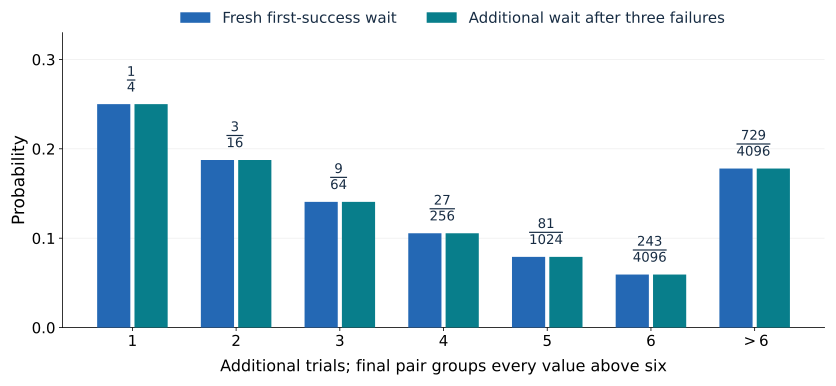
With success probability one quarter, condition on the first three trials having failed. The additional waiting time starts at trial four and has the same geometric probability sequence as a fresh run. Waiting beyond trial five then means two additional failures, so the conditional probability of X greater than five given X greater than three is nine sixteenths.

After three known failures, the next trial is the first additional trial. The two bars at each count coincide. In particular, P(X>5∣X>3)=P(X>2)=916P(X>5\mid X>3)=P(X>2)=\frac9{16}.

After three known failures, the fourth trial is the first additional trial. The remaining wait has the same geometric probabilities as a fresh run; two more failures have probability nine sixteenths.

Your turn

Let X∼Geo(13)X\sim\mathrm{Geo}(\frac{1}{3}). Given that the first four trials failed, find the probability of waiting beyond trial six and the probability that the first success is exactly on trial six.

Enter an exact value or round to 3 significant figures.

Enter an exact value or round to 3 significant figures.

Section 4 of 5 · Core · about 10 min

What does the reciprocal mean tell us about waiting?

For the geometric trial-count convention,

E(X)=1p.E(X)=\frac{1}{p}.

One way to see this is to add the chances that each trial is needed. Trial one is always needed, trial two is needed after one failure, trial three after two failures, and so on:

E(X)=1+q+q2+⋯=11−q=1p.E(X)=1+q+q^2+\cdots=\frac{1}{1-q}=\frac{1}{p}.

For 0<p<10<p<1, this geometric series converges. The constant case p=1p=1 gives mean one directly.

Worked example

An expected waiting time is an average, not a deadline

Independent attempts succeed with probability 25\frac{2}{5}, and attempts continue until the first success. Find the expected number of attempts. Does the answer imply that success must occur within three attempts?

  1. The trial-count variable has geometric mean

    E(X)=1p=125=52.E(X)=\frac{1}{p}=\frac{1}{\frac{2}{5}}=\frac{5}{2}.
  2. The mean is two and a half attempts across repeated independent runs of the experiment. Individual runs use an integer number of attempts; an expected value need not itself be a possible count.

  3. Waiting longer than three attempts remains possible:

    P(X>3)=(35)3=27125>0.P(X>3)=\left(\frac{3}{5}\right)^3=\frac{27}{125}>0.

    Thus the expected wait is not a maximum or a guarantee about one run.

  4. After any specified number of failures, the expected number of additional attempts is still 52\frac{5}{2}, provided the conditioning event has positive probability. The completed attempts are not included again in that additional-wait variable.

Your turn

A geometric trial-count variable has exact mean 103\frac{10}{3}. Find the success probability and P(X>2)P(X>2). After five known failures, what is the expected number of additional trials through the first success?

Enter an exact value or round to 3 significant figures.

Enter an exact value or round to 3 significant figures.

Enter an exact value or round to 3 significant figures.

A smaller positive success probability gives a longer expected wait, but individual runs remain variable. Memorylessness does not mean the experiment has no history; it means that known failures provide no change to the future trial probabilities under the independent, constant-probability model.

Section 5 of 5 · Core · about 14 min

Can the probability or confidence requirement determine the waiting model?

A tail probability often determines the parameter directly. If P(X>k)=aP(X>k)=a for a positive integer kk, then the failure probability satisfies

qk=a,q=a1k,p=1−a1k.q^k=a,\qquad q=a^{\frac{1}{k}},\qquad p=1-a^{\frac{1}{k}}.

Use the nonnegative probability root and check the original event. An exact first-success probability, such as P(X=2)P(X=2), can instead give a quadratic with more than one valid probability.

Worked example

An inverse first-success probability may have two admissible roots

Let X∼Geo(p)X\sim\mathrm{Geo}(p), counting the successful trial, and suppose P(X=2)=29P(X=2)=\frac{2}{9}. Find all possible values of pp. Then select the value consistent with P(X>1)>12P(X>1)>\frac{1}{2}.

  1. First success on trial two requires one failure and then success:

    (1−p)p=29⟹9p2−9p+2=0.(1-p)p=\frac{2}{9}\quad\Longrightarrow\quad9p^2-9p+2=0.
  2. (3p−1)(3p−2)=0,p=13orp=23.(3p-1)(3p-2)=0,\qquad p=\frac{1}{3}\quad\text{or}\quad p=\frac{2}{3}.

    Both values lie in the geometric parameter range and reproduce the given probability.

  3. The additional condition concerns a failed first trial:

    P(X>1)=1−p>12⟹p<12.P(X>1)=1-p>\frac{1}{2}\quad\Longrightarrow\quad p<\frac{1}{2}.

    It therefore selects p=13p=\frac{1}{3}.

  4. An exact first-success probability need not determine one parameter by itself. Keep both admissible roots until an extra condition distinguishes them.

Worked example

Prove the least number of trials needed for a confidence target

Each independent trial succeeds with probability 15\frac{1}{5}. Find the least positive integer mm such that the first success occurs within mm trials with probability at least 0.990.99.

  1. “Within mm trials” includes a first success on trial mm. Its complement is failure on all of the first mm trials:

    P(X≤m)=1−(45)m≥0.99.P(X\le m)=1-\left(\frac{4}{5}\right)^m\ge0.99.
  2. Rearrange and take logarithms:

    (45)m≤0.01,m≥log⁡(0.01)log⁡(0.8)≈20.6377.\left(\frac{4}{5}\right)^m\le0.01,\qquad m\ge\frac{\log(0.01)}{\log(0.8)}\approx20.6377.

    The inequality reverses when dividing by the negative logarithm.

  3. The candidate is twenty-one. Check it and the preceding integer in the original event:

    P(X≤20)=1−(45)20≈0.988471<0.99,P(X\le20)=1-\left(\frac{4}{5}\right)^{20}\approx0.988471<0.99,P(X≤21)=1−(45)21≈0.990777≥0.99.P(X\le21)=1-\left(\frac{4}{5}\right)^{21}\approx0.990777\ge0.99.
  4. The within-trial probability increases with mm, so twenty fails along with every smaller value, while twenty-one passes. The least required trial count is m=21m=21.

Your turn

Let X∼Geo(p)X\sim\mathrm{Geo}(p), and suppose P(X>2)=14P(X>2)=\frac{1}{4}. Find pp. Then find the least positive integer mm for which P(X≤m)≥78P(X\le m)\ge\frac{7}{8}, and the least for which P(X≤m)>78P(X\le m)>\frac{7}{8}.

Enter an exact value or round to 3 significant figures.

Enter an exact number, for example 3/2 or 2-sqrt(3).

Enter an exact number, for example 3/2 or 2-sqrt(3).

The event “first success within mm trials” is the same underlying event as “at least one success in the first mm trials”. This explains the common complement 1−(1−p)m1-(1-p)^m in geometric waiting and fixed-trial binomial questions, even though the random variables record different things.

For 0<p<10<p<1, no finite trial bound guarantees a success with probability exactly one. At p=1p=1, one trial is sufficient. At p=0p=0, a positive-probability success target cannot be reached. Check these endpoints before taking logarithms.

Worked examples

Practise the method

Core practice

Question 1 of 4

0 / 4 checked in this collection

Question list

Core practice

Fresh variants

Exam-style

A point, a tail and a cumulative probability

4 marks

Independent trials have constant success probability 14\frac{1}{4}. T is the first-success trial, including the successful trial. Find P(T=3)\mathrm P(T=3), P(T>4)\mathrm P(T>4), P(T≤4)\mathrm P(T\le 4), and E(T)\mathrm E(T).

Enter an exact value or round to 3 significant figures.

Enter an exact value or round to 3 significant figures.

Enter an exact value or round to 3 significant figures.

Enter an exact number, for example 3/2 or 2-sqrt(3).

Full answer-format guide

Exact numbers: 3/2, sqrt(5), 2-sqrt(3), pi/6, 3*pi/2. Sets: {1,4}. Intervals: (3,5]; a round bracket excludes the endpoint. Infinity: inf; union: U; no solutions: empty. Separate coordinate pairs or triples with semicolons. Expressions: 2x^2+3x-1; equations: x^2=3x+1 or the polynomial equal to zero. Factors: x-1 ; x+2. Parameter fraction: numerator ; denominator. List integer answers individually.

Review the method

Progress stays in this browser. Create an account to save it or sign in.

Extra practice from this lesson

The variable must count trials until a first success

Decide whether a geometric distribution on positive integers models each stated variable.

A: Independent trials each succeed with probability 0.30.3; XX is the trial number of the first success.

B: A bag contains two target counters and six other counters, drawn uniformly without replacement; XX is the draw number of the first target.

C: Twelve independent trials each succeed with probability 0.30.3; XX is the number of successes.

D: Independent trials each have success probability zero; XX is claimed to have a finite first-success trial number.

Experiment A
Experiment B
Experiment C
Experiment D

Surviving to a trial is different from succeeding on it

Independent trials each succeed with probability 27\frac{2}{7}. Let XX count trials up to and including the first success. Find P(X=1)P(X=1), P(X=4)P(X=4), P(X≥4)P(X\ge4) and P(X>4)P(X>4).

Enter an exact value or round to 3 significant figures.

Enter an exact value or round to 3 significant figures.

Enter an exact value or round to 3 significant figures.

Enter an exact value or round to 3 significant figures.

An interval removes the correct survival tail

The first-success trial number XX has success probability 25\frac{2}{5} on every independent trial. Find P(3≤X≤6)P(3\le X\le6), P(3<X≤6)P(3<X\le6) and P(X>7∣X>3)P(X>7\mid X>3).

Enter an exact value or round to 3 significant figures.

Enter an exact value or round to 3 significant figures.

Enter an exact value or round to 3 significant figures.

A fractional mean is not a possible fractional trial

Independent attempts each succeed with probability 0.080.08, and XX is the first-success attempt number. Find E(X)E(X) exactly. Then find P(X≤E(X))P(X\le E(X)) and P(X>E(X))P(X>E(X)), each to four decimal places.

Enter an exact number, for example 3/2 or 2-sqrt(3).

Give your answer to 4 decimal places.

Give your answer to 4 decimal places.

Inverse survival and the certain-success endpoint

Model A is a geometric first-success model with unknown success probability pp, and P(X>3)=827P(X>3)=\frac{8}{27}. Find pp and E(X)E(X). In a separate model B the success probability is one. Find the probability that its first success is on trial one and its expected first-success trial number.

Enter an exact value or round to 3 significant figures.

Enter an exact number, for example 3/2 or 2-sqrt(3).

Enter an exact number, for example 3/2 or 2-sqrt(3).

Enter an exact number, for example 3/2 or 2-sqrt(3).

Count the earlier failures

Independent trials succeed with probability 14\frac14. Find the probability the first success occurs on trial three.

Enter an exact value or round to 3 significant figures.

Translate the waiting tail

For a geometric waiting time TT with success probability 12\frac12, find P(T>4)\mathrm P(T>4).

Enter an exact value or round to 3 significant figures.

Recover the trial probability

For a geometric waiting time TT, the ratio P(T=3)P(T=2)\frac{\mathrm P(T=3)}{\mathrm P(T=2)} is 23\frac23. Find the trial success probability.

Enter an exact value or round to 3 significant figures.

Combine both routes into the cap

Let W=min⁡(T,4)W=\min(T,4), where TT is the first success with probability 14\frac14 per independent trial. Find P(W=4)\mathrm P(W=4).

Enter an exact value or round to 3 significant figures.

Apply it · original exam-style problems

Show your working on paper and compare it with the worked solution and marking guidance.

Start after this lesson

One first-success probability can identify two models 8 marks

Independent trials each succeed with probability pp, where 0<p≤10<p\le1, and XX is the first-success trial number. It is known that P(X=2)=316P(X=2)=\frac{3}{16}. Find both possible values of pp, giving the smaller and larger separately. You are then told that E(X)<3E(X)<3. Identify the remaining value of pp, and find the exact probability that the first success occurs within the first three trials under this model.

Hint

The second trial is the first success only if the first trial fails and the second succeeds. Solve the resulting quadratic completely, then apply the additional mean condition to both candidates.

Worked solution
  1. (1−p)p=316⟹16p2−16p+3=0,(1-p)p=\frac{3}{16}\quad\Longrightarrow\quad16p^2-16p+3=0,(4p−1)(4p−3)=0.(4p-1)(4p-3)=0.

    The two admissible candidates are p=14p=\frac{1}{4} and p=34p=\frac{3}{4}; both lie in the stated probability domain.

  2. Their expected first-success trial numbers are respectively four and 43\frac{4}{3}. Only the latter is strictly less than three, so the additional condition selects p=34p=\frac{3}{4}.

  3. P(X≤3)=1−(1−34)3=1−164=6364.P(X\le3)=1-\left(1-\frac{3}{4}\right)^3=1-\frac{1}{64}=\frac{63}{64}.

    The first probability equation alone was insufficient to choose between the two models.

Marking guidance
  • 1 mark: express a second-trial first success as one failure followed by success.
  • 1 mark: form the correct quadratic.
  • 1 mark: find the smaller probability root.
  • 1 mark: find the larger root and check both probability domains.
  • 1 mark: evaluate the expected wait for both candidates.
  • 1 mark: apply the strict mean condition to select the model.
  • 1 mark: use the complement of three failures for completion within three trials.
  • 1 mark: give the exact final probability.
Check the deadline and then reset only the additional wait 10 marks

Independent trials each succeed with probability 0.120.12, and XX counts trials up to the first success. Find the smallest positive integer mm such that P(X≤m)≥0.98P(X\le m)\ge0.98. Give P(X≤m−1)P(X\le m-1) and P(X≤m)P(X\le m), each to four decimal places, to justify your answer. Separately, given that the first five trials have failed, find the probability that the first success occurs within the next three trials, also to four decimal places.

Hint

Completion by trial m is the complement of m failures. After five known failures, the future trials retain their original independent success probability, and only three additional trials belong in the continuation calculation.

Worked solution
  1. 1−0.88m≥0.98⟺0.88m≤0.02.1-0.88^m\ge0.98\quad\Longleftrightarrow\quad0.88^m\le0.02.

    As ln⁡(0.88)<0\ln(0.88)<0,

    m≥ln⁡(0.02)ln⁡(0.88)≈30.6025.m\ge\frac{\ln(0.02)}{\ln(0.88)}\approx30.6025.
  2. P(X≤30)=1−0.8830=0.9783986…<0.98,P(X\le30)=1-0.88^{30}=0.9783986\ldots<0.98,P(X≤31)=1−0.8831=0.9809908…≥0.98.P(X\le31)=1-0.88^{31}=0.9809908\ldots\ge0.98.

    The completion probability increases with the trial number, so m=31m=31 is the minimum. The neighbouring values to four decimal places are 0.97840.9784 and 0.98100.9810.

  3. The separate conditional event is 5<X≤85<X\le8, given X>5X>5. The conditioning event has probability 0.885>00.88^5>0:

    P(X≤8∣X>5)=0.885−0.8880.885=1−0.883≈0.3185(4 d.p.).P(X\le8\mid X>5)=\frac{0.88^5-0.88^8}{0.88^5}=1-0.88^3\approx0.3185\quad\text{(4 d.p.)}.
  4. The five known failures do not make the next trial more likely to succeed. They change the original trial labels, while the additional waiting distribution retains the same success probability.

Marking guidance
  • 1 mark: express completion by the deadline as the complement of repeated failures.
  • 1 mark: form the required probability inequality.
  • 1 mark: use logarithms with the correct inequality direction.
  • 1 mark: identify the candidate integer deadline.
  • 1 mark: verify that the preceding integer fails using an unrounded probability.
  • 1 mark: verify that the chosen integer succeeds and justify minimality.
  • 1 mark: give both neighbour probabilities at the requested accuracy.
  • 1 mark: translate the continuation into three additional trials after five known failures.
  • 1 mark: use a valid conditional ratio or memorylessness with a nonzero conditioning probability.
  • 1 mark: obtain the continuation probability to the requested accuracy.

Come back to what needs practice

Quick revision sheet (A4)

Your review plan starts after your first check.

Question bank and saved work