Maths4UBETA

Parameters, moments and integer thresholds

Recover binomial parameters and find exact integer bounds while retaining all feasible branches.

Try the quick check →
Lesson 2 of 5

Section 1 of 5 · Core · about 12 min

How do binomial parameters determine the moments?

For X∼B(n,p)X\sim\mathrm{B}(n,p), the success count has mean, variance and standard deviation

μ=np,v=np(1−p),σ=np(1−p).\mu=np,\qquad v=np(1-p),\qquad \sigma=\sqrt{np(1-p)}.

Here nn is a positive integer and 0≤p≤10\le p\le1. A standard deviation must be squared before it can be substituted for vv.

For 0<p<10<p<1, the mean can be obtained directly from the binomial table. Using r(nr)=n(n−1r−1)r\binom{n}{r}=n\binom{n-1}{r-1}, its weighted sum becomes

E(X)=np∑s=0n−1(n−1s)ps(1−p)n−1−s=np.E(X)=np\sum_{s=0}^{n-1}\binom{n-1}{s}p^s(1-p)^{n-1-s}=np.

The remaining sum is one by the binomial expansion of (p+1−p)n−1(p+1-p)^{n-1}.

Similarly, weighting the table by r(r−1)r(r-1) gives n(n−1)p2n(n-1)p^2. Since r2=r(r−1)+rr^2=r(r-1)+r, the second-moment sum is n(n−1)p2+npn(n-1)p^2+np. Subtracting the square of the mean gives

Var⁡(X)=n(n−1)p2+np−n2p2=np(1−p).\operatorname{Var}(X)=n(n-1)p^2+np-n^2p^2=np(1-p).

This is a calculation from the finite probability table; the formulas also agree with the constant cases p=0p=0 and p=1p=1.

Worked example

Keep mean, variance and standard deviation distinct

Let X∼B(20,310)X\sim\mathrm{B}(20,\frac{3}{10}). Find its mean, variance and standard deviation. Give the standard deviation to three significant figures.

  1. The mean is the trial count multiplied by the success probability:

    E(X)=20⋅310=6.E(X)=20\cdot\frac{3}{10}=6.
  2. The variance includes the additional failure factor:

    Var⁡(X)=20⋅310⋅710=215=4.2.\operatorname{Var}(X)=20\cdot\frac{3}{10}\cdot\frac{7}{10}=\frac{21}{5}=4.2.
  3. The standard deviation is the nonnegative square root of the variance:

    σ=215≈2.05(3 significant figures).\sigma=\sqrt{\frac{21}{5}}\approx2.05\quad\text{(3 significant figures)}.
  4. The mean describes an average count over repeated groups of twenty trials. It does not guarantee six successes in a particular group. The standard deviation is measured in success-count units; the variance uses their square.
Your turn

Report A claims a binomial variable has exact mean six and standard deviation two. Report B claims exact mean six and standard deviation three. Find the two variances and identify which report is immediately ruled out by the binomial variance bound.

Enter an exact number, for example 3/2 or 2-sqrt(3).

Enter an exact number, for example 3/2 or 2-sqrt(3).

Which report is ruled out by variance exceeding its mean?

Section 2 of 5 · Core · about 10 min

Can the exact moments recover a valid integer trial count?

If the exact mean μ\mu is positive, divide the variance by the mean:

vμ=1−p,p=1−vμ.\frac{v}{\mu}=1-p,\qquad p=1-\frac{v}{\mu}.

Then recover the trial count from the original mean:

n=μp=μ2μ−v.n=\frac{\mu}{p}=\frac{\mu^2}{\mu-v}.

These formulas require μ>0\mu>0 and a resulting positive probability. Check 0≤v<μ0\le v<\mu first, then verify that nn is a positive integer and both original moment equations hold.

Worked example

Recover both parameters from exact positive moments

A binomial variable has exact mean six and exact variance 92\frac{9}{2}. Find its parameters nn and pp, and check the recovered model.

  1. The supplied conditions are

    np=6,np(1−p)=92.np=6,\qquad np(1-p)=\frac{9}{2}.
  2. The mean is positive, so divide the variance equation by the mean equation:

    1−p=926=34,p=14.1-p=\frac{\frac{9}{2}}{6}=\frac{3}{4},\qquad p=\frac{1}{4}.
  3. Substitute into the mean equation:

    n⋅14=6,n=24.n\cdot\frac{1}{4}=6,\qquad n=24.
  4. The trial count is a positive integer and the probability is admissible. Check both original conditions:

    24⋅14=6,24⋅14⋅34=92.24\cdot\frac{1}{4}=6,\qquad24\cdot\frac{1}{4}\cdot\frac{3}{4}=\frac{9}{2}.

    Therefore X∼B(24,14)X\sim\mathrm{B}(24,\frac{1}{4}).

Your turn

A binomial variable has exact mean nine and exact variance six. Recover pp and the positive integer trial count nn.

Enter an exact value or round to 3 significant figures.

Enter the value on its own or write n = … . Fractions and exact square roots are accepted.

Section 3 of 5 · Core · about 14 min

Which probability equation determines the unknown parameter?

For a known positive trial count, the no-success event gives

P(X=0)=(1−p)n.P(X=0)=(1-p)^n.

If this probability is aa, recover the nonnegative failure probability 1−p=a1n1-p=a^{\frac{1}{n}}, then check pp in its permitted range. With known 0<p<10<p<1, an unknown trial count may instead be recovered from n=log⁡(a)log⁡(1−p)n=\frac{\log(a)}{\log(1-p)}; an exact equality still requires an admissible integer trial count.

Worked example

Use a no-success event to recover the failure probability

Let X∼B(4,p)X\sim\mathrm{B}(4,p), with 0≤p≤10\le p\le1, and suppose P(X=0)=81256P(X=0)=\frac{81}{256}. Find every admissible value of pp.

  1. No successes means that all four trials fail:

    (1−p)4=81256=(34)4.(1-p)^4=\frac{81}{256}=\left(\frac{3}{4}\right)^4.
  2. As a real algebraic equation, this permits 1−p=341-p=\frac{3}{4} or 1−p=−341-p=-\frac{3}{4}. But a failure probability cannot be negative.

  3. The admissible branch is

    1−p=34,p=14.1-p=\frac{3}{4},\qquad p=\frac{1}{4}.

    The other branch would give p=74p=\frac{7}{4}, outside the permitted probability range.

  4. Substituting the valid answer gives (34)4=81256(\frac{3}{4})^4=\frac{81}{256}, exactly as stated. When a root represents a probability, its domain is part of the solution.

Your turn

Let X∼B(3,p)X\sim\mathrm{B}(3,p), and suppose P(X=0)=2764P(X=0)=\frac{27}{64}. Find pp, then find P(X=3)P(X=3).

Enter an exact value or round to 3 significant figures.

Enter an exact value or round to 3 significant figures.

For 0<p<10<p<1 and 0≤r<n0\le r<n, two consecutive positive binomial terms have ratio

P(X=r+1)P(X=r)=n−rr+1⋅p1−p.\frac{P(X=r+1)}{P(X=r)}=\frac{n-r}{r+1}\cdot\frac{p}{1-p}.

This can simplify an inverse calculation because the common powers cancel. Before dividing, check that the denominator is nonzero. An equality between two probabilities may allow endpoint solutions that a defined ratio would exclude.

Worked example

Check zero-probability endpoints before cancelling a ratio

Let X∼B(8,p)X\sim\mathrm{B}(8,p), where 0≤p≤10\le p\le1, and suppose

P(X=2)=32P(X=1).P(X=2)=\frac{3}{2}P(X=1).

Find all possible values of pp. Then explain how the answer changes if the stated information is the defined ratio P(X=2)P(X=1)=32\frac{P(X=2)}{P(X=1)}=\frac{3}{2}.

  1. Check endpoints before dividing. At p=0p=0, the count is always zero, so both probabilities in the equation are zero. At p=1p=1, the count is always eight, so both are again zero. Thus p=0p=0 and p=1p=1 satisfy the original equality.

  2. For an interior probability 0<p<10<p<1, both relevant terms are positive. Their ratio simplifies to

    P(X=2)P(X=1)=(82)p2(1−p)6(81)p(1−p)7=7p2(1−p).\frac{P(X=2)}{P(X=1)}=\frac{\binom{8}{2}p^2(1-p)^6}{\binom{8}{1}p(1-p)^7}=\frac{7p}{2(1-p)}.
  3. Set this ratio equal to the specified factor:

    7p2(1−p)=32⟹7p=3(1−p)⟹p=310.\frac{7p}{2(1-p)}=\frac{3}{2}\quad\Longrightarrow\quad7p=3(1-p)\quad\Longrightarrow\quad p=\frac{3}{10}.
  4. The complete solution of the original equality is

    p∈{0,310,1}.p\in\left\{0,\frac{3}{10},1\right\}.

    These include the two endpoint solutions that would be lost by dividing by P(X=1)P(X=1) without checking it.

  5. If the probability ratio itself is given as defined, its denominator must be positive. The endpoint cases then do not qualify, and the unique answer is p=310p=\frac{3}{10}.

Your turn

Let X∼B(2,p)X\sim\mathrm{B}(2,p), with 0≤p≤10\le p\le1, and suppose P(X=1)=49P(X=1)=\frac{4}{9}. Find both possible values of pp, then identify the one for which the mean exceeds one.

Enter an exact value or round to 3 significant figures.

Enter an exact value or round to 3 significant figures.

Enter an exact value or round to 3 significant figures.

Section 4 of 5 · Core · about 16 min

Which integer first meets or last meets the requirement?

A threshold question asks for a least or greatest integer satisfying a probability requirement. Start with the actual event and preserve whether the inequality is inclusive or strict. For at least one success in nn independent trials,

P(X≥1)=1−(1−p)n.P(X\ge1)=1-(1-p)^n.

For 0<p<10<p<1, this increases with nn, while the no-success probability (1−p)n(1-p)^n decreases. These monotonic directions explain which neighbour must fail at a least or greatest answer.

Worked example

Find the least trial count and verify the previous integer

Independent trials each have success probability 15\frac{1}{5}. Find the least positive integer nn for which the probability of at least one success is at least 0.950.95.

  1. Use the no-success complement and preserve the inclusive inequality:

    1−(45)n≥0.95⟺(45)n≤0.05.1-\left(\frac{4}{5}\right)^n\ge0.95\quad\Longleftrightarrow\quad\left(\frac{4}{5}\right)^n\le0.05.
  2. Taking logarithms gives

    nlog⁡(45)≤log⁡(0.05).n\log\left(\frac{4}{5}\right)\le\log(0.05).

    Since log⁡(45)<0\log(\frac{4}{5})<0, division reverses the inequality:

    n≥log⁡(0.05)log⁡(45)≈13.4251.n\ge\frac{\log(0.05)}{\log(\frac{4}{5})}\approx13.4251.
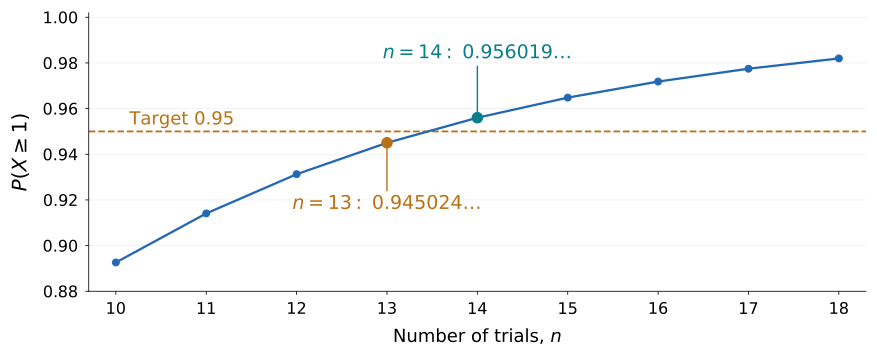
  3. The candidate least integer is fourteen. Check the original event at fourteen and thirteen:

    P14(X≥1)=1−(45)14=0.95601953488896≥0.95,P_{14}(X\ge1)=1-\left(\frac{4}{5}\right)^{14}=0.95601953488896\ge0.95,P13(X≥1)=1−(45)13=0.9450244186112<0.95.P_{13}(X\ge1)=1-\left(\frac{4}{5}\right)^{13}=0.9450244186112<0.95.
  4. The probability of at least one success increases with nn, so all smaller trial counts also fail. Hence the least trial count is n=14n=14. The probability notation here labels which trial count is being used.

For independent trials with success probability one fifth, the at-least-one probability one minus four fifths to the power n increases with n. The target is probability at least zero point nine five. The logarithmic real bound is approximately thirteen point four two five one. At thirteen trials the probability is zero point nine four five zero two four four one eight six one one two, below the target; at fourteen it is zero point nine five six zero one nine five three four eight eight eight nine six, above the target. Therefore fourteen is the least passing integer.

Fourteen is the first passing trial count. The original at-least-one event passes at fourteen and fails at thirteen, proving the least-integer conclusion.

Your turn

Independent trials have success probability 12\frac{1}{2}. Find the least positive integer trial count giving an at-least-one-success probability of at least 1516\frac{15}{16}. Then find the least trial count giving a probability strictly greater than 1516\frac{15}{16}. Also state the probability at four trials.

Enter an exact number, for example 3/2 or 2-sqrt(3).

Enter an exact number, for example 3/2 or 2-sqrt(3).

Enter an exact value or round to 3 significant figures.

Worked example

Find the greatest group size meeting a no-failure requirement

Each independently tested item has failure probability 150\frac{1}{50}. Find the greatest positive integer number nn of tested items for which the probability that none fails is at least 0.800.80.

  1. A nonfailure has probability 4950\frac{49}{50}, so the required event is

    P(X=0)=(4950)n≥0.80,P(X=0)=\left(\frac{49}{50}\right)^n\ge0.80,

    where XX counts failures.

  2. Taking logarithms and dividing by a negative number gives

    nlog⁡(4950)≥log⁡(0.80)⟹n≤log⁡(0.80)log⁡(4950)≈11.0452.n\log\left(\frac{49}{50}\right)\ge\log(0.80)\quad\Longrightarrow\quad n\le\frac{\log(0.80)}{\log(\frac{49}{50})}\approx11.0452.
  3. Check the largest candidate integer and the next one:

    (4950)11≈0.800731≥0.80,\left(\frac{49}{50}\right)^{11}\approx0.800731\ge0.80,(4950)12≈0.784717<0.80.\left(\frac{49}{50}\right)^{12}\approx0.784717<0.80.
  4. The no-failure probability decreases as more items are included. Therefore the greatest permitted group size is n=11n=11. Rounding the real bound to the nearest integer is not the general rule; the direction of the inequality determines which integers are allowed.

The threshold may be a count value rather than the number of trials. For example, if Y∼B(4,12)Y\sim\mathrm{B}(4,\frac{1}{2}), the least integer kk satisfying P(Y≤k)≥0.9P(Y\le k)\ge0.9 is three because

P(Y≤2)=1116<0.9,P(Y≤3)=1516≥0.9.P(Y\le2)=\frac{11}{16}<0.9,\qquad P(Y\le3)=\frac{15}{16}\ge0.9.

A cumulative probability is nondecreasing in its count bound, so checking the candidate and the previous bound establishes the minimum.

Handle endpoint probabilities before logarithms. If p=0p=0, the at-least-one probability is zero for every positive trial count; if p=1p=1, it is one for every positive trial count. For 0<p<10<p<1, no finite trial count reaches at-least-one probability exactly one. A target of zero or one must therefore be checked directly with its stated inclusive or strict inequality.

Section 5 of 5 · Core · about 11 min

Are the data exact, admissible and sufficient?

There are three separate checks. First, the moments must be compatible with a probability: for positive mean, 0≤v<μ0\le v<\mu. Second, the recovered trial count must be an integer. Third, the supplied information must identify the parameters uniquely; constant cases can leave a parameter undetermined.

Worked example

Audit exact moments, integer trial counts and constant cases

Assume the trial count nn is a positive integer. Assess these four proposed pairs of exact binomial moments: A has mean five and variance three; B has mean four and variance five; C has mean zero and variance zero; D has mean four and variance zero.

  1. For A, positive mean permits the usual division:

    p=1−35=25,n=525=252.p=1-\frac{3}{5}=\frac{2}{5},\qquad n=\frac{5}{\frac{2}{5}}=\frac{25}{2}.

    The probability is valid but the trial count is not an integer. No binomial distribution has exactly this pair of moments. Rounding the trial count would change the moments.

  2. For B, variance exceeds the positive mean. The recovery formula would give

    p=1−54=−14,p=1-\frac{5}{4}=-\frac{1}{4},

    which is not a probability. The proposed exact moments are inconsistent.

  3. For C, division by the mean is unavailable. Since np=0np=0 and nn is positive, p=0p=0. Every positive integer nn then gives the same constant count X=0X=0 and variance zero. The moments determine the distribution but do not uniquely determine nn.

  4. For D, positive mean and zero variance force p=1p=1. Then n=np=4n=np=4, so

    X∼B(4,1),P(X=4)=1.X\sim\mathrm{B}(4,1),\qquad P(X=4)=1.

    Zero variance is a valid constant case, not automatically an error.

  5. These conclusions use exact supplied moments. If a reported mean or variance has been rounded, apply its stated accuracy or rounding interval before claiming inconsistency; a noninteger answer from rounded numbers is not by itself proof that a binomial model is impossible.

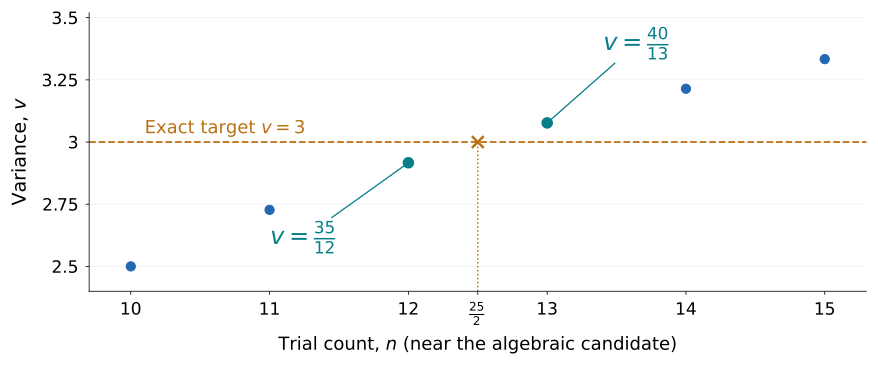
For exact mean five, p equals five over n and the variance equals five minus twenty-five over n, with integer n at least five. The plotted valid points correspond to integer trial counts. At n twelve the variance is thirty-five twelfths; at n thirteen it is forty thirteenths. Exact variance three would require n twenty-five halves, which lies between those integer points. This is an algebraic solution but not a binomial trial count.

With exact mean 55, the variance is 5−25n5-\frac{25}{n}. An exact variance of 33 lands at the cross, n=252n=\frac{25}{2}, between the allowed integer points.

Fixing exact mean five gives a discrete set of variances as the integer trial count varies. Exact variance three lies between the values for twelve and thirteen trials and corresponds to the inadmissible real trial count twelve and a half.

Your turn

A proposed binomial model has exact mean seven and exact variance three. Find the algebraic values of pp and nn, and decide whether an exact model exists. If instead both reported numbers were rounded to the nearest integer, would this calculation alone prove that no binomial model is possible?

Enter an exact value or round to 3 significant figures.

Enter an exact value or round to 3 significant figures.

Does the exact pair define a binomial model?
Does the same calculation rule out all models for rounded reports?

In this lesson the trial count is positive. If a different question explicitly allows zero trials, n=0n=0 also gives the constant zero count for any pp. State the convention rather than dividing an indeterminate equation or claiming a unique parameter pair.

Worked examples

Practise the method

Core practice

Question 1 of 4

0 / 4 checked in this collection

Question list

Core practice

Fresh variants

Exam-style

Recover trial count and success probability

3 marks

X is binomial with mean 22 and variance 11. Find n, p and P(X=2)\mathrm P(X=2).

Enter the value on its own or write n = … . Fractions and exact square roots are accepted.

Enter an exact value or round to 3 significant figures.

Enter an exact value or round to 3 significant figures.

Full answer-format guide

Exact numbers: 3/2, sqrt(5), 2-sqrt(3), pi/6, 3*pi/2. Sets: {1,4}. Intervals: (3,5]; a round bracket excludes the endpoint. Infinity: inf; union: U; no solutions: empty. Separate coordinate pairs or triples with semicolons. Expressions: 2x^2+3x-1; equations: x^2=3x+1 or the polynomial equal to zero. Factors: x-1 ; x+2. Parameter fraction: numerator ; denominator. List integer answers individually.

Review the method

Progress stays in this browser. Create an account to save it or sign in.

Extra practice from this lesson

Variance and standard deviation are different quantities

Let X∼B(32,14)X\sim\mathrm{B}\left(32,\frac{1}{4}\right). Find E(X)E(X), Var⁡(X)\operatorname{Var}(X) and the exact standard deviation.

Enter an exact number, for example 3/2 or 2-sqrt(3).

Enter an exact number, for example 3/2 or 2-sqrt(3).

Enter an exact number, for example 3/2 or 2-sqrt(3).

Exact moments require an integer trial total

A binomial count has exact mean six and exact variance 185\frac{18}{5}. Find its parameters nn and pp. A different proposed binomial count has exact mean nine and exact variance 275\frac{27}{5}. Decide whether that second model can exist.

Enter the value on its own or write n = … . Fractions and exact square roots are accepted.

Enter an exact value or round to 3 significant figures.

Can the second exact-moment model exist?

Recover the success probability from no successes

For X∼B(5,p)X\sim\mathrm{B}(5,p), it is known that P(X=0)=2431024P(X=0)=\frac{243}{1024}. Find pp, E(X)E(X) and the exact probability of at least one success.

Enter an exact value or round to 3 significant figures.

Enter an exact value or round to 3 significant figures.

Enter an exact number, for example 3/2 or 2-sqrt(3).

A minimum trial total needs the preceding integer checked

Independent trials each succeed with probability 0.180.18. Find the smallest positive integer number of trials needed so that the probability of at least one success is at least 0.950.95. Also give the at-least-one probabilities at that trial total and at one fewer trial, each to four decimal places.

Enter the value on its own or write n = … . Fractions and exact square roots are accepted.

Give your answer to 4 decimal places.

Give your answer to 4 decimal places.

Zero mean must be treated before division

Model A is X∼B(n,p)X\sim\mathrm{B}(n,p), where nn is a positive integer, and it has mean zero. Find pp, and decide what the mean tells you about nn. Model B is Y∼B(m,q)Y\sim\mathrm{B}(m,q), where mm is a positive integer, and it has exact mean eight and variance zero. Find qq and mm.

Enter the value on its own or write p = … . Fractions and exact square roots are accepted.

Trial total in model A

Enter the value on its own or write q = … . Fractions and exact square roots are accepted.

Enter the value on its own or write m = … . Fractions and exact square roots are accepted.

Recover both binomial parameters

A binomial variable has mean 99 and variance 66. Find its trial count and success probability.

Enter an exact number, for example 3/2 or 2-sqrt(3).

Enter an exact value or round to 3 significant figures.

Keep both permitted probabilities

A binomial variable has trial count 1616 and variance 33. Give both possible success probabilities.

Give the complete set: {1, 4} for separate values, (1, 5] for an interval, U for union or empty for no real solutions. Use sqrt(...) for exact roots.

Include a boundary that qualifies

Each independent trial succeeds with probability 12\frac12. Find the least trial count for which the chance of at least one success is at least 78\frac78.

Enter an exact number, for example 3/2 or 2-sqrt(3).

Check a strict target

Use independent trials with success probability 12\frac12. Find the least trial count making the chance of at least one success strictly more than 78\frac78.

Enter an exact number, for example 3/2 or 2-sqrt(3).

Apply it · original exam-style problems

Show your working on paper and compare it with the worked solution and marking guidance.

Start after this lesson

Recover the model and choose an integer count threshold 10 marks

A binomial random variable XX has exact mean twelve and exact variance nine. Find its parameters nn and pp. Then find the smallest integer kk for which P(X≤k)≥0.9P(X\le k)\ge0.9. Give P(X≤k−1)P(X\le k-1) and P(X≤k)P(X\le k) to four decimal places to justify the threshold. Use the exact binomial model.

Hint

Use the moment ratio to recover the model. Evaluate cumulative binomial probabilities at successive integer counts near the required percentile; do not round a continuous approximation into an unverified threshold.

Worked solution
  1. 1−p=912=34,p=14,n=12÷14=48.1-p=\frac{9}{12}=\frac{3}{4},\qquad p=\frac{1}{4},\qquad n=12\div\frac{1}{4}=48.

    The parameters satisfy both exact moment equations.

  2. The exact-model cumulative probability is

    P(X≤t)=∑r=0t(48r)⋅(14)r⋅(34)48−r.P(X\le t)=\sum_{r=0}^{t}\binom{48}{r}\cdot\left(\frac{1}{4}\right)^r\cdot\left(\frac{3}{4}\right)^{48-r}.
  3. P(X≤15)=0.8768222…<0.9,P(X≤16)=0.9295595…≥0.9.P(X\le15)=0.8768222\ldots<0.9,\qquad P(X\le16)=0.9295595\ldots\ge0.9.
  4. Cumulative probability cannot decrease as the included count increases. Therefore the smallest admissible threshold is k=16k=16. The neighbouring probabilities to four decimal places are 0.87680.8768 and 0.92960.9296. Their unrounded values establish the inequalities.

Marking guidance
  • 1 mark: use variance divided by the positive mean to determine the failure probability.
  • 1 mark: obtain the success probability.
  • 1 mark: recover the positive integer trial total.
  • 1 mark: verify the recovered parameters against the exact moments.
  • 1 mark: form or use the exact binomial cumulative probability.
  • 1 mark: evaluate the cumulative probability at fifteen.
  • 1 mark: evaluate the cumulative probability at sixteen.
  • 1 mark: compare the unrounded results with the target probability.
  • 1 mark: use cumulative monotonicity to justify minimality.
  • 1 mark: state the integer threshold and both probabilities at the requested accuracy.
Use an adjacent-probability relation, then find a maximum 10 marks

Let X∼B(10,p)X\sim\mathrm{B}(10,p), where 0<p<10<p<1, and suppose P(X=3)=2P(X=2)P(X=3)=2P(X=2). Find pp and E(X)E(X). A new experiment has mm independent trials with this same success probability. Find the greatest positive integer mm for which the probability of no successes is at least 0.010.01. Give the no-success probabilities at your chosen mm and at m+1m+1, each to four decimal places.

Hint

The stated strict probability domain makes P(X=2)>0P(X=2)>0, so division is valid. After simplifying the adjacent-probability ratio, use the failure probability for the new zero-success event. That event becomes less likely as the trial total grows.

Worked solution
  1. P(X=3)P(X=2)=(103)(102)⋅p1−p=83⋅p1−p=2.\frac{P(X=3)}{P(X=2)}=\frac{\binom{10}{3}}{\binom{10}{2}}\cdot\frac{p}{1-p}=\frac{8}{3}\cdot\frac{p}{1-p}=2.

    Thus 8p=6(1−p)8p=6(1-p), giving p=37p=\frac{3}{7}. The initial restriction excludes both degenerate endpoints before this division.

  2. E(X)=10⋅37=307.E(X)=10\cdot\frac{3}{7}=\frac{30}{7}.
  3. The new experiment has zero-success probability (47)m\left(\frac{4}{7}\right)^m. The required inequality is

    (47)m≥0.01⟹m≤ln⁡(0.01)ln⁡(47)≈8.2292.\left(\frac{4}{7}\right)^m\ge0.01\quad\Longrightarrow\quad m\le\frac{\ln(0.01)}{\ln\left(\frac{4}{7}\right)}\approx8.2292.
  4. (47)8=0.0113683…≥0.01,(47)9=0.0064961…<0.01.\left(\frac{4}{7}\right)^8=0.0113683\ldots\ge0.01,\qquad\left(\frac{4}{7}\right)^9=0.0064961\ldots<0.01.

    The greatest allowed trial total is eight. The corresponding probabilities to four decimal places are 0.01140.0114 and 0.00650.0065.

  5. The negative logarithm reverses the inequality when dividing. Checking eight and nine also verifies that the maximum, rather than a minimum, has been chosen.

Marking guidance
  • 1 mark: justify division by the nonzero probability under the stated parameter domain.
  • 1 mark: simplify the adjacent binomial probability ratio.
  • 1 mark: solve for the valid success probability.
  • 1 mark: obtain the expectation.
  • 1 mark: form the new no-success probability.
  • 1 mark: transform the inequality with the correct direction after dividing by a negative logarithm.
  • 1 mark: obtain an integer candidate for the maximum.
  • 1 mark: verify that the candidate satisfies the original inequality.
  • 1 mark: verify that the next integer fails.
  • 1 mark: state the maximum and both probabilities at the requested accuracy.

Come back to what needs practice

Quick revision sheet (A4)

Your review plan starts after your first check.

Question bank and saved work