Maths4UBETA

Inverse problems, rewards and decisions

Recover unknown scores, construct reward tables and compare expected gain with variability.

Try the quick check →
Lesson 5 of 5

Section 1 of 5 · Core · about 10 min

Which independent equations describe the unknown probabilities?

An inverse distribution problem supplies information about a random variable and asks you to recover missing probabilities or values. Begin by writing the complete table and naming every unknown. Normalisation is always available:

∑xP(X=x)=1.\sum_xP(X=x)=1.

A stated mean supplies a weighted equation:

∑xxP(X=x)=μ.\sum_xxP(X=x)=\mu.

These equations play different roles. Normalisation concerns the probabilities alone; the mean also depends on which value each probability belongs to.

Worked example

Use normalisation and the mean as two separate equations

The distribution of XX is shown below, and E(X)=74E(X)=\frac{7}{4}. Find pp and qq.

xx−1-12255
P(X=x)P(X=x)ppqq14\frac{1}{4}
  1. The probabilities total one:

    p+q+14=1,p+q=34.p+q+\frac{1}{4}=1,\qquad p+q=\frac{3}{4}.
  2. The mean supplies a different weighted equation:

    −p+2q+5⋅14=74,−p+2q=12.-p+2q+5\cdot\frac{1}{4}=\frac{7}{4},\qquad -p+2q=\frac{1}{2}.
  3. Add the two equations to eliminate pp:

    3q=54,q=512,p=34−512=13.3q=\frac{5}{4},\qquad q=\frac{5}{12},\qquad p=\frac{3}{4}-\frac{5}{12}=\frac{1}{3}.
  4. Both probabilities are in the permitted range, and the original conditions check:

    13+512+14=1,−1⋅13+2⋅512+5⋅14=74.\frac{1}{3}+\frac{5}{12}+\frac{1}{4}=1,\qquad -1\cdot\frac{1}{3}+2\cdot\frac{5}{12}+5\cdot\frac{1}{4}=\frac{7}{4}.

    Checking the original table also catches a sign error or a value entered into the wrong row.
Your turn

A table lists the values 0,2,40,2,4 and has mean two. Zero probabilities are allowed. Is the table uniquely determined? Choose the valid statement, then find the smallest and largest possible values of P(X=4)P(X=4).

What can the given conditions establish?

Enter an exact number, for example 3/2 or 2-sqrt(3).

Enter an exact value or round to 3 significant figures.

For each candidate, check every probability is between zero and one and that the probabilities sum to one. A zero entry may be allowed in a listed table, but it means that listed value is not in the actual support. If a problem explicitly says every listed value occurs with positive probability, enforce strict positivity.

Section 2 of 5 · Core · about 9 min

Which unknowns are values, and which are probabilities?

An unknown value belongs in the value row; it is multiplied by its probability when forming the mean and squared when forming the second moment. An unknown probability belongs in a weight, so it also appears in normalisation. Keep these two roles distinct.

Write any domain restrictions before solving. A count is a nonnegative integer, a positive count parameter must be at least one, an ordered support may require a<ba<b, and a money amount may be restricted to whole pennies. Such conditions are part of the model.

Worked example

An algebraic value must obey the physical meaning of the support

A count XX can take the values 0,n,n+20,n,n+2, where nn is a positive integer, with respective probabilities 12,13,16\frac{1}{2},\frac{1}{3},\frac{1}{6}. Its mean is 73\frac{7}{3}. Find nn. Could the same form of count model instead have mean 83\frac{8}{3}?

  1. The weighted mean is

    E(X)=0⋅12+n⋅13+(n+2)⋅16=n2+13.E(X)=0\cdot\frac{1}{2}+n\cdot\frac{1}{3}+(n+2)\cdot\frac{1}{6}=\frac{n}{2}+\frac{1}{3}.
  2. For the stated mean,

    n2+13=73⟹n=4.\frac{n}{2}+\frac{1}{3}=\frac{7}{3}\quad\Longrightarrow\quad n=4.

    The supported counts are therefore zero, four and six. They are distinct nonnegative integers, and their weighted mean is 73\frac{7}{3}.

  3. The proposed alternative mean would require

    n2+13=83⟹n=143.\frac{n}{2}+\frac{1}{3}=\frac{8}{3}\quad\Longrightarrow\quad n=\frac{14}{3}.
  4. This is not an integer, so there is no model of the stated form with that alternative mean. Rounding nn would change the mean and would not solve the original problem. A discrete variable need not always be integer-valued; the restriction here comes specifically from the fact that XX is a count.

Your turn

A count has values 0,n,n+30,n,n+3, with probabilities 12,14,14\frac{1}{2},\frac{1}{4},\frac{1}{4}, where nn is a positive integer. Find nn if the mean is 114\frac{11}{4}. A separate proposed model uses the same structure but has mean 52\frac{5}{2}; is that second model possible?

Enter the value on its own or write n = … . Fractions and exact square roots are accepted.

Can the proposed mean five halves fit this count model?

An unknown support value can coincide with another listed value unless the problem forbids it. If it does, those rows describe the same outcome value and their probabilities must be combined. When distinct or increasing values are stipulated, reject coincidences or reversed order instead.

Section 3 of 5 · Core · about 15 min

Which moments are known, and which algebraic candidates are valid?

Always distinguish the second moment from the variance:

Var⁡(X)=E(X2)−[E(X)]2.\operatorname{Var}(X)=E(X^2)-[E(X)]^2.

If both mean and variance are given, first compute E(X2)E(X^2). If the mean contains an unknown, substituting it into the variance can create a quadratic equation. Solve for every real root before applying probability, support and contextual restrictions.

Worked example

A variance equation can have two valid probability roots

A variable XX takes values zero and four, with P(X=4)=pP(X=4)=p. Its variance is three. Find all possible values of pp. Then identify the value consistent with the additional information E(X)<2E(X)<2.

  1. Start with the complete table: the probability at zero is 1−p1-p. Directly from its two rows,

    E(X)=0(1−p)+4p=4p,E(X2)=02(1−p)+42p=16p.E(X)=0(1-p)+4p=4p,\qquad E(X^2)=0^2(1-p)+4^2p=16p.
  2. Substitute both moments into the variance condition:

    16p−(4p)2=3⟹16p2−16p+3=0.16p-(4p)^2=3\quad\Longrightarrow\quad16p^2-16p+3=0.
  3. (4p−1)(4p−3)=0,p=14orp=34.(4p-1)(4p-3)=0,\qquad p=\frac{1}{4}\quad\text{or}\quad p=\frac{3}{4}.
  4. Both roots are valid probabilities. Their complete tables give means one and three respectively, and both give variance three. The variance alone does not select one of them.

  5. Only now apply the extra condition. Since 4p<24p<2, it requires p<12p<\frac{1}{2}, leaving

    p=14.p=\frac{1}{4}.

    A quadratic root is rejected only when it violates an actual requirement, not because another root looks simpler.

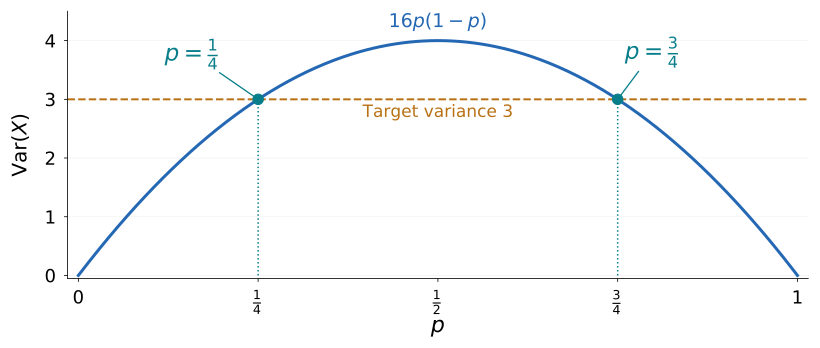
For a variable taking zero and four with probability p at four, the variance is sixteen p times one minus p. On the probability domain from zero to one, the horizontal variance level three intersects at p one quarter and p three quarters. The corresponding means are one and three. Both tables are valid; only the first satisfies mean below two.

For P(X=4)=pP(X=4)=p and P(X=0)=1−pP(X=0)=1-p, the mean is 4p4p and the variance is 16p(1−p)16p(1-p).

Both candidates give variance three

CandidateP(X=0)P(X=0)P(X=4)P(X=4)E(X)E(X)
14\frac{1}{4}34\frac{3}{4}14\frac{1}{4}11
34\frac{3}{4}14\frac{1}{4}34\frac{3}{4}33

The extra requirement E(X)<2E(X)<2 gives p=14p=\frac14.

The variance curve meets the target value at two admissible probabilities. The extra mean condition selects one; the variance condition alone does not.

Your turn

A variable takes values zero and five, with probability pp at five. Its variance is six. Find both possible values of pp, then select the value consistent with mean less than 52\frac{5}{2}.

Enter an exact value or round to 3 significant figures.

Enter an exact value or round to 3 significant figures.

Enter an exact value or round to 3 significant figures.

Worked example

Convert a stated variance into a second-moment equation

A variable takes values −2,1,4-2,1,4 with respective probabilities p,q,rp,q,r. Its mean is one and its variance is 92\frac{9}{2}. Find the complete probability distribution.

  1. Normalisation and the mean give

    p+q+r=1,−2p+q+4r=1.p+q+r=1,\qquad -2p+q+4r=1.
  2. The variance is not the second moment. First rearrange its definition:

    E(X2)=Var⁡(X)+[E(X)]2=92+1=112.E(X^2)=\operatorname{Var}(X)+[E(X)]^2=\frac{9}{2}+1=\frac{11}{2}.

    Therefore the third equation is

    4p+q+16r=112.4p+q+16r=\frac{11}{2}.
  3. Subtract normalisation from the mean equation:

    −3p+3r=0,r=p.-3p+3r=0,\qquad r=p.

    Subtract normalisation from the second-moment equation:

    3p+15r=92.3p+15r=\frac{9}{2}.
  4. With r=pr=p, this becomes 18p=9218p=\frac{9}{2}. Hence

    p=14,q=12,r=14.p=\frac{1}{4},\qquad q=\frac{1}{2},\qquad r=\frac{1}{4}.
  5. All weights are valid. Substituting gives

    E(X)=−2⋅14+1⋅12+4⋅14=1,E(X)=-2\cdot\frac{1}{4}+1\cdot\frac{1}{2}+4\cdot\frac{1}{4}=1,E(X2)=(−2)2⋅14+12⋅12+42⋅14=112,E(X^2)=(-2)^2\cdot\frac{1}{4}+1^2\cdot\frac{1}{2}+4^2\cdot\frac{1}{4}=\frac{11}{2},Var⁡(X)=112−12=92.\operatorname{Var}(X)=\frac{11}{2}-1^2=\frac{9}{2}.

Your turn

The values −1,1,3-1,1,3 have probabilities p,q,rp,q,r. The mean is 12\frac{1}{2} and the variance is 114\frac{11}{4}. Find E(X2)E(X^2) and the three probabilities.

Enter an exact number, for example 3/2 or 2-sqrt(3).

Enter an exact value or round to 3 significant figures.

Enter an exact value or round to 3 significant figures.

Enter an exact value or round to 3 significant figures.

A negative variance is impossible. A stated mean must lie between the smallest and largest supported values. These quick checks can expose inconsistent data before lengthy algebra, but passing them alone does not prove that a suitable distribution exists.

Section 4 of 5 · Core · about 15 min

What does the player actually gain after paying to enter?

A gross prize is the amount paid out by the game. A net gain is the amount left after deducting the entry fee and any other stated costs. A zero prize usually means a loss once the fee is included. Record the unit, such as pounds, and list every possible net gain with its probability before calculating moments.

In this lesson, a game is fair to the player when the expected net gain is zero. This definition concerns the weighted average of gains and losses. It does not mean equal chances of profit and loss or a guaranteed break-even result.

Worked example

Build the net-gain table before judging a game

A game pays a gross prize YY, in pounds, of zero, three or ten with probabilities 12,13,16\frac{1}{2},\frac{1}{3},\frac{1}{6}. Entry costs £2.50. Find the expected net gain, its variance, and the probabilities of profit and loss. Find the exact fair entry fee and assess the fee rounded to the nearest penny.

  1. Subtract the £2.50 fee from each possible prize. For net gain GG, measured in pounds, the full table is

    gg−52-\frac{5}{2}12\frac{1}{2}152\frac{15}{2}
    P(G=g)P(G=g)12\frac{1}{2}13\frac{1}{3}16\frac{1}{6}
  2. The net mean is computed from these net amounts:

    E(G)=−52⋅12+12⋅13+152⋅16=16.E(G)=-\frac{5}{2}\cdot\frac{1}{2}+\frac{1}{2}\cdot\frac{1}{3}+\frac{15}{2}\cdot\frac{1}{6}=\frac{1}{6}.

    The expected gain is exactly 16\frac{1}{6} of a pound per play, approximately £0.167. It is an average over repetitions, not a guaranteed gain on any one play.

  3. E(G2)=(−52)2⋅12+(12)2⋅13+(152)2⋅16=15112,E(G^2)=\left(-\frac{5}{2}\right)^2\cdot\frac{1}{2}+\left(\frac{1}{2}\right)^2\cdot\frac{1}{3}+\left(\frac{15}{2}\right)^2\cdot\frac{1}{6}=\frac{151}{12},Var⁡(G)=15112−(16)2=1139.\operatorname{Var}(G)=\frac{151}{12}-\left(\frac{1}{6}\right)^2=\frac{113}{9}.

    The variance is in squared pounds. The first row is a loss; the other two are profits. Thus P(G<0)=12P(G<0)=\frac{1}{2}, P(G>0)=12P(G>0)=\frac{1}{2}, and no outcome breaks even.

  4. For an entry fee of cc pounds, form the three net amounts −c,3−c,10−c-c,3-c,10-c. Fairness means zero expected net gain:

    (−c)⋅12+(3−c)⋅13+(10−c)⋅16=0.(-c)\cdot\frac{1}{2}+(3-c)\cdot\frac{1}{3}+(10-c)\cdot\frac{1}{6}=0.

    Expanding this weighted sum gives 83−c=0\frac{8}{3}-c=0, so the exact fair fee is 83\frac{8}{3} pounds.

  5. The nearest penny is £2.67, which is slightly above the exact fair fee. Substituting that fee gives

    E(G)=83−267100=−1300 pounds.E(G)=\frac{8}{3}-\frac{267}{100}=-\frac{1}{300}\text{ pounds}.

    The rounded fee creates a small expected loss. It is the nearest-penny fee to the fair value, but it is not exactly fair. No fee in whole pennies is exactly equal to 83\frac{8}{3} pounds.

Deduct the entry fee of £2.50 in every row. The prizes and gains are in pounds.

Net-gain distribution and weighted moments

PrizeggP(G=g)P(G=g)gP(G=g)gP(G=g)g2P(G=g)g^2P(G=g)
00−52-\frac{5}{2}12\frac{1}{2}−54-\frac{5}{4}258\frac{25}{8}
3312\frac{1}{2}13\frac{1}{3}16\frac{1}{6}112\frac{1}{12}
1010152\frac{15}{2}16\frac{1}{6}54\frac{5}{4}758\frac{75}{8}
Total—1116\frac{1}{6}15112\frac{151}{12}

E(G)=16E(G)=\frac16, E(G2)=15112E(G^2)=\frac{151}{12}, Var⁡(G)=15112−(16)2=1139\operatorname{Var}(G)=\frac{151}{12}-\left(\frac16\right)^2=\frac{113}{9} in squared pounds for the variance.

The first row is a loss and the others are profits, so P(G<0)=P(G>0)=12P(G<0)=P(G>0)=\frac12.

Every possible prize has the same entry fee deducted before the net-gain moments are calculated. The probabilities stay attached to the corresponding outcomes.

Worked example

Design a missing prize using zero expected net gain

A game pays gross prizes of £0, £2 and £jj with probabilities 35,310,110\frac{3}{5},\frac{3}{10},\frac{1}{10}. Entry costs £1.50. Find the jackpot jj that makes the game fair.

  1. The possible net gains, in pounds, are −32,12,j−32-\frac{3}{2},\frac{1}{2},j-\frac{3}{2}, with the same three probabilities:

    gg−32-\frac{3}{2}12\frac{1}{2}j−32j-\frac{3}{2}
    P(G=g)P(G=g)35\frac{3}{5}310\frac{3}{10}110\frac{1}{10}
  2. Fairness requires the weighted net gain to equal zero:

    −32⋅35+12⋅310+(j−32)⋅110=0.-\frac{3}{2}\cdot\frac{3}{5}+\frac{1}{2}\cdot\frac{3}{10}+\left(j-\frac{3}{2}\right)\cdot\frac{1}{10}=0.
  3. Simplifying gives

    −910+j10=0,j=9.-\frac{9}{10}+\frac{j}{10}=0,\qquad j=9.

    The fair gross jackpot is £9. Its net gain to the player is £7.50 after the fee.

  4. Check the completed table:

    −32⋅35+12⋅310+152⋅110=0.-\frac{3}{2}\cdot\frac{3}{5}+\frac{1}{2}\cdot\frac{3}{10}+\frac{15}{2}\cdot\frac{1}{10}=0.

    This fair game still has loss probability 35\frac{3}{5}. A zero mean does not imply equal probabilities of profit and loss; the sizes of the gains also matter.

Your turn

A game pays a gross prize of £0 with probability 47\frac{4}{7} and £1 with probability 37\frac{3}{7}. Find the exact fair entry fee, in pounds. If the fee is rounded to the nearest penny, £0.43, find the expected net gain in pounds and decide whether the rounded fee is exactly fair.

Enter an exact number, for example 3/2 or 2-sqrt(3).

Enter an exact value or round to 3 significant figures.

Is the rounded fee exactly fair?

Section 5 of 5 · Core · about 11 min

Which feature of the outcome distribution matters to the decision?

Expected net gain describes an average across repeated plays under the same probabilities. It does not tell you the chance of losing on one play, how large a possible loss is, or the amount needed to withstand it. Compare these quantities using the complete distribution and an explicitly stated objective.

Variance measures squared spread around the mean. A smaller variance is useful when that is the chosen risk measure, but it does not automatically imply a smaller probability of loss. For money amounts, standard deviation is easier to interpret in the original currency unit.

Worked example

Equal means do not rank every kind of risk

The following are net gains in pounds, so all fees have already been included. Game A gives −1-1 or 33, each with probability 12\frac{1}{2}. Game B gives −3-3 with probability 13\frac{1}{3} and 33 with probability 23\frac{2}{3}. Compare their means, variances and loss probabilities. Which game fits each of these aims: smaller variance, smaller probability of loss, and smaller worst possible loss?

  1. Write the complete net-gain tables:

    aa−1-133
    P(A=a)P(A=a)12\frac{1}{2}12\frac{1}{2}
    bb−3-333
    P(B=b)P(B=b)13\frac{1}{3}23\frac{2}{3}
  2. E(A)=−1⋅12+3⋅12=1,E(B)=−3⋅13+3⋅23=1.E(A)=-1\cdot\frac{1}{2}+3\cdot\frac{1}{2}=1,\qquad E(B)=-3\cdot\frac{1}{3}+3\cdot\frac{2}{3}=1.

    The expected net gains are equal at £1 per play, so the mean alone does not distinguish them.

  3. E(A2)=1⋅12+9⋅12=5,Var⁡(A)=5−12=4,E(A^2)=1\cdot\frac{1}{2}+9\cdot\frac{1}{2}=5,\qquad\operatorname{Var}(A)=5-1^2=4,E(B2)=9⋅13+9⋅23=9,Var⁡(B)=9−12=8.E(B^2)=9\cdot\frac{1}{3}+9\cdot\frac{2}{3}=9,\qquad\operatorname{Var}(B)=9-1^2=8.

    Game A has the smaller variance.

  4. However,

    P(A<0)=12,P(B<0)=13.P(A<0)=\frac{1}{2},\qquad P(B<0)=\frac{1}{3}.

    Game B has a smaller probability of loss. Its less frequent loss is larger: the worst loss is £3 in B, compared with £1 in A.

  5. Therefore choose A for the smaller variance or smaller worst possible loss, and B for the smaller loss probability. These are different objectives. Neither equal means nor a variance comparison by itself establishes a single best choice for every decision-maker.

Your turn

Game A has net gains −2,4-2,4, each with probability 12\frac{1}{2}. Game B has net gains −1,5-1,5, with probabilities 23,13\frac{2}{3},\frac{1}{3}. All amounts are in pounds. Find each variance, then select the game with the larger probability of a positive net gain and the game with the smaller variance.

Enter an exact number, for example 3/2 or 2-sqrt(3).

Enter an exact number, for example 3/2 or 2-sqrt(3).

Larger probability of a positive gain
Smaller variance

Profit, break-even and loss are distinct events:

P(G>0)+P(G=0)+P(G<0)=1.P(G>0)+P(G=0)+P(G<0)=1.

A prize equal to the fee belongs to break-even, not profit. If the task specifies a target such as “gain at least £3”, add only the probabilities of net-gain values satisfying that exact inequality.

Worked examples

Practise the method

Core practice

Question 1 of 4

0 / 4 checked in this collection

Question list

Core practice

Fresh variants

Exam-style

Rebuild the table after a negative transformation

5 marks

X has this table.

xxP(X=x)\mathrm P(X=x)
−1-114\frac{1}{4}
1112\frac{1}{2}
2214\frac{1}{4}

Define Y=-2X+5. Give the corresponding Y-value for each listed X in that order, then E(Y)\mathrm E(Y) and Var⁡(Y)\operatorname{Var}(Y).

Enter an exact number, for example 3/2 or 2-sqrt(3).

Enter an exact number, for example 3/2 or 2-sqrt(3).

Enter an exact number, for example 3/2 or 2-sqrt(3).

Enter an exact value or round to 3 significant figures.

Enter an exact value or round to 3 significant figures.

Full answer-format guide

Exact numbers: 3/2, sqrt(5), 2-sqrt(3), pi/6, 3*pi/2. Sets: {1,4}. Intervals: (3,5]; a round bracket excludes the endpoint. Infinity: inf; union: U; no solutions: empty. Separate coordinate pairs or triples with semicolons. Expressions: 2x^2+3x-1; equations: x^2=3x+1 or the polynomial equal to zero. Factors: x-1 ; x+2. Parameter fraction: numerator ; denominator. List integer answers individually.

Review the method

Progress stays in this browser. Create an account to save it or sign in.

Extra practice from this lesson

Use the mean to identify a normalized probability rule

A random variable has values −2,1,5-2,1,5 with respective probabilities k,2k,1−3kk,2k,1-3k. Its expectation is two. Find kk, P(X≥1)P(X\ge1) and Var⁡(X)\operatorname{Var}(X).

Enter an exact value or round to 3 significant figures.

Enter an exact value or round to 3 significant figures.

Enter an exact value or round to 3 significant figures.

An unknown value can be negative

A random variable has three distinct possible values a,2,5a,2,5, with respective probabilities 14,12,14\frac{1}{4},\frac{1}{2},\frac{1}{4}. Its expectation is 32\frac{3}{2}. Find aa, E(X2)E(X^2) and Var⁡(X)\operatorname{Var}(X).

Enter the value on its own or write a = … . Fractions and exact square roots are accepted.

Enter an exact value or round to 3 significant figures.

Enter an exact value or round to 3 significant figures.

Variance alone can leave two valid probabilities

A random variable equals six with probability pp and zero with probability 1−p1-p. Its variance is eight. Find the smaller and larger admissible values of pp. If the larger value is used, find the expectation.

Enter an exact value or round to 3 significant figures.

Enter an exact value or round to 3 significant figures.

Enter an exact number, for example 3/2 or 2-sqrt(3).

Merge repeated prizes before subtracting an entry fee

One of four equally likely tickets is selected. Their gross prizes are £0,£2,£2,£8\text{£}0,\text{£}2,\text{£}2,\text{£}8. Find the probability of receiving a gross prize of £2\text{£}2, the fair entry fee, and the probability of a strictly positive net gain at that fair fee. If the actual entry fee is instead £2.50\text{£}2.50, find the expected net gain per play.

Enter an exact value or round to 3 significant figures.

Enter an exact number, for example 3/2 or 2-sqrt(3).

Enter an exact value or round to 3 significant figures.

Enter an exact value or round to 3 significant figures.

Equal means can rank differently on two measures of risk

Option A gives net gains −£1-\text{£}1 and £5\text{£}5, each with probability 12\frac{1}{2}. Option B gives net gains −£4-\text{£}4 and £4\text{£}4, with respective probabilities 14\frac{1}{4} and 34\frac{3}{4}. Find the expected net gain for B and the variance of each option, measured in squared pounds. Which option has the smaller probability of a loss?

Enter an exact number, for example 3/2 or 2-sqrt(3).

Enter an exact number, for example 3/2 or 2-sqrt(3).

Enter an exact number, for example 3/2 or 2-sqrt(3).

Option with the smaller probability of loss

Transform each possible value

The values −1-1 and 33 are equally likely for XX. Find the mean of Y=5−2XY=5-2X.

Enter an exact number, for example 3/2 or 2-sqrt(3).

Recover the missing score

The values zero and tt have equal probability. The mean is 22. Find tt.

Enter an exact number, for example 3/2 or 2-sqrt(3).

Find a fair fee

A game pays 88 pounds on a win and nothing otherwise. The win probability is 14\frac14. What single entry fee makes the expected net gain zero?

Enter an exact number, for example 3/2 or 2-sqrt(3).

Compare variation

A random prize is equally likely to be 00 or 88 pounds. Find the variance.

Enter an exact number, for example 3/2 or 2-sqrt(3).

Apply it · original exam-style problems

Show your working on paper and compare it with the worked solution and marking guidance.

Start after this lesson

Use the ordering condition to reject an algebraic pair 10 marks

A random variable has values −2,a,b-2,a,b, where −2<a<b-2<a<b, and respective probabilities 14,12,14\frac{1}{4},\frac{1}{2},\frac{1}{4}. Its mean is two and its variance is eight. Find E(X2)E(X^2), aa, bb, P(X>2)P(X>2) and P(X=b∣X>0)P(X=b\mid X>0). Show how all algebraic candidates are checked.

Hint

Recover the second moment from the variance and mean. The two moment equations give a quadratic for one unknown value. The ordered values remain attached to their stated probabilities, so do not silently swap a rejected pair.

Worked solution
  1. E(X2)=Var⁡(X)+[E(X)]2=8+22=12.E(X^2)=\operatorname{Var}(X)+[E(X)]^2=8+2^2=12.
  2. The first and second moment equations are

    (−2)⋅14+a⋅12+b⋅14=2,(-2)\cdot\frac{1}{4}+a\cdot\frac{1}{2}+b\cdot\frac{1}{4}=2,4⋅14+a2⋅12+b2⋅14=12.4\cdot\frac{1}{4}+a^2\cdot\frac{1}{2}+b^2\cdot\frac{1}{4}=12.

    After multiplying by four, these become 2a+b=102a+b=10 and 2a2+b2=442a^2+b^2=44.

  3. Substitute b=10−2ab=10-2a:

    2a2+(10−2a)2=44⟹3a2−20a+28=0,2a^2+(10-2a)^2=44\quad\Longrightarrow\quad3a^2-20a+28=0,(a−2)(3a−14)=0.(a-2)(3a-14)=0.

    The candidate pairs are (a,b)=(2,6)(a,b)=(2,6) and (143,23)\left(\frac{14}{3},\frac{2}{3}\right).

  4. The second pair violates a<ba<b; swapping its coordinates would also swap which value carries probability 12\frac{1}{2}, so it is not a permissible repair. The unique valid pair is a=2,b=6a=2,b=6, which satisfies both original moments.

  5. P(X>2)=P(X=6)=14,P(X=b∣X>0)=1412+14=13.P(X>2)=P(X=6)=\frac{1}{4},\qquad P(X=b\mid X>0)=\frac{\frac{1}{4}}{\frac{1}{2}+\frac{1}{4}}=\frac{1}{3}.

    The strict inequality excludes the value two.

Marking guidance
  • 1 mark: recover the second moment from variance and mean.
  • 1 mark: form the first-moment equation with the given probabilities.
  • 1 mark: form the second-moment equation.
  • 1 mark: eliminate one unknown value.
  • 1 mark: solve the resulting quadratic completely.
  • 1 mark: calculate both corresponding value pairs.
  • 1 mark: reject the pair violating the ordered-support condition without swapping attached probabilities.
  • 1 mark: check the surviving values in the original conditions.
  • 1 mark: interpret the strict upper-tail event.
  • 1 mark: form and simplify the conditional probability.
The exact fair fee and a payable rounded fee differ 10 marks

A game uses seven equally likely tickets: three pay no prize, three pay £2\text{£}2, and one pays £9\text{£}9. Prizes are gross amounts before the entry fee. Find the exact mathematical fair fee, then give that fee rounded to the nearest penny. If the rounded fee is charged, find the exact expected net gain per play and the probability of a strictly positive net gain. Finally, suppose the largest prize is changed to £j\text{£}j, with the other six tickets unchanged and a fixed entry fee of £2\text{£}2. Find jj making this revised game fair.

Hint

Form the net-gain table for each proposed fee. Retain the exact fair fee until the explicit rounding step. A rounded fee need not make expected net gain exactly zero.

Worked solution
  1. The gross-prize values zero, two and nine have probabilities 37,37,17\frac{3}{7},\frac{3}{7},\frac{1}{7}. For a fee of cc pounds, the direct weighted net mean is

    (−c)⋅37+(2−c)⋅37+(9−c)⋅17=157−c.(-c)\cdot\frac{3}{7}+(2-c)\cdot\frac{3}{7}+(9-c)\cdot\frac{1}{7}=\frac{15}{7}-c.

    The exact fair fee is therefore 157\frac{15}{7} pounds.

  2. 157=2.142857…⟹nearest-penny fee=£2.14.\frac{15}{7}=2.142857\ldots\quad\Longrightarrow\quad\text{nearest-penny fee}=\text{£}2.14.

    The exact mathematical fee is not an integral number of pennies.

  3. At the rounded fee the net gains, in pounds, are −10750,−750,34350-\frac{107}{50},-\frac{7}{50},\frac{343}{50}. Their weighted mean is

    (−10750)⋅37+(−750)⋅37+34350⋅17=1350.\left(-\frac{107}{50}\right)\cdot\frac{3}{7}+\left(-\frac{7}{50}\right)\cdot\frac{3}{7}+\frac{343}{50}\cdot\frac{1}{7}=\frac{1}{350}.

    The tiny positive expectation comes from rounding the charged fee below its exact fair value. It does not guarantee a gain on any individual play.

  4. Only the nine-pound prize exceeds the rounded fee. Thus the probability of strictly positive net gain is 17\frac{1}{7}.

  5. For the revised game with fee two pounds, the net values are −2,0,j−2-2,0,j-2. Fairness requires

    (−2)⋅37+0⋅37+(j−2)⋅17=0⟹j=8.(-2)\cdot\frac{3}{7}+0\cdot\frac{3}{7}+(j-2)\cdot\frac{1}{7}=0\quad\Longrightarrow\quad j=8.

    The new largest prize is £8\text{£}8; receiving a two-pound prize now breaks even.

Marking guidance
  • 1 mark: construct the gross-prize probabilities, including repeated prizes.
  • 1 mark: subtract the fee on every possible outcome.
  • 1 mark: solve the zero-expected-net-gain equation for the exact fair fee.
  • 1 mark: round only the requested fee to the nearest penny.
  • 1 mark: construct the net-gain values at the rounded fee.
  • 1 mark: obtain the exact small positive expected net gain.
  • 1 mark: identify which prizes strictly exceed the charged fee.
  • 1 mark: obtain the positive-net-gain probability.
  • 1 mark: form the revised fairness equation with the unknown largest prize.
  • 1 mark: solve for the admissible prize.

Come back to what needs practice

Quick revision sheet (A4)

Your review plan starts after your first check.

Question bank and saved work