Maths4UBETA

Repeated successes and mixed stopping rules

Count success positions and terminal histories without applying an unrequired named distribution.

Try the quick check →
Lesson 5 of 5

Section 1 of 5 · Core · about 11 min

Where must the final required success occur?

For independent trials with constant success probability pp, let TrT_r be the trial on which the rrth success occurs. Here rr is a positive integer. To have Tr=nT_r=n, trial nn must succeed and the first n−1n-1 trials must contain exactly r−1r-1 successes. For 0<p<10<p<1 and integer n≥rn\ge r, elementary position counting gives

P(Tr=n)=(n−1r−1)pr(1−p)n−r.P(T_r=n)=\binom{n-1}{r-1}p^r(1-p)^{n-r}.

The coefficient chooses only the earlier success positions. For n<rn<r, the event is impossible. When r=1r=1, this reduces to the first-success geometric probability.

Worked example

Fix the final success and count the earlier success positions

Independent trials each succeed with probability 13\frac{1}{3}. Find the probability that the second success occurs on trial six.

  1. Trial six must be a success. The first five trials must contain exactly one success, so the second success has not already occurred.

  2. The earlier success can occupy any one of five positions. Each permitted complete pattern contains two successes and four failures:

    P(second success on trial 6)=(51)(13)2(23)4=80729.P(\text{second success on trial }6)=\binom{5}{1}\left(\frac{1}{3}\right)^2\left(\frac{2}{3}\right)^4=\frac{80}{729}.
  3. The coefficient is (51)\binom{5}{1}, not (62)\binom{6}{2}, because the final success position is already fixed. Counting all two-success patterns in six trials would also include cases whose second success occurs earlier.

  4. The condition “exactly one success among the first five” ensures no permitted pattern has already reached the two-success target before trial six.
The second success occurs on trial 6

Trial 6 succeeds. Among the first five trials, choose the position of the one earlier success.

Position of first successTrial sequence
1S F F F F S
2F S F F F S
3F F S F F S
4F F F S F S
5F F F F S S

For independent trials with p=13p=\frac13, all five patterns have the same probability. Therefore P(T2=6)=(51)(13)2(23)4=80729.P(T_2=6)=\binom51\left(\frac13\right)^2\left(\frac23\right)^4=\frac{80}{729}.

The final trial is fixed as a success. Choose the single earlier success from the first five positions; each of the five patterns contains two successes and four failures.

Your turn

Independent fair trials have success probability 12\frac{1}{2}. To obtain the third success on trial seven, which condition is needed? Choose it, then find the number of permitted patterns and the probability.

Which event fixes the correct first-completion time?

Enter an exact number, for example 3/2 or 2-sqrt(3).

Enter an exact value or round to 3 significant figures.

At p=1p=1, the rrth success occurs deterministically at trial rr. At p=0p=0, no positive success target is reached in a finite time. These endpoint cases should be handled directly rather than through an ambiguous zero-power expression.

Section 2 of 5 · Core · about 10 min

Does the process genuinely restart with independent trials?

After a success in an independent constant-probability sequence, the next trial starts a fresh wait for the next success. The successful trial already completed is not counted again. If every new trial has the same probability and is independent of the past, the successive waits have the same geometric trial-count distribution and are independent.

A restart can also introduce a new trial probability, provided the new experiment is explicitly independent. In that case each wait uses its own parameter. A retained hidden type or a changing physical state must be accounted for before multiplying waiting probabilities.

Worked example

A fresh wait after success uses new independent trials

Trials are mutually independent and each succeeds with probability 25\frac{2}{5}. Let XX count trials through the first success, and let YY count additional trials after that success through the second success. Find P(X=2,Y=3)P(X=2,Y=3) and P(Y>2∣X=4)P(Y>2\mid X=4).

  1. The first successful trial belongs to XX. The next trial starts the count YY, so both waiting variables begin at one. The fresh independent trials have the same success probability.

  2. The joint event X=2,Y=3X=2,Y=3 is the stopped pattern FSFFS. Its two waiting segments have probabilities 35⋅25\frac{3}{5}\cdot\frac{2}{5} and (35)2⋅25(\frac{3}{5})^2\cdot\frac{2}{5}:

    P(X=2,Y=3)=(35⋅25)((35)2⋅25)=1083125.P(X=2,Y=3)=\left(\frac{3}{5}\cdot\frac{2}{5}\right)\left(\left(\frac{3}{5}\right)^2\cdot\frac{2}{5}\right)=\frac{108}{3125}.
  3. Knowing that the first success was on trial four fixes past outcomes. It leaves the subsequent independent trials unchanged. The condition has positive probability, so

    P(Y>2∣X=4)=(35)2=925.P(Y>2\mid X=4)=\left(\frac{3}{5}\right)^2=\frac{9}{25}.
  4. More generally, a joint event X=a,Y=bX=a,Y=b consists of a−1a-1 failures, success, then b−1b-1 failures and success. Its probability factors into the two geometric waiting probabilities. This justifies independence of the separate waits under the stated independent-trial model.

Your turn

A first independent trial sequence has success probability 14\frac{1}{4}. After its first success, a new trial sequence with success probability 12\frac{1}{2} begins, independent of all first-stage outcomes. Let XX and YY count trials through the first success in their respective stages. Find P(X=2,Y=1)P(X=2,Y=1) and P(X+Y=3)P(X+Y=3).

Enter an exact value or round to 3 significant figures.

Enter an exact value or round to 3 significant figures.

Section 3 of 5 · Core · about 13 min

What event makes the experiment reach its final permitted trial?

A capped first-success experiment stops at the first success or after a fixed positive integer cap NN. For positive pp, if XX is the uncapped first-success time, its actual trial count is T=min⁡(X,N)T=\min(X,N). For 0<p<10<p<1 and N≥2N\ge2,

P(T=t)=(1−p)t−1p(1≤t<N),P(T=t)=(1-p)^{t-1}p\quad(1\le t<N),P(T=N)=(1−p)N−1.P(T=N)=(1-p)^{N-1}.

The final event requires only the first N−1N-1 failures. It includes success on trial NN and failure on every one of the NN trials.

Worked example

The final stopping-time value combines success and failure at the cap

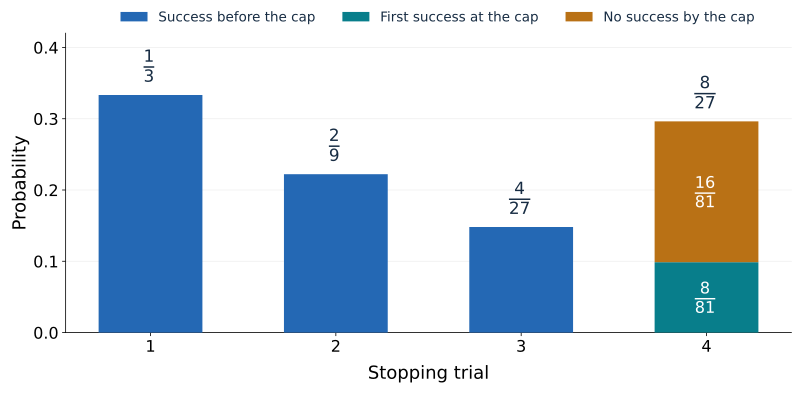
Independent trials succeed with probability 13\frac{1}{3}. Stop at the first success or after four trials, whichever happens first. Let TT be the number of trials actually made. Construct its distribution and split the final mass according to whether trial four succeeds or all four trials fail.

  1. For stopping times one, two and three, the experiment must end in a first success:

    P(T=1)=13,P(T=2)=23⋅13=29,P(T=1)=\frac{1}{3},\qquad P(T=2)=\frac{2}{3}\cdot\frac{1}{3}=\frac{2}{9},P(T=3)=(23)2⋅13=427.P(T=3)=\left(\frac{2}{3}\right)^2\cdot\frac{1}{3}=\frac{4}{27}.
  2. To make four trials, only the first three must fail. Trial four is performed and the experiment then stops regardless of its result:

    P(T=4)=(23)3=827.P(T=4)=\left(\frac{2}{3}\right)^3=\frac{8}{27}.
  3. tt11223344
    P(T=t)P(T=t)13\frac{1}{3}29\frac{2}{9}427\frac{4}{27}827\frac{8}{27}

    The probabilities total 9+6+4+827=1\frac{9+6+4+8}{27}=1.

  4. The two terminal histories at time four are FFFS and FFFF:

    P(FFFS)=(23)3⋅13=881,P(\mathrm{FFFS})=\left(\frac{2}{3}\right)^3\cdot\frac{1}{3}=\frac{8}{81},P(FFFF)=(23)4=1681.P(\mathrm{FFFF})=\left(\frac{2}{3}\right)^4=\frac{16}{81}.

    Their sum is 2481=827\frac{24}{81}=\frac{8}{27}, the final stopping-time mass. Using only 881\frac{8}{81} for T=4T=4 would omit unsuccessful runs that reach the cap.

Independent trials succeed with probability one third and stop at the first success or after four trials. The stopping-time probabilities at one two three and four are one third, two ninths, four twenty-sevenths and eight twenty-sevenths. The final mass consists of first success on four with probability eight eighty-firsts and no success with probability sixteen eighty-firsts.

At the cap, stopping time four merges a success on trial four with four failures. Their weights add to eight twenty-sevenths; neither terminal history may be omitted.

Your turn

Independent trials succeed with probability 14\frac{1}{4}. Stop at the first success or after three trials, and let TT be the number of trials made. Find the probability of making three trials, the probability of first success on trial three, the probability of no success at all, and the success probability conditional on making three trials.

Enter an exact value or round to 3 significant figures.

Enter an exact value or round to 3 significant figures.

Enter an exact value or round to 3 significant figures.

Enter an exact value or round to 3 significant figures.

Endpoint rules remain meaningful for the capped experiment. With p=0p=0, exactly NN trials are made and no success occurs, even though an uncapped first-success time has no distribution on positive integers. With p=1p=1, a first-success experiment stops at one. If N=1N=1, it always makes one trial, with success or failure still distinguished by that trial’s result.

Section 4 of 5 · Core · about 14 min

Which terminal histories give the same time or reward?

A bounded stopping process has a finite set of terminal histories. First assign each history its actual probability. Then map it to the recorded variable: number of trials, reward, final score or completion status. Histories with the same variable value must have their probabilities added.

Calculate moments from the complete resulting table:

E(Z)=∑zzP(Z=z),E(Z2)=∑zz2P(Z=z),E(Z)=\sum_z zP(Z=z),\qquad E(Z^2)=\sum_z z^2P(Z=z),Var⁡(Z)=E(Z2)−[E(Z)]2.\operatorname{Var}(Z)=E(Z^2)-[E(Z)]^2.

For a capped waiting variable, use its finite stopping table rather than an uncapped geometric mean.

Worked example

Calculate capped-wait moments from its full finite table

Use the stopping time from Worked example 3: success probability 13\frac{1}{3}, stopping at the first success or the four-trial cap. Find E(T)E(T) and Var⁡(T)\operatorname{Var}(T).

  1. The complete table is

    tt11223344
    P(T=t)P(T=t)927\frac{9}{27}627\frac{6}{27}427\frac{4}{27}827\frac{8}{27}
  2. Weight the actual stopping times:

    E(T)=1⋅927+2⋅627+3⋅427+4⋅827=6527.E(T)=1\cdot\frac{9}{27}+2\cdot\frac{6}{27}+3\cdot\frac{4}{27}+4\cdot\frac{8}{27}=\frac{65}{27}.
  3. Use the same full table for the second moment:

    E(T2)=12⋅927+22⋅627+32⋅427+42⋅827=19727.E(T^2)=1^2\cdot\frac{9}{27}+2^2\cdot\frac{6}{27}+3^2\cdot\frac{4}{27}+4^2\cdot\frac{8}{27}=\frac{197}{27}.
  4. Var⁡(T)=19727−(6527)2=1094729.\operatorname{Var}(T)=\frac{197}{27}-\left(\frac{65}{27}\right)^2=\frac{1094}{729}.

    The uncapped first-success mean would be three. The capped variable is different: it can never exceed four, and its correct mean comes from the capped table.

Your turn

A stopping time TT takes values one, two and three with probabilities 12,14,14\frac{1}{2},\frac{1}{4},\frac{1}{4}. Find its mean and variance from the full table.

Enter an exact value or round to 3 significant figures.

Enter an exact value or round to 3 significant figures.

Worked example

A reward may distinguish histories with the same stopping time

A fair coin is tossed independently until the first head or until three tosses have been made. The gross reward RR, measured in pounds, is £4 if the first head is on toss one or two, £1 if it is on toss three, and £0 if no head appears. Construct the reward distribution, calculate its mean and variance, and find the probability of a £1 reward given that three tosses were made.

  1. The terminal paths H, TH, TTH and TTT have probabilities 12,14,18,18\frac{1}{2},\frac{1}{4},\frac{1}{8},\frac{1}{8}, respectively. H and TH both give reward four; TTH gives one; TTT gives zero.

  2. rr001144
    P(R=r)P(R=r)18\frac{1}{8}18\frac{1}{8}34\frac{3}{4}

    Stopping after three tosses combines TTH and TTT, but their rewards differ. A stopping-time table alone does not identify the reward unless the reward rule is also tracked.

  3. E(R)=0⋅18+1⋅18+4⋅34=258,E(R)=0\cdot\frac{1}{8}+1\cdot\frac{1}{8}+4\cdot\frac{3}{4}=\frac{25}{8},E(R2)=02⋅18+12⋅18+42⋅34=978,E(R^2)=0^2\cdot\frac{1}{8}+1^2\cdot\frac{1}{8}+4^2\cdot\frac{3}{4}=\frac{97}{8},Var⁡(R)=978−(258)2=15164.\operatorname{Var}(R)=\frac{97}{8}-\left(\frac{25}{8}\right)^2=\frac{151}{64}.

    The mean is in pounds and the variance in squared pounds.

  4. Let TT be the number of tosses made. The event T=3T=3 has probability 14\frac{1}{4}, and the joint event R=1,T=3R=1,T=3 has probability 18\frac{1}{8}. Hence

    P(R=1∣T=3)=1814=12.P(R=1\mid T=3)=\frac{\frac{1}{8}}{\frac{1}{4}}=\frac{1}{2}.

An early terminal path is weighted only through its actual final trial. For example, a first-toss head in the three-toss reward game has probability 12\frac{1}{2}, not 18\frac{1}{8}. Later tosses are not performed; a full-length enumeration is valid only if all irrelevant continuations are summed consistently.

Section 5 of 5 · Core · about 16 min

Which rule stops the path first?

When the process stops at a success target or a cap, a path is terminal as soon as either rule is met. For a target of rr successes, reaching the final permitted trial NN means that fewer than rr successes occurred in the first N−1N-1 trials. It does not mean the target remains unmet after trial NN.

For stopping times below the cap, use the target’s first-completion event. At the cap, combine every surviving branch, keeping completion and noncompletion separate if the question needs them. If the target is impossible before the cap, all paths still end at the cap.

Worked example

Stop at a success-count target or the cap

Independent trials have success probability 12\frac{1}{2}. Stop when the second success occurs or when four trials have been made. Let TT be the stopping time. Construct its distribution, find the probability of reaching the two-success target, and find that probability conditional on T=4T=4.

  1. Stopping at two requires SS. Stopping at three requires SFS or FSS:

    P(T=2)=14,P(T=3)=2⋅18=14.P(T=2)=\frac{1}{4},\qquad P(T=3)=2\cdot\frac{1}{8}=\frac{1}{4}.
  2. Reaching trial four means that the first three trials have fewer than two successes. Their permitted counts are zero and one:

    P(T=4)=(30)+(31)8=12.P(T=4)=\frac{\binom{3}{0}+\binom{3}{1}}{8}=\frac{1}{2}.
    tt223344
    P(T=t)P(T=t)14\frac{1}{4}14\frac{1}{4}12\frac{1}{2}
  3. To complete the target on trial four, the first three trials contain exactly one success and the fourth succeeds. The valid paths are SFFS, FSFS and FFSS:

    P(target reached on trial 4)=3⋅116=316.P(\text{target reached on trial }4)=3\cdot\frac{1}{16}=\frac{3}{16}.

    All other terminal paths at the cap fail to reach the target, with total probability 516\frac{5}{16}.

  4. Combining early and final-trial completion gives

    P(target reached)=14+14+316=1116.P(\text{target reached})=\frac{1}{4}+\frac{1}{4}+\frac{3}{16}=\frac{11}{16}.
  5. Within the positive-probability condition T=4T=4,

    P(target reached∣T=4)=31612=38.P(\text{target reached}\mid T=4)=\frac{\frac{3}{16}}{\frac{1}{2}}=\frac{3}{8}.

    A run that reaches the cap need not have failed; some runs reach their target on the final permitted trial.

Your turn

Independent trials succeed with probability 13\frac{1}{3}. Stop at the second success or after three trials, and let TT be the number of trials made. Find P(T=3)P(T=3), the probability of reaching the target, and the target-completion probability given T=3T=3.

Enter an exact value or round to 3 significant figures.

Enter an exact value or round to 3 significant figures.

Enter an exact value or round to 3 significant figures.

Worked example

Consecutive successes require a different state than a total success count

Independent trials have success probability 12\frac{1}{2}. Stop when two consecutive successes occur or when three trials have been made. Let TT be the number of trials actually made. Find its distribution, the probability of completing the consecutive-success target, and the completion probability given that three trials were made.

  1. SS stops after two trials, with probability 14\frac{1}{4}. Otherwise a third trial is made. The length-three terminal paths are SFS, SFF, FSS, FSF, FFS and FFF, each with probability 18\frac{1}{8}.

  2. tt2233
    P(T=t)P(T=t)14\frac{1}{4}34\frac{3}{4}

    There are no length-three terminal paths SSS or SSF: both would already have stopped at the earlier SS.

  3. Target completion occurs through the length-two path SS or the length-three path FSS:

    P(target completed)=14+18=38.P(\text{target completed})=\frac{1}{4}+\frac{1}{8}=\frac{3}{8}.
  4. Only FSS completes the target among the paths with T=3T=3. Therefore

    P(target completed∣T=3)=1834=16.P(\text{target completed}\mid T=3)=\frac{\frac{1}{8}}{\frac{3}{4}}=\frac{1}{6}.
  5. SFS has two successes in total but not two consecutive successes. A count-only binomial condition would include it incorrectly. The stopping rule must track the relevant recent history, not just the total number of successes.

Your turn

Independent fair trials stop at two consecutive successes or after four trials. Let TT be the number of trials made. Find the probability of making four trials, the probability of completing the consecutive-success target, and the completion probability given that four trials were made.

Enter an exact value or round to 3 significant figures.

Enter an exact value or round to 3 significant figures.

Enter an exact value or round to 3 significant figures.

A total-success target and a consecutive-success target need different information. For the former, track the number of successes so far. For the latter, track the recent run of successes as well. Overlapping success windows are not independent trials, so a waiting time for a pattern must not automatically be assigned a geometric parameter equal to the pattern’s single-window probability.

Worked examples

Practise the method

Core practice

Question 1 of 4

0 / 4 checked in this collection

Question list

Core practice

Fresh variants

Exam-style

Fix the final trial of the second success

3 marks

Independent trials have success probability 12\frac{1}{2}. Let S₂ be the trial of the second success. Find P(S2=4)\mathrm P(S₂=4), P(S2≤4)\mathrm P(S₂\le 4), and the probability the first success is on trial 1 and the second on trial 4.

Enter an exact value or round to 3 significant figures.

Enter an exact value or round to 3 significant figures.

Enter an exact value or round to 3 significant figures.

Full answer-format guide

Exact numbers: 3/2, sqrt(5), 2-sqrt(3), pi/6, 3*pi/2. Sets: {1,4}. Intervals: (3,5]; a round bracket excludes the endpoint. Infinity: inf; union: U; no solutions: empty. Separate coordinate pairs or triples with semicolons. Expressions: 2x^2+3x-1; equations: x^2=3x+1 or the polynomial equal to zero. Factors: x-1 ; x+2. Parameter fraction: numerator ; denominator. List integer answers individually.

Review the method

Progress stays in this browser. Create an account to save it or sign in.

Extra practice from this lesson

The final trial fixes the position of the third success

Independent trials each succeed with probability 25\frac{2}{5}. Find the probability that the third success occurs on trial five, by trial five, and after trial five.

Enter an exact value or round to 3 significant figures.

Enter an exact value or round to 3 significant figures.

Enter an exact value or round to 3 significant figures.

Independent fresh waits may have different probabilities

A first process uses independent trials with success probability 13\frac{1}{3} until its first success; let its trial count be XX. A separate, independent process uses success probability 12\frac{1}{2} until its first success; let its count be YY. Find P(X=1,Y=3)P(X=1,Y=3), P(X+Y=4)P(X+Y=4), and the probability that both processes finish within their own first two trials.

Enter an exact value or round to 3 significant figures.

Enter an exact value or round to 3 significant figures.

Enter an exact value or round to 3 significant figures.

The cap value includes either result on the final trial

Independent trials succeed with probability 25\frac{2}{5}. Stop at the first success or after three trials, whichever occurs first. Let TT be the number of trials actually made. Find P(T=3)P(T=3), the probability of finding a success by the time the process stops, E(T)E(T) and Var⁡(T)\operatorname{Var}(T).

Enter an exact value or round to 3 significant figures.

Enter an exact value or round to 3 significant figures.

Enter an exact value or round to 3 significant figures.

Enter an exact value or round to 3 significant figures.

Equal rewards merge paths, but terminal failure stays separate

A fair coin is tossed until its first head or until three tosses have been made. A first head on toss one pays £8\text{£}8; a first head on toss two or three pays £5\text{£}5; no head by the end pays nothing. Let RR be the reward and TT the number of tosses. Find P(R=£5)P(R=\text{£}5), P(T=3∣R=£5)P(T=3\mid R=\text{£}5) and the exact expected reward.

Enter an exact value or round to 3 significant figures.

Enter an exact value or round to 3 significant figures.

Enter an exact number, for example 3/2 or 2-sqrt(3).

A finite cap still defines a trial count when success is impossible

A process makes independent trials with success probability pp, stopping at its first success or after five trials. Let TT be the number made. If p=0p=0, find E(T)E(T) and the probability of finding a success. If p=1p=1, find E(T)E(T), and decide whether the probability of success given T=5T=5 is defined.

Enter an exact number, for example 3/2 or 2-sqrt(3).

Enter an exact number, for example 3/2 or 2-sqrt(3).

Enter an exact number, for example 3/2 or 2-sqrt(3).

Conditional probability given five trials when success is certain

Fix the last success

Each independent trial succeeds with probability 12\frac12. Find the probability the second success occurs at trial five.

Enter an exact value or round to 3 significant figures.

Keep the two waiting times separate

Two independent sequences both succeed with probability 12\frac12 per trial. Find the probability their first successes both occur at trial two.

Enter an exact value or round to 3 significant figures.

Find a marked position

Shuffle four white counters and one red counter. Find the probability the red counter first appears on draw three.

Enter an exact value or round to 3 significant figures.

Stop on either event

Independent trials succeed with probability 35\frac35. Stop after two successes or after the first failure. Find the probability the stopping time is exactly two.

Enter an exact value or round to 3 significant figures.

Apply it · original exam-style problems

Show your working on paper and compare it with the worked solution and marking guidance.

Start after this lesson

Stop at the second success or at the fourth trial 11 marks

Independent trials each succeed with probability 25\frac{2}{5}. Stop as soon as two successes have occurred or after four trials, whichever happens first. Let TT be the number of trials made. Find P(T=4)P(T=4), the probability of reaching two successes before or on the final permitted trial, E(T)E(T), Var⁡(T)\operatorname{Var}(T), and the probability of reaching two successes given that T=4T=4.

Hint

The process cannot stop before trial two. It reaches trial four precisely when the first three trials contain at most one success. Among the paths reaching four, distinguish those that obtain the second success there from those that stop only because of the cap.

Worked solution
  1. P(T=2)=(25)2=425,P(T=3)=2⋅(25)2⋅35=24125.P(T=2)=\left(\frac{2}{5}\right)^2=\frac{4}{25},\qquad P(T=3)=2\cdot\left(\frac{2}{5}\right)^2\cdot\frac{3}{5}=\frac{24}{125}.
  2. P(T=4)=(35)3+(31)⋅25⋅(35)2=81125.P(T=4)=\left(\frac{3}{5}\right)^3+\binom{3}{1}\cdot\frac{2}{5}\cdot\left(\frac{3}{5}\right)^2=\frac{81}{125}.

    The three trial-count probabilities sum to one.

  3. Reaching the target by trial four is equivalent to at least two successes in the first four independent trials:

    P(target reached)=∑r=24(4r)⋅(25)r⋅(35)4−r=328625.P(\text{target reached})=\sum_{r=2}^{4}\binom{4}{r}\cdot\left(\frac{2}{5}\right)^r\cdot\left(\frac{3}{5}\right)^{4-r}=\frac{328}{625}.
  4. E(T)=2⋅425+3⋅24125+4⋅81125=436125,E(T)=2\cdot\frac{4}{25}+3\cdot\frac{24}{125}+4\cdot\frac{81}{125}=\frac{436}{125},E(T2)=4⋅425+9⋅24125+16⋅81125=1592125.E(T^2)=4\cdot\frac{4}{25}+9\cdot\frac{24}{125}+16\cdot\frac{81}{125}=\frac{1592}{125}.Var⁡(T)=1592125−(436125)2=890415625.\operatorname{Var}(T)=\frac{1592}{125}-\left(\frac{436}{125}\right)^2=\frac{8904}{15625}.
  5. To reach the target on trial four, the first three must contain exactly one success and the fourth must succeed:

    P(second success on four)=(31)⋅(25)2⋅(35)2=108625.P(\text{second success on four})=\binom{3}{1}\cdot\left(\frac{2}{5}\right)^2\cdot\left(\frac{3}{5}\right)^2=\frac{108}{625}.P(target reached∣T=4)=108625÷81125=415.P(\text{target reached}\mid T=4)=\frac{108}{625}\div\frac{81}{125}=\frac{4}{15}.

    The probability of making four trials is not itself the probability of completing the two-success target.

Marking guidance
  • 1 mark: identify the possible stopping counts two, three and four.
  • 1 mark: calculate the probability of stopping at two successes on trial two.
  • 1 mark: calculate the third-trial stopping probability.
  • 1 mark: obtain the cap mass by allowing zero or one success in the first three trials.
  • 1 mark: form the completion-by-four event as a fixed-trial success count.
  • 1 mark: obtain the target-completion probability.
  • 1 mark: calculate the mean directly from the stopping table.
  • 1 mark: calculate its second moment.
  • 1 mark: obtain the variance.
  • 1 mark: identify the joint target-on-four numerator.
  • 1 mark: normalize by the cap probability for the final conditional result.
A successful first stage opens an independent second stage 10 marks

Stage A uses success probability 0.30.3 on independent attempts. Stop stage A at its first success or after two attempts. If it fails on both attempts, end the whole process. If stage A succeeds, start a fresh independent stage B, whose success probability is 0.50.5 per attempt; stop B at its first success or after two attempts. Let TT be the total number of attempts made across both stages. Completion means that both stages succeed within their permitted attempts. Find the completion probability, P(T=3)P(T=3), E(T)E(T), and the probability of completion given T=2T=2.

Hint

List the paths that trigger stage B and the path that ends before B begins. A total of two attempts can mean success at both stages on their first attempts, or complete failure at stage A.

Worked solution
  1. Stage A succeeds within two attempts with probability 1−0.72=0.511-0.7^2=0.51. Conditional on entering the fresh B stage, its completion probability is 1−0.52=0.751-0.5^2=0.75. Therefore

    P(completion)=0.51⋅0.75=153400.P(\text{completion})=0.51\cdot0.75=\frac{153}{400}.
  2. Two total attempts arise from two A failures, or from an immediate success at A followed by an immediate B success:

    P(T=2)=0.72+0.3⋅0.5=1625.P(T=2)=0.7^2+0.3\cdot0.5=\frac{16}{25}.
  3. Three total attempts arise either from A succeeding first and B making two attempts, or from A succeeding second and B succeeding first:

    P(T=3)=0.3⋅0.5+(0.7⋅0.3)⋅0.5=51200.P(T=3)=0.3\cdot0.5+(0.7\cdot0.3)\cdot0.5=\frac{51}{200}.

    The first term includes both success and failure on B’s final attempt.

  4. Four attempts require A to succeed second and B to need its second attempt:

    P(T=4)=(0.7⋅0.3)⋅0.5=21200.P(T=4)=(0.7\cdot0.3)\cdot0.5=\frac{21}{200}.

    The complete count table sums to one, and

    E(T)=2⋅1625+3⋅51200+4⋅21200=493200.E(T)=2\cdot\frac{16}{25}+3\cdot\frac{51}{200}+4\cdot\frac{21}{200}=\frac{493}{200}.
  5. The only completion path with two total attempts has one immediate success at each stage, with probability 0.3⋅0.5=3200.3\cdot0.5=\frac{3}{20}. Thus

    P(completion∣T=2)=320÷1625=1564.P(\text{completion}\mid T=2)=\frac{3}{20}\div\frac{16}{25}=\frac{15}{64}.

    The first-stage failures do not create a B stage. Applying one geometric model to all attempts would ignore both the branch rule and the changed success probability.

Marking guidance
  • 1 mark: obtain the first-stage completion probability.
  • 1 mark: use the fresh independent B-stage completion probability.
  • 1 mark: multiply the required stage probabilities for overall completion.
  • 1 mark: include both ways of using two total attempts.
  • 1 mark: include both ways of using three total attempts.
  • 1 mark: identify the four-attempt event and complete the normalized count table.
  • 1 mark: calculate the expected total directly from that table.
  • 1 mark: identify immediate success in both stages as the two-attempt completion numerator.
  • 1 mark: retain first-stage failure in the two-attempt conditioning denominator.
  • 1 mark: obtain the conditional completion probability.

Come back to what needs practice

Quick revision sheet (A4)

Your review plan starts after your first check.

Question bank and saved work