Maths4U · Learning together
Repeated successes and mixed stopping rules
Notes
Objective
Count success positions and terminal histories without applying an unrequired named distribution.
Before you start
Use exact probabilities, combinations and conditional sample spaces from chapters 4–6. Short checks ask for exact fractions unless stated otherwise; follow each written question’s own rounding instruction. counts trials up to and including the first success, starting at 1.
Key ideas
A second success fixes the final trial
For the second success on trial t, the first t−1 trials contain exactly one success and trial t succeeds. Use the earlier binomial count and multiply by the final success probability. This is a construction from familiar methods; no negative-binomial theorem is required.
By a trial and on a trial are different events
The second success by trial m is equivalent to at least two successes in the first m trials. The second success exactly on m excludes histories that had already reached two successes earlier. A specified first-success position can impose further restrictions on those earlier histories.
Independent waiting processes keep separate parameters
For two independent first-success processes, multiply their point probabilities for a specified pair of finish times. Sum disjoint pairs for events such as simultaneous finishes within a finite window. Given both finish in that window, divide by the probability of that condition.
Sampling without replacement changes the hazard
A first marked item in a finite bag has a changing success chance after each failure. Use the finite tree or marked-position subsets. The initial success proportion alone does not justify or the mean .
Stop immediately when either condition is met
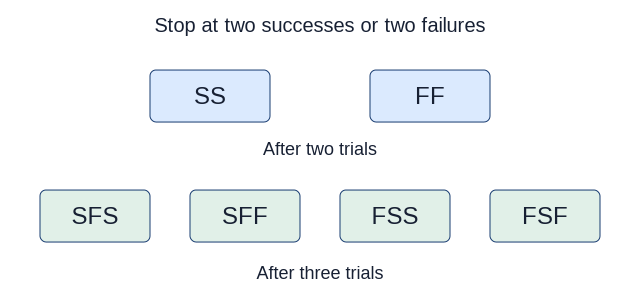
In a race to two successes or two failures, SS and FF end after two trials. Only SF and FS continue. On trial three every remaining path ends. List these terminal histories once, multiply their probabilities and check that the total is one. Never append a trial to an already stopped history.
Method
- Define success and what the random variable counts.
- Check independence, constant probability and whether the trial count is fixed or stops at an event.
- Translate words into an exact integer event before choosing a formula or complement.
- For conditional or staged models, identify the reached branch and denominator.
- Keep exact values until the final step; test neighbouring integers for a minimum or maximum.
- Check every feasible parameter branch and explain any stopping rule.
Common mistakes
- The final success needs its own probability factor.
- Second success on t excludes an earlier second success.
- A first success in a finite bag need not be geometric.
- Do not count histories after a stopping condition has already occurred.
Worked examples
Fix the final trial of the second success
Independent trials have success probability . Let S₂ be the trial of the second success. Find , , and the probability the first success is on trial 1 and the second on trial 4.
Follow the solutionFor the second success on t, use exactly one success among the first t−1 trials and success on trial t. For the joint event, the first and final trials succeed and every intervening trial fails.
Complete answers
Second success on the stated trial: .
Second success by the stated trial: .
First on one and second on the stated trial: .
Two waiting clocks can finish together
Two independent processes have first-success trial counts T_A and T_B, with success probabilities and . Find the probability both finish by 3, exactly one finishes by 3, and that they finish on the same trial given both finish by 3.
Follow the solutionFor both, multiply the two cumulative probabilities. Exactly one has two disjoint routes. For simultaneous finishes within the window, sum products of matching point probabilities, then condition on both finishing.
Complete answers
Both finish by the limit: .
Exactly one finishes by the limit: .
Same finish time given both finish by the limit: .
A finite bag is not an independent-trial model
A bag contains 2 marked and 4 unmarked counters. Draw uniformly without replacement until the first marked counter appears; T is its position. Find , , and choose the correct model statement.
Follow the solutionIn a random order every subset of marked positions is equally likely. For T=t, the first marked position is t and the other marked positions are chosen afterwards. The finite table sums to one; it does not have a geometric tail.
Complete answers
Probability of first marked on trial three: .
Expected first marked position: .
Correct conclusion: The success probability changes after failure; use a finite model.
Stop on either of two competing targets
Independent trials succeed with probability . Stop as soon as two successes or two failures have occurred. T is the number of trials and W means stopping with two successes. Find , , , and .
Follow the solutionSS and FF stop immediately. SF and FS each allow one more trial. These six terminal histories are mutually exclusive and exhaustive; no trial follows an already stopped path.
| Terminal history | Probability |
|---|---|
| SS | |
| FF | |
| SFS | |
| SFF | |
| FSS | |
| FSF |
Complete answers
Probability of stopping with two successes: .
Probability of three trials: .
Expected trial count: .
Win given three trials: .