Maths4UBETA

Without replacement, transfers and changing contents

Track colour counts and denominators at each step, retaining stopping rules and the exact object identity when relevant.

Try the quick check →
Lesson 5 of 5

Section 1 of 5 · Core · about 8 min

What changes after a counter is removed?

Uniform selection means every available physical object has the same chance. Two red counters are still two different objects. A colour probability is the number of counters of that colour divided by the current total.

After a draw without replacement, remove one counter of its actual colour and reduce the total by one. With RR red and BB blue counters, N=R+B≥2N=R+B\ge2, the second red chance is

P(R2∣R1)=R−1N−1(R>0),P(R2∣B1)=RN−1(B>0).P(R_2\mid R_1)=\frac{R-1}{N-1}\quad(R>0),\qquad P(R_2\mid B_1)=\frac{R}{N-1}\quad(B>0).

Here RiR_i and BiB_i mean a red or blue result on draw ii. A history with no available first counter is impossible; do not create negative contents or calculate a conditional on that history.

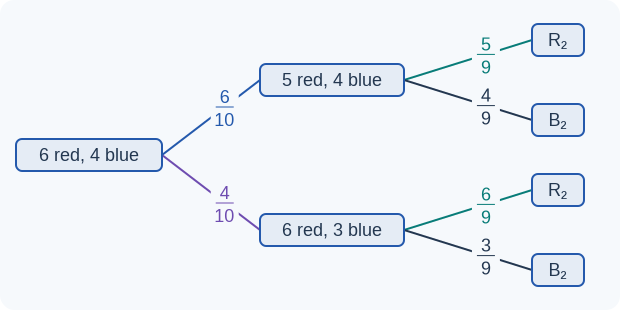
Start with six red and four blue counters. After red, five red and four blue remain. After blue, six red and three blue remain.

The subscripts identify the draws. Let RiR_i and BiB_i mean red and blue on draw ii.

RouteJoint probability
R1∩R2R_1\cap R_2610⋅59=13\frac6{10}\cdot\frac59=\frac13
R1∩B2R_1\cap B_2610⋅49=415\frac6{10}\cdot\frac49=\frac4{15}
B1∩R2B_1\cap R_2410⋅69=415\frac4{10}\cdot\frac69=\frac4{15}
B1∩B2B_1\cap B_2410⋅39=215\frac4{10}\cdot\frac39=\frac2{15}
P(different colours)=415+415=815.P(\text{different colours})=\frac4{15}+\frac4{15}=\frac8{15}.

The current numerator and denominator come from the reached contents. Both remaining bags contain nine counters, but their red counts differ.

Worked example

Compare replacement and no replacement

A bag contains 66 red and 44 blue counters. Two are drawn uniformly without replacement. Find the probabilities of two red counters, different colours, and a red first draw given that the second is red. Compare the two-red probability with independent draws made with replacement.

  1. After a red draw, the bag has 55 red and 44 blue counters. After a blue draw, it has 66 red and 33 blue. The four route weights are

    P(RR)=610⋅59=13,P(RB)=610⋅49=415,P(BR)=410⋅69=415,P(BB)=410⋅39=215.\begin{aligned}P(\mathrm{RR})&=\frac{6}{10}\cdot\frac{5}{9}=\frac{1}{3},& P(\mathrm{RB})&=\frac{6}{10}\cdot\frac{4}{9}=\frac{4}{15},\\ P(\mathrm{BR})&=\frac{4}{10}\cdot\frac{6}{9}=\frac{4}{15},& P(\mathrm{BB})&=\frac{4}{10}\cdot\frac{3}{9}=\frac{2}{15}.\end{aligned}
  2. P(different)=P(RB)+P(BR)=815.P(\text{different})=P(\mathrm{RB})+P(\mathrm{BR})=\frac{8}{15}.

    The four complete route probabilities sum to one.

  3. P(second red)=P(RR)+P(BR)=35.P(\text{second red})=P(\mathrm{RR})+P(\mathrm{BR})=\frac{3}{5}.P(first red∣second red)=1335=59.P(\text{first red}\mid\text{second red})=\frac{\frac{1}{3}}{\frac{3}{5}}=\frac{5}{9}.
  4. With replacement and independent mixing, the original proportion is restored:

    Pwith replacement(RR)=(610)2=925.P_{\text{with replacement}}(\mathrm{RR})=\left(\frac{6}{10}\right)^2=\frac{9}{25}.

    Without replacement, each fixed position still has red probability 35\frac{3}{5}, but the joint probability is not its square. The two colours are dependent.
Your turn

A bag contains 44 red and 22 blue counters. Two counters are drawn, each uniformly from those available. First suppose there is no replacement: find the probabilities of two red counters and two different colours. Then find the probability of two red counters if the first counter is returned and the bag mixed before an independent second draw.

Enter an exact value or round to 3 significant figures.

Enter an exact value or round to 3 significant figures.

Enter an exact value or round to 3 significant figures.

Section 2 of 5 · Core · about 8 min

Does drawing simultaneously change the sample probability?

A uniform simultaneous sample of kk distinct objects is equivalent to drawing kk uniformly without replacement and then ignoring their order. It has no “first colour” unless an order is separately specified. For a colour count, either add every allowed ordered path once or count equally likely unordered physical subsets.

The number of ways to choose kk distinct objects from nn, ignoring order, is

(nk)=n!k!(n−k)!,0≤k≤n,\binom{n}{k}=\frac{n!}{k!(n-k)!},\qquad 0\le k\le n,

where n,kn,k are integers, n!=n(n−1)⋯1n!=n(n-1)\cdots1 for positive nn, and 0!=10!=1. Dividing by k!k! removes the different orders of the same subset. An impossible selection has zero ways; never evaluate a negative factorial.

Worked example

Match sequential orders to an unordered sample

Three counters are selected uniformly without replacement from a bag containing 66 red and 44 blue counters. Find the probability of exactly two reds, first by ordered paths and then by counting unordered subsets.

  1. The possible colour orders are RRB, RBR and BRR. Their equal route weights can be checked directly:

    610⋅59⋅48=610⋅49⋅58=410⋅69⋅58=16.\frac{6}{10}\cdot\frac{5}{9}\cdot\frac{4}{8} =\frac{6}{10}\cdot\frac{4}{9}\cdot\frac{5}{8} =\frac{4}{10}\cdot\frac{6}{9}\cdot\frac{5}{8} =\frac{1}{6}.
  2. P(exactly two red)=3⋅16=12.P(\text{exactly two red})=3\cdot\frac{1}{6}=\frac{1}{2}.
  3. There are (103)=120\binom{10}{3}=120 equally likely physical subsets. Choose two of the six red counters and one of the four blue counters:

    P(exactly two red)=(62)(41)(103)=15⋅4120=12.P(\text{exactly two red})=\frac{\binom{6}{2}\binom{4}{1}}{\binom{10}{3}}=\frac{15\cdot4}{120}=\frac{1}{2}.
  4. Each physical subset is counted once, regardless of the order in which its counters could be drawn. Do not multiply by three again.

For RR red and BB blue counters, exactly jj reds in a uniform kk-counter sample has probability

(Rj)(Bk−j)(R+Bk),max⁡(0,k−B)≤j≤min⁡(k,R).\frac{\binom{R}{j}\binom{B}{k-j}}{\binom{R+B}{k}},\qquad \max(0,k-B)\le j\le\min(k,R).

All counts are integers, and 0≤k≤R+B0\le k\le R+B. With three colours, multiply the three required colour-selection counts and divide by the total sample count. For “at least” or “same colour”, add the disjoint permitted colour-count cases.

Your turn

A bag contains 44 red, 33 blue and 22 green counters. Every three-counter subset is equally likely to be selected. Find the probabilities of one counter of each colour and of no green counters.

Enter an exact value or round to 3 significant figures.

Enter an exact value or round to 3 significant figures.

Section 3 of 5 · Core · about 12 min

Which contents must I update after a transfer or return?

Split by the transferred colour. Remove that counter from the donor and add it to the recipient before calculating any later draw. If a new colour enters the recipient, retain it as a separate category. Compute the required probability within each updated state, then add the state probability times its conditional result.

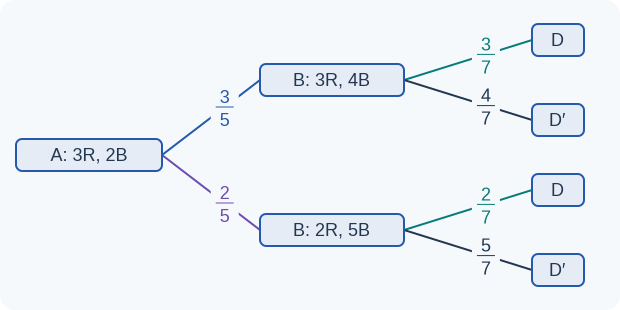
Transfer from three red and two blue counters in A. After a red transfer B has three red and four blue. After a blue transfer B has two red and five blue.

A starts with three red and two blue counters. B starts with two red and four blue. Let T mean a red transfer from A to B and D a red draw from B.

RouteJoint probability
T∩DT\cap D35⋅37=935\frac35\cdot\frac37=\frac9{35}
T∩D′T\cap D^{\prime}35⋅47=1235\frac35\cdot\frac47=\frac{12}{35}
T′∩DT^{\prime}\cap D25⋅27=435\frac25\cdot\frac27=\frac4{35}
T′∩D′T^{\prime}\cap D^{\prime}25⋅57=1035\frac25\cdot\frac57=\frac{10}{35}
P(D)=935+435=1335,P(T∣D)=9351335=913.P(D)=\frac9{35}+\frac4{35}=\frac{13}{35},\quad P(T\mid D)=\frac{\frac9{35}}{\frac{13}{35}}=\frac9{13}.

The transfer changes both boxes. The final red observation is possible after either transfer colour.

Worked example

Update both boxes after a transfer

Box A contains 33 red and 22 blue counters. Box B contains 22 red and 44 blue. Transfer one uniformly chosen counter from A to B, then draw one counter uniformly from B. Let T mean that the transfer was red and D mean that the final draw is red. Find P(D)P(D) and P(T∣D)P(T\mid D).

  1. The transfer probabilities are P(T)=35P(T)=\frac{3}{5} and P(T′)=25P(T^{\prime})=\frac{2}{5}. After T, A contains 22 red and 22 blue, while B contains 33 red and 44 blue. After a blue transfer, A contains 33 red and 11 blue, while B contains 22 red and 55 blue.

  2. Both recipient states contain seven counters, but their red numerators differ:

    P(D∣T)=37,P(D∣T′)=27.P(D\mid T)=\frac{3}{7},\qquad P(D\mid T^{\prime})=\frac{2}{7}.
  3. P(D)=35⋅37+25⋅27=1335.P(D)=\frac{3}{5}\cdot\frac{3}{7}+\frac{2}{5}\cdot\frac{2}{7}=\frac{13}{35}.
  4. P(T∣D)=35⋅371335=913.P(T\mid D)=\frac{\frac{3}{5}\cdot\frac{3}{7}}{\frac{13}{35}}=\frac{9}{13}.

    The final red counter could be an original B counter, so a red observation does not prove that the transfer was red.

A return draw can select the transferred counter or a different counter of the same colour. Give a named counter its own label when identity matters. If a recipient originally contains MM objects, its uniform immediate draw after one transfer selects the exact transferred object with probability 1M+1\frac{1}{M+1}; conditioning on an observed colour may change that probability.

More generally, a uniform kk-object subset from N>0N>0 distinct objects contains a specified object with probability kN\frac{k}{N}, for integers 0≤k≤N0\le k\le N. All NN objects have the same inclusion chance, and exactly kk are selected.

For repeated cycles, carry the resulting contents into the next cycle. A short table of possible states often replaces a large tree. Track both boxes, and track a named object’s location separately when the question asks about that object.

Worked example

Track a returned object and repeated cycles

Box A initially contains 22 red and 11 blue counter; box B contains 11 red and 11 green. One cycle transfers a uniformly chosen counter from A to B, then returns a uniformly chosen counter from B to A. Find the probabilities that the returned counter is the exact transferred object and that it has the transferred colour. Repeat the same cycle once without resetting either box: find the probability that A has its original colour counts after two cycles, and the probability that a particular original red counter from A is in A after two cycles.

  1. Immediately before the return, B has three distinct objects, one of which is the transferred counter:

    P(same physical counter returned)=13.P(\text{same physical counter returned})=\frac{1}{3}.

    For the same colour, a red transfer leaves two red counters in B, while a blue transfer leaves one blue:

    P(same colour returned)=23⋅23+13⋅13=59.P(\text{same colour returned})=\frac{2}{3}\cdot\frac{2}{3}+\frac{1}{3}\cdot\frac{1}{3}=\frac{5}{9}.
  2. For repeated cycles, record the resulting contents rather than restarting the original tree. Write each state as (red, blue, green):

    A after cycle oneB after cycle oneState probabilityChance next cycle restores original A colour counts
    (2,1,0)(2,1,0)(1,0,1)(1,0,1)59\frac{5}{9}59\frac{5}{9}
    (1,1,1)(1,1,1)(2,0,0)(2,0,0)29\frac{2}{9}29\frac{2}{9}
    (3,0,0)(3,0,0)(0,1,1)(0,1,1)19\frac{1}{9}13\frac{1}{3}
    (2,0,1)(2,0,1)(1,1,0)(1,1,0)19\frac{1}{9}19\frac{1}{9}
  3. The first row collects same-colour returns. The other first-cycle histories are red then green, blue then red, and blue then green. To obtain the last column, use each new pair of boxes. For example, from A=(1,1,1)\mathrm{A}=(1,1,1), B=(2,0,0)\mathrm{B}=(2,0,0), restoration needs a green transfer then a red return, with probability 13⋅23=29\frac{1}{3}\cdot\frac{2}{3}=\frac{2}{9}. From A=(3,0,0)\mathrm{A}=(3,0,0), a red is transferred and a blue must return, with probability 13\frac{1}{3}.

  4. P(A restored after two cycles)=59⋅59+29⋅29+19⋅13+19⋅19=1127.P(\text{A restored after two cycles})=\frac{5}{9}\cdot\frac{5}{9}+\frac{2}{9}\cdot\frac{2}{9}+\frac{1}{9}\cdot\frac{1}{3}+\frac{1}{9}\cdot\frac{1}{9}=\frac{11}{27}.
  5. For the named original red counter, track its location separately. If it starts a cycle in A, it stays there unless it is transferred and not returned:

    P(in A next∣in A now)=23+13⋅13=79.P(\text{in A next}\mid\text{in A now})=\frac{2}{3}+\frac{1}{3}\cdot\frac{1}{3}=\frac{7}{9}.

    If it starts in B, the return selects it with probability 13\frac{1}{3}. These location probabilities do not depend on its colour.

  6. P(named counter in A after two cycles)=79⋅79+29⋅13=5581.P(\text{named counter in A after two cycles})=\frac{7}{9}\cdot\frac{7}{9}+\frac{2}{9}\cdot\frac{1}{3}=\frac{55}{81}.

    A colour-count state alone does not identify which physical red counter is present.

Your turn

Box A contains 22 red and 44 blue counters; box B contains 11 red and 33 blue. One counter is transferred uniformly from A to B, then one counter is drawn uniformly from B. Let T mean that the transferred counter was red and D mean that the final draw is red. Find P(D)P(D), P(T∣D)P(T\mid D), the probability that the final draw is the exact transferred counter, and that same identity probability given D.

Enter an exact value or round to 3 significant figures.

Enter an exact value or round to 3 significant figures.

Enter an exact value or round to 3 significant figures.

Enter an exact value or round to 3 significant figures.

Section 4 of 5 · Core · about 9 min

What if the action depends on the colour or a stopping rule?

Read the instructions in order: draw, remove or return, add or transfer, then draw again. Make a separate state for each first outcome. Different branches can have different totals; do not reduce or restore every denominator automatically.

Worked example

Apply a different action after each colour

A bag initially contains 33 red and 11 blue counter. Draw one counter uniformly. If it is red, return it and add one blue counter. If it is blue, keep it out and add one red counter. Then draw uniformly again. Find the probability that the second counter is red.

  1. Keep the action order explicit:

    First drawActionContents before second drawRed chance
    RedReturn red; add blue3 red, 2 blue3\text{ red},\ 2\text{ blue}35\frac{3}{5}
    BlueRemove blue; add red4 red, 0 blue4\text{ red},\ 0\text{ blue}11
  2. P(second red)=34⋅35+14⋅1=710.P(\text{second red})=\frac{3}{4}\cdot\frac{3}{5}+\frac{1}{4}\cdot1=\frac{7}{10}.
  3. The second-draw totals are different: five after a red first draw and four after a blue first draw. Using one denominator for both histories would describe the wrong process.

For a stopping rule, end the string at the first result that meets it. “Stop on the second red at draw tt” means exactly one red in the first t−1t-1 positions and red at position tt. Use the remaining stock at every stage, and exclude times requiring more counters of a colour than exist.

Worked example

Stop at the second red without extending completed paths

A bag contains 33 red and 22 blue counters. Draw uniformly without replacement until the second red appears. Find every possible value of the number of draws TT and its probability.

  1. The process can finish at draw two, three or four. It cannot reach draw five: with only two blue counters, the second red must have appeared by draw four. The valid terminal strings are RR, RBR, BRR, RBBR, BRBR and BBRR.

  2. P(T=2)=P(RR)=35⋅24=310.P(T=2)=P(\mathrm{RR})=\frac{3}{5}\cdot\frac{2}{4}=\frac{3}{10}.
  3. P(T=3)=P(RBR)+P(BRR)=2(35⋅24⋅23)=25.P(T=3)=P(\mathrm{RBR})+P(\mathrm{BRR})=2\left(\frac{3}{5}\cdot\frac{2}{4}\cdot\frac{2}{3}\right)=\frac{2}{5}.
  4. Each of RBBR, BRBR and BBRR has weight 110\frac{1}{10}. For example,

    P(RBBR)=35⋅24⋅13⋅1=110.P(\mathrm{RBBR})=\frac{3}{5}\cdot\frac{2}{4}\cdot\frac{1}{3}\cdot1=\frac{1}{10}.P(T=4)=310.P(T=4)=\frac{3}{10}.
  5. 310+25+310=1.\frac{3}{10}+\frac{2}{5}+\frac{3}{10}=1.

    No valid terminal string has a second red before its final letter.

Your turn

A bag contains 22 red and 33 blue counters. Counters are drawn uniformly without replacement until the second red appears. Let TT be the number of draws made. Find P(T=3)P(T=3) and the probability that the first draw was red given T=3T=3. Is RRB a possible complete terminal string?

Enter an exact value or round to 3 significant figures.

Enter an exact value or round to 3 significant figures.

Can RRB be a terminal string?

Section 5 of 5 · Core · about 7 min

How do I find an unknown original number of counters?

Let the unknown be an integer count, and record its permitted range before simplifying. Build the probability from the original contents and actions. If a transfer occurs, include every possible transfer route. Solve the equation, then check every algebraic candidate in the original model.

Keep only counts that satisfy all positivity or nonnegativity conditions, leave enough objects for every required draw, and make each conditioning event have positive probability. Never round an invalid fractional count into a solution. Multiplying by a denominator does not remove the need to check where that denominator was allowed.

Worked example

Recover an unknown stock after a transfer

Box A contains a positive integer rr red counters and 44 blue counters. Box B initially contains 22 red and 11 blue. Transfer one uniformly chosen counter from A to B, then draw two counters uniformly without replacement from B. The probability that both final counters are red is 13\frac{1}{3}. Find rr.

  1. A red transfer has probability rr+4\frac{r}{r+4}, leaving B with 33 red and 11 blue. A blue transfer has probability 4r+4\frac{4}{r+4}, leaving B with 22 red and 22 blue.

  2. P(RR∣red transfer)=34⋅23=12,P(RR∣blue transfer)=24⋅13=16.P(\mathrm{RR}\mid\text{red transfer})=\frac{3}{4}\cdot\frac{2}{3}=\frac{1}{2},\qquad P(\mathrm{RR}\mid\text{blue transfer})=\frac{2}{4}\cdot\frac{1}{3}=\frac{1}{6}.
  3. rr+4⋅12+4r+4⋅16=13.\frac{r}{r+4}\cdot\frac{1}{2}+\frac{4}{r+4}\cdot\frac{1}{6}=\frac{1}{3}.

    Since r+4>0r+4>0, multiplying by 6(r+4)6(r+4) gives

    3r+4=2r+8⟹r=4.3r+4=2r+8\quad\Longrightarrow\quad r=4.
  4. This is a valid positive integer. Each transfer colour has probability 12\frac{1}{2}, and the original expression checks:

    12⋅12+12⋅16=13.\frac{1}{2}\cdot\frac{1}{2}+\frac{1}{2}\cdot\frac{1}{6}=\frac{1}{3}.

Your turn

A bag contains a positive integer rr red counters and 33 blue counters. Two counters are drawn uniformly without replacement. The probability of two blue counters is 328\frac{3}{28}. Solve the resulting quadratic and identify the valid original red count.

Give every root, for example x = 1 or x = 4, or 1, 4. Use sqrt(...) for exact roots, or empty if there are none.

Enter an exact number, for example 3/2 or 2-sqrt(3).

Worked examples

Practise the method

Core practice

Question 1 of 4

0 / 4 checked in this collection

Question list

Core practice

Fresh variants

Exam-style

Without replacement has two different denominators

3 marks

Draw two counters uniformly without replacement from 3 red and 5 blue. Find both-red and exactly-one-red probabilities, then both red given at least one red.

Enter an exact value or round to 3 significant figures.

Enter an exact value or round to 3 significant figures.

Enter an exact value or round to 3 significant figures.

Full answer-format guide

Exact numbers: 3/2, sqrt(5), 2-sqrt(3), pi/6, 3*pi/2. Sets: {1,4}. Intervals: (3,5]; a round bracket excludes the endpoint. Infinity: inf; union: U; no solutions: empty. Separate coordinate pairs or triples with semicolons. Expressions: 2x^2+3x-1; equations: x^2=3x+1 or the polynomial equal to zero. Factors: x-1 ; x+2. Parameter fraction: numerator ; denominator. List integer answers individually.

Review the method

Progress stays in this browser. Create an account to save it or sign in.

Extra practice from this lesson

Different orders and an unchanged marginal

A bag contains 55 red and 44 blue counters. Two counters are drawn uniformly in sequence without replacement. Find the probabilities that both are red, exactly one is red, and the second is red. Also find the probability both are red given that at least one is red.

Enter an exact value or round to 3 significant figures.

Enter an exact value or round to 3 significant figures.

Enter an exact value or round to 3 significant figures.

Enter an exact value or round to 3 significant figures.

Choose a consistent unordered sample space

A bag contains 33 red, 22 blue and 22 green counters, each a distinct physical item. A set of 33 counters is chosen uniformly without replacement. Find the probabilities of one of each colour, exactly two reds, no greens, and at least two different colours.

Enter an exact value or round to 3 significant figures.

Enter an exact value or round to 3 significant figures.

Enter an exact value or round to 3 significant figures.

Enter an exact value or round to 3 significant figures.

A new colour and one named transferred object

Box A contains 22 red and 33 green counters. Box B contains 33 red and 22 blue counters. One counter is selected uniformly from A and transferred to B. Then two counters are selected uniformly from B without replacement. One particular original red counter in A is named K.

Find the probabilities that both selected counters are red, at least one is green, the two-counter sample includes the transferred counter, and it includes K. Finally find the probability that the transfer was red given that both selected counters are red.

Enter an exact value or round to 3 significant figures.

Enter an exact value or round to 3 significant figures.

Enter an exact value or round to 3 significant figures.

Enter an exact value or round to 3 significant figures.

Enter an exact value or round to 3 significant figures.

A replacement rule changes the branch totals

A bag initially contains 33 red and 44 blue counters. Draw one uniformly. If it is red, return it. If it is blue, keep it out and add two new red counters. Then draw one counter uniformly from the resulting bag. Find the probability that the second draw is red, that the two drawn colours agree, and that the first draw was blue given that the second is red.

Enter an exact value or round to 3 significant figures.

Enter an exact value or round to 3 significant figures.

Enter an exact value or round to 3 significant figures.

Stop before extending a completed path

A bag contains 33 red and 33 blue counters. Draw uniformly without replacement until the second red appears. Let T be the number of draws. Find P(T=4)P(T=4), P(B1∣T=4)P(B_1\mid T=4), and P(T≥4)P(T\ge4). Which displayed sequence is a complete terminal path of this process?

Enter an exact value or round to 3 significant figures.

Enter an exact value or round to 3 significant figures.

Enter an exact value or round to 3 significant figures.

Valid complete terminal path

Apply it · original exam-style problems

Show your working on paper and compare it with the worked solution and marking guidance.

Start after this lesson

Recover an integer stock from a transfer experiment 8 marks

Box A contains 22 red and 11 blue counter. Box B contains n red and 33 blue counters, where n is a nonnegative integer. Move one uniformly selected counter from A to B, then draw two counters uniformly from B without replacement. The probability both drawn counters are red is 1342\frac{13}{42}.

Find n. Then find the probabilities that the transfer was red given two red draws, that at least one draw is red, and that the two-item sample contains the transferred counter.

Hint

After either transfer, B contains n+4n+4 counters. Its red count is n+1n+1 or n. Write both RR paths, solve the equation, and check integer-count restrictions before using the result.

Worked solution
  1. The numerators (n+1)n(n+1)n and n(n−1)n(n-1) count ordered pairs of red items after each transfer. There are zero such pairs if fewer than two reds are present; no later conditional on an impossible first-red draw is formed.

    P(RR)=23(n+1)n(n+4)(n+3)+13n(n−1)(n+4)(n+3)=n(3n+1)3(n+4)(n+3).P(RR)=\frac{2}{3}\frac{(n+1)n}{(n+4)(n+3)}+\frac{1}{3}\frac{n(n-1)}{(n+4)(n+3)}=\frac{n(3n+1)}{3(n+4)(n+3)}.

    At n=0 the event is impossible and has probability zero; the expression agrees. The original totals are positive for every allowed n.

  2. n(3n+1)3(n+4)(n+3)=1342⟹29n2−77n−156=0.\frac{n(3n+1)}{3(n+4)(n+3)}=\frac{13}{42}\quad\Longrightarrow\quad29n^2-77n-156=0.
  3. (n−4)(29n+39)=0⟹n=4 or n=−3929.(n-4)(29n+39)=0\quad\Longrightarrow\quad n=4\ \text{or}\ n=-\frac{39}{29}.

    Only n=4 is a nonnegative integer. It gives valid contents and reproduces the required probability.

  4. P(red transfer and RR)=23⋅58⋅47=521.P(\text{red transfer and }RR)=\frac{2}{3}\cdot\frac{5}{8}\cdot\frac{4}{7}=\frac{5}{21}.
  5. P(red transfer∣RR)=5211342=1013.P(\text{red transfer}\mid RR)=\frac{\frac{5}{21}}{\frac{13}{42}}=\frac{10}{13}.
  6. P(BB)=23⋅38⋅27+13⋅48⋅37=17.P(BB)=\frac{2}{3}\cdot\frac{3}{8}\cdot\frac{2}{7}+\frac{1}{3}\cdot\frac{4}{8}\cdot\frac{3}{7}=\frac{1}{7}.

    Therefore the probability of at least one red is 67\frac{6}{7}.

  7. The transferred counter is one particular item among eight. A uniform two-item sample includes it with probability 28=14\frac{2}{8}=\frac{1}{4}, whichever colour was transferred.

Marking guidance
  • 1 mark: update the destination counts on both transfer branches.
  • 1 mark: form the weighted RR equation.
  • 1 mark: solve the quadratic.
  • 1 mark: retain only the valid integer count and check it in the model.
  • 1 mark: find the red-transfer-and-RR joint.
  • 1 mark: obtain the reverse conditional.
  • 1 mark: use the BB complement for at least one red.
  • 1 mark: distinguish the particular transferred item from its colour and obtain its inclusion chance.
Carry the actual contents through two transfer cycles 9 marks

Box A initially holds one red and one blue counter; box B initially holds two red counters. The original red counter in A is named K. A cycle selects one counter uniformly from A and moves it to B, then selects one uniformly from B and returns it to A. Perform two cycles, without resetting either box between them.

Find the probability that A contains two reds after one cycle and after two cycles. Given that A contains two reds after cycle two, find the probability it also contained two reds after cycle one. Finally find the probability that K is in A after two cycles.

Hint

After a completed cycle, each box again has two counters, but the colours may have changed. There is only one blue counter in total. Use states C: A has one red and one blue, and D: A has two reds. Track the named item’s box separately for the last part.

Worked solution
  1. From C, A becomes all red only by transferring its blue and returning a red:

    P(D∣C)=12⋅23=13,P(C∣C)=23.P(D\mid C)=\frac{1}{2}\cdot\frac{2}{3}=\frac{1}{3},\qquad P(C\mid C)=\frac{2}{3}.
  2. From D, the other box contains one red and one blue. After a red transfer, B has two reds and one blue:

    P(D∣D)=23,P(C∣D)=13.P(D\mid D)=\frac{2}{3},\qquad P(C\mid D)=\frac{1}{3}.
  3. The initial state is C, so the first-cycle all-red probability is 13\frac{1}{3}. For two cycles, retain the actual intermediate state:

    P(D2)=23⋅13+13⋅23=49.P(D_2)=\frac{2}{3}\cdot\frac{1}{3}+\frac{1}{3}\cdot\frac{2}{3}=\frac{4}{9}.
  4. P(D1∩D2)=13⋅23=29,P(D1∣D2)=2949=12.P(D_1\cap D_2)=\frac{1}{3}\cdot\frac{2}{3}=\frac{2}{9},\qquad P(D_1\mid D_2)=\frac{\frac{2}{9}}{\frac{4}{9}}=\frac{1}{2}.
  5. For the named item K, starting in A it remains there if it is not transferred, or if transferred and then returned:

    P(K ends in A∣K starts in A)=12+12⋅13=23.P(K\text{ ends in A}\mid K\text{ starts in A})=\frac{1}{2}+\frac{1}{2}\cdot\frac{1}{3}=\frac{2}{3}.
  6. If K starts a cycle in B, it returns to A with probability 13\frac{1}{3}. Since it originally starts in A,

    P(K in A after two cycles)=23⋅23+13⋅13=59.P(K\text{ in A after two cycles})=\frac{2}{3}\cdot\frac{2}{3}+\frac{1}{3}\cdot\frac{1}{3}=\frac{5}{9}.

    This identity event differs from A having two red counters.

Marking guidance
  • 1 mark: identify the two possible colour states after a full cycle.
  • 1 mark: calculate the transition from the mixed state to all red.
  • 1 mark: calculate transitions from the all-red state.
  • 1 mark: retain the intermediate state in both two-cycle routes.
  • 1 mark: obtain the two-cycle all-red probability.
  • 1 mark: calculate the joint all-red history.
  • 1 mark: obtain the conditional first-cycle probability.
  • 1 mark: derive the named-item box transition probabilities.
  • 1 mark: obtain its final location probability without replacing identity by colour.

Come back to what needs practice

Quick revision sheet (A4)

Your review plan starts after your first check.

Question bank and saved work