Maths4UBETA

Sample spaces, complements and event relations

Build an appropriate outcome space and distinguish inclusive or, exactly one, mutually exclusive and independent.

Try the quick check →
Lesson 1 of 5

Section 1 of 5 · Core · about 6 min

What should I put in the sample space?

The sample space Ω\Omega contains all possible elementary outcomes of the experiment. An event is a set of outcomes that satisfy a condition. For a two-stage experiment, an ordered pair records both results in their correct positions. A total or product can summarise several different pairs.

In the finite sample spaces used here, list every elementary outcome once. Its probability is between 00 and 11, and all outcome probabilities sum to 11. The complete event Ω\Omega has probability 11; the empty event ∅\varnothing has probability 00.

The first fair spinner has labels 1,21,2. The second has 1,2,31,2,3. Let SS be their sum.

P({(i,j)})=12⋅13=16.P(\{(i,j)\})=\frac12\cdot\frac13=\frac16.
First spinSecond: 1Second: 2Second: 3
1(1,1)(1,1)
S=2S=2
(1,2)(1,2)
S=3S=3
(1,3)(1,3)
S=4S=4
2(2,1)(2,1)
S=3S=3
(2,2)(2,2)
S=4S=4
(2,3)(2,3)
S=5S=5
ssNumber of cellsP(S=s)P(S=s)
2116\frac{1}{6}
3213\frac{1}{3}
4213\frac{1}{3}
5116\frac{1}{6}
{S=3}={(1,2),(2,1)},P(S=3)=26=13.\{S=3\}=\{(1,2),(2,1)\},\qquad P(S=3)=\frac26=\frac13.

The six ordered spinner pairs each have probability 16\frac{1}{6}. Total 33 appears in two cells, so its probability is 13\frac{1}{3}.

Worked example

List a complete two-stage sample space

Two fair spinners are spun independently. The first has labels 1,21,2; the second has labels 1,2,31,2,3. Find the probability that their total is 33, and explain why choosing equally among the four possible total labels would give a wrong answer.

  1. Record the first result first. The complete elementary sample space is

    Ω={(1,1),(1,2),(1,3),(2,1),(2,2),(2,3)}.\Omega=\{(1,1),(1,2),(1,3),(2,1),(2,2),(2,3)\}.
  2. Each pair has probability 12⋅13=16\frac{1}{2}\cdot\frac{1}{3}=\frac{1}{6}, because both spinners are fair and the spins are independent.

  3. Total 33 occurs at (1,2)(1,2) or (2,1)(2,1), so

    P(total 3)=26=13.P(\text{total }3)=\frac{2}{6}=\frac{1}{3}.
  4. The totals 2,3,4,52,3,4,5 occur in 1,2,2,11,2,2,1 cells. They are valid summary values, but they are not equally likely. The event “total 33” contains two elementary outcomes.

Your turn

Two fair spinners are spun independently. The first has labels 0,1,20,1,2; the second has labels 1,31,3. Give all ordered pairs whose total is 33, and find the probability of this event. Are the five possible totals equally likely?

Enter each pair in the order shown. Separate complete pairs with commas or semicolons.

Enter an exact value or round to 3 significant figures.

Are the distinct totals equally likely?

Section 2 of 5 · Core · about 8 min

How do and, or and not select event regions?

ExpressionMeaning
A∩BA\cap BBoth A and B.
A∪BA\cup BA or B or both: inclusive “or”.
A′A^{\prime}Not A, relative to the complete sample space.
A∩B′A\cap B^{\prime}A only.
A′∩B′=(A∪B)′A^{\prime}\cap B^{\prime}=(A\cup B)^{\prime}Neither A nor B.

Exactly one means A only together with B only. “Not both” also includes neither, so it is a different event. A complement and its event cover the whole space without overlap:

P(A′)=1−P(A).P(A^{\prime})=1-P(A).

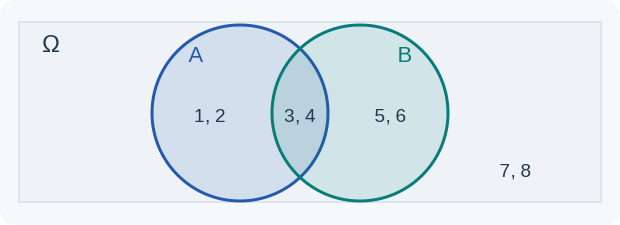
Tickets 1 and 2 are in A alone. Tickets 3 and 4 are in both circles. Tickets 5 and 6 are in B alone. Tickets 7 and 8 are outside both.

Use eight equally likely tickets. Let A={1,2,3,4}A=\{1,2,3,4\} and B={3,4,5,6}B=\{3,4,5,6\}.

P(A∪B)=68=34,P(A∩B)=28=14.P(A\cup B)=\frac68=\frac34,\qquad P(A\cap B)=\frac28=\frac14.P(exactly one)=48=12,P(neither)=28=14.P(\text{exactly one})=\frac48=\frac12,\quad P(\text{neither})=\frac28=\frac14.

Here P(A)P(B)=12⋅12=14=P(A∩B)P(A)P(B)=\frac12\cdot\frac12=\frac14=P(A\cap B), so the events are independent. Their intersection is nonempty.

Each ticket belongs to exactly one of the four regions. All eight tickets are equally likely, so each two-ticket region has probability 14\frac{1}{4}; the drawn circle areas are not probability scales.

Worked example

Separate inclusive or, exactly one and neither

One of eight tickets numbered 11 to 88 is selected uniformly. Let A={1,2,3,4}A=\{1,2,3,4\} and B={3,4,5,6}B=\{3,4,5,6\}. Find the probabilities of A or B, exactly one of them, neither, and not A.

  1. Split the tickets into four disjoint regions:

    A∩B′={1,2},A∩B={3,4},A\cap B^{\prime}=\{1,2\},\qquad A\cap B=\{3,4\},A′∩B={5,6},A′∩B′={7,8}.A^{\prime}\cap B=\{5,6\},\qquad A^{\prime}\cap B^{\prime}=\{7,8\}.
  2. Inclusive “or” includes the overlap once:

    A∪B={1,2,3,4,5,6},P(A∪B)=68=34.A\cup B=\{1,2,3,4,5,6\},\qquad P(A\cup B)=\frac{6}{8}=\frac{3}{4}.
  3. Exactly one excludes the overlap, giving tickets 1,2,5,61,2,5,6:

    P(exactly one)=48=12.P(\text{exactly one})=\frac{4}{8}=\frac{1}{2}.
  4. P(neither)=28=14.P(\text{neither})=\frac{2}{8}=\frac{1}{4}.

    Not A includes B only and neither:

    A′={5,6,7,8},P(A′)=12.A^{\prime}=\{5,6,7,8\},\qquad P(A^{\prime})=\frac{1}{2}.

For probabilities a=P(A)a=P(A), b=P(B)b=P(B), i=P(A∩B)i=P(A\cap B), the four regions are

a−i,i,b−i,1−a−b+i.a-i,\qquad i,\qquad b-i,\qquad1-a-b+i.

Add the three union regions to obtain the convenient summary P(A∪B)=a+b−iP(A\cup B)=a+b-i; exactly one has probability a+b−2ia+b-2i. This follows from the regions, so you can always rebuild it instead of relying on a slogan.

Every region must be non-negative. In particular, with 0≤a,b≤10\le a,b\le1,

max⁡(0,a+b−1)≤i≤min⁡(a,b).\max(0,a+b-1)\le i\le\min(a,b).

An intersection outside these bounds describes impossible probabilities.

Your turn

Events satisfy P(A)=38P(A)=\frac{3}{8}, P(B)=12P(B)=\frac{1}{2} and P(A∩B)=14P(A\cap B)=\frac{1}{4}. Find the probabilities of A only, exactly one of A and B, and neither. With the same marginal probabilities, could the intersection instead be 716\frac{7}{16}?

Enter an exact value or round to 3 significant figures.

Enter an exact value or round to 3 significant figures.

Enter an exact value or round to 3 significant figures.

Could the alternative intersection be valid?

Section 3 of 5 · Core · about 6 min

Are mutually exclusive events the same as independent events?

Mutually exclusive events share no elementary outcome: A∩B=∅A\cap B=\varnothing, so they cannot occur together. Independence is a probability relationship:

P(A∩B)=P(A)P(B).P(A\cap B)=P(A)P(B).

Use the actual intersection to test independence. Do not assume multiplication merely because the question says “and”. Likewise, adding marginal probabilities for “or” is valid without subtraction only when the overlap has probability zero.

Worked example

Independence does not mean disjointness

Select one of tickets 11 to 88 uniformly. Define A={1,2,3,4}A=\{1,2,3,4\}, B={3,4,5,6}B=\{3,4,5,6\} and C={5,6,7,8}C=\{5,6,7,8\}. Decide whether A and B are independent or mutually exclusive. Repeat for A and C.

  1. P(A)=P(B)=P(C)=12.P(A)=P(B)=P(C)=\frac{1}{2}.
  2. P(A∩B)=28=14=P(A)P(B).P(A\cap B)=\frac{2}{8}=\frac{1}{4}=P(A)P(B).

    A and B are independent. They share tickets 3,43,4, so they are not mutually exclusive.

  3. A and C have no shared ticket, so they are mutually exclusive. However,

    P(A∩C)=0≠14=P(A)P(C).P(A\cap C)=0\ne\frac{1}{4}=P(A)P(C).

    They are dependent.

  4. These relationships concern the particular event sets. Events from one experiment can be independent; independent generating trials do not make every pair of events built from those trials independent.

Your turn

For events A and B, P(A)=25P(A)=\frac{2}{5}, P(B)=310P(B)=\frac{3}{10} and P(A∩B)=325P(A\cap B)=\frac{3}{25}. Classify their relationship. Separately, U and V are mutually exclusive with probabilities 16\frac{1}{6} and 14\frac{1}{4}: are they independent? Finally, can the empty event be both mutually exclusive and independent of A?

Relationship of A and B
Are U and V independent?
Empty event with A

More generally, a zero-probability event satisfies the independence product test with every event. Mutual exclusivity still concerns an empty intersection, not just its probability; do not reverse that definition when a model includes zero-weight outcomes.

Section 4 of 5 · Core · about 7 min

What if the elementary outcomes are not equally likely?

Add the probabilities of the distinct elementary outcomes belonging to an event. Equal-count fractions work only when their weights are equal. For two independent trials, the weight of an ordered pair is

P(first x and second y)=P(first x)P(second y).P(\text{first }x\text{ and second }y)=P(\text{first }x)P(\text{second }y).

The independence is an assumption about these trials. Once the pairs are weighted, form events by collecting the required cells and adding their weights once each.

Worked example

Add unequal ordered-outcome probabilities

A spinner gives scores 1,3,51,3,5 with probabilities 12,14,14\frac{1}{2},\frac{1}{4},\frac{1}{4}. Two spins are independent. Let E be the event that their total is 66. Find P(E)P(E).

  1. Each ordered pair has the product of its two score probabilities. The complete weights are:

    First score / second score113355
    1114\frac{1}{4}18\frac{1}{8}18\frac{1}{8}
    3318\frac{1}{8}116\frac{1}{16}116\frac{1}{16}
    5518\frac{1}{8}116\frac{1}{16}116\frac{1}{16}
  2. E={(1,5),(3,3),(5,1)}.E=\{(1,5),(3,3),(5,1)\}.

    These three distinct outcomes are mutually exclusive.

  3. P(E)=18+116+18=516.P(E)=\frac{1}{8}+\frac{1}{16}+\frac{1}{8}=\frac{5}{16}.
  4. The event contains three of nine pairs, but 39\frac{3}{9} is not its probability because the pairs have different weights.

Your turn

A device gives 00 with probability pp and 11 with probability 1−p1-p. Two trials are independent. The probability of different results is 38\frac{3}{8}. Find every valid pp, then select it if result 11 is more likely than result 00.

Give the complete set: {1, 4} for separate values, (1, 5] for an interval, U for union or empty for no real solutions. Use sqrt(...) for exact roots.

Enter an exact value or round to 3 significant figures.

Section 5 of 5 · Core · about 7 min

What changes when an event is given?

“Given F” restricts attention to outcomes inside F. Count or weight only those outcomes for the denominator, then keep those that also belong to E for the numerator. Provided P(F)>0P(F)>0,

P(E∣F)=P(E∩F)P(F).P(E\mid F)=\frac{P(E\cap F)}{P(F)}.

For equally likely elementary outcomes, this is the number in both divided by the number in F. For unequal weights, use their probability totals. The event after the vertical bar identifies the denominator.

If P(F)=0P(F)=0, this elementary conditional probability is undefined; do not report zero. Reversing the condition usually gives a different value. For independent E and F with P(F)>0P(F)>0, the product test gives P(E∣F)=P(E)P(E\mid F)=P(E).

Worked example

Condition on a weighted event

Two independent spins each give scores 1,3,51,3,5 with probabilities 12,14,14\frac{1}{2},\frac{1}{4},\frac{1}{4}. Let E mean a total of 66, and F mean at least one score is 55. Find P(E∣F)P(E\mid F).

  1. The conditioning event has positive probability. Its complement is that neither spin gives 55:

    P(F)=1−(34)2=716.P(F)=1-\left(\frac{3}{4}\right)^2=\frac{7}{16}.
  2. Inside F, the total can be 66 only through (1,5)(1,5) or (5,1)(5,1). The pair (3,3)(3,3) gives total 66 but is excluded by the condition.

  3. P(E∩F)=12⋅14+14⋅12=14.P(E\cap F)=\frac{1}{2}\cdot\frac{1}{4}+\frac{1}{4}\cdot\frac{1}{2}=\frac{1}{4}.
  4. P(E∣F)=P(E∩F)P(F)=14716=47.P(E\mid F)=\frac{P(E\cap F)}{P(F)}=\frac{\frac{1}{4}}{\frac{7}{16}}=\frac{4}{7}.
  5. F contains five ordered pairs, but they have unequal weights. Counting the two favourable pairs out of five would incorrectly give 25\frac{2}{5}.

Your turn

Two independent trials each give scores 0,2,40,2,4 with probabilities 14,12,14\frac{1}{4},\frac{1}{2},\frac{1}{4}, respectively. Let E mean equal scores and F mean both scores are nonzero. Find P(F)P(F), P(E∩F)P(E\cap F), P(E∣F)P(E\mid F) and P(F∣E)P(F\mid E).

Enter an exact value or round to 3 significant figures.

Enter an exact value or round to 3 significant figures.

Enter an exact value or round to 3 significant figures.

Enter an exact value or round to 3 significant figures.

Worked examples

Practise the method

Core practice

Question 1 of 4

0 / 4 checked in this collection

Question list

Core practice

Fresh variants

Exam-style

Count the ordered elementary outcomes

3 marks

Two independent fair 4-sector spinners each show 1 to 4. Find the number of ordered pairs with total at least 6, the size of the whole ordered sample space, and the event probability.

Enter an exact number, for example 3/2 or 2-sqrt(3).

Enter an exact number, for example 3/2 or 2-sqrt(3).

Enter an exact value or round to 3 significant figures.

Full answer-format guide

Exact numbers: 3/2, sqrt(5), 2-sqrt(3), pi/6, 3*pi/2. Sets: {1,4}. Intervals: (3,5]; a round bracket excludes the endpoint. Infinity: inf; union: U; no solutions: empty. Separate coordinate pairs or triples with semicolons. Expressions: 2x^2+3x-1; equations: x^2=3x+1 or the polynomial equal to zero. Factors: x-1 ; x+2. Parameter fraction: numerator ; denominator. List integer answers individually.

Review the method

Progress stays in this browser. Create an account to save it or sign in.

Extra practice from this lesson

Count ordered outcomes before calculating a union

A fair six-sided die labelled 11 to 66 and a fair two-sector spinner labelled 2,52,5 are used independently. An elementary outcome is the ordered pair (die, spinner). Let AA mean that the total is at least 99, and BB that the product is even. Find the size of the sample space and the requested probabilities.

Enter an exact number, for example 3/2 or 2-sqrt(3).

Enter an exact value or round to 3 significant figures.

Enter an exact value or round to 3 significant figures.

Enter an exact value or round to 3 significant figures.

Enter an exact value or round to 3 significant figures.

Fill all four disjoint regions

Two events satisfy P(A)=712\mathrm{P}(A)=\frac{7}{12}, P(B)=12\mathrm{P}(B)=\frac{1}{2} and P(A∩B)=13\mathrm{P}(A\cap B)=\frac{1}{3}. Find the probabilities of A only, both, B only, neither, and exactly one of the events.

Enter an exact value or round to 3 significant figures.

Enter an exact value or round to 3 significant figures.

Enter an exact value or round to 3 significant figures.

Enter an exact value or round to 3 significant figures.

Enter an exact value or round to 3 significant figures.

Test independence from the actual events

A fair six-sided die is rolled once. Let A={2,4,6}A=\{2,4,6\} and B={3,6}B=\{3,6\}. Find the intersection probability and classify this pair. Separately classify AA and C={1,3,5}C=\{1,3,5\}. Finally, is AA independent of the empty event Z=∅Z=\varnothing?

Enter an exact value or round to 3 significant figures.

Relationship between A and B
Relationship between A and C
Is A independent of the empty event?

Use probability weights for biased colours

Each use of a signal device gives red, blue or green with probabilities 25,25,15\frac{2}{5},\frac{2}{5},\frac{1}{5}, respectively. Two uses are independent. Find the probabilities of different colours, at least one green, and exactly one green. Choose the valid method for its nine ordered colour pairs.

Enter an exact value or round to 3 significant figures.

Enter an exact value or round to 3 significant figures.

Enter an exact value or round to 3 significant figures.

How are the ordered pairs weighted?

Restrict the denominator to the condition

One of twelve tickets numbered 11 to 1212 is selected uniformly at random. Let AA be an even number and BB a number greater than 88. Find P(A∣B)\mathrm{P}(A\mid B), P(B∣A)\mathrm{P}(B\mid A) and P(A∣B′)\mathrm{P}(A\mid B^{\prime}). What can be said about conditioning on a ticket greater than 1212?

Enter an exact value or round to 3 significant figures.

Enter an exact value or round to 3 significant figures.

Enter an exact value or round to 3 significant figures.

Condition: ticket greater than twelve

Apply it · original exam-style problems

Show your working on paper and compare it with the worked solution and marking guidance.

Start after this lesson

Recover an overlap from exactly one 7 marks

Two events have probabilities P(A)=35\mathrm{P}(A)=\frac{3}{5} and P(B)=12\mathrm{P}(B)=\frac{1}{2}. The probability that exactly one occurs is 12\frac{1}{2}. Find the intersection and union probabilities, decide whether the events are independent, and find P(A∣B)\mathrm{P}(A\mid B) and P(A′∣B′)\mathrm{P}(A^{\prime}\mid B^{\prime}).

Hint

Let the overlap be tt. The A-only and B-only regions are 35−t\frac{3}{5}-t and 12−t\frac{1}{2}-t. Exactly one adds those two regions.

Worked solution
  1. (35−t)+(12−t)=12⟹t=310.\left(\frac{3}{5}-t\right)+\left(\frac{1}{2}-t\right)=\frac{1}{2}\quad\Longrightarrow\quad t=\frac{3}{10}.
  2. The four region probabilities (A only, both, B only, neither) are

    310,310,15,15.\frac{3}{10},\quad\frac{3}{10},\quad\frac{1}{5},\quad\frac{1}{5}.

    They are non-negative and sum to one, so the recovered overlap is feasible.

  3. P(A∪B)=45,P(A)P(B)=35⋅12=310=P(A∩B).\mathrm{P}(A\cup B)=\frac{4}{5},\qquad\mathrm{P}(A)\mathrm{P}(B)=\frac{3}{5}\cdot\frac{1}{2}=\frac{3}{10}=\mathrm{P}(A\cap B).

    Therefore the events are independent, even though they overlap.

  4. P(A∣B)=31012=35,P(A′∣B′)=1512=25.\mathrm{P}(A\mid B)=\frac{\frac{3}{10}}{\frac{1}{2}}=\frac{3}{5},\qquad\mathrm{P}(A^{\prime}\mid B^{\prime})=\frac{\frac{1}{5}}{\frac{1}{2}}=\frac{2}{5}.
Marking guidance
  • 1 mark: express exactly one as the sum of the two exclusive regions.
  • 1 mark: solve for the overlap.
  • 1 mark: recover valid remaining regions and the union.
  • 1 mark: calculate the product of the event probabilities.
  • 1 mark: justify independence by equality with the intersection.
  • 1 mark: use the correct denominator for the first conditional probability.
  • 1 mark: use the neither region and complement denominator for the second.
Recover a biased model and retain both feasible roots 8 marks

A spinner scores 0,1,20,1,2 with probabilities p,p,1−2pp,p,1-2p, respectively, where 0≤p≤120\le p\le\frac{1}{2}. Two spins are independent. The probability of equal scores is 38\frac{3}{8}. Find every possible pp. Additional information says that a score of 22 is more likely than a score of 00: select pp. For this selected model, find the probability that the total is at least 33, the probability of at least one score of 22, and the probability that the total is at least 33 given at least one score of 22.

Hint

Equal scores comprise three disjoint ordered pairs. Form their weighted sum. Check every algebraic root against the probability interval and then the extra strict inequality.

Worked solution
  1. p2+p2+(1−2p)2=38⟹48p2−32p+5=0.p^2+p^2+(1-2p)^2=\frac{3}{8}\quad\Longrightarrow\quad48p^2-32p+5=0.
  2. (4p−1)(12p−5)=0⟹p=14 or p=512.(4p-1)(12p-5)=0\quad\Longrightarrow\quad p=\frac{1}{4}\text{ or }p=\frac{5}{12}.
  3. Both lie in the permitted interval and produce non-negative probabilities summing to one. The additional condition gives

    1−2p>p⟹p<13,1-2p>p\quad\Longrightarrow\quad p<\frac{1}{3},

    so p=14p=\frac{1}{4}, and the probabilities for scores 0,1,20,1,2 are 14,14,12\frac{1}{4},\frac{1}{4},\frac{1}{2}.

  4. Let EE mean total at least 33. Its disjoint pairs are (1,2),(2,1),(2,2)(1,2),(2,1),(2,2), so

    P(E)=14⋅12+12⋅14+(12)2=12.\mathrm{P}(E)=\frac{1}{4}\cdot\frac{1}{2}+\frac{1}{2}\cdot\frac{1}{4}+\left(\frac{1}{2}\right)^2=\frac{1}{2}.
  5. Let HH mean at least one score of 22. Its complement is no score of 22:

    P(H)=1−(12)2=34.\mathrm{P}(H)=1-\left(\frac{1}{2}\right)^2=\frac{3}{4}.
  6. Every outcome in EE is also in HH, so E∩H=EE\cap H=E. Therefore,

    P(E∣H)=1234=23.\mathrm{P}(E\mid H)=\frac{\frac{1}{2}}{\frac{3}{4}}=\frac{2}{3}.
Marking guidance
  • 1 mark: form the weighted equal-score probability.
  • 1 mark: obtain the quadratic equation.
  • 1 mark: find both roots and check probability feasibility.
  • 1 mark: apply the additional strict probability comparison.
  • 1 mark: identify all disjoint pairs with total at least three.
  • 1 mark: add their correct weights.
  • 1 mark: calculate the probability of the conditioning event.
  • 1 mark: recognise containment and divide by the conditioning probability.

Come back to what needs practice

Quick revision sheet (A4)

Your review plan starts after your first check.

Question bank and saved work