Maths4U · Learning together
Sample spaces, complements and event relations
Notes
Objective
Build an appropriate outcome space and distinguish inclusive or, exactly one, mutually exclusive and independent.
Before you start
Use exact fractions and identify what is selected at random. Counting-selections questions refer to the next chapter; the combination notation used there is introduced briefly in the final lesson.
Key ideas
Choose the elementary outcomes first
An event is a set of outcomes. If these outcomes really are equally likely, its probability is the favourable count divided by the total count. Independence and fair individual trials do not make their possible totals equally likely. Keep order when a first and a second result are distinguishable.
Union, intersection and complement
means A or B or both; means both; means not A.
For exactly one, add the two non-overlapping A-only and B-only regions. Neither is the complement of the union.
Mutual exclusion is not independence
Mutually exclusive events cannot occur together. Independence instead requires . Two disjoint events with positive probabilities are dependent: the intersection is zero but the product is positive. If an event has probability zero, that shortcut needs separate care.
Use weights for biased trials
For independent biased spins multiply the relevant individual probabilities for each ordered pair, then add qualifying pairs. Do not divide by the number of listed pairs unless their weights are equal.
Method
- Define outcomes, events and any condition before calculating.
- Decide which outcomes are equally likely and which branch probabilities change.
- Multiply along a path and add only disjoint qualifying paths.
- For a conditional probability, restrict both numerator and denominator to the stated condition.
- Check probability bounds, all branches and original model restrictions.
Common mistakes
- Possible totals are not usually equally likely.
- Inclusive or includes the intersection once.
- Exactly one excludes the intersection.
- Positive mutually exclusive events are dependent.
Worked examples
Count ordered pairs rather than possible totals
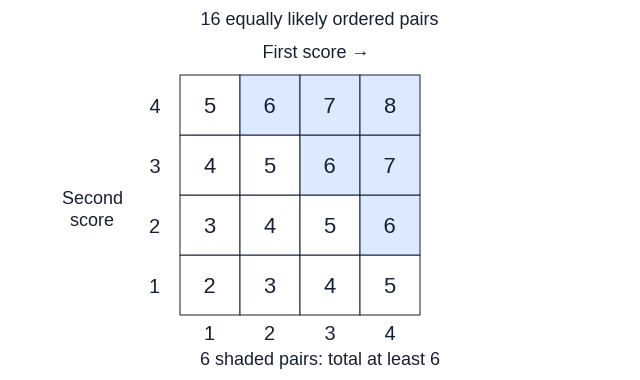
Two fair four-sector spinners labelled 1 to 4 are spun independently. Let A mean total at least 6 and B mean equal scores. Find , and .
Follow the solutionThere are 16 equally likely ordered pairs. Six have total at least 6, four have equal scores, and (3,3), (4,4) satisfy both.
Keep the four disjoint regions separate
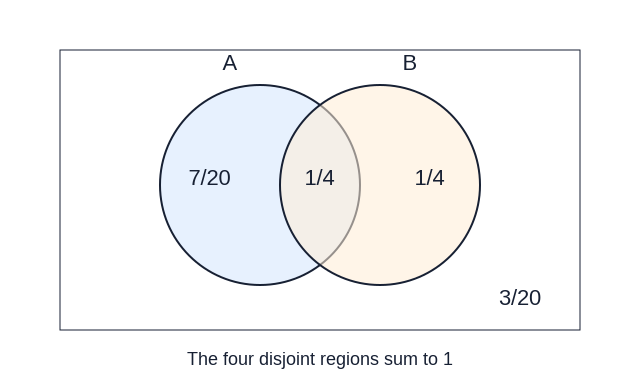
, , . Find the four Venn-region probabilities and the probability of exactly one event.
Follow the solutionExactly one has probability . The four regions sum to 1.
Disjoint positive events cannot be independent
A and B are mutually exclusive with probabilities and . Find the union probability and decide whether they are independent.
Follow the solutionThe intersection is zero, whereas . They are not independent. Mutual exclusion justifies adding here, not multiplying.
A biased spinner needs weighted outcomes
A spinner scores 1, 2, 4 with probabilities , , . Spin twice independently. Given at least one 4, find the probability that the total is 5.
Follow the solutionLet E mean total 5 and H mean at least one 4. Only (1,4) and (4,1) contribute to E.