Maths4UBETA

Independent trials, sequences and stopping rules

Add complete disjoint sequences, using complements where useful and stopping paths when the experiment ends.

Try the quick check →
Lesson 2 of 5

Section 1 of 5 · Core · about 8 min

How do I calculate a fixed sequence of results?

A trial is one repetition of an experiment. Choose a result of interest and label it S; label every other result F. “Success” is just a label—it can mean a defect or a missed target. Write the results in their actual order.

Independent trials let you multiply their individual probabilities along a specified string. Independence does not say that every trial has the same success chance. When every trial does have probability pp, put q=1−pq=1-p. For 0<p<10<p<1, a specified string containing rr successes in nn trials has weight prqn−rp^rq^{n-r}. If p=0p=0 or p=1p=1, only the all-failure or all-success string can occur.

Worked example

Separate one string from a success count

Four independent trials each succeed with probability 13\frac{1}{3}. Find the probabilities of the specified string SFSF, exactly two successes, and at least two successes.

  1. Put p=13p=\frac{1}{3} and q=23q=\frac{2}{3}. For one specified order, multiply its four factors:

    P(SFSF)=pqpq=p2q2=481.P(\mathrm{SFSF})=pqpq=p^2q^2=\frac{4}{81}.
  2. Exactly two successes can occur in six different strings:

    SSFF, SFSF, SFFS, FSSF, FSFS, FFSS.\mathrm{SSFF},\ \mathrm{SFSF},\ \mathrm{SFFS},\ \mathrm{FSSF},\ \mathrm{FSFS},\ \mathrm{FFSS}.

    Each has the same weight here, so

    P(exactly two S)=6p2q2=827.P(\text{exactly two S})=6p^2q^2=\frac{8}{27}.
  3. The complement of at least two successes is zero or one success. These are disjoint cases:

    P(zero S)=q4=1681,P(exactly one S)=4pq3=3281.P(\text{zero S})=q^4=\frac{16}{81},\qquad P(\text{exactly one S})=4pq^3=\frac{32}{81}.
  4. P(at least two S)=1−1681−3281=1127.P(\text{at least two S})=1-\frac{16}{81}-\frac{32}{81}=\frac{11}{27}.

    As a check, exactly three and exactly four contribute 881\frac{8}{81} and 181\frac{1}{81}, which add to 827\frac{8}{27} to give the same result.

Your turn

Three independent trials each succeed with probability 14\frac{1}{4}. Write S for success and F for failure. Find the probabilities of the specified string SFF, exactly one success, and at least one success.

Enter an exact value or round to 3 significant figures.

Enter an exact value or round to 3 significant figures.

Enter an exact value or round to 3 significant figures.

Section 2 of 5 · Core · about 6 min

What changes if the trial probabilities differ?

Keep a separate probability pip_i for success on trial ii. A failure on that trial has probability 1−pi1-p_i. Independence still permits products, but two strings with the same number of successes can have different weights.

P(SSF)=p1p2(1−p3),P(SFS)=p1(1−p2)p3.P(\mathrm{SSF})=p_1p_2(1-p_3),\qquad P(\mathrm{SFS})=p_1(1-p_2)p_3.

The all-failure complement still works:

P(at least one S)=1−(1−p1)(1−p2)⋯(1−pn).P(\text{at least one S})=1-(1-p_1)(1-p_2)\cdots(1-p_n).

The independent trial success probabilities are 12\frac{1}{2}, 23\frac{2}{3} and 34\frac{3}{4}, in that order. Here S means success and F means failure.

HistorySuccessesProbability
SSS314\frac{1}{4}
SSF2112\frac{1}{12}
SFS218\frac{1}{8}
SFF1124\frac{1}{24}
FSS214\frac{1}{4}
FSF1112\frac{1}{12}
FFS118\frac{1}{8}
FFF0124\frac{1}{24}
P(SSF)=12⋅23⋅14=112.P(SSF)=\frac12\cdot\frac23\cdot\frac14=\frac1{12}.P(exactly two)=112+18+14=1124.P(\text{exactly two})=\frac1{12}+\frac18+\frac14=\frac{11}{24}.P(at least two)=1124+14=1724.P(\text{at least two})=\frac{11}{24}+\frac14=\frac{17}{24}.

The eight complete three-trial strings have their own weights. The three highlighted strings give exactly two successes; adding SSS gives at least two.

Worked example

Weight the success positions separately

Three trials are independent. Their success probabilities, in order, are 12\frac{1}{2}, 23\frac{2}{3} and 34\frac{3}{4}. Find the probabilities of exactly two successes, at least two successes, and at least one success.

  1. Exactly two successes occurs through SSF, SFS or FSS. Their weights are different:

    P(SSF)=12⋅23⋅14=112,P(SFS)=12⋅13⋅34=18,P(FSS)=12⋅23⋅34=14.\begin{aligned}P(\mathrm{SSF})&=\frac{1}{2}\cdot\frac{2}{3}\cdot\frac{1}{4}=\frac{1}{12},\\P(\mathrm{SFS})&=\frac{1}{2}\cdot\frac{1}{3}\cdot\frac{3}{4}=\frac{1}{8},\\P(\mathrm{FSS})&=\frac{1}{2}\cdot\frac{2}{3}\cdot\frac{3}{4}=\frac{1}{4}.\end{aligned}
  2. P(exactly two S)=112+18+14=1124.P(\text{exactly two S})=\frac{1}{12}+\frac{1}{8}+\frac{1}{4}=\frac{11}{24}.
  3. P(SSS)=12⋅23⋅34=14,P(at least two S)=1124+14=1724.P(\mathrm{SSS})=\frac{1}{2}\cdot\frac{2}{3}\cdot\frac{3}{4}=\frac{1}{4},\qquad P(\text{at least two S})=\frac{11}{24}+\frac{1}{4}=\frac{17}{24}.
  4. P(at least one S)=1−P(FFF)=1−12⋅13⋅14=2324.P(\text{at least one S})=1-P(\mathrm{FFF})=1-\frac{1}{2}\cdot\frac{1}{3}\cdot\frac{1}{4}=\frac{23}{24}.

Your turn

Three trials are independent, with success probabilities 14\frac{1}{4}, 12\frac{1}{2} and 23\frac{2}{3}, in that order. Find the probabilities of exactly one success and at least one success. Can the exactly-one result be found by multiplying the probability of SFF by three?

Enter an exact value or round to 3 significant figures.

Enter an exact value or round to 3 significant figures.

Can one path weight be multiplied by three?

Section 3 of 5 · Core · about 8 min

How do I count an adjacency or colour pattern?

A count of successes does not record their positions. For an adjacency condition, list the permitted complete strings or split them into cases that cannot overlap. A run means consecutive occurrences, so “exactly two successes, adjacent” differs from “at least one adjacent pair of successes”.

Worked example

Allow a run without counting it twice

Four independent trials each succeed with probability 13\frac{1}{3}. Find the probability of exactly two successes which are adjacent. Then find the probability of at least one adjacent pair of successes.

  1. Exactly two adjacent successes gives SSFF, FSSF or FFSS. With p=13p=\frac{1}{3} and q=23q=\frac{2}{3},

    P(exactly two S, adjacent)=3p2q2=427.P(\text{exactly two S, adjacent})=3p^2q^2=\frac{4}{27}.
  2. For at least one adjacent pair, also include the four strings with three successes—SSSF, SSFS, SFSS and FSSS—and the string SSSS. All eight complete strings are distinct.

  3. P(at least one adjacent SS)=3p2q2+4p3q+p4=12+8+181=727.P(\text{at least one adjacent SS})=3p^2q^2+4p^3q+p^4=\frac{12+8+1}{81}=\frac{7}{27}.
  4. SSSS contains three adjacent pairs but is only one outcome. Adding three unrestricted pair probabilities would count overlapping outcomes more than once.

Your turn

Three independent trials each succeed with probability 34\frac{3}{4}. Find the probability that there are exactly two successes and they are adjacent. Then find the probability that there is at least one adjacent pair of successes.

Enter an exact value or round to 3 significant figures.

Enter an exact value or round to 3 significant figures.

The same method works for more than two result labels. For three independent trials with the same colour probabilities, one of each of R, G and B can occur as RGB, RBG, GRB, GBR, BRG or BGR. Add these six path weights. “Exactly two distinct colours” is the complement of “all three the same” or “all three different”; it is not the same as exactly two results of a chosen colour.

Read how a code is generated. Independent uniform choices from three symbols allow repeats: a three-symbol code has 2727 equally likely strings, of which 66 have no repeated symbol. Generating a code without replacement is a different experiment: all its permitted strings already have no repetition.

Section 4 of 5 · Core · about 8 min

Which paths remain when attempts stop at success?

Write the stopping rule first. A terminal path ends when success occurs or the stated attempt limit is reached. Do not add further results after that point. Terminal paths can have different lengths and different probabilities.

When failed items are removed, use the chance among the items that remain. Those branches describe conditional probabilities after the recorded failures; the attempts are not independent. “Reached attempt jj”, “succeeded on attempt jj” and “succeeded by attempt jj” are different events.

Worked example

Stop at success or at the attempt limit

Exactly one of five distinct keys opens a lock. They are tried in a uniformly random order without replacement. Stop when the lock opens, or after three attempts. Let TT be the number of attempts made. Find P(open)P(\text{open}), P(T=3)P(T=3), and P(open∣T=3)P(\text{open}\mid T=3).

  1. The complete terminal strings are S, FS, FFS and FFF. After each failure there is one working key among fewer untried keys.

    P(S)=15,P(FS)=45⋅14=15,P(FFS)=45⋅34⋅13=15.P(\mathrm{S})=\frac{1}{5},\quad P(\mathrm{FS})=\frac{4}{5}\cdot\frac{1}{4}=\frac{1}{5},\quad P(\mathrm{FFS})=\frac{4}{5}\cdot\frac{3}{4}\cdot\frac{1}{3}=\frac{1}{5}.
  2. P(FFF)=45⋅34⋅23=25.P(\mathrm{FFF})=\frac{4}{5}\cdot\frac{3}{4}\cdot\frac{2}{3}=\frac{2}{5}.

    The four terminal weights sum to one.

  3. P(open)=P(S)+P(FS)+P(FFS)=35.P(\text{open})=P(\mathrm{S})+P(\mathrm{FS})+P(\mathrm{FFS})=\frac{3}{5}.
  4. Reaching the third attempt means the first two keys failed. The third attempt is then made whether it succeeds or fails:

    P(T=3)=P(FFS)+P(FFF)=35.P(T=3)=P(\mathrm{FFS})+P(\mathrm{FFF})=\frac{3}{5}.
  5. P(open∣T=3)=P(FFS)P(T=3)=1535=13.P(\text{open}\mid T=3)=\frac{P(\mathrm{FFS})}{P(T=3)}=\frac{\frac{1}{5}}{\frac{3}{5}}=\frac{1}{3}.

    The two probabilities equal to 35\frac{3}{5} describe different events. Neither equals the unconditional probability 15\frac{1}{5} of opening specifically on the third attempt.

More generally, with one working key among mm keys in uniform random order, its position is equally likely to be any of 1,…,m1,\ldots,m. For an attempt limit rr, where 1≤r≤m1\le r\le m, the first rr positions give success by the limit. Positions r,…,mr,\ldots,m require reaching attempt rr:

P(success by r)=rm,P(reach r)=m−r+1m.P(\text{success by }r)=\frac{r}{m},\qquad P(\text{reach }r)=\frac{m-r+1}{m}.

On reaching that attempt, one of the m−r+1m-r+1 remaining keys works, so the conditional chance of success there is 1m−r+1\frac{1}{m-r+1}.

Your turn

Exactly one of seven distinct keys opens a lock. Keys are tried in a uniformly random order without replacement. Testing stops immediately when the lock opens, or after four attempts. Find the probability of opening the lock, the probability of reaching attempt four, and the probability of opening it given that attempt four is reached.

Enter an exact value or round to 3 significant figures.

Enter an exact value or round to 3 significant figures.

Enter an exact value or round to 3 significant figures.

Section 5 of 5 · Core · about 10 min

How do I handle a contest or a changing history?

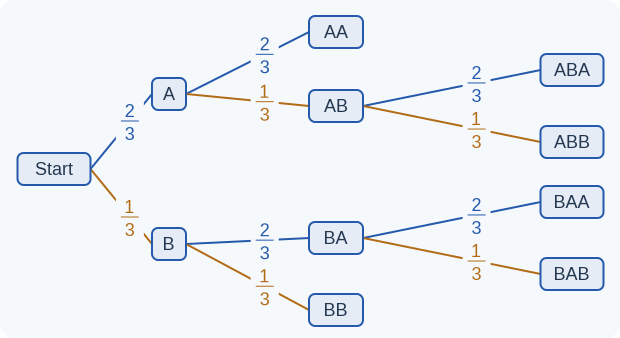
In a first-to-two contest, stop each path at the second win for either player. A fixed number of scheduled rounds and a contest that stops early are different sample spaces. You can imagine unused later outcomes to check a model, but never count an extension of an already finished path as a second observed result.

AA and BB stop after two rounds. ABA, ABB, BAA and BAB stop after three rounds.

Rounds are independent with A-win probability 23\frac{2}{3} and B-win probability 13\frac{1}{3}. Stop as soon as one player wins two rounds.

Terminal pathWeight
AA(23)2=49\left(\frac23\right)^2=\frac49
ABA, BAA(23)213=427\left(\frac23\right)^2\frac13=\frac4{27} each
ABB, BAB23(13)2=227\frac23\left(\frac13\right)^2=\frac2{27} each
BB(13)2=19\left(\frac13\right)^2=\frac19
P(A wins)=49+427+427=2027.P(\text{A wins})=\frac49+\frac4{27}+\frac4{27}=\frac{20}{27}.P(three rounds)=427+227+427+227=49.P(\text{three rounds})=\frac4{27}+\frac2{27}+\frac4{27}+\frac2{27}=\frac49.

The contest has six terminal paths. AA and BB end after two rounds; the other four paths end after three.

Worked example

End each contest path at the second win

A and B play independent rounds, with no draws. A wins each round with probability 23\frac{2}{3}. The contest ends when either player has won two rounds. Find the probability that A wins, the probability of three rounds, and the probability of three rounds given that A wins.

  1. The terminal strings are AA, BB, ABA, ABB, BAA and BAB. A third letter is not appended to AA or BB because the contest has already ended.

  2. P(AA)=49,P(ABA)=P(BAA)=427.P(\mathrm{AA})=\frac{4}{9},\qquad P(\mathrm{ABA})=P(\mathrm{BAA})=\frac{4}{27}.

    These are the three disjoint routes to an A win.

    P(A wins)=49+427+427=2027.P(\text{A wins})=\frac{4}{9}+\frac{4}{27}+\frac{4}{27}=\frac{20}{27}.
  3. A third round is needed exactly when the first two winners differ:

    P(three rounds)=P(AB)+P(BA)=2⋅23⋅13=49.P(\text{three rounds})=P(\mathrm{AB})+P(\mathrm{BA})=2\cdot\frac{2}{3}\cdot\frac{1}{3}=\frac{4}{9}.
  4. P(three rounds∣A wins)=P(ABA)+P(BAA)P(A wins)=8272027=25.P(\text{three rounds}\mid\text{A wins})=\frac{P(\mathrm{ABA})+P(\mathrm{BAA})}{P(\text{A wins})}=\frac{\frac{8}{27}}{\frac{20}{27}}=\frac{2}{5}.
  5. The remaining weights are P(BB)=19P(\mathrm{BB})=\frac{1}{9} and P(ABB)=P(BAB)=227P(\mathrm{ABB})=P(\mathrm{BAB})=\frac{2}{27}. Together with the three A-winning paths, they sum to one.

For a constant per-round A-win probability pp, put q=1−pq=1-p. The same terminal paths give

P(A wins)=p2+2p2q,P(three rounds)=2pq.P(\text{A wins})=p^2+2p^2q,\qquad P(\text{three rounds})=2pq.

When p>0p>0, conditioning on an A win is valid:

P(three rounds∣A wins)=2p2qp2+2p2q=2q1+2q.P(\text{three rounds}\mid\text{A wins})=\frac{2p^2q}{p^2+2p^2q}=\frac{2q}{1+2q}.

Even with independent rounds, learning the current score can change the eventual winning chance. In the preceding example, after A wins round one, A wins the contest unless B wins both remaining rounds. That chance is 1−(13)2=891-\left(\frac{1}{3}\right)^2=\frac{8}{9}, while A’s next-round chance remains 23\frac{2}{3}.

When the problem gives different chances after different histories, multiply the conditional branch probabilities actually reached. Here AiA_i and BiB_i mean that A and B, respectively, win round ii. For a three-step path, the rule is

P(A1∩B2∩A3)=P(A1) P(B2∣A1) P(A3∣A1∩B2).P(A_1\cap B_2\cap A_3)=P(A_1)\,P(B_2\mid A_1)\,P(A_3\mid A_1\cap B_2).

Use a conditional branch only at a history with positive probability; an unreachable history contributes no path weight. Every set of outgoing probabilities at a reachable node must sum to one.

Worked example

Follow conditional chances when the history changes

A contest has no draws and ends at two wins for either player. A wins round one with probability 12\frac{1}{2}. A wins round two with probability 34\frac{3}{4} after an A win, or 13\frac{1}{3} after a B win. If the first two rounds are split, A wins round three with probability 25\frac{2}{5}, in either order. Find the probability that A wins the contest.

  1. The winning terminal strings remain AA, ABA and BAA, but their branch probabilities depend on the preceding results.

    P(AA)=12⋅34=38.P(\mathrm{AA})=\frac{1}{2}\cdot\frac{3}{4}=\frac{3}{8}.
  2. P(ABA)=12⋅14⋅25=120,P(BAA)=12⋅13⋅25=115.P(\mathrm{ABA})=\frac{1}{2}\cdot\frac{1}{4}\cdot\frac{2}{5}=\frac{1}{20},\qquad P(\mathrm{BAA})=\frac{1}{2}\cdot\frac{1}{3}\cdot\frac{2}{5}=\frac{1}{15}.
  3. P(A wins)=38+120+115=59120.P(\text{A wins})=\frac{3}{8}+\frac{1}{20}+\frac{1}{15}=\frac{59}{120}.
  4. For a check, the B-winning terminal weights are P(BB)=13P(\mathrm{BB})=\frac{1}{3}, P(ABB)=340P(\mathrm{ABB})=\frac{3}{40} and P(BAB)=110P(\mathrm{BAB})=\frac{1}{10}. They sum to 61120\frac{61}{120}, the required complement.

Your turn

A contest has no draws and ends as soon as A or B has won two rounds. A wins the first round with probability 35\frac{3}{5}. In round two, A wins with probability 12\frac{1}{2} if A won round one, and with probability 14\frac{1}{4} if B won round one. If a third round is needed, A wins it with probability 34\frac{3}{4}, for either possible order of the first two results. Find the probabilities that A wins the contest, that three rounds are played, and that three rounds were played given that A won.

Enter an exact value or round to 3 significant figures.

Enter an exact value or round to 3 significant figures.

Enter an exact value or round to 3 significant figures.

In the model, change the independent per-round probability pp that A wins. Inspect all six terminal weights, the winning probability and the chance of three rounds. At p=0p=0, conditioning on an A win is undefined because A cannot win. This model keeps one constant pp; the changing-history example above needs its separate branch probabilities.

Worked examples

Practise the method

Core practice

Question 1 of 4

0 / 4 checked in this collection

Question list

Core practice

Fresh variants

Exam-style

Exactly one success includes all its positions

3 marks

Three independent trials each succeed with probability 25\frac{2}{5}. Find the probabilities of SFF, exactly one success, and at least one success.

Enter an exact value or round to 3 significant figures.

Enter an exact value or round to 3 significant figures.

Enter an exact value or round to 3 significant figures.

Full answer-format guide

Exact numbers: 3/2, sqrt(5), 2-sqrt(3), pi/6, 3*pi/2. Sets: {1,4}. Intervals: (3,5]; a round bracket excludes the endpoint. Infinity: inf; union: U; no solutions: empty. Separate coordinate pairs or triples with semicolons. Expressions: 2x^2+3x-1; equations: x^2=3x+1 or the polynomial equal to zero. Factors: x-1 ; x+2. Parameter fraction: numerator ; denominator. List integer answers individually.

Review the method

Progress stays in this browser. Create an account to save it or sign in.

Extra practice from this lesson

Separate one path, exactly one and at least one

Four independent trials each succeed with probability 15\frac{1}{5}. Write S for success and F for failure. Find the probabilities of the particular sequence SFFF, exactly one success, at least one success and at most one success.

Enter an exact value or round to 3 significant figures.

Enter an exact value or round to 3 significant figures.

Enter an exact value or round to 3 significant figures.

Enter an exact value or round to 3 significant figures.

Unequal chances give unequal sequence weights

Three independent checks have pass probabilities 25,12,35\frac{2}{5},\frac{1}{2},\frac{3}{5} in that order. Find the probabilities of all passing, exactly two passing, and at least one passing. Given that exactly two pass, find the probability that the third check passes.

Enter an exact value or round to 3 significant figures.

Enter an exact value or round to 3 significant figures.

Enter an exact value or round to 3 significant figures.

Enter an exact value or round to 3 significant figures.

Do not count overlapping runs twice

A fair coin is tossed independently four times. Find the probability of at least one adjacent HH pair. Separately, find the probability of exactly two heads with those two heads adjacent. A student adds the probabilities of HH in positions 1,21,2, 2,32,3, and 3,43,4, obtaining 34\frac{3}{4} for the first question. Is that addition valid?

Enter an exact value or round to 3 significant figures.

Enter an exact value or round to 3 significant figures.

Is the proposed addition valid?

Distinguish reaching the limit from succeeding there

Exactly one of eight distinct keys opens a lock. Keys are tried in a uniformly random order without repetition. The procedure stops on success or after the third attempt. Let TT be the number of attempts actually made, and WW the event that the lock opens. Find P(W)P(W), P(T=3)P(T=3), P(W∣T=3)P(W\mid T=3) and P(T=3∣W)P(T=3\mid W).

Enter an exact value or round to 3 significant figures.

Enter an exact value or round to 3 significant figures.

Enter an exact value or round to 3 significant figures.

Enter an exact value or round to 3 significant figures.

End a contest as soon as somebody wins twice

In each round A beats B with probability 14\frac{1}{4}, independently of previous rounds. There are no draws. The contest stops as soon as either player has won two rounds. Find the probability of an A contest win, the probability of three rounds, and the probability of three rounds given an A contest win. Is AABA an additional terminal sequence?

Enter an exact value or round to 3 significant figures.

Enter an exact value or round to 3 significant figures.

Enter an exact value or round to 3 significant figures.

Is AABA a terminal sequence?

Apply it · original exam-style problems

Show your working on paper and compare it with the worked solution and marking guidance.

Start after this lesson

Use the probability attached to the reached history 8 marks

A contest without draws stops when either player A or B has won twice. A wins the first round with probability 23\frac{2}{3}. In round two, A wins with probability 12\frac{1}{2} if A won round one, but with probability 34\frac{3}{4} if B won round one. If a third round is reached, A wins it with probability 14\frac{1}{4} after either mixed two-round history. Find the probabilities of an A contest win and three rounds. Given an A contest win, find the probability of three rounds and the probability that A won the first round.

Hint

The second-round probabilities depend on the first result. Label each reached branch with its own conditional probability, and stop at AA or BB.

Worked solution
  1. P(AA)=23⋅12=13,P(BB)=13⋅14=112.P(\mathrm{AA})=\frac{2}{3}\cdot\frac{1}{2}=\frac{1}{3},\qquad P(\mathrm{BB})=\frac{1}{3}\cdot\frac{1}{4}=\frac{1}{12}.
  2. P(AB)=13,P(BA)=13⋅34=14.P(\mathrm{AB})=\frac{1}{3},\qquad P(\mathrm{BA})=\frac{1}{3}\cdot\frac{3}{4}=\frac{1}{4}.

    Only these two mixed histories continue, giving P(three rounds)=13+14=712P(\text{three rounds})=\frac{1}{3}+\frac{1}{4}=\frac{7}{12}.

  3. P(ABA)=13⋅14=112,P(BAA)=14⋅14=116.P(\mathrm{ABA})=\frac{1}{3}\cdot\frac{1}{4}=\frac{1}{12},\qquad P(\mathrm{BAA})=\frac{1}{4}\cdot\frac{1}{4}=\frac{1}{16}.
  4. P(A wins)=13+112+116=2348.P(\text{A wins})=\frac{1}{3}+\frac{1}{12}+\frac{1}{16}=\frac{23}{48}.
  5. P(three∣A wins)=112+1162348=723.P(\text{three}\mid\text{A wins})=\frac{\frac{1}{12}+\frac{1}{16}}{\frac{23}{48}}=\frac{7}{23}.
  6. An A contest win with an A first-round win occurs through AA or ABA:

    P(first A∣A wins)=13+1122348=2023.P(\text{first A}\mid\text{A wins})=\frac{\frac{1}{3}+\frac{1}{12}}{\frac{23}{48}}=\frac{20}{23}.
  7. The remaining terminal paths ABB and BAB have probabilities 14\frac{1}{4} and 316\frac{3}{16}. Along with AA, BB, ABA and BAA, all terminal weights sum to one.

Marking guidance
  • 1 mark: use the correct history-dependent second-round probabilities.
  • 1 mark: obtain both mixed-history weights.
  • 1 mark: calculate the chance of reaching round three.
  • 1 mark: obtain both three-round A-winning weights.
  • 1 mark: add all disjoint A-winning terminal paths.
  • 1 mark: form the correct numerator for three rounds and an A win.
  • 1 mark: divide by the A-win probability.
  • 1 mark: condition the first-round result using AA and ABA.
Count colour sequences as disjoint alternatives 8 marks

Three labels are generated independently. Each label is red, green or blue with probabilities 12,13,16\frac{1}{2},\frac{1}{3},\frac{1}{6}, respectively. Find the probabilities that all three colours appear, that all labels have the same colour, and that exactly two distinct colours appear. Also find the probability of at least one red label, and the probability that all three colours appear given at least one red label.

Hint

All three colours appear through the six orders of RGB. Classify the complete sample by the number of distinct colours: one, two or three. These categories are disjoint and exhaustive.

Worked solution
  1. The six orders are RGB, RBG, GRB, GBR, BRG and BGR. Each has probability 12⋅13⋅16=136\frac{1}{2}\cdot\frac{1}{3}\cdot\frac{1}{6}=\frac{1}{36}, so

    P(all three colours)=6(136)=16.P(\text{all three colours})=6\left(\frac{1}{36}\right)=\frac{1}{6}.
  2. P(all same)=(12)3+(13)3+(16)3=27+8+1216=16.P(\text{all same})=\left(\frac{1}{2}\right)^3+\left(\frac{1}{3}\right)^3+\left(\frac{1}{6}\right)^3=\frac{27+8+1}{216}=\frac{1}{6}.
  3. Exactly two distinct colours means one colour appears twice and another once. It is the remaining category:

    P(exactly two distinct colours)=1−16−16=23.P(\text{exactly two distinct colours})=1-\frac{1}{6}-\frac{1}{6}=\frac{2}{3}.
  4. P(at least one red)=1−(12)3=78.P(\text{at least one red})=1-\left(\frac{1}{2}\right)^3=\frac{7}{8}.
  5. All three colours necessarily includes red. Therefore the conditional numerator is the all-three probability:

    P(all three∣at least one red)=1678=421.P(\text{all three}\mid\text{at least one red})=\frac{\frac{1}{6}}{\frac{7}{8}}=\frac{4}{21}.

    The 2727 ordered colour strings are not equally likely; only strings containing the same numbers of each colour have equal weights under this fixed-probability model.

Marking guidance
  • 1 mark: list or account for all six orders containing all three colours.
  • 1 mark: calculate their common path probability and total.
  • 1 mark: form the weighted sum of the three all-same paths.
  • 1 mark: calculate that sum.
  • 1 mark: identify the one/two/three-colour partition.
  • 1 mark: find exactly two distinct colours by subtraction.
  • 1 mark: find the positive conditioning probability using a complement.
  • 1 mark: use containment and divide by that conditioning probability.

Come back to what needs practice

Quick revision sheet (A4)

Your review plan starts after your first check.

Question bank and saved work