Worked example
Find the scalar product
Calculate for and .
Multiply corresponding components, then add.
.
Use scalar products to find directed vector angles, smaller line angles and perpendicular directions.
Try the quick check →Section 1 of 5 · Core · about 6 min
Multiply matching components and add the products. The resulting scalar can be negative, zero or positive.
Worked example
Calculate for and .
Multiply corresponding components, then add.
.
Section 2 of 5 · Core · about 6 min
Put both vector arrows tail to tail. For non-zero vectors, divide the dot product by the two positive magnitudes to get the cosine of their angle.
Worked example
Find the angle between the vectors and . Give your answer in degrees to one decimal place.
Keep the sign of the scalar product because the two vector arrows have fixed directions.
The magnitudes are and , giving .
Therefore .
Worked example
Find the angle between the vectors and . Give your answer in degrees to one decimal place.
Try it on paper first.
Keep the sign of the scalar product because the two vector arrows have fixed directions.
The magnitudes are and , giving .
Therefore .
Section 3 of 5 · Core · about 6 min
A direction vector can be reversed without changing a line. The angle between two lines is the smaller angle made by a pair of their directions, whether or not the lines meet.
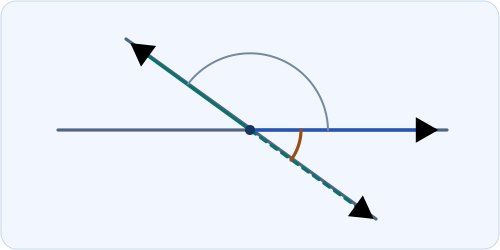
Either sense can describe the teal line. Its smaller angle with the blue line is the acute angle in this sketch.
Worked example
Find the smaller angle between and . Give your answer in degrees to one decimal place.
Use the direction vectors. Their dot product is . The absolute value gives the smaller angle because either direction can represent a line.
The magnitudes are and , giving .
Therefore .
Worked example
Find the smaller angle between and . Give the exact value of .
Try it on paper first.
Use the direction vectors. Their dot product is . The absolute value gives the smaller angle because either direction can represent a line.
The magnitudes are and , giving .
.
Section 4 of 5 · Core · about 6 min
The dot product of non-zero vectors vanishes exactly when the cosine of their angle is zero. This gives an equation for unknown components.
Worked example
Find when and are perpendicular.
Both vectors have non-zero length when perpendicular. Their scalar product must be zero.
The equation is .
Solving gives .
Section 5 of 5 · Further applications · about 5 min
Taking the dot product with a unit direction gives the signed length of a component. A negative result means the component points against the chosen direction.
Worked example
Find the signed scalar component of along the direction . Give an exact value.
Turn the direction into a unit vector .
Take the dot product with that unit vector. The signed component is .
Question 1 of 4
0 / 4 checked in this collection
Calculate for and .
Progress stays in this browser. Create an account to save it or sign in.
Show your working on paper and compare it with the worked solution and marking guidance.
Your review plan starts after your first check.