Maths4UBETA

Components, displacements and unit vectors

Use 2D and 3D vectors to describe position, displacement, length and midpoint.

Try the quick check →
Lesson 1 of 5

Section 1 of 5 · Core · about 6 min

How do I read a vector in 2D or 3D?

An ordered list of components describes a movement. The point P(2,−1,3)P(2,-1,3) has position vector OP→\overrightarrow{OP}. The same column can describe a displacement between other points.

Worked example

Read the basis components

Write 3i−5k3 \mathbf i - 5 \mathbf k as a column vector. Give all 3 components.

  1. The coefficients of i,j,k\mathbf i,\mathbf j,\mathbf k give the components in that order.

  2. The column vector is (30−5)\begin{pmatrix}3\\0\\-5\end{pmatrix}.

Your turn

Write −2i−4j- 2 \mathbf i - 4 \mathbf j as a column vector. Give all 3 components.

Enter an exact number, for example 3/2 or 2-sqrt(3).

Enter an exact number, for example 3/2 or 2-sqrt(3).

Enter an exact number, for example 3/2 or 2-sqrt(3).

Section 2 of 5 · Core · about 6 min

Which point do I subtract first?

Think of a route from the origin. Going to AA and then moving by AB→\overrightarrow{AB} must arrive at BB. Reversing the route negates the displacement.
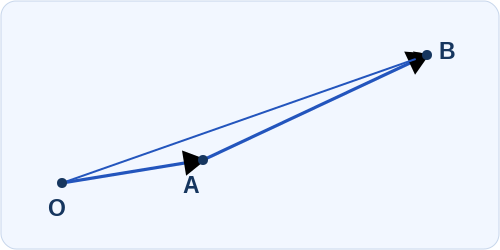
Three arrows show the route from O to A, from O to B and from A to B.

The route O→A→BO\to A\to B and the direct route O→BO\to B have the same total displacement.

Worked example

Find endpoint minus start point

Find AB→\overrightarrow{AB} for A(2,−3,5)A(2, -3, 5) and B(−4,1,2)B(-4, 1, 2).

  1. The movement must start at AA and finish at BB. Subtract the starting position from the ending position.

  2. AB→=(−412)−(2−35)=(−64−3)\overrightarrow{AB}=\begin{pmatrix}-4\\1\\2\end{pmatrix}-\begin{pmatrix}2\\-3\\5\end{pmatrix}=\begin{pmatrix}-6\\4\\-3\end{pmatrix}.

Your turn

Find AB→\overrightarrow{AB} for A(−5,2,4)A(-5, 2, 4) and B(3,−1,−2)B(3, -1, -2).

Enter an exact number, for example 3/2 or 2-sqrt(3).

Enter an exact number, for example 3/2 or 2-sqrt(3).

Enter an exact number, for example 3/2 or 2-sqrt(3).

Worked example

Find endpoint minus start point

Find AB→\overrightarrow{AB} for A(6,−3)A(6, -3) and B(−2,0)B(-2, 0).

Try it on paper first.

  1. The movement must start at AA and finish at BB. Subtract the starting position from the ending position.

  2. AB→=(−20)−(6−3)=(−83)\overrightarrow{AB}=\begin{pmatrix}-2\\0\end{pmatrix}-\begin{pmatrix}6\\-3\end{pmatrix}=\begin{pmatrix}-8\\3\end{pmatrix}.

Section 3 of 5 · Core · about 6 min

How do I add and scale movements?

To take two steps, translate the second arrow so it starts at the first arrow’s tip. To multiply by a scalar, multiply all the components by that number.

Worked example

Combine two vectors

Given a=(14−2),b=(−305)\mathbf a=\begin{pmatrix}1\\4\\-2\end{pmatrix},\quad\mathbf b=\begin{pmatrix}-3\\0\\5\end{pmatrix}, calculate 2a−3b2 \mathbf a - 3 \mathbf b. Give all components.

  1. Scale every component before adding or subtracting.

  2. 2a−3b=2(14−2)−3(−305)=(118−19)2 \mathbf a - 3 \mathbf b=2\begin{pmatrix}1\\4\\-2\end{pmatrix}-3\begin{pmatrix}-3\\0\\5\end{pmatrix}=\begin{pmatrix}11\\8\\-19\end{pmatrix}.

Your turn

DABCDABC is a parallelogram, with vertices given in order. Find BB if D(2,1,−1)D(2, 1, -1), A(5,4,0)A(5, 4, 0) and C(0,3,4)C(0, 3, 4). Give all coordinates.

Enter an exact number, for example 3/2 or 2-sqrt(3).

Enter an exact number, for example 3/2 or 2-sqrt(3).

Enter an exact number, for example 3/2 or 2-sqrt(3).

Worked example

Complete a parallelogram

DABCDABC is a parallelogram, with vertices given in order. Find BB if D(3,−2,2)D(3, -2, 2), A(4,3,0)A(4, 3, 0) and C(−1,0,5)C(-1, 0, 5). Give all coordinates.

Try it on paper first.

  1. Opposite edges have the same directed displacement, so AB→=DC→\overrightarrow{AB}=\overrightarrow{DC}.

  2. Add the displacement (−105)−(3−22)\begin{pmatrix}-1\\0\\5\end{pmatrix}-\begin{pmatrix}3\\-2\\2\end{pmatrix} to the position of AA.

  3. The resulting point is B(0,5,3)B(0, 5, 3).

Section 4 of 5 · Core · about 6 min

How do I find length and unit direction?

Use Pythagoras on mutually perpendicular axes. The length is x2+y2+z2\sqrt{x^2+y^2+z^2} in 3D. In 2D omit the last term. A direction without its original speed or length can be given by a unit vector.

Worked example

Build a unit vector

Find the length of d=(2−36)\mathbf d=\begin{pmatrix}2\\-3\\6\end{pmatrix} and the unit vector in the direction of d\mathbf d. Give exact entries.

  1. Pythagoras gives ∣d∣=7|\mathbf d|=7.

  2. Divide every component by the positive length, preserving their signs.

  3. The length is 77 and the requested unit vector is (27−3767)\begin{pmatrix}\frac{2}{7}\\- \frac{3}{7}\\\frac{6}{7}\end{pmatrix}.

Your turn

Find the length of d=(−442)\mathbf d=\begin{pmatrix}-4\\4\\2\end{pmatrix} and the unit vector opposite to d\mathbf d. Give exact entries.

Enter an exact number, for example 3/2 or 2-sqrt(3).

Enter an exact number, for example 3/2 or 2-sqrt(3).

Enter an exact number, for example 3/2 or 2-sqrt(3).

Enter an exact number, for example 3/2 or 2-sqrt(3).

Section 5 of 5 · Core · about 6 min

Why does averaging locate the midpoint?

Start at AA and take half the displacement to BB. This gives an average of the endpoint position vectors, and it works in either dimension.

Worked example

Find the midpoint

Find the midpoint of ABAB when A(3,−8,1)A(3, -8, 1) and B(−5,2,4)B(-5, 2, 4). Give all coordinates.

  1. At the midpoint the displacement from AA is half of AB→\overrightarrow{AB}.

  2. Average the two position vectors. OM→=12((3−81)+(−524))=(−1−352)\overrightarrow{OM}=\frac12\left(\begin{pmatrix}3\\-8\\1\end{pmatrix}+\begin{pmatrix}-5\\2\\4\end{pmatrix}\right)=\begin{pmatrix}-1\\-3\\\frac{5}{2}\end{pmatrix}.

  3. The midpoint is M(−1,−3,52)M(-1, -3, \frac{5}{2}).

Your turn

Find the midpoint of ABAB when A(2,9,−6)A(2, 9, -6) and B(−5,1,8)B(-5, 1, 8). Give all coordinates.

Enter an exact number, for example 3/2 or 2-sqrt(3).

Enter an exact number, for example 3/2 or 2-sqrt(3).

Enter an exact number, for example 3/2 or 2-sqrt(3).

Worked examples

Practise the method

Core practice

Question 1 of 4

0 / 4 checked in this collection

Question list

Core practice

Fresh variants

Exam-style

Find endpoint minus start point

4 marks

Find AB→\overrightarrow{AB} and the exact length ABAB for A(3,−2,0)A(3, -2, 0) and B(1,−6,5)B(1, -6, 5).

Enter an exact number, for example 3/2 or 2-sqrt(3).

Enter an exact number, for example 3/2 or 2-sqrt(3).

Enter an exact number, for example 3/2 or 2-sqrt(3).

Enter an exact number, for example 3/2 or 2-sqrt(3).

Full answer-format guide

Exact numbers: 3/2, sqrt(5), 2-sqrt(3), pi/6, 3*pi/2. Sets: {1,4}. Intervals: (3,5]; a round bracket excludes the endpoint. Infinity: inf; union: U; no solutions: empty. Separate coordinate pairs or triples with semicolons. Expressions: 2x^2+3x-1; equations: x^2=3x+1 or the polynomial equal to zero. Factors: x-1 ; x+2. Parameter fraction: numerator ; denominator. List integer answers individually.

Review the method

Progress stays in this browser. Create an account to save it or sign in.

Extra practice from this lesson

Read the basis components

Write 6i−5j6 \mathbf i - 5 \mathbf j as a column vector. Give all 3 components.

Enter an exact number, for example 3/2 or 2-sqrt(3).

Enter an exact number, for example 3/2 or 2-sqrt(3).

Enter an exact number, for example 3/2 or 2-sqrt(3).

Find endpoint minus start point

Find AB→\overrightarrow{AB} and the exact length ABAB for A(3,−6,2)A(3, -6, 2) and B(−2,1,4)B(-2, 1, 4).

Enter an exact number, for example 3/2 or 2-sqrt(3).

Enter an exact number, for example 3/2 or 2-sqrt(3).

Enter an exact number, for example 3/2 or 2-sqrt(3).

Enter an exact number, for example 3/2 or 2-sqrt(3).

Combine two vectors

Given a=(20−3),b=(−473)\mathbf a=\begin{pmatrix}2\\0\\-3\end{pmatrix},\quad\mathbf b=\begin{pmatrix}-4\\7\\3\end{pmatrix}, calculate −a+2b- \mathbf a + 2 \mathbf b. Give all components.

Enter an exact number, for example 3/2 or 2-sqrt(3).

Enter an exact number, for example 3/2 or 2-sqrt(3).

Enter an exact number, for example 3/2 or 2-sqrt(3).

Build a unit vector

Find the length of d=(6−32)\mathbf d=\begin{pmatrix}6\\-3\\2\end{pmatrix} and the unit vector in the direction of d\mathbf d. Give exact entries.

Enter an exact number, for example 3/2 or 2-sqrt(3).

Enter an exact number, for example 3/2 or 2-sqrt(3).

Enter an exact number, for example 3/2 or 2-sqrt(3).

Enter an exact number, for example 3/2 or 2-sqrt(3).

Find the midpoint

Find the midpoint of ABAB when A(2,2)A(2, 2) and B(5,−3)B(5, -3). Give all coordinates.

Enter an exact number, for example 3/2 or 2-sqrt(3).

Enter an exact number, for example 3/2 or 2-sqrt(3).

Apply it · original exam-style problems

Show your working on paper and compare it with the worked solution and marking guidance.

Come back to what needs practice

Quick revision sheet (A4)

Your review plan starts after your first check.