Maths4UBETA

Foot of a perpendicular and point-to-line distance

Find the foot on a line, prove the nearest distance and use the method on spatial diagonals.

Try the quick check →
Lesson 5 of 5

Section 1 of 5 · Core · about 6 min

Where does a perpendicular from P reach a line?

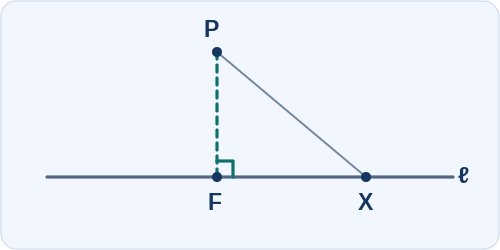
Write the foot FF as a general point on the line. The displacement from FF to PP must be perpendicular to the line direction.

A dashed perpendicular drops from P to F on line l. A different point X on the line joins P at a slant.

FF is on the line, and PFPF makes a right angle with it. The route to a different point XX is longer.

Worked example

Drop a perpendicular from a point

For P(5,2,6)P(5, 2, 6) and the line r=(1−12)+t(21−1)\mathbf r=\begin{pmatrix}1\\-1\\2\end{pmatrix}+t\begin{pmatrix}2\\1\\-1\end{pmatrix}, find the foot of the perpendicular FF. Give the parameter and every coordinate of FF.

  1. Put f=(1−12)+t(21−1)\mathbf f=\begin{pmatrix}1\\-1\\2\end{pmatrix}+t\begin{pmatrix}2\\1\\-1\end{pmatrix} on the line. The displacement from FF to PP must be perpendicular to its direction.

  2. Set the scalar product to zero. This gives 7−6t=07 - 6 t=0, so t=76t=\frac{7}{6}.

  3. Substitute into the line to obtain F(103,16,56)F(\frac{10}{3}, \frac{1}{6}, \frac{5}{6}).

  4. The perpendicular foot is F(103,16,56)F(\frac{10}{3}, \frac{1}{6}, \frac{5}{6}) at t=76t=\frac{7}{6}.

Your turn

For P(5,8,−1)P(5, 8, -1) and the line r=(420)+t(−132)\mathbf r=\begin{pmatrix}4\\2\\0\end{pmatrix}+t\begin{pmatrix}-1\\3\\2\end{pmatrix}, find the foot of the perpendicular FF. Give the parameter and every coordinate of FF.

Enter the value on its own or write t = … . Fractions and exact square roots are accepted.

Enter an exact number, for example 3/2 or 2-sqrt(3).

Enter an exact number, for example 3/2 or 2-sqrt(3).

Enter an exact number, for example 3/2 or 2-sqrt(3).

Section 2 of 5 · Core · about 6 min

How do I verify a candidate perpendicular foot?

A foot must lie on the given line and make a right angle with it. Solve for the parameter first and substitute back into the line. Test both conditions if a point has already been proposed.

Worked example

Drop a perpendicular from a point

For P(6,0,2)P(6, 0, 2) and the line r=(231)+t(03−2)\mathbf r=\begin{pmatrix}2\\3\\1\end{pmatrix}+t\begin{pmatrix}0\\3\\-2\end{pmatrix}, find the foot of the perpendicular FF. Give the parameter and every coordinate of FF.

  1. Put f=(231)+t(03−2)\mathbf f=\begin{pmatrix}2\\3\\1\end{pmatrix}+t\begin{pmatrix}0\\3\\-2\end{pmatrix} on the line. The displacement from FF to PP must be perpendicular to its direction.

  2. Set the scalar product to zero. This gives −13t−11=0- 13 t - 11=0, so t=−1113t=- \frac{11}{13}.

  3. Substitute into the line to obtain F(2,613,3513)F(2, \frac{6}{13}, \frac{35}{13}).

  4. The perpendicular foot is F(2,613,3513)F(2, \frac{6}{13}, \frac{35}{13}) at t=−1113t=- \frac{11}{13}.

Your turn

For P(5,1,7)P(5, 1, 7) and the line r=(−135)+t(221)\mathbf r=\begin{pmatrix}-1\\3\\5\end{pmatrix}+t\begin{pmatrix}2\\2\\1\end{pmatrix}, find the foot of the perpendicular FF. Give the parameter and every coordinate of FF.

Enter the value on its own or write t = … . Fractions and exact square roots are accepted.

Enter an exact number, for example 3/2 or 2-sqrt(3).

Enter an exact number, for example 3/2 or 2-sqrt(3).

Enter an exact number, for example 3/2 or 2-sqrt(3).

Worked example

Drop a perpendicular from a point

For P(5,−4,2)P(5, -4, 2) and the line r=(230)+t(31−2)\mathbf r=\begin{pmatrix}2\\3\\0\end{pmatrix}+t\begin{pmatrix}3\\1\\-2\end{pmatrix}, find the foot of the perpendicular FF. Give the parameter and every coordinate of FF.

Try it on paper first.

  1. Put f=(230)+t(31−2)\mathbf f=\begin{pmatrix}2\\3\\0\end{pmatrix}+t\begin{pmatrix}3\\1\\-2\end{pmatrix} on the line. The displacement from FF to PP must be perpendicular to its direction.

  2. Set the scalar product to zero. This gives −14t−2=0- 14 t - 2=0, so t=−17t=- \frac{1}{7}.

  3. Substitute into the line to obtain F(117,207,27)F(\frac{11}{7}, \frac{20}{7}, \frac{2}{7}).

  4. The perpendicular foot is F(117,207,27)F(\frac{11}{7}, \frac{20}{7}, \frac{2}{7}) at t=−17t=- \frac{1}{7}.

Section 3 of 5 · Core · about 6 min

Why is the perpendicular the shortest route?

For any other point XX on the line, triangle PFXPFX is right-angled at FF. So PX2=PF2+FX2PX^2=PF^2+FX^2, and any non-zero FXFX increases the distance.

Worked example

Drop a perpendicular from a point

For P(5,1,2)P(5, 1, 2) and the line r=(1−23)+t(201)\mathbf r=\begin{pmatrix}1\\-2\\3\end{pmatrix}+t\begin{pmatrix}2\\0\\1\end{pmatrix}, find the foot of the perpendicular FF and exact distance PFPF. Give every coordinate of FF.

  1. Put f=(1−23)+t(201)\mathbf f=\begin{pmatrix}1\\-2\\3\end{pmatrix}+t\begin{pmatrix}2\\0\\1\end{pmatrix} on the line. The displacement from FF to PP must be perpendicular to its direction.

  2. Set the scalar product to zero. This gives 7−5t=07 - 5 t=0, so t=75t=\frac{7}{5}.

  3. Substitute into the line to obtain F(195,−2,225)F(\frac{19}{5}, -2, \frac{22}{5}).

  4. The foot is F(195,−2,225)F(\frac{19}{5}, -2, \frac{22}{5}) and PF=955PF=\frac{9 \sqrt{5}}{5}. Use the magnitude of the perpendicular displacement (653−125)\begin{pmatrix}\frac{6}{5}\\3\\- \frac{12}{5}\end{pmatrix}.

Your turn

For P(2,7,−1)P(2, 7, -1) and the line r=(031)+t(3−11)\mathbf r=\begin{pmatrix}0\\3\\1\end{pmatrix}+t\begin{pmatrix}3\\-1\\1\end{pmatrix}, find the foot of the perpendicular FF and exact distance PFPF. Give every coordinate of FF.

Enter an exact number, for example 3/2 or 2-sqrt(3).

Enter an exact number, for example 3/2 or 2-sqrt(3).

Enter an exact number, for example 3/2 or 2-sqrt(3).

Enter an exact number, for example 3/2 or 2-sqrt(3).

Worked example

Drop a perpendicular from a point

For P(−1,9,−5)P(-1, 9, -5) and the line r=(234)+t(1−23)\mathbf r=\begin{pmatrix}2\\3\\4\end{pmatrix}+t\begin{pmatrix}1\\-2\\3\end{pmatrix}, find the foot of the perpendicular FF and exact distance PFPF. Give every coordinate of FF.

Try it on paper first.

  1. Put f=(234)+t(1−23)\mathbf f=\begin{pmatrix}2\\3\\4\end{pmatrix}+t\begin{pmatrix}1\\-2\\3\end{pmatrix} on the line. The displacement from FF to PP must be perpendicular to its direction.

  2. Set the scalar product to zero. This gives −14t−42=0- 14 t - 42=0, so t=−3t=-3.

  3. Substitute into the line to obtain F(−1,9,−5)F(-1, 9, -5).

  4. The foot is F(−1,9,−5)F(-1, 9, -5) and PF=0PF=0. Use the magnitude of the perpendicular displacement (000)\begin{pmatrix}0\\0\\0\end{pmatrix}.

Section 4 of 5 · Core · about 6 min

How does the method work with a solid?

Assign axes along mutually perpendicular edges. For a cuboid, the coordinates of each vertex can then be read from its side lengths. Build the line and perpendicular condition from these coordinates.

Worked example

Drop a perpendicular from a point

For P(0,0,12)P(0, 0, 12) and the line r=(000)+t(4312)\mathbf r=\begin{pmatrix}0\\0\\0\end{pmatrix}+t\begin{pmatrix}4\\3\\12\end{pmatrix}, find the foot of the perpendicular FF and exact distance PFPF. Give every coordinate of FF.

  1. Put f=(000)+t(4312)\mathbf f=\begin{pmatrix}0\\0\\0\end{pmatrix}+t\begin{pmatrix}4\\3\\12\end{pmatrix} on the line. The displacement from FF to PP must be perpendicular to its direction.

  2. Set the scalar product to zero. This gives 144−169t=0144 - 169 t=0, so t=144169t=\frac{144}{169}.

  3. Substitute into the line to obtain F(576169,432169,1728169)F(\frac{576}{169}, \frac{432}{169}, \frac{1728}{169}).

  4. The foot is F(576169,432169,1728169)F(\frac{576}{169}, \frac{432}{169}, \frac{1728}{169}) and PF=6013PF=\frac{60}{13}. Use the magnitude of the perpendicular displacement (−576169−432169300169)\begin{pmatrix}- \frac{576}{169}\\- \frac{432}{169}\\\frac{300}{169}\end{pmatrix}.

Your turn

For P(3,0,4)P(3, 0, 4) and the line r=(000)+t(344)\mathbf r=\begin{pmatrix}0\\0\\0\end{pmatrix}+t\begin{pmatrix}3\\4\\4\end{pmatrix}, find the foot of the perpendicular FF and exact distance PFPF. Give every coordinate of FF.

Enter an exact number, for example 3/2 or 2-sqrt(3).

Enter an exact number, for example 3/2 or 2-sqrt(3).

Enter an exact number, for example 3/2 or 2-sqrt(3).

Enter an exact number, for example 3/2 or 2-sqrt(3).

Section 5 of 5 · Extension · about 5 min

When does the nearest point on a segment lie at an endpoint?

For application questions on a finite segment, use the closest point on its supporting line first. If the foot lies outside the segment, compare the endpoints or use PX2=PF2+FX2PX^2=PF^2+FX^2 to choose the closer endpoint.

Worked example

Find the nearest point on a closed segment

Find the point of segment ABAB nearest to P(4,2,4)P(4, 2, 4). A(2,0,1)A(2, 0, 1) and B(4,1,3)B(4, 1, 3). Give all coordinates and the exact distance.

  1. Put f=(201)+t(212)\mathbf f=\begin{pmatrix}2\\0\\1\end{pmatrix}+t\begin{pmatrix}2\\1\\2\end{pmatrix} on the line. The displacement from FF to PP must be perpendicular to its direction.

  2. Set the scalar product to zero. This gives 12−9t=012 - 9 t=0, so t=43t=\frac{4}{3}.

  3. Substitute into the line to obtain F(143,43,113)F(\frac{14}{3}, \frac{4}{3}, \frac{11}{3}).

  4. The foot parameter 43\frac{4}{3} is outside [0,1][0,1]. The nearest allowable parameter is 11.

  5. The nearest point is (4,1,3)(4, 1, 3) and its distance from PP is 2\sqrt{2}.

Your turn

Find the point of segment ABAB nearest to P(−3,0,0)P(-3, 0, 0). A(0,0,2)A(0, 0, 2) and B(2,3,3)B(2, 3, 3). Give all coordinates and the exact distance.

Enter an exact number, for example 3/2 or 2-sqrt(3).

Enter an exact number, for example 3/2 or 2-sqrt(3).

Enter an exact number, for example 3/2 or 2-sqrt(3).

Enter an exact number, for example 3/2 or 2-sqrt(3).

Worked examples

Practise the method

Core practice

Question 1 of 4

0 / 4 checked in this collection

Question list

Core practice

Fresh variants

Exam-style

Drop a perpendicular from a point

4 marks

For P(4,0,6)P(4, 0, 6) and the line r=(032)+t(31−2)\mathbf r=\begin{pmatrix}0\\3\\2\end{pmatrix}+t\begin{pmatrix}3\\1\\-2\end{pmatrix}, find the foot of the perpendicular FF. Give the parameter and every coordinate of FF.

Enter the value on its own or write t = … . Fractions and exact square roots are accepted.

Enter an exact number, for example 3/2 or 2-sqrt(3).

Enter an exact number, for example 3/2 or 2-sqrt(3).

Enter an exact number, for example 3/2 or 2-sqrt(3).

Full answer-format guide

Exact numbers: 3/2, sqrt(5), 2-sqrt(3), pi/6, 3*pi/2. Sets: {1,4}. Intervals: (3,5]; a round bracket excludes the endpoint. Infinity: inf; union: U; no solutions: empty. Separate coordinate pairs or triples with semicolons. Expressions: 2x^2+3x-1; equations: x^2=3x+1 or the polynomial equal to zero. Factors: x-1 ; x+2. Parameter fraction: numerator ; denominator. List integer answers individually.

Review the method

Progress stays in this browser. Create an account to save it or sign in.

Extra practice from this lesson

Drop a perpendicular from a point

For P(−2,−3,0)P(-2, -3, 0) and the line r=(23−5)+t(140)\mathbf r=\begin{pmatrix}2\\3\\-5\end{pmatrix}+t\begin{pmatrix}1\\4\\0\end{pmatrix}, find the foot of the perpendicular FF. Give the parameter and every coordinate of FF.

Enter the value on its own or write t = … . Fractions and exact square roots are accepted.

Enter an exact number, for example 3/2 or 2-sqrt(3).

Enter an exact number, for example 3/2 or 2-sqrt(3).

Enter an exact number, for example 3/2 or 2-sqrt(3).

Drop a perpendicular from a point

For P(3,−3,4)P(3, -3, 4) and the line r=(014)+t(22−1)\mathbf r=\begin{pmatrix}0\\1\\4\end{pmatrix}+t\begin{pmatrix}2\\2\\-1\end{pmatrix}, find the foot of the perpendicular FF. Give the parameter and every coordinate of FF.

Enter the value on its own or write t = … . Fractions and exact square roots are accepted.

Enter an exact number, for example 3/2 or 2-sqrt(3).

Enter an exact number, for example 3/2 or 2-sqrt(3).

Enter an exact number, for example 3/2 or 2-sqrt(3).

Drop a perpendicular from a point

For P(3,2,4)P(3, 2, 4) and the line r=(211)+t(121)\mathbf r=\begin{pmatrix}2\\1\\1\end{pmatrix}+t\begin{pmatrix}1\\2\\1\end{pmatrix}, find the foot of the perpendicular FF and exact distance PFPF. Give every coordinate of FF.

Enter an exact number, for example 3/2 or 2-sqrt(3).

Enter an exact number, for example 3/2 or 2-sqrt(3).

Enter an exact number, for example 3/2 or 2-sqrt(3).

Enter an exact number, for example 3/2 or 2-sqrt(3).

Drop a perpendicular from a point

For P(2,6,0)P(2, 6, 0) and the line r=(000)+t(263)\mathbf r=\begin{pmatrix}0\\0\\0\end{pmatrix}+t\begin{pmatrix}2\\6\\3\end{pmatrix}, find the foot of the perpendicular FF and exact distance PFPF. Give every coordinate of FF.

Enter an exact number, for example 3/2 or 2-sqrt(3).

Enter an exact number, for example 3/2 or 2-sqrt(3).

Enter an exact number, for example 3/2 or 2-sqrt(3).

Enter an exact number, for example 3/2 or 2-sqrt(3).

Find the nearest point on a closed segment

Find the point of segment ABAB nearest to P(3,1,1)P(3, 1, 1). A(0,0,0)A(0, 0, 0) and B(4,1,2)B(4, 1, 2). Give all coordinates and the exact distance.

Enter an exact number, for example 3/2 or 2-sqrt(3).

Enter an exact number, for example 3/2 or 2-sqrt(3).

Enter an exact number, for example 3/2 or 2-sqrt(3).

Enter an exact number, for example 3/2 or 2-sqrt(3).

Apply it · original exam-style problems

Show your working on paper and compare it with the worked solution and marking guidance.

Come back to what needs practice

Quick revision sheet (A4)

Your review plan starts after your first check.