Maths4UBETA

Vector equations of straight lines

Build line equations from points and directions, test membership and restrict parameters to a segment.

Try the quick check →
Lesson 2 of 5

Section 1 of 5 · Core · about 6 min

What does each part of a line equation do?

In r=a+td\mathbf r=\mathbf a+t\mathbf d, a\mathbf a fixes the position at t=0t=0, and non-zero d\mathbf d gives the direction of movement as tt increases.

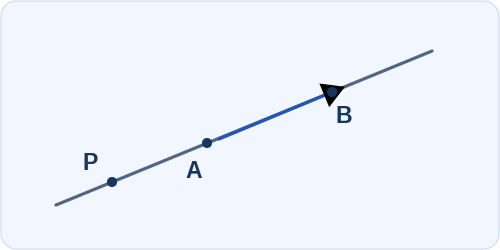
A rising straight line has points marked in order P, A, B. Its direction arrow points from A towards B.

At t=0t=0 the vector line is at its anchor AA. Increasing tt moves along the direction arrow.

Worked example

Read a point from its parameter

A line has equation r=(31−2)+t(−421)\mathbf r=\begin{pmatrix}3\\1\\-2\end{pmatrix}+t\begin{pmatrix}-4\\2\\1\end{pmatrix}. Find the point at t=−2t=-2. Give all coordinates.

  1. Substitute the same parameter into all coordinates.

  2. r=(31−2)+(−2)(−421)=(11−3−4)\mathbf r=\begin{pmatrix}3\\1\\-2\end{pmatrix}+\left(-2\right)\begin{pmatrix}-4\\2\\1\end{pmatrix}=\begin{pmatrix}11\\-3\\-4\end{pmatrix}.

  3. The point is P(11,−3,−4)P(11, -3, -4).

Your turn

A line has equation r=(05−1)+t(3−24)\mathbf r=\begin{pmatrix}0\\5\\-1\end{pmatrix}+t\begin{pmatrix}3\\-2\\4\end{pmatrix}. Find the point at t=32t=\frac{3}{2}. Give all coordinates.

Enter an exact number, for example 3/2 or 2-sqrt(3).

Enter an exact number, for example 3/2 or 2-sqrt(3).

Enter an exact number, for example 3/2 or 2-sqrt(3).

Section 2 of 5 · Core · about 6 min

How do two points determine a line?

Either point can anchor the line. Take the difference of the two position vectors to get a direction. Swapping their order reverses the arrow along the same line.

Worked example

Write a line through two points

Use A(2,1,−4)A(2, 1, -4) and B(6,−5,−2)B(6, -5, -2) to construct r=a+td\mathbf r=\mathbf a+t\mathbf d. Take the anchor at AA and use AB→\overrightarrow{AB} as the direction. Give every component of both vectors.

  1. Use the position of AA for the anchor.

  2. AB→=(4−62)\overrightarrow{AB}=\begin{pmatrix}4\\-6\\2\end{pmatrix} by subtracting the starting position from the final one.

  3. The line is r=(21−4)+t(4−62)\mathbf r=\begin{pmatrix}2\\1\\-4\end{pmatrix}+t\begin{pmatrix}4\\-6\\2\end{pmatrix}.

Your turn

Use A(−1,3,8)A(-1, 3, 8) and B(−1,−1,14)B(-1, -1, 14) to construct r=a+td\mathbf r=\mathbf a+t\mathbf d. Take the anchor at BB and use BA→\overrightarrow{BA} as the direction. Give every component of both vectors.

Enter an exact number, for example 3/2 or 2-sqrt(3).

Enter an exact number, for example 3/2 or 2-sqrt(3).

Enter an exact number, for example 3/2 or 2-sqrt(3).

Enter an exact number, for example 3/2 or 2-sqrt(3).

Enter an exact number, for example 3/2 or 2-sqrt(3).

Enter an exact number, for example 3/2 or 2-sqrt(3).

Worked example

Write a line through two points

Use A(1,6)A(1, 6) and B(−5,8)B(-5, 8) to construct r=a+td\mathbf r=\mathbf a+t\mathbf d. Take the anchor at AA and use AB→\overrightarrow{AB} as the direction. Give every component of both vectors.

Try it on paper first.

  1. Use the position of AA for the anchor.

  2. AB→=(−62)\overrightarrow{AB}=\begin{pmatrix}-6\\2\end{pmatrix} by subtracting the starting position from the final one.

  3. The line is r=(16)+t(−62)\mathbf r=\begin{pmatrix}1\\6\end{pmatrix}+t\begin{pmatrix}-6\\2\end{pmatrix}.

Section 3 of 5 · Core · about 6 min

How do I test whether a point is on the line?

Write the three coordinate equations and use a changing coordinate to get a candidate parameter. All coordinates must agree at that same value.

Worked example

Test point membership

A line has equation r=(0−47)+t(02−3)\mathbf r=\begin{pmatrix}0\\-4\\7\end{pmatrix}+t\begin{pmatrix}0\\2\\-3\end{pmatrix}. Find the parameter of P(0,−8,13)P(0, -8, 13) and verify the other coordinates.

  1. The y-coordinate requires 2t−4=−82 t - 4=-8, so t=−2t=-2.

  2. Test the same value in the full equation. It gives (0−813)\begin{pmatrix}0\\-8\\13\end{pmatrix}, which matches all the coordinates.

  3. The point lies on the line at t=−2t=-2.

Your turn

Does P(3,9,−1)P(3, 9, -1) lie on r=(261)+t(03−2)\mathbf r=\begin{pmatrix}2\\6\\1\end{pmatrix}+t\begin{pmatrix}0\\3\\-2\end{pmatrix}?

Point on line

Worked example

Test point membership

A line has equation r=(256)+t(20−4)\mathbf r=\begin{pmatrix}2\\5\\6\end{pmatrix}+t\begin{pmatrix}2\\0\\-4\end{pmatrix}. Find the parameter of P(3,5,4)P(3, 5, 4) and verify the other coordinates.

Try it on paper first.

  1. The x-coordinate requires 2t+2=32 t + 2=3, so t=12t=\frac{1}{2}.

  2. Test the same value in the full equation. It gives (354)\begin{pmatrix}3\\5\\4\end{pmatrix}, which matches all the coordinates.

  3. The point lies on the line at t=12t=\frac{1}{2}.

Section 4 of 5 · Core · about 6 min

Can the same line have a different equation?

Choose another anchor already on the line, and scale the direction by a non-zero number. The new parameter still traces all the same points.

Worked example

Change the anchor and direction

A line is r=(1−53)+t(23−1)\mathbf r=\begin{pmatrix}1\\-5\\3\end{pmatrix}+t\begin{pmatrix}2\\3\\-1\end{pmatrix}. Rewrite it using the point at t=2t=2 as the new anchor and −2d-2\mathbf d as the direction, where d=(23−1)\mathbf d=\begin{pmatrix}2\\3\\-1\end{pmatrix}. Give both vectors.

  1. The new anchor is b=(1−53)+(2)(23−1)=(511)\mathbf b=\begin{pmatrix}1\\-5\\3\end{pmatrix}+\left(2\right)\begin{pmatrix}2\\3\\-1\end{pmatrix}=\begin{pmatrix}5\\1\\1\end{pmatrix}.

  2. Multiplying a direction by a non-zero scalar changes the parameter scale or sense. It covers the same set of points.

  3. One equivalent form is r=(511)+u(−4−62)\mathbf r=\begin{pmatrix}5\\1\\1\end{pmatrix}+u\begin{pmatrix}-4\\-6\\2\end{pmatrix}.

Your turn

A line is r=(041)+t(−320)\mathbf r=\begin{pmatrix}0\\4\\1\end{pmatrix}+t\begin{pmatrix}-3\\2\\0\end{pmatrix}. Rewrite it using the point at t=−1t=-1 as the new anchor and 3d3\mathbf d as the direction, where d=(−320)\mathbf d=\begin{pmatrix}-3\\2\\0\end{pmatrix}. Give both vectors.

Enter an exact number, for example 3/2 or 2-sqrt(3).

Enter an exact number, for example 3/2 or 2-sqrt(3).

Enter an exact number, for example 3/2 or 2-sqrt(3).

Enter an exact number, for example 3/2 or 2-sqrt(3).

Enter an exact number, for example 3/2 or 2-sqrt(3).

Enter an exact number, for example 3/2 or 2-sqrt(3).

Section 5 of 5 · Further applications · about 5 min

How do I identify points on the segment AB?

The entire line through AA and BB also extends beyond its endpoints. In the parameterisation from AA along the full displacement AB→\overrightarrow{AB}, the endpoints are t=0t=0 and t=1t=1.

Worked example

Read a point from its parameter

A line has equation r=(6−34)+t(−396)\mathbf r=\begin{pmatrix}6\\-3\\4\end{pmatrix}+t\begin{pmatrix}-3\\9\\6\end{pmatrix}. Find the point at t=13t=\frac{1}{3}. Give all coordinates.

  1. Substitute the same parameter into all coordinates.

  2. r=(6−34)+(13)(−396)=(506)\mathbf r=\begin{pmatrix}6\\-3\\4\end{pmatrix}+\left(\frac{1}{3}\right)\begin{pmatrix}-3\\9\\6\end{pmatrix}=\begin{pmatrix}5\\0\\6\end{pmatrix}.

  3. The point is P(5,0,6)P(5, 0, 6).

Your turn

A line has equation r=(−317)+t(12−48)\mathbf r=\begin{pmatrix}-3\\1\\7\end{pmatrix}+t\begin{pmatrix}12\\-4\\8\end{pmatrix}. Find the point at t=34t=\frac{3}{4}. Give all coordinates.

Enter an exact number, for example 3/2 or 2-sqrt(3).

Enter an exact number, for example 3/2 or 2-sqrt(3).

Enter an exact number, for example 3/2 or 2-sqrt(3).

Worked examples

Practise the method

Core practice

Question 1 of 4

0 / 4 checked in this collection

Question list

Core practice

Fresh variants

Exam-style

Read a point from its parameter

3 marks

A line has equation r=(41−2)+t(−234)\mathbf r=\begin{pmatrix}4\\1\\-2\end{pmatrix}+t\begin{pmatrix}-2\\3\\4\end{pmatrix}. Find the point at t=−2t=-2. Give all coordinates.

Enter an exact number, for example 3/2 or 2-sqrt(3).

Enter an exact number, for example 3/2 or 2-sqrt(3).

Enter an exact number, for example 3/2 or 2-sqrt(3).

Full answer-format guide

Exact numbers: 3/2, sqrt(5), 2-sqrt(3), pi/6, 3*pi/2. Sets: {1,4}. Intervals: (3,5]; a round bracket excludes the endpoint. Infinity: inf; union: U; no solutions: empty. Separate coordinate pairs or triples with semicolons. Expressions: 2x^2+3x-1; equations: x^2=3x+1 or the polynomial equal to zero. Factors: x-1 ; x+2. Parameter fraction: numerator ; denominator. List integer answers individually.

Review the method

Progress stays in this browser. Create an account to save it or sign in.

Extra practice from this lesson

Read a point from its parameter

A line has equation r=(103)+t(−2−11)\mathbf r=\begin{pmatrix}1\\0\\3\end{pmatrix}+t\begin{pmatrix}-2\\-1\\1\end{pmatrix}. Find the point at t=−32t=- \frac{3}{2}. Give all coordinates.

Enter an exact number, for example 3/2 or 2-sqrt(3).

Enter an exact number, for example 3/2 or 2-sqrt(3).

Enter an exact number, for example 3/2 or 2-sqrt(3).

Write a line through two points

Use A(5,−1,6)A(5, -1, 6) and B(4,−3,10)B(4, -3, 10) to construct r=a+td\mathbf r=\mathbf a+t\mathbf d. Take the anchor at AA and use AB→\overrightarrow{AB} as the direction. Give every component of both vectors.

Enter an exact number, for example 3/2 or 2-sqrt(3).

Enter an exact number, for example 3/2 or 2-sqrt(3).

Enter an exact number, for example 3/2 or 2-sqrt(3).

Enter an exact number, for example 3/2 or 2-sqrt(3).

Enter an exact number, for example 3/2 or 2-sqrt(3).

Enter an exact number, for example 3/2 or 2-sqrt(3).

Test point membership

A line has equation r=(031)+t(4−23)\mathbf r=\begin{pmatrix}0\\3\\1\end{pmatrix}+t\begin{pmatrix}4\\-2\\3\end{pmatrix}. Find the parameter of P(8,−1,7)P(8, -1, 7). Check the other coordinates in your working.

Enter the value on its own or write t = … . Fractions and exact square roots are accepted.

Change the anchor and direction

A line is r=(7−20)+t(13−1)\mathbf r=\begin{pmatrix}7\\-2\\0\end{pmatrix}+t\begin{pmatrix}1\\3\\-1\end{pmatrix}. Rewrite it using the point at t=2t=2 as the new anchor and −3d-3\mathbf d as the direction, where d=(13−1)\mathbf d=\begin{pmatrix}1\\3\\-1\end{pmatrix}. Give both vectors.

Enter an exact number, for example 3/2 or 2-sqrt(3).

Enter an exact number, for example 3/2 or 2-sqrt(3).

Enter an exact number, for example 3/2 or 2-sqrt(3).

Enter an exact number, for example 3/2 or 2-sqrt(3).

Enter an exact number, for example 3/2 or 2-sqrt(3).

Enter an exact number, for example 3/2 or 2-sqrt(3).

Read a point from its parameter

A line has equation r=(236)+t(6−9−3)\mathbf r=\begin{pmatrix}2\\3\\6\end{pmatrix}+t\begin{pmatrix}6\\-9\\-3\end{pmatrix}. Find the point at t=13t=\frac{1}{3}. Give all coordinates.

Enter an exact number, for example 3/2 or 2-sqrt(3).

Enter an exact number, for example 3/2 or 2-sqrt(3).

Enter an exact number, for example 3/2 or 2-sqrt(3).

Apply it · original exam-style problems

Show your working on paper and compare it with the worked solution and marking guidance.

Come back to what needs practice

Quick revision sheet (A4)

Your review plan starts after your first check.