Maths4UBETA

Parallel, intersecting and skew lines

Classify two lines in space, verify coordinate consistency and find an intersection when it exists.

Try the quick check →
Lesson 4 of 5

Section 1 of 5 · Core · about 6 min

How can I tell if two lines are parallel?

Check whether the second direction equals a non-zero scalar times the first. Then distinguish a single common line from two distinct parallel lines.

Worked example

Classify a pair of lines

Classify the lines l1:r=(1−24)+t(203)l_1: \mathbf r=\begin{pmatrix}1\\-2\\4\end{pmatrix}+t\begin{pmatrix}2\\0\\3\end{pmatrix} and l2:r=(4−13)+u(−40−6)l_2: \mathbf r=\begin{pmatrix}4\\-1\\3\end{pmatrix}+u\begin{pmatrix}-4\\0\\-6\end{pmatrix}.

  1. The second direction is −2-2 times the first. Test the displacement between anchors (31−1)\begin{pmatrix}3\\1\\-1\end{pmatrix} against that direction.

  2. The lines are distinct and parallel. Their anchor displacement is not a multiple of the direction.
Your turn

Classify the lines l1:r=(41−2)+t(03−1)l_1: \mathbf r=\begin{pmatrix}4\\1\\-2\end{pmatrix}+t\begin{pmatrix}0\\3\\-1\end{pmatrix} and l2:r=(54−3)+u(0−93)l_2: \mathbf r=\begin{pmatrix}5\\4\\-3\end{pmatrix}+u\begin{pmatrix}0\\-9\\3\end{pmatrix}.

Line relationship

Section 2 of 5 · Core · about 6 min

How can different equations give the same line?

A point of one parallel line lies on the other precisely when the two lines coincide. Check the anchor difference to show this directly.

Worked example

Classify a pair of lines

Classify the lines l1:r=(02−3)+t(2−10)l_1: \mathbf r=\begin{pmatrix}0\\2\\-3\end{pmatrix}+t\begin{pmatrix}2\\-1\\0\end{pmatrix} and l2:r=(6−1−3)+u(−420)l_2: \mathbf r=\begin{pmatrix}6\\-1\\-3\end{pmatrix}+u\begin{pmatrix}-4\\2\\0\end{pmatrix}.

  1. The second direction is −2-2 times the first. Test the displacement between anchors (6−30)\begin{pmatrix}6\\-3\\0\end{pmatrix} against that direction.

  2. The lines are coincident. Both anchors lie on the same line and its directions are parallel.

Your turn

Classify the lines l1:r=(340)+t(102)l_1: \mathbf r=\begin{pmatrix}3\\4\\0\end{pmatrix}+t\begin{pmatrix}1\\0\\2\end{pmatrix} and l2:r=(−14−8)+u(306)l_2: \mathbf r=\begin{pmatrix}-1\\4\\-8\end{pmatrix}+u\begin{pmatrix}3\\0\\6\end{pmatrix}.

Line relationship

Worked example

Classify a pair of lines

Classify the lines l1:r=(2−34)+t(4−21)l_1: \mathbf r=\begin{pmatrix}2\\-3\\4\end{pmatrix}+t\begin{pmatrix}4\\-2\\1\end{pmatrix} and l2:r=(−2−13)+u(−84−2)l_2: \mathbf r=\begin{pmatrix}-2\\-1\\3\end{pmatrix}+u\begin{pmatrix}-8\\4\\-2\end{pmatrix}.

Try it on paper first.

  1. The second direction is −2-2 times the first. Test the displacement between anchors (−42−1)\begin{pmatrix}-4\\2\\-1\end{pmatrix} against that direction.

  2. The lines are coincident. Both anchors lie on the same line and its directions are parallel.

Section 3 of 5 · Core · about 6 min

How do I find where two lines meet?

For non-parallel directions, a shared point can occur only once. Use two separate parameters, one for each line. Equate their three coordinate expressions.

Worked example

Classify a pair of lines

Classify the lines l1:r=(1−24)+t(23−1)l_1: \mathbf r=\begin{pmatrix}1\\-2\\4\end{pmatrix}+t\begin{pmatrix}2\\3\\-1\end{pmatrix} and l2:r=(354)+u(−212)l_2: \mathbf r=\begin{pmatrix}3\\5\\4\end{pmatrix}+u\begin{pmatrix}-2\\1\\2\end{pmatrix}. Give all coordinates of their intersection.

  1. Directions are not proportional. Equate coordinates, keeping separate parameters for the two lines.

  2. Solve 2t+1=3−2u2 t + 1=3 - 2 u and 3t−2=u+53 t - 2=u + 5 to get t=2t=2 and u=−1u=-1.

  3. The remaining z-coordinates are 22 and 22.

  4. All three coordinates match. The lines intersect at (5,4,2)(5, 4, 2).

Your turn

Classify the lines l1:r=(43−2)+t(1−12)l_1: \mathbf r=\begin{pmatrix}4\\3\\-2\end{pmatrix}+t\begin{pmatrix}1\\-1\\2\end{pmatrix} and l2:r=(−14−5)+u(31−1)l_2: \mathbf r=\begin{pmatrix}-1\\4\\-5\end{pmatrix}+u\begin{pmatrix}3\\1\\-1\end{pmatrix}. Give all coordinates of their intersection.

Line relationship

Enter an exact number, for example 3/2 or 2-sqrt(3).

Enter an exact number, for example 3/2 or 2-sqrt(3).

Enter an exact number, for example 3/2 or 2-sqrt(3).

Worked example

Classify a pair of lines

Classify the lines l1:r=(−201)+t(321)l_1: \mathbf r=\begin{pmatrix}-2\\0\\1\end{pmatrix}+t\begin{pmatrix}3\\2\\1\end{pmatrix} and l2:r=(346)+u(10−3)l_2: \mathbf r=\begin{pmatrix}3\\4\\6\end{pmatrix}+u\begin{pmatrix}1\\0\\-3\end{pmatrix}. Give all coordinates of their intersection.

Try it on paper first.

  1. Directions are not proportional. Equate coordinates, keeping separate parameters for the two lines.

  2. Solve 3t−2=u+33 t - 2=u + 3 and 2t=42 t=4 to get t=2t=2 and u=1u=1.

  3. The remaining z-coordinates are 33 and 33.

  4. All three coordinates match. The lines intersect at (4,4,3)(4, 4, 3).

Section 4 of 5 · Core · about 6 min

What makes two lines skew?

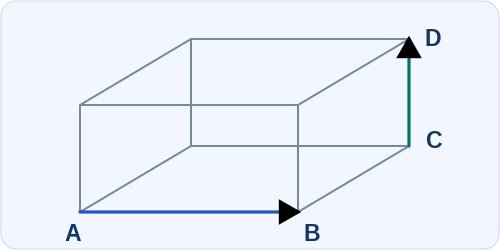
Two non-parallel lines in 3D can miss each other. If the only candidate from two independent equations fails the third, the lines are skew.

A wireframe cuboid shows one horizontal front bottom edge and one vertical back edge highlighted. The edges never meet.

The highlighted edges lie in different faces. The blue edge is horizontal, the teal edge vertical, and their extensions have no common point.

Worked example

Classify a pair of lines

Classify the lines l1:r=(110)+t(123)l_1: \mathbf r=\begin{pmatrix}1\\1\\0\end{pmatrix}+t\begin{pmatrix}1\\2\\3\end{pmatrix} and l2:r=(169)+u(2−1−1)l_2: \mathbf r=\begin{pmatrix}1\\6\\9\end{pmatrix}+u\begin{pmatrix}2\\-1\\-1\end{pmatrix}.

  1. Directions are not proportional. Equate coordinates, keeping separate parameters for the two lines.

  2. Solve t+1=2u+1t + 1=2 u + 1 and 2t+1=6−u2 t + 1=6 - u to get t=2t=2 and u=1u=1.

  3. The remaining z-coordinates are 66 and 88.

  4. The third equation fails, although the directions are not parallel. The lines are skew.

Your turn

Classify the lines l1:r=(04−5)+t(211)l_1: \mathbf r=\begin{pmatrix}0\\4\\-5\end{pmatrix}+t\begin{pmatrix}2\\1\\1\end{pmatrix} and l2:r=(011−1)+u(−130)l_2: \mathbf r=\begin{pmatrix}0\\11\\-1\end{pmatrix}+u\begin{pmatrix}-1\\3\\0\end{pmatrix}.

Line relationship

Section 5 of 5 · Core · about 6 min

What if the first two equations depend on each other?

If solving the first two coordinate equations gives the same condition twice, use another coordinate equation. If two equations are inconsistent, there can be no intersection.

Worked example

Classify a pair of lines

Classify the lines l1:r=(23−4)+t(241)l_1: \mathbf r=\begin{pmatrix}2\\3\\-4\end{pmatrix}+t\begin{pmatrix}2\\4\\1\end{pmatrix} and l2:r=(−3−7−8)+u(122)l_2: \mathbf r=\begin{pmatrix}-3\\-7\\-8\end{pmatrix}+u\begin{pmatrix}1\\2\\2\end{pmatrix}. Give all coordinates of their intersection.

  1. Directions are not proportional. Equate coordinates, keeping separate parameters for the two lines.

  2. Solve 2t+2=u−32 t + 2=u - 3 and t−4=2u−8t - 4=2 u - 8 to get t=−2t=-2 and u=1u=1.

  3. The remaining y-coordinates are −5-5 and −5-5.

  4. All three coordinates match. The lines intersect at (−2,−5,−6)(-2, -5, -6).

Your turn

Classify the lines l1:r=(1−22)+t(13−2)l_1: \mathbf r=\begin{pmatrix}1\\-2\\2\end{pmatrix}+t\begin{pmatrix}1\\3\\-2\end{pmatrix} and l2:r=(511−1)+u(261)l_2: \mathbf r=\begin{pmatrix}5\\11\\-1\end{pmatrix}+u\begin{pmatrix}2\\6\\1\end{pmatrix}.

Line relationship

Worked examples

Practise the method

Core practice

Question 1 of 4

0 / 4 checked in this collection

Question list

Core practice

Fresh variants

Exam-style

Classify a pair of lines

1 mark

Classify the lines l1:r=(112)+t(201)l_1: \mathbf r=\begin{pmatrix}1\\1\\2\end{pmatrix}+t\begin{pmatrix}2\\0\\1\end{pmatrix} and l2:r=(132)+u(−40−2)l_2: \mathbf r=\begin{pmatrix}1\\3\\2\end{pmatrix}+u\begin{pmatrix}-4\\0\\-2\end{pmatrix}.

Line relationship

Choose one option. Explain your reasoning on paper.

Review the method

Progress stays in this browser. Create an account to save it or sign in.

Extra practice from this lesson

Classify a pair of lines

Classify the lines l1:r=(1−12)+t(03−1)l_1: \mathbf r=\begin{pmatrix}1\\-1\\2\end{pmatrix}+t\begin{pmatrix}0\\3\\-1\end{pmatrix} and l2:r=(013)+u(0−62)l_2: \mathbf r=\begin{pmatrix}0\\1\\3\end{pmatrix}+u\begin{pmatrix}0\\-6\\2\end{pmatrix}.

Line relationship

Classify a pair of lines

Classify the lines l1:r=(−2−14)+t(210)l_1: \mathbf r=\begin{pmatrix}-2\\-1\\4\end{pmatrix}+t\begin{pmatrix}2\\1\\0\end{pmatrix} and l2:r=(424)+u(630)l_2: \mathbf r=\begin{pmatrix}4\\2\\4\end{pmatrix}+u\begin{pmatrix}6\\3\\0\end{pmatrix}.

Line relationship

Classify a pair of lines

Classify the lines l1:r=(40−4)+t(103)l_1: \mathbf r=\begin{pmatrix}4\\0\\-4\end{pmatrix}+t\begin{pmatrix}1\\0\\3\end{pmatrix} and l2:r=(1−6−3)+u(13−2)l_2: \mathbf r=\begin{pmatrix}1\\-6\\-3\end{pmatrix}+u\begin{pmatrix}1\\3\\-2\end{pmatrix}. Give all coordinates of their intersection.

Line relationship

Enter an exact number, for example 3/2 or 2-sqrt(3).

Enter an exact number, for example 3/2 or 2-sqrt(3).

Enter an exact number, for example 3/2 or 2-sqrt(3).

Classify a pair of lines

Classify the lines l1:r=(14−2)+t(313)l_1: \mathbf r=\begin{pmatrix}1\\4\\-2\end{pmatrix}+t\begin{pmatrix}3\\1\\3\end{pmatrix} and l2:r=(295)+u(−121)l_2: \mathbf r=\begin{pmatrix}2\\9\\5\end{pmatrix}+u\begin{pmatrix}-1\\2\\1\end{pmatrix}.

Line relationship

Classify a pair of lines

Classify the lines l1:r=(5−31)+t(124)l_1: \mathbf r=\begin{pmatrix}5\\-3\\1\end{pmatrix}+t\begin{pmatrix}1\\2\\4\end{pmatrix} and l2:r=(0−137)+u(36−1)l_2: \mathbf r=\begin{pmatrix}0\\-13\\7\end{pmatrix}+u\begin{pmatrix}3\\6\\-1\end{pmatrix}. Give all coordinates of their intersection.

Line relationship

Enter an exact number, for example 3/2 or 2-sqrt(3).

Enter an exact number, for example 3/2 or 2-sqrt(3).

Enter an exact number, for example 3/2 or 2-sqrt(3).

Apply it · original exam-style problems

Show your working on paper and compare it with the worked solution and marking guidance.

Come back to what needs practice

Quick revision sheet (A4)

Your review plan starts after your first check.