Maths4UBETA

Trigonometric integrals and logarithmic derivatives

Rewrite trigonometric squares and products before integrating, and identify logarithmic derivatives and tangent integrals.

Try the quick check →
Lesson 2 of 5

Section 1 of 5 · Core · about 7 min

How can a squared sine or cosine become a sum?

Choose a double-angle identity that isolates the squared function. A constant term and an ordinary cosine are easier to integrate separately.
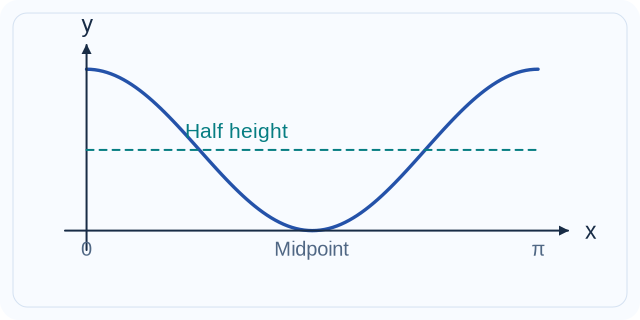
A cosine-squared graph starts at one, drops to zero and returns to one each half-turn. A horizontal dashed line marks half height.

The dashed line is y=12y=\tfrac12. The graph of y=cos⁡2xy=\cos^2x oscillates around it. This explains the constant term after using a double-angle identity.

What you seeRewrite before integrating
sin⁡2u\sin^2u1−cos⁡(2u)2\frac{1-\cos(2u)}2
cos⁡2u\cos^2u1+cos⁡(2u)2\frac{1+\cos(2u)}2
sin⁡ucos⁡u\sin u\cos u12sin⁡(2u)\frac12\sin(2u)
tan⁡u\tan usin⁡ucos⁡u\frac{\sin u}{\cos u}, compare with the derivative of cos⁡u\cos u

Worked example

Replace a squared cosine with a doubled angle

Evaluate ∫0π46cos⁡2(2x) dx\int_0^{\frac{\pi}{4}}6\cos^2(2x)\,\mathrm dx.

  1. Use cos⁡2u=1+cos⁡(2u)2\cos^2u=\frac{1+\cos(2u)}2 with u=2xu=2x. The integrand becomes 3+3cos⁡(4x)3+3\cos(4x).

  2. A primitive is 3x+34sin⁡(4x)3x+\frac34\sin(4x). Its sine term is zero at both endpoints.

  3. Upper minus lower gives 3π4\frac{3\pi}{4}.

Worked example

Separate the constant term from the doubled wave

Write ∫7cos⁡2(5x) dx\int 7 \cos^{2}{\left(5 x \right)}\,\mathrm dx as Ax+Bsin⁡(10x)+CAx+B\sin(10x)+C. Give AA and BB.

Try it on paper first.

  1. Use cos⁡2u=1+cos⁡2u2\cos^2 u=\frac{1+\cos 2u}{2} with u=5xu=5x.

  2. Integrating the constant term gives 72x\frac{7}{2}x. The cosine term contributes a sine with inner slope 1010.

  3. The primitive is 7x2+7sin⁡(10x)20+C\frac{7 x}{2} + \frac{7 \sin{\left(10 x \right)}}{20}+C.

Your turn

Evaluate ∫0π64sin⁡2(3x) dx\int_0^{\frac{\pi}{6}}4\sin^2(3x)\,\mathrm dx exactly.

Enter an exact number, for example 3/2 or 2-sqrt(3).

Section 2 of 5 · Core · about 7 min

What if sine and cosine share an angle?

The identity for sine of a double angle turns an equal-angle product into a standard integral.

Worked example

Turn an equal-angle product into one sine

Evaluate ∫0π68sin⁡(3x)cos⁡(3x) dx\int_0^{\frac{\pi}{6}}8\sin(3x)\cos(3x)\,\mathrm dx.

  1. The double-angle identity gives 8sin⁡(3x)cos⁡(3x)=4sin⁡(6x)8\sin(3x)\cos(3x)=4\sin(6x).

  2. A primitive of 4sin⁡(6x)4\sin(6x) is −23cos⁡(6x)-\frac23\cos(6x).

  3. Evaluate at the endpoints. The result is −23cos⁡π+23cos⁡0=43-\frac23\cos\pi+\frac23\cos0=\frac43.

Worked example

Turn an equal-angle product into one sine

Write ∫8sin⁡(3x)cos⁡(3x) dx\int 8 \sin{\left(3 x \right)} \cos{\left(3 x \right)}\,\mathrm dx as Acos⁡(6x)+CA\cos(6x)+C. Find AA.

Try it on paper first.

  1. Use 2sin⁡ucos⁡u=sin⁡(2u)2\sin u\cos u=\sin(2u) to rewrite the integrand.

  2. The cosine primitive has negative sign and an extra factor from the inner slope. The final coefficient is −23- \frac{2}{3}.

Your turn

Evaluate ∫0π812sin⁡(2x)cos⁡(2x) dx\int_0^{\frac{\pi}{8}}12\sin(2x)\cos(2x)\,\mathrm dx exactly.

Enter an exact number, for example 3/2 or 2-sqrt(3).

Section 3 of 5 · Core · about 8 min

When does a quotient lead to a logarithm?

Keep the denominator as one function ff, differentiate it and compare the whole numerator with f′f'. A constant mismatch can be taken outside.

Worked example

Match a numerator to its denominator's derivative

Evaluate ∫129x2x3+5 dx\int_1^2\frac{9x^2}{x^3+5}\,\mathrm dx, keeping the denominator intact.

  1. With f(x)=x3+5f(x)=x^3+5, its derivative is 3x23x^2. The numerator is 3f′(x)3 f'(x).

  2. The denominator is positive on the interval. A primitive is 3ln⁡(x3+5)3\ln(x^3+5).

  3. The value is 3ln⁡13−3ln⁡6=3ln⁡(136)3\ln13-3\ln6=3\ln\left(\frac{13}{6}\right).

Your turn

Write ∫026xx2+5 dx=kln⁡r\int_0^2\frac{6x}{x^2+5}\,\mathrm dx=k\ln r, with r=∣f(2)∣∣f(0)∣r=\frac{|f(2)|}{|f(0)|} and f(x)=x2+5f(x)=x^2+5. Give kk and rr.

Enter an exact number, for example 3/2 or 2-sqrt(3).

Enter an exact number, for example 3/2 or 2-sqrt(3).

Section 4 of 5 · Core · about 8 min

Where does the minus sign come from when integrating tangent?

Write tangent as sine divided by cosine. This exposes the negative sign in the derivative of cosine.

Worked example

Integrate tangent from a logarithmic derivative

Evaluate ∫0π32tan⁡x dx\int_0^{\frac{\pi}{3}}2\tan x\,\mathrm dx.

  1. Write 2tan⁡x=2sin⁡xcos⁡x2\tan x=\frac{2\sin x}{\cos x}. The derivative of cos⁡x\cos x is −sin⁡x-\sin x.

  2. The integrand therefore has primitive −2ln⁡∣cos⁡x∣-2\ln|\cos x|. Cosine is positive and has no zero between the given limits.

  3. The difference is −2ln⁡(12)+2ln⁡1=2ln⁡2-2\ln\left(\frac12\right)+2\ln1=2\ln2.

Your turn

Write ∫−π30tan⁡x dx=kln⁡2\int_{-\frac{\pi}{3}}^{0}\tan x\,\mathrm dx=k\ln2. Give kk.

Enter an exact number, for example 3/2 or 2-sqrt(3).

Section 5 of 5 · Core · about 5 min

Why do I check the interval before using a trig logarithm?

The logarithmic primitive of tangent is valid only on an interval with no pole.

Worked example

Evaluate tangent on an interval with no pole

Write ∫0π9tan⁡(3x) dx\int_0^{\frac{\pi}{9}}\tan(3x)\,\mathrm dx as a0ln⁡ra_0\ln r, using the positive value of rr obtained directly from the endpoint cosine ratio. Give a0a_0 and rr.

  1. Rewrite tangent as sin⁡(ax)cos⁡(ax)\frac{\sin(ax)}{\cos(ax)}. The derivative of its denominator is −asin⁡(ax)-a\sin(ax).

  2. The primitive is −ln⁡(cos⁡(3x))3- \frac{\ln{\left(\cos{\left(3 x \right)} \right)}}{3}. Cosine stays positive on this interval.

  3. Evaluate the logarithm at both ends. Because cos⁡0=1\cos 0=1, the result is 13ln⁡(2)\frac{1}{3}\ln\left(2\right).

Your turn

Write ∫0π8tan⁡(2x) dx\int_0^{\frac{\pi}{8}}\tan(2x)\,\mathrm dx as a0ln⁡ra_0\ln r, using the positive value of rr obtained directly from the endpoint cosine ratio. Give a0a_0 and rr.

Enter the value on its own or write a = … . Fractions and exact square roots are accepted.

Enter the value on its own or write r = … . Fractions and exact square roots are accepted.

Worked examples

Practise the method

Core practice

Question 1 of 4

0 / 4 checked in this collection

Question list

Core practice

Fresh variants

Exam-style

Reduce a squared sine before evaluating

1 mark

Find the exact value of ∫0π812sin⁡2(2x) dx\int_0^{\frac{\pi}{8}}12\sin^2(2x)\,\mathrm dx.

Enter an exact number, for example 3/2 or 2-sqrt(3).

Full answer-format guide

Exact numbers: 3/2, sqrt(5), 2-sqrt(3), pi/6, 3*pi/2. Sets: {1,4}. Intervals: (3,5]; a round bracket excludes the endpoint. Infinity: inf; union: U; no solutions: empty. Separate coordinate pairs or triples with semicolons. Expressions: 2x^2+3x-1; equations: x^2=3x+1 or the polynomial equal to zero. Factors: x-1 ; x+2. Parameter fraction: numerator ; denominator. List integer answers individually.

Review the method

Progress stays in this browser. Create an account to save it or sign in.

Extra practice from this lesson

Separate the constant term from the doubled wave

Write ∫5sin⁡2(3x) dx\int 5 \sin^{2}{\left(3 x \right)}\,\mathrm dx as Ax+Bsin⁡(6x)+CAx+B\sin(6x)+C. Give AA and BB.

Enter the value on its own or write A = … . Fractions and exact square roots are accepted.

Enter the value on its own or write B = … . Fractions and exact square roots are accepted.

Turn an equal-angle product into one sine

Write ∫3sin⁡(4x)cos⁡(4x) dx\int 3 \sin{\left(4 x \right)} \cos{\left(4 x \right)}\,\mathrm dx as Acos⁡(8x)+CA\cos(8x)+C. Find AA.

Enter the value on its own or write A = … . Fractions and exact square roots are accepted.

Compare the whole numerator with the denominator derivative

Find aa if ∫16x+122x2+3x+5 dx=a(ln⁡(2x2+3x+5))+C\int \frac{16 x + 12}{2 x^{2} + 3 x + 5}\,\mathrm dx=a\left(\ln{\left(2 x^{2} + 3 x + 5 \right)}\right)+C. Use x=1 and nearby inputsx=1\text{ and nearby inputs}.

Enter the value on its own or write a = … . Fractions and exact square roots are accepted.

Evaluate tangent on an interval with no pole

Write ∫0π15tan⁡(5x) dx\int_0^{\frac{\pi}{15}}\tan(5x)\,\mathrm dx as a0ln⁡ra_0\ln r, using the positive value of rr obtained directly from the endpoint cosine ratio. Give a0a_0 and rr.

Enter the value on its own or write a = … . Fractions and exact square roots are accepted.

Enter the value on its own or write r = … . Fractions and exact square roots are accepted.

Separate the constant term from the doubled wave

Write ∫2cos⁡2(7x) dx\int 2 \cos^{2}{\left(7 x \right)}\,\mathrm dx as Ax+Bsin⁡(14x)+CAx+B\sin(14x)+C. Give AA and BB.

Enter the value on its own or write A = … . Fractions and exact square roots are accepted.

Enter the value on its own or write B = … . Fractions and exact square roots are accepted.

Turn an equal-angle product into one sine

Write ∫7sin⁡(5x)cos⁡(5x) dx\int 7 \sin{\left(5 x \right)} \cos{\left(5 x \right)}\,\mathrm dx as Acos⁡(10x)+CA\cos(10x)+C. Find AA.

Enter the value on its own or write A = … . Fractions and exact square roots are accepted.

Apply it · original exam-style problems

Show your working on paper and compare it with the worked solution and marking guidance.

Come back to what needs practice

Quick revision sheet (A4)

Your review plan starts after your first check.