Worked example
Undo the inner exponential slope
Find .
Differentiating produces . The exponential keeps its whole exponent.
To get the coefficient , multiply the primitive by .
The answer is , since its derivative is the original integrand.
Recognise the standard primitives, reverse a linear inside slope and evaluate exact definite integrals on the right interval.
Try the quick check →Section 1 of 5 · Core · about 7 min
Integration reverses differentiation. Take a known primitive of the outer function and check what differentiation would multiply it by.
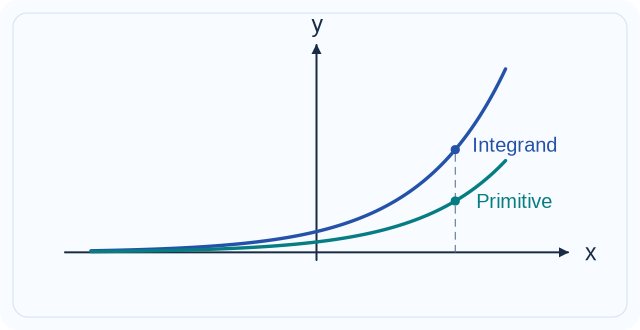
The lower curve is . Its slope at the marked input equals the height of the upper curve there.
| Integrand | Primitive before adding |
|---|---|
| , |
Worked example
Find .
Differentiating produces . The exponential keeps its whole exponent.
To get the coefficient , multiply the primitive by .
The answer is , since its derivative is the original integrand.
Worked example
Find if .
Try it on paper first.
The derivative of the exponent is .
Differentiating introduces an extra factor . Divide the original multiplier by it.
Comparing with the proposed primitive gives .
Section 2 of 5 · Core · about 7 min
A reciprocal linear function has one excluded input. On either interval where its denominator is non-zero, the modulus makes the logarithm defined.
Worked example
Evaluate as a single logarithm.
The linear denominator is negative throughout this interval and has no zero there.
The integrand is the derivative of . The expression inside the modulus is evaluated at both limits.
Upper minus lower gives .
Worked example
Find if . Use .
Try it on paper first.
The derivative of the denominator is . A logarithm of its absolute value differentiates to .
Use on the stated branch.
Comparing with the proposed primitive gives .
Section 3 of 5 · Core · about 7 min
Use and . Then divide by the slope of the angle; the standard trigonometric rules use radians.
Worked example
Find .
For the sine term use negative cosine and divide by , giving .
For the cosine term use sine and divide by the signed inner slope , giving .
Therefore the primitive is . Differentiating checks both signs.
Section 4 of 5 · Core · about 8 min
calls for tangent. A positive quadratic of the form in a reciprocal calls for inverse tangent.
Worked example
Evaluate and .
In the first integral the argument never reaches a pole. Use .
For the second, . The primitive is .
The second integral is .
Section 5 of 5 · Core · about 5 min
The chain rule makes the candidate primitive testable.
Worked example
Find if .
Factor out of the denominator to obtain the pattern .
Use . Taking the derivative of the inverse tangent introduces .
Comparing with the proposed primitive gives .
Question 1 of 4
0 / 4 checked in this collection
Write . Give .
Progress stays in this browser. Create an account to save it or sign in.
Show your working on paper and compare it with the worked solution and marking guidance.
Your review plan starts after your first check.