Maths4UBETA

Integration using partial fractions

Decompose rational functions, integrate each part and check definite intervals for poles.

Try the quick check →
Lesson 3 of 5

Section 1 of 5 · Core · about 6 min

How do separate linear factors produce logarithms?

First factor the denominator and check that the fraction is proper. Give each distinct linear factor a constant numerator. Clear the denominators to solve for the constants.

Worked example

Two different linear factors

Integrate 5x+7(x+1)(x+3)\frac{5x+7}{(x+1)(x+3)} with respect to xx.

  1. Clear denominators to obtain 5x+7=A(x+3)+B(x+1)5x+7=A(x+3)+B(x+1).

  2. At x=−1x=-1 obtain A=1A=1. At x=−3x=-3 obtain B=4B=4.

  3. Integrate the two terms to get ln⁡∣x+1∣+4ln⁡∣x+3∣+C\ln|x+1|+4\ln|x+3|+C. This holds on each interval without poles.

Worked example

Recover both coefficients before integration

Write x+10(x+1)(x+4)\frac{x + 10}{\left(x + 1\right) \left(x + 4\right)} as Ax+1+Bx+4\frac{A}{x + 1}+\frac{B}{x + 4}. Give AA and BB.

Try it on paper first.

  1. Each distinct linear factor gets its own numerator. Clear denominators with the original factorisation.

  2. Matching coefficients gives A=3,B=−2A=3,\quad B=-2.

  3. For x>−1x>-1, integrating term by term then gives 3ln⁡(x+1)−2ln⁡(x+4)+C3 \ln{\left(x + 1 \right)} - 2 \ln{\left(x + 4 \right)}+C.

Your turn

An antiderivative of 7x+17(x+2)(x+5)\frac{7x+17}{(x+2)(x+5)} is aln⁡∣x+2∣+bln⁡∣x+5∣+Ca\ln|x+2|+b\ln|x+5|+C. Give aa and bb.

Enter the value on its own or write a = … . Fractions and exact square roots are accepted.

Enter the value on its own or write b = … . Fractions and exact square roots are accepted.

Section 2 of 5 · Core · about 7 min

What changes when a factor is squared?

Include one term for each power of the repeated factor. For a squared linear factor that means keeping both the first power and the square.

Worked example

Keep both powers of a repeated factor

Integrate 5x+11(x+1)(x+2)2\frac{5x+11}{(x+1)(x+2)^2} with respect to xx.

  1. Use the form Ax+1+Bx+2+D(x+2)2\frac A{x+1}+\frac B{x+2}+\frac D{(x+2)^2}. Clearing denominators gives 5x+11=A(x+2)2+B(x+1)(x+2)+D(x+1)5x+11=A(x+2)^2+B(x+1)(x+2)+D(x+1).

  2. Substitute x=−1x=-1 and x=−2x=-2 to get A=6A=6 and D=−1D=-1. The coefficient of x2x^2 gives A+B=0A+B=0, so B=−6B=-6.

  3. Integrate to get 6ln⁡∣x+1∣−6ln⁡∣x+2∣+1x+2+C6\ln|x+1|-6\ln|x+2|+\frac1{x+2}+C. The reciprocal term is positive because differentiating it gives the negative squared-denominator term.

Worked example

Recover both coefficients before integration

Write 4x+17(x+3)2\frac{4 x + 17}{\left(x + 3\right)^{2}} as Ax+3+B(x+3)2\frac{A}{x + 3}+\frac{B}{\left(x + 3\right)^{2}}. Give AA and BB.

Try it on paper first.

  1. Each power of the repeated factor gets its own numerator. Clear denominators with the original factorisation.

  2. Matching coefficients gives A=4,B=5A=4,\quad B=5.

  3. For x>−3x>-3, integrating term by term then gives 4ln⁡(x+3)−5x+3+C4 \ln{\left(x + 3 \right)} - \frac{5}{x + 3}+C.

Your turn

The fraction 7x+22(x+2)(x+4)2\frac{7x+22}{(x+2)(x+4)^2} splits as Ax+2+Bx+4+D(x+4)2\frac A{x+2}+\frac B{x+4}+\frac D{(x+4)^2}. Give DD and the coefficient kk of 1x+4\frac1{x+4} in its antiderivative.

Enter the value on its own or write D = … . Fractions and exact square roots are accepted.

Enter the value on its own or write k = … . Fractions and exact square roots are accepted.

Section 3 of 5 · Core · about 8 min

Why can one quadratic factor give two types of integral?

A real factor x2+a2x^2+a^2 with a>0a>0 does not split into real linear factors. Keep a numerator of degree at most one for that denominator.

Worked example

Split the numerator over a quadratic

Integrate 5x2+7x+10(x+2)(x2+4)\frac{5x^2+7x+10}{(x+2)(x^2+4)} with respect to xx.

  1. Use Ax+2+Bx+Dx2+4\frac A{x+2}+\frac{Bx+D}{x^2+4}. At x=−2x=-2 the numerator identity gives A=2A=2. Comparing the quadratic and linear coefficients gives B=3B=3 and D=1D=1.

  2. The numerator 3x+13x+1 splits as 32(2x)+1\frac32(2x)+1. The first part is a multiple of the derivative of x2+4x^2+4.

  3. Integrate to obtain 2ln⁡∣x+2∣+32ln⁡(x2+4)+12tan⁡−1 ⁣(x2)+C2\ln|x+2|+\frac32\ln(x^2+4)+\frac12\tan^{-1}\!\left(\frac x2\right)+C.

Your turn

An antiderivative of 5x2+6x+11(x+1)(x2+9)\frac{5x^2+6x+11}{(x+1)(x^2+9)} is aln⁡∣x+1∣+bln⁡(x2+9)+ctan⁡−1 ⁣(x3)+Ca\ln|x+1|+b\ln(x^2+9)+c\tan^{-1}\!\left(\frac x3\right)+C. Give a,b,ca,b,c.

Enter the value on its own or write a = … . Fractions and exact square roots are accepted.

Enter the value on its own or write b = … . Fractions and exact square roots are accepted.

Enter the value on its own or write c = … . Fractions and exact square roots are accepted.

Section 4 of 5 · Core · about 7 min

When do I divide first, and can I use the given limits?

If numerator and denominator have equal degree, divide to get a constant plus a proper fraction. Then decompose the proper remainder. Check the original denominator throughout any definite interval. Polynomial division also gives a proper remainder when the numerator degree is higher. Paper 3 partial-fraction cases go up to equal degrees.
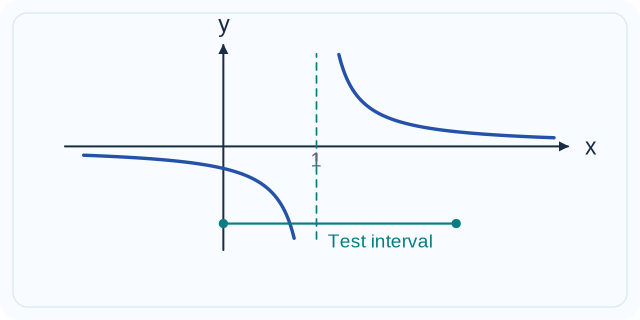
Two branches of a reciprocal graph approach opposite sides of a vertical dashed asymptote at x equals one. The highlighted test interval spans the pole.

The test interval shown crosses the pole at x=1x=1. The ordinary definite-integral method applies on a connected interval where the integrand is defined.

Worked example

Divide before integrating a definite rational function

Evaluate ∫242x2+7x−3(x−1)(x+2) dx\int_2^4\frac{2x^2+7x-3}{(x-1)(x+2)}\,\mathrm dx exactly.

  1. The denominator is x2+x−2x^2+x-2. Subtract twice this denominator from the numerator to get 5x+15x+1.

  2. The remainder splits as 5x+1(x−1)(x+2)=2x−1+3x+2\frac{5x+1}{(x-1)(x+2)}=\frac2{x-1}+\frac3{x+2}. Both poles lie outside the integration interval.

  3. Use [2x+2ln⁡(x−1)+3ln⁡(x+2)]24\left[2x+2\ln(x-1)+3\ln(x+2)\right]_2^4. The exact value is 4+2ln⁡3+3ln⁡(32)4+2\ln3+3\ln\left(\frac32\right).

Your turn

For R(x)=3x2−4x−13(x−2)(x+1)R(x)=\frac{3x^2-4x-13}{(x-2)(x+1)}, write R(x)=q+Ax−2+Bx+1R(x)=q+\frac A{x-2}+\frac B{x+1}. Give q,A,Bq,A,B and choose the interval on which the ordinary definite integral is defined.

Enter the value on its own or write q = … . Fractions and exact square roots are accepted.

Enter the value on its own or write A = … . Fractions and exact square roots are accepted.

Enter the value on its own or write B = … . Fractions and exact square roots are accepted.

Interval without a pole

Section 5 of 5 · Core · about 5 min

How do I decide which part gives a logarithm?

A quadratic denominator often gives two different antiderivatives.

Worked example

Match two numerator pieces with two different primitives

Write ∫8x+7x2+9 dx\int \frac{8 x + 7}{x^{2} + 9}\,\mathrm dx as Aln⁡(x2+9)+Btan⁡−1(x3)+CA\ln(x^{2} + 9)+B\tan^{-1}\left(\frac{x}{3}\right)+C. Find AA and BB.

  1. Split the numerator into its xx term and its constant.

  2. The derivative of x2+9x^{2} + 9 is 2x2x, so the logarithm coefficient is 44.

  3. The constant part matches inverse tangent with an inner derivative factor. The second coefficient is 73\frac{7}{3}.

Your turn

Write ∫5x+3x2+4 dx\int \frac{5 x + 3}{x^{2} + 4}\,\mathrm dx as Aln⁡(x2+4)+Btan⁡−1(x2)+CA\ln(x^{2} + 4)+B\tan^{-1}\left(\frac{x}{2}\right)+C. Find AA and BB.

Enter the value on its own or write a = … . Fractions and exact square roots are accepted.

Enter the value on its own or write b = … . Fractions and exact square roots are accepted.

Worked examples

Practise the method

Core practice

Question 1 of 4

0 / 4 checked in this collection

Question list

Core practice

Fresh variants

Exam-style

Adjust the coefficient of a logarithm

2 marks

Find coefficients a,ba,b such that aln⁡∣2x+1∣+bln⁡∣x+3∣+Ca\ln|2x+1|+b\ln|x+3|+C is an antiderivative of 8x+9(2x+1)(x+3)\frac{8x+9}{(2x+1)(x+3)}.

Enter the complete form using all three fields: a(x − h)² + c.

Enter the value on its own or write a = … . Fractions and exact square roots are accepted.

Enter the value on its own or write b = … . Fractions and exact square roots are accepted.

Full answer-format guide

Exact numbers: 3/2, sqrt(5), 2-sqrt(3), pi/6, 3*pi/2. Sets: {1,4}. Intervals: (3,5]; a round bracket excludes the endpoint. Infinity: inf; union: U; no solutions: empty. Separate coordinate pairs or triples with semicolons. Expressions: 2x^2+3x-1; equations: x^2=3x+1 or the polynomial equal to zero. Factors: x-1 ; x+2. Parameter fraction: numerator ; denominator. List integer answers individually.

Review the method

Progress stays in this browser. Create an account to save it or sign in.

Extra practice from this lesson

Recover both coefficients before integration

Write 3(x+1)(x+2)(x+5)\frac{3 \left(x + 1\right)}{\left(x + 2\right) \left(x + 5\right)} as Ax+2+Bx+5\frac{A}{x + 2}+\frac{B}{x + 5}. Give AA and BB.

Enter the value on its own or write a = … . Fractions and exact square roots are accepted.

Enter the value on its own or write b = … . Fractions and exact square roots are accepted.

Recover both coefficients before integration

Write 2x+3(x+4)2\frac{2 x + 3}{\left(x + 4\right)^{2}} as Ax+4+B(x+4)2\frac{A}{x + 4}+\frac{B}{\left(x + 4\right)^{2}}. Give AA and BB.

Enter the value on its own or write a = … . Fractions and exact square roots are accepted.

Enter the value on its own or write b = … . Fractions and exact square roots are accepted.

Match two numerator pieces with two different primitives

Write ∫x+2x2+25 dx\int \frac{x + 2}{x^{2} + 25}\,\mathrm dx as Aln⁡(x2+25)+Btan⁡−1(x5)+CA\ln(x^{2} + 25)+B\tan^{-1}\left(\frac{x}{5}\right)+C. Find AA and BB.

Enter the value on its own or write a = … . Fractions and exact square roots are accepted.

Enter the value on its own or write b = … . Fractions and exact square roots are accepted.

Recover both coefficients before integration

Write 11x+59(x+1)(x+7)\frac{11 x + 59}{\left(x + 1\right) \left(x + 7\right)} as Ax+1+Bx+7\frac{A}{x + 1}+\frac{B}{x + 7}. Give AA and BB.

Enter the value on its own or write a = … . Fractions and exact square roots are accepted.

Enter the value on its own or write b = … . Fractions and exact square roots are accepted.

Recover both coefficients before integration

Write −3(x+6)(x+8)2- \frac{3 \left(x + 6\right)}{\left(x + 8\right)^{2}} as Ax+8+B(x+8)2\frac{A}{x + 8}+\frac{B}{\left(x + 8\right)^{2}}. Give AA and BB.

Enter the value on its own or write a = … . Fractions and exact square roots are accepted.

Enter the value on its own or write b = … . Fractions and exact square roots are accepted.

Match two numerator pieces with two different primitives

Write ∫9x+7x2+16 dx\int \frac{9 x + 7}{x^{2} + 16}\,\mathrm dx as Aln⁡(x2+16)+Btan⁡−1(x4)+CA\ln(x^{2} + 16)+B\tan^{-1}\left(\frac{x}{4}\right)+C. Find AA and BB.

Enter the value on its own or write a = … . Fractions and exact square roots are accepted.

Enter the value on its own or write b = … . Fractions and exact square roots are accepted.

Apply it · original exam-style problems

Show your working on paper and compare it with the worked solution and marking guidance.

Come back to what needs practice

Quick revision sheet (A4)

Your review plan starts after your first check.