Maths4UBETA

Integration by parts and choosing a method

Choose factors for integration by parts, simplify logarithmic and repeated products, and evaluate exact definite integrals.

Try the quick check →
Lesson 5 of 5

Section 1 of 5 · Core · about 8 min

What makes a good choice of u?

Parts reverses the product rule. Arrange the two factors so that the second integral takes less work than the first.

Worked example

Reduce a linear factor to a constant

Find ∫(2x+1)e2x dx\int (2x+1)e^{2x}\,dx.

  1. Set u=2x+1u=2x+1 and v′=e2xv'=e^{2x}. Then u′=2u'=2 and v=12e2xv=\frac12e^{2x}.

  2. ∫(2x+1)e2x dx=(x+12)e2x−∫e2x dx.\int (2x+1)e^{2x}\,dx=\left(x+\frac12\right)e^{2x}-\int e^{2x}\,dx.
  3. The remaining primitive is 12e2x\frac12e^{2x}. The terms cancel to give xe2x+Cxe^{2x}+C. Differentiating returns (2x+1)e2x(2x+1)e^{2x}.

Worked example

Apply integration by parts and keep the remainder

Write ∫(2x+3)e7x dx\int \left(2 x + 3\right) \mathrm e^{7 x}\,\mathrm dx as (Ax+B)e7x+C(Ax+B)\mathrm e^{7 x}+C. Find AA and BB.

Try it on paper first.

  1. Choose u=2x+3,dvdx=e7xu=2 x + 3,\quad \frac{\mathrm dv}{\mathrm dx}=\mathrm e^{7 x}. Then dudx=2,v=e7x7\frac{\mathrm du}{\mathrm dx}=2,\quad v=\frac{\mathrm e^{7 x}}{7}.

  2. Write the product term, then subtract the integral of 2e7x7\frac{2 \mathrm e^{7 x}}{7}.

  3. Integrating that remainder gives (14x+19)e7x49+C\frac{\left(14 x + 19\right) \mathrm e^{7 x}}{49}+C for the original primitive.

Your turn

Write ∫(3x+4)e−x dx\int (3x+4)e^{-x}\,dx as (Ax+B)e−x+C(Ax+B)e^{-x}+C. Give AA and BB.

Enter the value on its own or write a = … . Fractions and exact square roots are accepted.

Enter the value on its own or write b = … . Fractions and exact square roots are accepted.

Section 2 of 5 · Core · about 8 min

How can I integrate a logarithm on its own?

Write an isolated logarithm as 1×1\times the logarithm. Its derivative is rational, so the next integral may admit an algebraic simplification.

Worked example

Reveal the rational remainder

Find ∫ln⁡(3x+1) dx\int \ln(3x+1)\,dx, for x>−13x>-\frac13.

  1. Use u=ln⁡(3x+1)u=\ln(3x+1) and v′=1v'=1. This gives u′=33x+1u'=\frac{3}{3x+1} and v=xv=x.

  2. ∫ln⁡(3x+1) dx=xln⁡(3x+1)−∫(1−13x+1) dx.\int\ln(3x+1)\,dx=x\ln(3x+1)-\int\left(1-\frac{1}{3x+1}\right)\,dx.
  3. Integrate the split remainder and collect logarithms. The result is (x+13)ln⁡(3x+1)−x+C\left(x+\frac13\right)\ln(3x+1)-x+C.

Worked example

Apply integration by parts and keep the remainder

Write ∫4ln⁡(x) dx\int 4 \ln{\left(x \right)}\,\mathrm dx as Axln⁡x+Bx+CAx\ln x+Bx+C for x>0x>0. Find AA and BB.

Try it on paper first.

  1. Choose u=ln⁡(x),dvdx=4u=\ln{\left(x \right)},\quad \frac{\mathrm dv}{\mathrm dx}=4. Then dudx=1x,v=4x\frac{\mathrm du}{\mathrm dx}=\frac{1}{x},\quad v=4 x.

  2. Write the product term, then subtract the integral of 44.

  3. Integrating that remainder gives 4x(ln⁡(x)−1)+C4 x \left(\ln{\left(x \right)} - 1\right)+C for the original primitive.

Your turn

For x>0x>0, write ∫xln⁡x dx\int x\ln x\,dx as Ax2ln⁡x+Bx2+CA x^2\ln x+B x^2+C. Give AA and BB.

Enter the value on its own or write a = … . Fractions and exact square roots are accepted.

Enter the value on its own or write b = … . Fractions and exact square roots are accepted.

Section 3 of 5 · Core · about 8 min

When should I use parts a second time?

A polynomial of degree two becomes linear after one use of parts. A second use removes the remaining variable factor.

Worked example

Lower a quadratic factor twice

Find ∫x2e−x dx\int x^2e^{-x}\,dx.

  1. Use parts with u=x2, v=−e−xu=x^2,\ v=-e^{-x}.

    ∫x2e−x dx=−x2e−x+∫2xe−x dx.\int x^2e^{-x}\,dx=-x^2e^{-x}+\int 2xe^{-x}\,dx.
  2. StepDifferentiated factorPrimitive used
    Firstu=x2u=x^2v=−e−xv=-e^{-x}
    Secondu=2xu=2xv=−e−xv=-e^{-x}

    For the new integral, use u=2xu=2x and the same primitive v=−e−xv=-e^{-x}. It gives −2xe−x−2e−x-2xe^{-x}-2e^{-x}, up to a constant.

  3. Collect terms to obtain −(x2+2x+2)e−x+C-(x^2+2x+2)e^{-x}+C.

Your turn

Write ∫(x2+4x)ex dx\int (x^2+4x)e^x\,dx as (Ax2+Bx+D)ex+C(Ax^2+Bx+D)e^x+C. Give A,B,DA,B,D.

Enter the value on its own or write a = … . Fractions and exact square roots are accepted.

Enter the value on its own or write b = … . Fractions and exact square roots are accepted.

Enter the value on its own or write d = … . Fractions and exact square roots are accepted.

Section 4 of 5 · Core · about 8 min

How do I handle limits and signs?

For an integral with bounds, apply both limits to the boundary term and keep the same limits on the remaining integral.
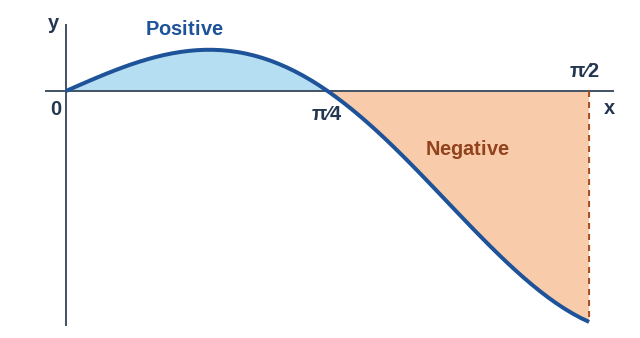
The graph of x cosine of twice x is above the horizontal axis before pi over four and below it afterwards, up to pi over two.

In the Your turn integral, xcos⁡(2x)x\cos(2x) changes sign at x=π4x=\frac{\pi}{4}. The part below the axis contributes a negative value when evaluating the integral.

Worked example

Evaluate a trigonometric product

Find ∫0π2xsin⁡(2x) dx\int_0^{\frac{\pi}{2}}x\sin(2x)\,dx, using radians.

  1. Select u=xu=x, v′=sin⁡(2x)v'=\sin(2x). Then u′=1u'=1 and v=−12cos⁡(2x)v=-\frac12\cos(2x).

  2. ∫0π2xsin⁡(2x) dx=[−xcos⁡(2x)2+sin⁡(2x)4]0π2.\int_0^{\frac{\pi}{2}}x\sin(2x)\,dx=\left[-\frac{x\cos(2x)}2+\frac{\sin(2x)}4\right]_0^{\frac{\pi}{2}}.
  3. At the upper limit, cos⁡π=−1\cos\pi=-1 and sin⁡π=0\sin\pi=0. The lower value is 00, so the integral is π4\frac{\pi}{4}.

Your turn

Find the exact signed integral ∫0π2xcos⁡(2x) dx\int_0^{\frac{\pi}{2}}x\cos(2x)\,dx.

Enter an exact number, for example 3/2 or 2-sqrt(3).

Section 5 of 5 · Core · about 5 min

How can the endpoints simplify a by-parts calculation?

The product term at the endpoints and the remaining integral may behave differently.
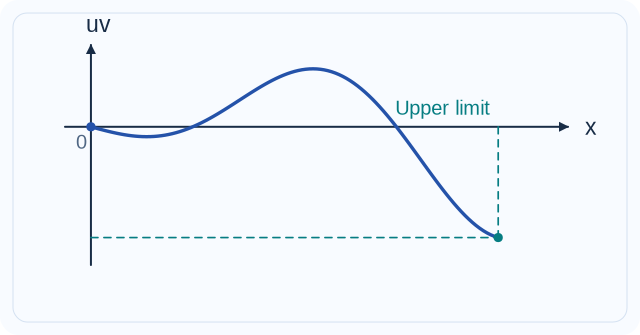
The product curve starts at zero and ends below the axis. A marked point at the final input makes the negative end value visible.

The product term uv=−14xcos⁡(4x)uv=-\tfrac14 x\cos(4x) has values 00 then −π8-\tfrac{\pi}{8} at the endpoints of [0,π2][0,\tfrac{\pi}{2}]. Include the remaining integral after taking the product difference.

Worked example

Apply integration by parts and keep the remainder

Evaluate ∫0π2xsin⁡(4x) dx\int_{0}^{\frac{\pi}{2}}x \sin{\left(4 x \right)}\,\mathrm dx exactly by parts.

  1. Choose u=x,dvdx=sin⁡(4x)u=x,\quad \frac{\mathrm dv}{\mathrm dx}=\sin{\left(4 x \right)}. Then dudx=1,v=−cos⁡(4x)4\frac{\mathrm du}{\mathrm dx}=1,\quad v=- \frac{\cos{\left(4 x \right)}}{4}.

  2. Write the product term, then subtract the integral of −cos⁡(4x)4- \frac{\cos{\left(4 x \right)}}{4}.

  3. Integrating that remainder gives −xcos⁡(4x)4+sin⁡(4x)16+C- \frac{x \cos{\left(4 x \right)}}{4} + \frac{\sin{\left(4 x \right)}}{16}+C for the original primitive.

  4. Evaluate the primitive at the upper limit, then subtract its value at the lower limit. The integral is −π8- \frac{\pi}{8}.

Your turn

Evaluate ∫0π3xsin⁡(6x) dx\int_{0}^{\frac{\pi}{3}}x \sin{\left(6 x \right)}\,\mathrm dx exactly by parts.

Enter an exact number, for example 3/2 or 2-sqrt(3).

Worked examples

Practise the method

Core practice

Question 1 of 4

0 / 4 checked in this collection

Question list

Core practice

Fresh variants

Exam-style

Find a linear exponential primitive

2 marks

Find A,BA,B such that ∫(3x+1)e2x dx=(Ax+B)e2x+C\int (3x+1)e^{2x}\,dx=(Ax+B)e^{2x}+C.

Enter the complete form using all three fields: a(x − h)² + c.

Enter the value on its own or write a = … . Fractions and exact square roots are accepted.

Enter the value on its own or write b = … . Fractions and exact square roots are accepted.

Full answer-format guide

Exact numbers: 3/2, sqrt(5), 2-sqrt(3), pi/6, 3*pi/2. Sets: {1,4}. Intervals: (3,5]; a round bracket excludes the endpoint. Infinity: inf; union: U; no solutions: empty. Separate coordinate pairs or triples with semicolons. Expressions: 2x^2+3x-1; equations: x^2=3x+1 or the polynomial equal to zero. Factors: x-1 ; x+2. Parameter fraction: numerator ; denominator. List integer answers individually.

Review the method

Progress stays in this browser. Create an account to save it or sign in.

Extra practice from this lesson

Apply integration by parts and keep the remainder

Write ∫(5x+1)e3x dx\int \left(5 x + 1\right) \mathrm e^{3 x}\,\mathrm dx as (Ax+B)e3x+C(Ax+B)\mathrm e^{3 x}+C. Find AA and BB.

Enter the value on its own or write a = … . Fractions and exact square roots are accepted.

Enter the value on its own or write b = … . Fractions and exact square roots are accepted.

Apply integration by parts and keep the remainder

Write ∫7ln⁡(x) dx\int 7 \ln{\left(x \right)}\,\mathrm dx as Axln⁡x+Bx+CAx\ln x+Bx+C for x>0x>0. Find AA and BB.

Enter the value on its own or write a = … . Fractions and exact square roots are accepted.

Enter the value on its own or write b = … . Fractions and exact square roots are accepted.

Apply integration by parts and keep the remainder

Evaluate ∫0π3xcos⁡(3x) dx\int_{0}^{\frac{\pi}{3}}x \cos{\left(3 x \right)}\,\mathrm dx exactly by parts.

Enter an exact number, for example 3/2 or 2-sqrt(3).

Apply integration by parts and keep the remainder

Write ∫(3x−2)e−2x dx\int \left(3 x - 2\right) \mathrm e^{- 2 x}\,\mathrm dx as (Ax+B)e−2x+C(Ax+B)\mathrm e^{- 2 x}+C. Find AA and BB.

Enter the value on its own or write a = … . Fractions and exact square roots are accepted.

Enter the value on its own or write b = … . Fractions and exact square roots are accepted.

Apply integration by parts and keep the remainder

Write ∫2ln⁡(x) dx\int 2 \ln{\left(x \right)}\,\mathrm dx as Axln⁡x+Bx+CAx\ln x+Bx+C for x>0x>0. Find AA and BB.

Enter the value on its own or write a = … . Fractions and exact square roots are accepted.

Enter the value on its own or write b = … . Fractions and exact square roots are accepted.

Apply integration by parts and keep the remainder

Evaluate ∫0π22xsin⁡(2x) dx\int_{0}^{\frac{\pi}{2}}2 x \sin{\left(2 x \right)}\,\mathrm dx exactly by parts.

Enter an exact number, for example 3/2 or 2-sqrt(3).

Apply it · original exam-style problems

Show your working on paper and compare it with the worked solution and marking guidance.

Come back to what needs practice

Quick revision sheet (A4)

Your review plan starts after your first check.