Maths4UBETA

Vertical motion and lift forces

Use signed vertical acceleration to find and interpret a normal reaction.

Try the quick check →
Lesson 2 of 5

Section 1 of 5 · Core · about 7 min

Which forces act on a parcel in a lift?

Choose the parcel separately from the cage. The earth pulls the parcel downwards. The floor pushes it upwards as long as the parcel stays in contact. The cable force acts on the lift assembly.

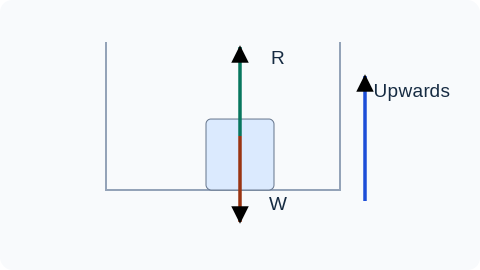
A parcel is supported by the lift floor. Its normal reaction R acts upward and its weight W acts downward.

Only forces on the parcel enter its force equation. The arrow marked upwards indicates the chosen positive direction.

Worked example

Find the floor reaction while accelerating upwards

A 12 kg12\, \mathrm{kg} parcel remains in contact with the floor of a lift. Take upwards as positive and use g=10 m s−2g=10\, \mathrm{m\,s^{-2}}. The signed acceleration is 2 m s−22\, \mathrm{m\,s^{-2}}. Find the weight of the parcel and the normal force from the floor.

  1. W=120 NW=120\, \mathrm N acts downwards and the reaction acts upwards.

  2. R−mg=maR-mg=ma. Keep the signs in this relation even if the lift is moving downwards.

  3. a=2 m s−2a=2\, \mathrm{m\,s^{-2}} and R=144 NR=144\, \mathrm N satisfy the vertical equation.

Your turn

A 9 kg9\, \mathrm{kg} parcel remains in contact with the floor of a lift. Take upwards as positive and use g=10 m s−2g=10\, \mathrm{m\,s^{-2}}. The signed acceleration is 3 m s−23\, \mathrm{m\,s^{-2}}. Find the weight of the parcel and the normal force from the floor.

Enter an exact number, for example 3/2 or 2-sqrt(3).

Enter an exact number, for example 3/2 or 2-sqrt(3).

Section 2 of 5 · Core · about 7 min

How does the acceleration affect the scale reading?

Acceleration upwards requires an upward resultant, so the floor reaction exceeds the weight. Acceleration downwards requires a downward resultant, so the reaction is below the weight. The direction of motion is a separate fact.

Worked example

Compare reaction to weight during downward acceleration

A 15 kg15\, \mathrm{kg} parcel remains in contact with the floor of a lift. Take upwards as positive and use g=10 m s−2g=10\, \mathrm{m\,s^{-2}}. The signed acceleration is −3 m s−2-3\, \mathrm{m\,s^{-2}}. Find the weight of the parcel and the normal force from the floor.

  1. W=150 NW=150\, \mathrm N acts downwards and the reaction acts upwards.

  2. R−mg=maR-mg=ma. Keep the signs in this relation even if the lift is moving downwards.

  3. a=−3 m s−2a=-3\, \mathrm{m\,s^{-2}} and R=105 NR=105\, \mathrm N satisfy the vertical equation.

Worked example

Recover acceleration from a low reading

A 14 kg14\, \mathrm{kg} parcel remains in contact with the floor of a lift. Take upwards as positive and use g=10 m s−2g=10\, \mathrm{m\,s^{-2}}. The floor exerts an upward normal force of 112 N112\, \mathrm N. Find the signed acceleration.

Try it on paper first.

  1. W=140 NW=140\, \mathrm N acts downwards and the reaction acts upwards.

  2. R−mg=maR-mg=ma. Keep the signs in this relation even if the lift is moving downwards.

  3. a=−2 m s−2a=-2\, \mathrm{m\,s^{-2}} and R=112 NR=112\, \mathrm N satisfy the vertical equation.

Your turn

A 18 kg18\, \mathrm{kg} parcel remains in contact with the floor of a lift. Take upwards as positive and use g=10 m s−2g=10\, \mathrm{m\,s^{-2}}. The signed acceleration is −2 m s−2-2\, \mathrm{m\,s^{-2}}. Find the weight of the parcel and the normal force from the floor.

Enter an exact number, for example 3/2 or 2-sqrt(3).

Enter an exact number, for example 3/2 or 2-sqrt(3).

Section 3 of 5 · Core · about 7 min

What can a normal reaction tell us?

A force scale under a parcel measures the contact force. Once its reading and mass are known, the acceleration can be found from the net vertical force. A scale calibrated in mass first needs to be converted using the gravity specified in the problem.

Worked example

Determine acceleration from a scale reading

A 20 kg20\, \mathrm{kg} parcel remains in contact with the floor of a lift. Take upwards as positive and use g=10 m s−2g=10\, \mathrm{m\,s^{-2}}. The floor exerts an upward normal force of 230 N230\, \mathrm N. Find the signed acceleration.

  1. W=200 NW=200\, \mathrm N acts downwards and the reaction acts upwards.

  2. R−mg=maR-mg=ma. Keep the signs in this relation even if the lift is moving downwards.

  3. a=32 m s−2a=\frac{3}{2}\, \mathrm{m\,s^{-2}} and R=230 NR=230\, \mathrm N satisfy the vertical equation.

Your turn

A 12 kg12\, \mathrm{kg} parcel remains in contact with the floor of a lift. Take upwards as positive and use g=10 m s−2g=10\, \mathrm{m\,s^{-2}}. The floor exerts an upward normal force of 108 N108\, \mathrm N. Find the signed acceleration.

Enter an exact number, for example 3/2 or 2-sqrt(3).

Section 4 of 5 · Core · about 8 min

Can the floor ever pull the parcel down?

A normal reaction from an ordinary floor is compressive. If the equation required a negative value, the assumed contact could not be kept. At the limiting state, the normal reaction is zero and the parcel accelerates under its weight alone.

Worked example

Find the reaction in free fall

A 9 kg9\, \mathrm{kg} parcel remains in contact with the floor of a lift. Take upwards as positive and use g=10 m s−2g=10\, \mathrm{m\,s^{-2}}. The signed acceleration is −10 m s−2-10\, \mathrm{m\,s^{-2}}. Find the weight of the parcel and the normal force from the floor.

  1. W=90 NW=90\, \mathrm N acts downwards and the reaction acts upwards.

  2. R−mg=maR-mg=ma. Keep the signs in this relation even if the lift is moving downwards.

  3. a=−10 m s−2a=-10\, \mathrm{m\,s^{-2}} and R=0 NR=0\, \mathrm N satisfy the vertical equation.

Your turn

A 13 kg13\, \mathrm{kg} parcel remains in contact with the floor of a lift. Take upwards as positive and use g=10 m s−2g=10\, \mathrm{m\,s^{-2}}. The signed acceleration is −10 m s−2-10\, \mathrm{m\,s^{-2}}. Find the weight of the parcel and the normal force from the floor.

Enter an exact number, for example 3/2 or 2-sqrt(3).

Enter an exact number, for example 3/2 or 2-sqrt(3).

Section 5 of 5 · Core · about 6 min

When does the scale read the true weight?

During steady ascent or descent, zero acceleration gives equal upward and downward forces on the parcel. A change in speed changes the reading even if the direction of travel remains the same.

Worked example

Infer the weight and support at steady velocity

A 17 kg17\, \mathrm{kg} parcel remains in contact with the floor of a lift. Take upwards as positive and use g=10 m s−2g=10\, \mathrm{m\,s^{-2}}. The signed acceleration is 0 m s−20\, \mathrm{m\,s^{-2}}. Find the weight of the parcel and the normal force from the floor.

  1. W=170 NW=170\, \mathrm N acts downwards and the reaction acts upwards.

  2. R−mg=maR-mg=ma. Keep the signs in this relation even if the lift is moving downwards.

  3. a=0 m s−2a=0\, \mathrm{m\,s^{-2}} and R=170 NR=170\, \mathrm N satisfy the vertical equation.

Worked example

Compare a smaller positive vertical acceleration

A 25 kg25\, \mathrm{kg} parcel remains in contact with the floor of a lift. Take upwards as positive and use g=10 m s−2g=10\, \mathrm{m\,s^{-2}}. The signed acceleration is 25 m s−2\frac{2}{5}\, \mathrm{m\,s^{-2}}. Find the weight of the parcel and the normal force from the floor.

Try it on paper first.

  1. W=250 NW=250\, \mathrm N acts downwards and the reaction acts upwards.

  2. R−mg=maR-mg=ma. Keep the signs in this relation even if the lift is moving downwards.

  3. a=25 m s−2a=\frac{2}{5}\, \mathrm{m\,s^{-2}} and R=260 NR=260\, \mathrm N satisfy the vertical equation.

Your turn

A 22 kg22\, \mathrm{kg} parcel remains in contact with the floor of a lift. Take upwards as positive and use g=10 m s−2g=10\, \mathrm{m\,s^{-2}}. The signed acceleration is 0 m s−20\, \mathrm{m\,s^{-2}}. Find the weight of the parcel and the normal force from the floor.

Enter an exact number, for example 3/2 or 2-sqrt(3).

Enter an exact number, for example 3/2 or 2-sqrt(3).

Worked examples

Practise the method

Core practice

Question 1 of 4

0 / 4 checked in this collection

Question list

Core practice

Fresh variants

Exam-style

Find the reaction during upward acceleration

2 marks

A 15 kg15\, \mathrm{kg} parcel remains in contact with the floor of a lift. Take upwards as positive and use g=10 m s−2g=10\, \mathrm{m\,s^{-2}}. The signed acceleration is 2 m s−22\, \mathrm{m\,s^{-2}}. Find the weight of the parcel and the normal force from the floor.

Enter an exact number, for example 3/2 or 2-sqrt(3).

Enter an exact number, for example 3/2 or 2-sqrt(3).

Full answer-format guide

Exact numbers: 3/2, sqrt(5), 2-sqrt(3), pi/6, 3*pi/2. Sets: {1,4}. Intervals: (3,5]; a round bracket excludes the endpoint. Infinity: inf; union: U; no solutions: empty. Separate coordinate pairs or triples with semicolons. Expressions: 2x^2+3x-1; equations: x^2=3x+1 or the polynomial equal to zero. Factors: x-1 ; x+2. Parameter fraction: numerator ; denominator. List integer answers individually.

Review the method

Progress stays in this browser. Create an account to save it or sign in.

Extra practice from this lesson

Find the upward reaction on a crate

A 16 kg16\, \mathrm{kg} parcel remains in contact with the floor of a lift. Take upwards as positive and use g=10 m s−2g=10\, \mathrm{m\,s^{-2}}. The signed acceleration is 2 m s−22\, \mathrm{m\,s^{-2}}. Find the weight of the parcel and the normal force from the floor.

Enter an exact number, for example 3/2 or 2-sqrt(3).

Enter an exact number, for example 3/2 or 2-sqrt(3).

Find the normal force during downward acceleration

A 28 kg28\, \mathrm{kg} parcel remains in contact with the floor of a lift. Take upwards as positive and use g=10 m s−2g=10\, \mathrm{m\,s^{-2}}. The signed acceleration is −4 m s−2-4\, \mathrm{m\,s^{-2}}. Find the weight of the parcel and the normal force from the floor.

Enter an exact number, for example 3/2 or 2-sqrt(3).

Enter an exact number, for example 3/2 or 2-sqrt(3).

Read the direction from a high force reading

A 24 kg24\, \mathrm{kg} parcel remains in contact with the floor of a lift. Take upwards as positive and use g=10 m s−2g=10\, \mathrm{m\,s^{-2}}. The floor exerts an upward normal force of 312 N312\, \mathrm N. Find the signed acceleration.

Enter an exact number, for example 3/2 or 2-sqrt(3).

Use the equality at steady motion

A 33 kg33\, \mathrm{kg} parcel remains in contact with the floor of a lift. Take upwards as positive and use g=10 m s−2g=10\, \mathrm{m\,s^{-2}}. The signed acceleration is 0 m s−20\, \mathrm{m\,s^{-2}}. Find the weight of the parcel and the normal force from the floor.

Enter an exact number, for example 3/2 or 2-sqrt(3).

Enter an exact number, for example 3/2 or 2-sqrt(3).

Interpret a low scale reading

A 26 kg26\, \mathrm{kg} parcel remains in contact with the floor of a lift. Take upwards as positive and use g=10 m s−2g=10\, \mathrm{m\,s^{-2}}. The floor exerts an upward normal force of 221 N221\, \mathrm N. Find the signed acceleration.

Enter an exact value or round to 3 significant figures.

Check a near-free-fall reading

A 10 kg10\, \mathrm{kg} parcel remains in contact with the floor of a lift. Take upwards as positive and use g=10 m s−2g=10\, \mathrm{m\,s^{-2}}. The signed acceleration is −9 m s−2-9\, \mathrm{m\,s^{-2}}. Find the weight of the parcel and the normal force from the floor.

Enter an exact number, for example 3/2 or 2-sqrt(3).

Enter an exact number, for example 3/2 or 2-sqrt(3).

Apply it · original exam-style problems

Show your working on paper and compare it with the worked solution and marking guidance.

Come back to what needs practice

Quick revision sheet (A4)

Your review plan starts after your first check.