Maths4UBETA

Connected particles in a straight line

Find the common acceleration and distinguish pull, push and slack connection models.

Try the quick check →
Lesson 4 of 5

Section 1 of 5 · Core · about 8 min

Why do linked vehicles have one acceleration?

A taut inextensible rope or a rigid bar of fixed length keeps the distance between the vehicles constant along the line. During that stage the velocities, and therefore the accelerations, are equal on a common rightward axis.

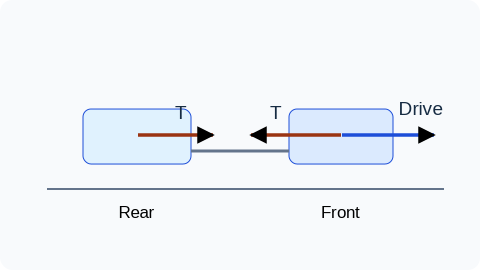
Two vehicles are joined by a connector. It pulls the front vehicle to the left and the rear vehicle to the right. A drive arrow acts right on the front vehicle.

The connector forces act on different vehicles. For the combined system they cancel. Include all external resistances when finding the common acceleration.

Worked example

Find common acceleration and rope tension

Two vehicles move to the right on a horizontal line, joined by a light taut inextensible rope. The leading vehicle has mass 14 kg14\, \mathrm{kg}, thrust 55 N55\, \mathrm N and resistance 13 N13\, \mathrm N. The rear vehicle has mass 8 kg8\, \mathrm{kg} and resistance 9 N9\, \mathrm N. Take right as positive. Find their common acceleration and the magnitude of the connection force. State whether the connection is in tension or compression, or exerts zero force.

  1. a=55−13−922a=\frac{55-13-9}{22} for the whole system. The connector forces are internal to this system.

  2. On the rear vehicle, the signed horizontal force from the connector satisfies T−9=8(32)T-9=8\left(\frac{3}{2}\right).

  3. The signed connector force on the rear vehicle is 21 N21\, \mathrm N. Tension therefore has magnitude 21 N21\, \mathrm N.

  4. The force on the front vehicle from the connector has the same magnitude and the opposite direction in this ideal light model.

Your turn

Two vehicles move to the right on a horizontal line, joined by a light taut inextensible rope. The leading vehicle has mass 9 kg9\, \mathrm{kg}, thrust 62 N62\, \mathrm N and resistance 17 N17\, \mathrm N. The rear vehicle has mass 6 kg6\, \mathrm{kg} and resistance 9 N9\, \mathrm N. Take right as positive. Find their common acceleration and the magnitude of the connection force. State whether the connection is in tension or compression, or exerts zero force.

Enter an exact value or round to 3 significant figures.

Enter an exact value or round to 3 significant figures.

State of connector

Section 2 of 5 · Core · about 7 min

Where does the connector force come back into the calculation?

To find the connector force, use the force equation for one vehicle. It is now external to your chosen body. The rear vehicle often has fewer forces, which makes that equation simpler.

Worked example

A different acceleration still produces a pull

Two vehicles move to the right on a horizontal line, joined by a light taut inextensible rope. The leading vehicle has mass 11 kg11\, \mathrm{kg}, thrust 49 N49\, \mathrm N and resistance 16 N16\, \mathrm N. The rear vehicle has mass 6 kg6\, \mathrm{kg} and resistance 7 N7\, \mathrm N. Take right as positive. Find their common acceleration and the magnitude of the connection force. State whether the connection is in tension or compression, or exerts zero force.

  1. a=49−16−717a=\frac{49-16-7}{17} for the whole system. The connector forces are internal to this system.

  2. On the rear vehicle, the signed horizontal force from the connector satisfies T−7=6(2617)T-7=6\left(\frac{26}{17}\right).

  3. The signed connector force on the rear vehicle is 27517 N\frac{275}{17}\, \mathrm N. Tension therefore has magnitude 27517 N\frac{275}{17}\, \mathrm N.

  4. The force on the front vehicle from the connector has the same magnitude and the opposite direction in this ideal light model.

Worked example

Balance common motion at steady speed

Two vehicles move to the right on a horizontal line, joined by a light taut inextensible rope. The leading vehicle has mass 14 kg14\, \mathrm{kg}, thrust 25 N25\, \mathrm N and resistance 11 N11\, \mathrm N. The rear vehicle has mass 14 kg14\, \mathrm{kg} and resistance 14 N14\, \mathrm N. Take right as positive. Find their common acceleration and the magnitude of the connection force. State whether the connection is in tension or compression, or exerts zero force.

Try it on paper first.

  1. a=25−11−1428a=\frac{25-11-14}{28} for the whole system. The connector forces are internal to this system.

  2. On the rear vehicle, the signed horizontal force from the connector satisfies T−14=14(0)T-14=14\left(0\right).

  3. The signed connector force on the rear vehicle is 14 N14\, \mathrm N. Tension therefore has magnitude 14 N14\, \mathrm N.

  4. The force on the front vehicle from the connector has the same magnitude and the opposite direction in this ideal light model.

Your turn

Two vehicles move to the right on a horizontal line, joined by a light taut inextensible rope. The leading vehicle has mass 15 kg15\, \mathrm{kg}, thrust 84 N84\, \mathrm N and resistance 14 N14\, \mathrm N. The rear vehicle has mass 10 kg10\, \mathrm{kg} and resistance 15 N15\, \mathrm N. Take right as positive. Find their common acceleration and the magnitude of the connection force. State whether the connection is in tension or compression, or exerts zero force.

Enter an exact value or round to 3 significant figures.

Enter an exact number, for example 3/2 or 2-sqrt(3).

State of connector

Section 3 of 5 · Core · about 8 min

How does a tow-bar differ from a rope?

A rigid bar can push as well as pull when the model keeps its length fixed. Let the force on the rear be positive forwards. A negative signed force means the bar pushes the rear vehicle backwards.

Worked example

Slow with a rigid bar in compression

Two vehicles move to the right on a horizontal line, joined by a light rigid tow-bar. The leading vehicle has mass 10 kg10\, \mathrm{kg}, thrust 0 N0\, \mathrm N and resistance 40 N40\, \mathrm N. The rear vehicle has mass 6 kg6\, \mathrm{kg} and resistance 4 N4\, \mathrm N. Take right as positive. Find their common acceleration and the magnitude of the connection force. State whether the connection is in tension or compression, or exerts zero force.

  1. a=0−40−416a=\frac{0-40-4}{16} for the whole system. The connector forces are internal to this system.

  2. On the rear vehicle, the signed horizontal force from the connector satisfies T−4=6(−114)T-4=6\left(-\frac{11}{4}\right).

  3. The signed connector force on the rear vehicle is −252 N-\frac{25}{2}\, \mathrm N. Compression therefore has magnitude 252 N\frac{25}{2}\, \mathrm N.

  4. The force on the front vehicle from the connector has the same magnitude and the opposite direction in this ideal light model.

Your turn

Two vehicles move to the right on a horizontal line, joined by a light rigid tow-bar. The leading vehicle has mass 11 kg11\, \mathrm{kg}, thrust 0 N0\, \mathrm N and resistance 50 N50\, \mathrm N. The rear vehicle has mass 9 kg9\, \mathrm{kg} and resistance 10 N10\, \mathrm N. Take right as positive. Find their common acceleration and the magnitude of the connection force. State whether the connection is in tension or compression, or exerts zero force.

Enter an exact number, for example 3/2 or 2-sqrt(3).

Enter an exact number, for example 3/2 or 2-sqrt(3).

State of connector

Section 4 of 5 · Core · about 7 min

Can a connector exert no force during motion?

If the two vehicles would have the same acceleration when treated independently, no connector force is needed to maintain their separation. The connector can therefore exert zero force while both vehicles are moving.

Worked example

A moving rigid connection can exert no force

Two vehicles move to the right on a horizontal line, joined by a light rigid tow-bar. The leading vehicle has mass 10 kg10\, \mathrm{kg}, thrust 5 N5\, \mathrm N and resistance 15 N15\, \mathrm N. The rear vehicle has mass 5 kg5\, \mathrm{kg} and resistance 5 N5\, \mathrm N. Take right as positive. Find their common acceleration and the magnitude of the connection force. State whether the connection is in tension or compression, or exerts zero force.

  1. a=5−15−515a=\frac{5-15-5}{15} for the whole system. The connector forces are internal to this system.

  2. On the rear vehicle, the signed horizontal force from the connector satisfies T−5=5(−1)T-5=5\left(-1\right).

  3. The signed connector force on the rear vehicle is 0 N0\, \mathrm N. Zero connection force therefore has magnitude 0 N0\, \mathrm N.

  4. The force on the front vehicle from the connector has the same magnitude and the opposite direction in this ideal light model.

Your turn

Two vehicles move to the right on a horizontal line, joined by a light rigid tow-bar. The leading vehicle has mass 12 kg12\, \mathrm{kg}, thrust 4 N4\, \mathrm N and resistance 16 N16\, \mathrm N. The rear vehicle has mass 8 kg8\, \mathrm{kg} and resistance 8 N8\, \mathrm N. Take right as positive. Find their common acceleration and the magnitude of the connection force. State whether the connection is in tension or compression, or exerts zero force.

Enter an exact number, for example 3/2 or 2-sqrt(3).

Enter an exact number, for example 3/2 or 2-sqrt(3).

State of connector

Section 5 of 5 · Core · about 8 min

Can a rope remain taut while the pair slows?

When the net external force is negative, both vehicles can decelerate while moving right. If the rear vehicle would slow more rapidly on its own, the rope must pull it forwards to keep their relative position fixed.

Worked example

Find the forward pull during controlled slowing

Two vehicles move to the right on a horizontal line, joined by a light taut inextensible rope. The leading vehicle has mass 18 kg18\, \mathrm{kg}, thrust 6 N6\, \mathrm N and resistance 10 N10\, \mathrm N. The rear vehicle has mass 12 kg12\, \mathrm{kg} and resistance 20 N20\, \mathrm N. Take right as positive. Find their common acceleration and the magnitude of the connection force. State whether the connection is in tension or compression, or exerts zero force.

  1. a=6−10−2030a=\frac{6-10-20}{30} for the whole system. The connector forces are internal to this system.

  2. On the rear vehicle, the signed horizontal force from the connector satisfies T−20=12(−45)T-20=12\left(-\frac{4}{5}\right).

  3. The signed connector force on the rear vehicle is 525 N\frac{52}{5}\, \mathrm N. Tension therefore has magnitude 525 N\frac{52}{5}\, \mathrm N.

  4. The force on the front vehicle from the connector has the same magnitude and the opposite direction in this ideal light model.

Worked example

A fresh bar transmits a compressive force

Two vehicles move to the right on a horizontal line, joined by a light rigid tow-bar. The leading vehicle has mass 12 kg12\, \mathrm{kg}, thrust 5 N5\, \mathrm N and resistance 40 N40\, \mathrm N. The rear vehicle has mass 8 kg8\, \mathrm{kg} and resistance 5 N5\, \mathrm N. Take right as positive. Find their common acceleration and the magnitude of the connection force. State whether the connection is in tension or compression, or exerts zero force.

Try it on paper first.

  1. a=5−40−520a=\frac{5-40-5}{20} for the whole system. The connector forces are internal to this system.

  2. On the rear vehicle, the signed horizontal force from the connector satisfies T−5=8(−2)T-5=8\left(-2\right).

  3. The signed connector force on the rear vehicle is −11 N-11\, \mathrm N. Compression therefore has magnitude 11 N11\, \mathrm N.

  4. The force on the front vehicle from the connector has the same magnitude and the opposite direction in this ideal light model.

Your turn

Two vehicles move to the right on a horizontal line, joined by a light taut inextensible rope. The leading vehicle has mass 21 kg21\, \mathrm{kg}, thrust 6 N6\, \mathrm N and resistance 14 N14\, \mathrm N. The rear vehicle has mass 9 kg9\, \mathrm{kg} and resistance 22 N22\, \mathrm N. Take right as positive. Find their common acceleration and the magnitude of the connection force. State whether the connection is in tension or compression, or exerts zero force.

Enter an exact number, for example 3/2 or 2-sqrt(3).

Enter an exact number, for example 3/2 or 2-sqrt(3).

State of connector

Worked examples

Practise the method

Core practice

Question 1 of 4

0 / 4 checked in this collection

Question list

Core practice

Fresh variants

Exam-style

Find a taut-rope tension

3 marks

Two vehicles move to the right on a horizontal line, joined by a light taut inextensible rope. The leading vehicle has mass 16 kg16\, \mathrm{kg}, thrust 92 N92\, \mathrm N and resistance 26 N26\, \mathrm N. The rear vehicle has mass 10 kg10\, \mathrm{kg} and resistance 14 N14\, \mathrm N. Take right as positive. Find their common acceleration and the magnitude of the connection force. State whether the connection is in tension or compression, or exerts zero force.

Enter an exact number, for example 3/2 or 2-sqrt(3).

Enter an exact number, for example 3/2 or 2-sqrt(3).

State of connector

Choose one option. Explain your reasoning on paper.

Full answer-format guide

Exact numbers: 3/2, sqrt(5), 2-sqrt(3), pi/6, 3*pi/2. Sets: {1,4}. Intervals: (3,5]; a round bracket excludes the endpoint. Infinity: inf; union: U; no solutions: empty. Separate coordinate pairs or triples with semicolons. Expressions: 2x^2+3x-1; equations: x^2=3x+1 or the polynomial equal to zero. Factors: x-1 ; x+2. Parameter fraction: numerator ; denominator. List integer answers individually.

Review the method

Progress stays in this browser. Create an account to save it or sign in.

Extra practice from this lesson

Find tension with three external forces

Two vehicles move to the right on a horizontal line, joined by a light taut inextensible rope. The leading vehicle has mass 12 kg12\, \mathrm{kg}, thrust 73 N73\, \mathrm N and resistance 21 N21\, \mathrm N. The rear vehicle has mass 8 kg8\, \mathrm{kg} and resistance 12 N12\, \mathrm N. Take right as positive. Find their common acceleration and the magnitude of the connection force. State whether the connection is in tension or compression, or exerts zero force.

Enter an exact number, for example 3/2 or 2-sqrt(3).

Enter an exact number, for example 3/2 or 2-sqrt(3).

State of connector

Use a smaller system acceleration

Two vehicles move to the right on a horizontal line, joined by a light taut inextensible rope. The leading vehicle has mass 16 kg16\, \mathrm{kg}, thrust 61 N61\, \mathrm N and resistance 20 N20\, \mathrm N. The rear vehicle has mass 14 kg14\, \mathrm{kg} and resistance 16 N16\, \mathrm N. Take right as positive. Find their common acceleration and the magnitude of the connection force. State whether the connection is in tension or compression, or exerts zero force.

Enter an exact value or round to 3 significant figures.

Enter an exact value or round to 3 significant figures.

State of connector

Read compression from a sign

Two vehicles move to the right on a horizontal line, joined by a light rigid tow-bar. The leading vehicle has mass 16 kg16\, \mathrm{kg}, thrust 2 N2\, \mathrm N and resistance 49 N49\, \mathrm N. The rear vehicle has mass 14 kg14\, \mathrm{kg} and resistance 11 N11\, \mathrm N. Take right as positive. Find their common acceleration and the magnitude of the connection force. State whether the connection is in tension or compression, or exerts zero force.

Enter an exact value or round to 3 significant figures.

Enter an exact value or round to 3 significant figures.

State of connector

Find the matching independent acceleration

Two vehicles move to the right on a horizontal line, joined by a light rigid tow-bar. The leading vehicle has mass 18 kg18\, \mathrm{kg}, thrust 6 N6\, \mathrm N and resistance 24 N24\, \mathrm N. The rear vehicle has mass 12 kg12\, \mathrm{kg} and resistance 12 N12\, \mathrm N. Take right as positive. Find their common acceleration and the magnitude of the connection force. State whether the connection is in tension or compression, or exerts zero force.

Enter an exact number, for example 3/2 or 2-sqrt(3).

Enter an exact number, for example 3/2 or 2-sqrt(3).

State of connector

Distinguish slowing and tension

Two vehicles move to the right on a horizontal line, joined by a light taut inextensible rope. The leading vehicle has mass 20 kg20\, \mathrm{kg}, thrust 3 N3\, \mathrm N and resistance 5 N5\, \mathrm N. The rear vehicle has mass 10 kg10\, \mathrm{kg} and resistance 18 N18\, \mathrm N. Take right as positive. Find their common acceleration and the magnitude of the connection force. State whether the connection is in tension or compression, or exerts zero force.

Enter an exact value or round to 3 significant figures.

Enter an exact value or round to 3 significant figures.

State of connector

Recover the connector force for steady travel

Two vehicles move to the right on a horizontal line, joined by a light taut inextensible rope. The leading vehicle has mass 12 kg12\, \mathrm{kg}, thrust 25 N25\, \mathrm N and resistance 13 N13\, \mathrm N. The rear vehicle has mass 16 kg16\, \mathrm{kg} and resistance 12 N12\, \mathrm N. Take right as positive. Find their common acceleration and the magnitude of the connection force. State whether the connection is in tension or compression, or exerts zero force.

Enter an exact number, for example 3/2 or 2-sqrt(3).

Enter an exact number, for example 3/2 or 2-sqrt(3).

State of connector

Apply it · original exam-style problems

Show your working on paper and compare it with the worked solution and marking guidance.

Come back to what needs practice

Quick revision sheet (A4)

Your review plan starts after your first check.