Maths4UBETA

Dynamics on a rough inclined plane

Use perpendicular balance and direction-dependent friction to determine along-plane acceleration.

Try the quick check →
Lesson 3 of 5

Section 1 of 5 · Core · about 8 min

Which axes make the force equations shorter?

Choose one axis up the plane and the other outward, perpendicular to it. A body following a straight plane has no acceleration across the surface. The reaction therefore appears only in the perpendicular equation.

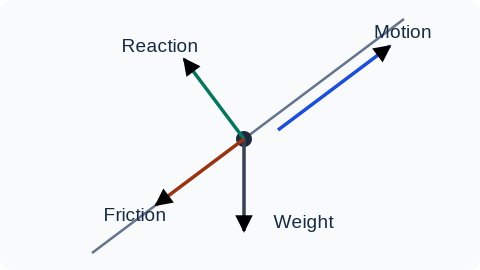
An inclined surface slopes upwards to the right. Weight is vertical down, the reaction is perpendicular to the surface, and friction is downhill while the box moves uphill.

The normal and frictional components of contact point in different directions. The positive axis along the plane is uphill.

Worked example

Resolve a weight on a slope

A 5 kg5\, \mathrm{kg} box moves up a rough plane at an instant. The plane makes angle θ\theta to the horizontal, where sin⁡θ=35\sin\theta=\frac{3}{5} and cos⁡θ=45\cos\theta=\frac{4}{5}. Use g=10 m s−2g=10\, \mathrm{m\,s^{-2}} and take up the plane as positive. The coefficient of friction is 14\frac{1}{4}. Find the normal reaction and the signed acceleration.

  1. Perpendicular to the surface there is no acceleration. Hence R=mgcos⁡θR=mg\cos\theta gives 40 N40\, \mathrm N.

  2. The sliding friction has magnitude μR\mu R = 10 N10\, \mathrm N and acts down the plane.

  3. ma=0−30−10ma=0-30-10 after resolving along the plane.

  4. a=−8 m s−2a=-8\, \mathrm{m\,s^{-2}} with the stated positive direction.

Your turn

A 10 kg10\, \mathrm{kg} box moves up a rough plane at an instant. The plane makes angle θ\theta to the horizontal, where sin⁡θ=35\sin\theta=\frac{3}{5} and cos⁡θ=45\cos\theta=\frac{4}{5}. Use g=10 m s−2g=10\, \mathrm{m\,s^{-2}} and take up the plane as positive. The coefficient of friction is 15\frac{1}{5}. Find the normal reaction and the signed acceleration.

Enter an exact number, for example 3/2 or 2-sqrt(3).

Enter an exact value or round to 3 significant figures.

Section 2 of 5 · Core · about 8 min

Why does friction turn round when the particle does?

Friction acts against relative sliding at the contact. For a slider moving downhill, the friction arrow points uphill. For the same slider moving uphill, it points downhill. The direction of its acceleration does not decide that arrow.

Worked example

Reverse the friction direction on descent

A 10 kg10\, \mathrm{kg} box moves down a rough plane at an instant. The plane makes angle θ\theta to the horizontal, where sin⁡θ=35\sin\theta=\frac{3}{5} and cos⁡θ=45\cos\theta=\frac{4}{5}. Use g=10 m s−2g=10\, \mathrm{m\,s^{-2}} and take up the plane as positive. The coefficient of friction is 15\frac{1}{5}. Find the normal reaction and the signed acceleration.

  1. Perpendicular to the surface there is no acceleration. Hence R=mgcos⁡θR=mg\cos\theta gives 80 N80\, \mathrm N.

  2. The sliding friction has magnitude μR\mu R = 16 N16\, \mathrm N and acts up the plane.

  3. ma=0−60+16ma=0-60+16 after resolving along the plane.

  4. a=−225 m s−2a=-\frac{22}{5}\, \mathrm{m\,s^{-2}} with the stated positive direction.

Worked example

Compare an uphill pull during downhill travel

A 13 kg13\, \mathrm{kg} box moves down a rough plane at an instant. The plane makes angle θ\theta to the horizontal, where sin⁡θ=513\sin\theta=\frac{5}{13} and cos⁡θ=1213\cos\theta=\frac{12}{13}. Use g=10 m s−2g=10\, \mathrm{m\,s^{-2}} and take up the plane as positive. The coefficient of friction is 15\frac{1}{5}. There is also a force of 28 N28\, \mathrm N parallel to and up the plane. Find the normal reaction and the signed acceleration.

Try it on paper first.

  1. Perpendicular to the surface there is no acceleration. Hence R=mgcos⁡θR=mg\cos\theta gives 120 N120\, \mathrm N.

  2. The sliding friction has magnitude μR\mu R = 24 N24\, \mathrm N and acts up the plane.

  3. ma=28−50+24ma=28-50+24 after resolving along the plane.

  4. a=213 m s−2a=\frac{2}{13}\, \mathrm{m\,s^{-2}} with the stated positive direction.

Your turn

A 15 kg15\, \mathrm{kg} box moves down a rough plane at an instant. The plane makes angle θ\theta to the horizontal, where sin⁡θ=35\sin\theta=\frac{3}{5} and cos⁡θ=45\cos\theta=\frac{4}{5}. Use g=10 m s−2g=10\, \mathrm{m\,s^{-2}} and take up the plane as positive. The coefficient of friction is 25\frac{2}{5}. Find the normal reaction and the signed acceleration.

Enter an exact number, for example 3/2 or 2-sqrt(3).

Enter an exact value or round to 3 significant figures.

Section 3 of 5 · Core · about 7 min

How do I include a drive parallel to the plane?

An applied force along the plane changes the net force without changing the normal equation. Find the signs of drive, weight and friction separately. The uphill direction may stay positive even for an object currently moving downhill.

Worked example

Include an uphill pull

A 13 kg13\, \mathrm{kg} box moves up a rough plane at an instant. The plane makes angle θ\theta to the horizontal, where sin⁡θ=513\sin\theta=\frac{5}{13} and cos⁡θ=1213\cos\theta=\frac{12}{13}. Use g=10 m s−2g=10\, \mathrm{m\,s^{-2}} and take up the plane as positive. The coefficient of friction is 14\frac{1}{4}. There is also a force of 110 N110\, \mathrm N parallel to and up the plane. Find the normal reaction and the signed acceleration.

  1. Perpendicular to the surface there is no acceleration. Hence R=mgcos⁡θR=mg\cos\theta gives 120 N120\, \mathrm N.

  2. The sliding friction has magnitude μR\mu R = 30 N30\, \mathrm N and acts down the plane.

  3. ma=110−50−30ma=110-50-30 after resolving along the plane.

  4. a=3013 m s−2a=\frac{30}{13}\, \mathrm{m\,s^{-2}} with the stated positive direction.

Your turn

A 26 kg26\, \mathrm{kg} box moves up a rough plane at an instant. The plane makes angle θ\theta to the horizontal, where sin⁡θ=513\sin\theta=\frac{5}{13} and cos⁡θ=1213\cos\theta=\frac{12}{13}. Use g=10 m s−2g=10\, \mathrm{m\,s^{-2}} and take up the plane as positive. The coefficient of friction is 16\frac{1}{6}. There is also a force of 135 N135\, \mathrm N parallel to and up the plane. Find the normal reaction and the signed acceleration.

Enter an exact number, for example 3/2 or 2-sqrt(3).

Enter an exact value or round to 3 significant figures.

Section 4 of 5 · Core · about 8 min

What changes when the pull has a normal component?

If a pull has an outward component, the normal contact force can be smaller. The perpendicular equation still says that those components balance. Then the changed reaction changes friction even if the coefficient stays the same.

Worked example

A pull lifts partly away from the slope

A 8 kg8\, \mathrm{kg} slider is travelling up a rough slope. The angle satisfies sin⁡θ=35\sin\theta=\frac35 and cos⁡θ=45\cos\theta=\frac45. A pull has an up-slope component 74 N74\, \mathrm N and a component 16 N16\, \mathrm N acting perpendicularly away from the surface. Use g=10 m s−2g=10\, \mathrm{m\,s^{-2}} and coefficient of friction 14\frac{1}{4}. Find the reaction and the signed acceleration with uphill positive.

  1. R+F⊥=mgcos⁡θR+F_\perp=mg\cos\theta perpendicular to the surface, so R=48 NR=48\, \mathrm N.

  2. The direction of motion is uphill. Friction therefore has downhill magnitude F=12 NF=12\, \mathrm N.

  3. ma=F∥−mgsin⁡θ−μRma=F_\parallel-mg\sin\theta-\mu R gives a=74 m s−2a=\frac{7}{4}\, \mathrm{m\,s^{-2}}.

Your turn

A 10 kg10\, \mathrm{kg} slider is travelling up a rough slope. The angle satisfies sin⁡θ=35\sin\theta=\frac35 and cos⁡θ=45\cos\theta=\frac45. A pull has an up-slope component 81 N81\, \mathrm N and a component 20 N20\, \mathrm N acting perpendicularly away from the surface. Use g=10 m s−2g=10\, \mathrm{m\,s^{-2}} and coefficient of friction 15\frac{1}{5}. Find the reaction and the signed acceleration with uphill positive.

Enter an exact number, for example 3/2 or 2-sqrt(3).

Enter an exact value or round to 3 significant figures.

Section 5 of 5 · Core · about 8 min

Can one acceleration cover the whole trip?

On a rough slope the force signs can change at a turning point. Evaluate the upward motion while sliding friction points down. If the particle then starts sliding down, use a fresh equation with the friction reversed. At rest, the static balance or threshold is checked first.

Worked example

Use the same settings for a different travelling direction

A 17 kg17\, \mathrm{kg} box moves up a rough plane at an instant. The plane makes angle θ\theta to the horizontal, where sin⁡θ=817\sin\theta=\frac{8}{17} and cos⁡θ=1517\cos\theta=\frac{15}{17}. Use g=10 m s−2g=10\, \mathrm{m\,s^{-2}} and take up the plane as positive. The coefficient of friction is 15\frac{1}{5}. There is also a force of 110 N110\, \mathrm N parallel to and up the plane. Find the normal reaction and the signed acceleration.

  1. Perpendicular to the surface there is no acceleration. Hence R=mgcos⁡θR=mg\cos\theta gives 150 N150\, \mathrm N.

  2. The sliding friction has magnitude μR\mu R = 30 N30\, \mathrm N and acts down the plane.

  3. ma=110−80−30ma=110-80-30 after resolving along the plane.

  4. a=0 m s−2a=0\, \mathrm{m\,s^{-2}} with the stated positive direction.

Worked example

Compare downhill travel after a change in direction

A 17 kg17\, \mathrm{kg} box moves down a rough plane at an instant. The plane makes angle θ\theta to the horizontal, where sin⁡θ=817\sin\theta=\frac{8}{17} and cos⁡θ=1517\cos\theta=\frac{15}{17}. Use g=10 m s−2g=10\, \mathrm{m\,s^{-2}} and take up the plane as positive. The coefficient of friction is 15\frac{1}{5}. There is also a force of 110 N110\, \mathrm N parallel to and up the plane. Find the normal reaction and the signed acceleration.

Try it on paper first.

  1. Perpendicular to the surface there is no acceleration. Hence R=mgcos⁡θR=mg\cos\theta gives 150 N150\, \mathrm N.

  2. The sliding friction has magnitude μR\mu R = 30 N30\, \mathrm N and acts up the plane.

  3. ma=110−80+30ma=110-80+30 after resolving along the plane.

  4. a=6017 m s−2a=\frac{60}{17}\, \mathrm{m\,s^{-2}} with the stated positive direction.

Your turn

A 34 kg34\, \mathrm{kg} box moves down a rough plane at an instant. The plane makes angle θ\theta to the horizontal, where sin⁡θ=817\sin\theta=\frac{8}{17} and cos⁡θ=1517\cos\theta=\frac{15}{17}. Use g=10 m s−2g=10\, \mathrm{m\,s^{-2}} and take up the plane as positive. The coefficient of friction is 13\frac{1}{3}. There is also a force of 148 N148\, \mathrm N parallel to and up the plane. Find the normal reaction and the signed acceleration.

Enter an exact number, for example 3/2 or 2-sqrt(3).

Enter an exact value or round to 3 significant figures.

Worked examples

Practise the method

Core practice

Question 1 of 4

0 / 4 checked in this collection

Question list

Core practice

Fresh variants

Exam-style

Find reaction and acceleration while climbing

2 marks

A 13 kg13\, \mathrm{kg} box moves up a rough plane at an instant. The plane makes angle θ\theta to the horizontal, where sin⁡θ=513\sin\theta=\frac{5}{13} and cos⁡θ=1213\cos\theta=\frac{12}{13}. Use g=10 m s−2g=10\, \mathrm{m\,s^{-2}} and take up the plane as positive. The coefficient of friction is 16\frac{1}{6}. Find the normal reaction and the signed acceleration.

Enter an exact number, for example 3/2 or 2-sqrt(3).

Enter an exact value or round to 3 significant figures.

Full answer-format guide

Exact numbers: 3/2, sqrt(5), 2-sqrt(3), pi/6, 3*pi/2. Sets: {1,4}. Intervals: (3,5]; a round bracket excludes the endpoint. Infinity: inf; union: U; no solutions: empty. Separate coordinate pairs or triples with semicolons. Expressions: 2x^2+3x-1; equations: x^2=3x+1 or the polynomial equal to zero. Factors: x-1 ; x+2. Parameter fraction: numerator ; denominator. List integer answers individually.

Review the method

Progress stays in this browser. Create an account to save it or sign in.

Extra practice from this lesson

Resolve a quick uphill model

A 20 kg20\, \mathrm{kg} box moves up a rough plane at an instant. The plane makes angle θ\theta to the horizontal, where sin⁡θ=35\sin\theta=\frac{3}{5} and cos⁡θ=45\cos\theta=\frac{4}{5}. Use g=10 m s−2g=10\, \mathrm{m\,s^{-2}} and take up the plane as positive. The coefficient of friction is 14\frac{1}{4}. Find the normal reaction and the signed acceleration.

Enter an exact number, for example 3/2 or 2-sqrt(3).

Enter an exact number, for example 3/2 or 2-sqrt(3).

Resolve a quick downhill model

A 25 kg25\, \mathrm{kg} box moves down a rough plane at an instant. The plane makes angle θ\theta to the horizontal, where sin⁡θ=35\sin\theta=\frac{3}{5} and cos⁡θ=45\cos\theta=\frac{4}{5}. Use g=10 m s−2g=10\, \mathrm{m\,s^{-2}} and take up the plane as positive. The coefficient of friction is 16\frac{1}{6}. Find the normal reaction and the signed acceleration.

Enter an exact number, for example 3/2 or 2-sqrt(3).

Enter an exact value or round to 3 significant figures.

Add an uphill pull during descent

A 39 kg39\, \mathrm{kg} box moves down a rough plane at an instant. The plane makes angle θ\theta to the horizontal, where sin⁡θ=513\sin\theta=\frac{5}{13} and cos⁡θ=1213\cos\theta=\frac{12}{13}. Use g=10 m s−2g=10\, \mathrm{m\,s^{-2}} and take up the plane as positive. The coefficient of friction is 18\frac{1}{8}. There is also a force of 56 N56\, \mathrm N parallel to and up the plane. Find the normal reaction and the signed acceleration.

Enter an exact number, for example 3/2 or 2-sqrt(3).

Enter an exact value or round to 3 significant figures.

Compute a revised reaction with outward pull

A 14 kg14\, \mathrm{kg} slider is travelling up a rough slope. The angle satisfies sin⁡θ=35\sin\theta=\frac35 and cos⁡θ=45\cos\theta=\frac45. A pull has an up-slope component 93 N93\, \mathrm N and a component 14 N14\, \mathrm N acting perpendicularly away from the surface. Use g=10 m s−2g=10\, \mathrm{m\,s^{-2}} and coefficient of friction 17\frac{1}{7}. Find the reaction and the signed acceleration with uphill positive.

Enter an exact number, for example 3/2 or 2-sqrt(3).

Enter an exact value or round to 3 significant figures.

Check a new steep slope

A 51 kg51\, \mathrm{kg} box moves up a rough plane at an instant. The plane makes angle θ\theta to the horizontal, where sin⁡θ=817\sin\theta=\frac{8}{17} and cos⁡θ=1517\cos\theta=\frac{15}{17}. Use g=10 m s−2g=10\, \mathrm{m\,s^{-2}} and take up the plane as positive. The coefficient of friction is 14\frac{1}{4}. There is also a force of 302 N302\, \mathrm N parallel to and up the plane. Find the normal reaction and the signed acceleration.

Enter an exact number, for example 3/2 or 2-sqrt(3).

Enter an exact value or round to 3 significant figures.

Test a fresh downhill net force

A 68 kg68\, \mathrm{kg} box moves down a rough plane at an instant. The plane makes angle θ\theta to the horizontal, where sin⁡θ=817\sin\theta=\frac{8}{17} and cos⁡θ=1517\cos\theta=\frac{15}{17}. Use g=10 m s−2g=10\, \mathrm{m\,s^{-2}} and take up the plane as positive. The coefficient of friction is 15\frac{1}{5}. There is also a force of 165 N165\, \mathrm N parallel to and up the plane. Find the normal reaction and the signed acceleration.

Enter an exact number, for example 3/2 or 2-sqrt(3).

Enter an exact value or round to 3 significant figures.

Apply it · original exam-style problems

Show your working on paper and compare it with the worked solution and marking guidance.

Come back to what needs practice

Quick revision sheet (A4)

Your review plan starts after your first check.