Maths4UBETA

Resultant force and acceleration

Relate a signed force sum to acceleration and use that acceleration in straight-line motion.

Try the quick check →
Lesson 1 of 5

Section 1 of 5 · Core · about 7 min

Which force belongs in Newton’s second law?

Choose one body and decide a positive direction. Write the component of each force along that direction, keeping its sign. The sum gives a single resultant that describes the effect of all the arrows you have included.

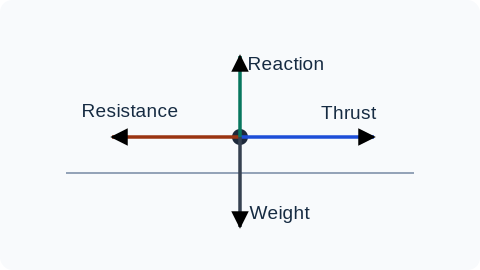
A trolley has thrust to the right, resistance to the left, weight down and the normal reaction upwards.

The vertical forces balance while the trolley stays on the level surface. Use the two horizontal arrows to find the signed resultant.

Worked example

Find a positive resultant

A 8 kg8\, \mathrm{kg} instrument trolley travels right on a level test track. Take right as positive. Its driving force is 43 N43\, \mathrm N and its resistance is 11 N11\, \mathrm N. Find the signed resultant and acceleration.

  1. Fnet=43−11=32F_\mathrm{net}=43-11=32 in newtons, because the thrust points right and the resistance points left.

  2. a=4 m s−2a=4\, \mathrm{m\,s^{-2}} by dividing the signed resultant by the trolley mass.

Your turn

A 6 kg6\, \mathrm{kg} instrument trolley travels right on a level test track. Take right as positive. Its driving force is 29 N29\, \mathrm N and its resistance is 11 N11\, \mathrm N. Find the signed resultant and acceleration.

Enter an exact number, for example 3/2 or 2-sqrt(3).

Enter an exact number, for example 3/2 or 2-sqrt(3).

Section 2 of 5 · Core · about 7 min

Does a negative acceleration mean the trolley moves left?

Velocity tells you which way the particle is travelling now. Acceleration tells you how that velocity is changing. They can have opposite signs while a particle slows. A positive velocity and a negative acceleration are consistent for as long as the velocity stays positive.

Worked example

Find negative acceleration during forward motion

A 12 kg12\, \mathrm{kg} instrument trolley travels right on a level test track. Take right as positive. Its driving force is 18 N18\, \mathrm N and its resistance is 36 N36\, \mathrm N. Find the signed resultant and acceleration.

  1. Fnet=18−36=−18F_\mathrm{net}=18-36=-18 in newtons, because the thrust points right and the resistance points left.

  2. a=−32 m s−2a=-\frac{3}{2}\, \mathrm{m\,s^{-2}} by dividing the signed resultant by the trolley mass.

Worked example

Recover resistance while the trolley slows

A 11 kg11\, \mathrm{kg} instrument trolley travels right on a level test track. Take right as positive. The thrust is 12 N12\, \mathrm N and the constant acceleration is −2 m s−2-2\, \mathrm{m\,s^{-2}}. Find the resistance.

Try it on paper first.

  1. 12−R=11(−2)12-R=11\left(-2\right). The resistance contributes a negative component.

  2. Solving gives R=34 NR=34\, \mathrm N. The answer is a magnitude and acts left.

Your turn

A 10 kg10\, \mathrm{kg} instrument trolley travels right on a level test track. Take right as positive. Its driving force is 17 N17\, \mathrm N and its resistance is 32 N32\, \mathrm N. Find the signed resultant and acceleration.

Enter an exact number, for example 3/2 or 2-sqrt(3).

Enter an exact value or round to 3 significant figures.

Section 3 of 5 · Core · about 7 min

How can acceleration determine an unknown force?

If the acceleration is known, mass times acceleration gives the signed resultant. This can help recover an individual force when the other forces are known. Label every unknown force as a magnitude with a direction, or as a signed component.

Worked example

Recover an unknown resistance

A 10 kg10\, \mathrm{kg} instrument trolley travels right on a level test track. Take right as positive. The thrust is 38 N38\, \mathrm N and the constant acceleration is 52 m s−2\frac{5}{2}\, \mathrm{m\,s^{-2}}. Find the resistance.

  1. 38−R=10(52)38-R=10\left(\frac{5}{2}\right). The resistance contributes a negative component.

  2. Solving gives R=13 NR=13\, \mathrm N. The answer is a magnitude and acts left.

Your turn

A 11 kg11\, \mathrm{kg} instrument trolley travels right on a level test track. Take right as positive. The thrust is 60 N60\, \mathrm N and the constant acceleration is 3 m s−23\, \mathrm{m\,s^{-2}}. Find the resistance.

Enter an exact number, for example 3/2 or 2-sqrt(3).

Section 4 of 5 · Core · about 8 min

How do force and time combine in one question?

Start with the force diagram, then find the acceleration. For constant forces and constant mass, acceleration in this model is constant. The motion equations can then use that acceleration and the given initial velocity or elapsed time.

Worked example

Use force to predict a final velocity

A 9 kg9\, \mathrm{kg} instrument trolley travels right on a level test track. Take right as positive. It initially moves at 4 m s−14\, \mathrm{m\,s^{-1}}. For 3 s3\, \mathrm s the thrust is 40 N40\, \mathrm N and resistance is 22 N22\, \mathrm N. Find its signed acceleration and the final velocity.

  1. Fnet=40−22=18F_\mathrm{net}=40-22=18 in newtons, because the thrust points right and the resistance points left.

  2. a=2 m s−2a=2\, \mathrm{m\,s^{-2}} by dividing the signed resultant by the trolley mass.

  3. v=u+at=4+(2)(3)v=u+at=4+\left(2\right)(3) gives v=10 m s−1v=10\, \mathrm{m\,s^{-1}}.

Your turn

A 14 kg14\, \mathrm{kg} instrument trolley travels right on a level test track. Take right as positive. It initially moves at 5 m s−15\, \mathrm{m\,s^{-1}}. For 3 s3\, \mathrm s the thrust is 39 N39\, \mathrm N and resistance is 11 N11\, \mathrm N. Find its signed acceleration and the final velocity.

Enter an exact number, for example 3/2 or 2-sqrt(3).

Enter an exact number, for example 3/2 or 2-sqrt(3).

Section 5 of 5 · Core · about 6 min

What does steady velocity imply about forces?

A particle can move steadily while two or more forces act. Newton’s second law tells us that zero acceleration gives zero net force, which still allows nonzero individual arrows. At a stop or change in drive, write a new force sum for the new stage.

Worked example

Recognise constant velocity with balanced forces

A 7 kg7\, \mathrm{kg} instrument trolley travels right on a level test track. Take right as positive. Its driving force is 21 N21\, \mathrm N and its resistance is 21 N21\, \mathrm N. Find the signed resultant and acceleration.

  1. Fnet=21−21=0F_\mathrm{net}=21-21=0 in newtons, because the thrust points right and the resistance points left.

  2. a=0 m s−2a=0\, \mathrm{m\,s^{-2}} by dividing the signed resultant by the trolley mass.

Worked example

Use exact fractional acceleration

A 12 kg12\, \mathrm{kg} instrument trolley travels right on a level test track. Take right as positive. It initially moves at 6 m s−16\, \mathrm{m\,s^{-1}}. For 2 s2\, \mathrm s the thrust is 29 N29\, \mathrm N and resistance is 8 N8\, \mathrm N. Find its signed acceleration and the final velocity.

Try it on paper first.

  1. Fnet=29−8=21F_\mathrm{net}=29-8=21 in newtons, because the thrust points right and the resistance points left.

  2. a=74 m s−2a=\frac{7}{4}\, \mathrm{m\,s^{-2}} by dividing the signed resultant by the trolley mass.

  3. v=u+at=6+(74)(2)v=u+at=6+\left(\frac{7}{4}\right)(2) gives v=192 m s−1v=\frac{19}{2}\, \mathrm{m\,s^{-1}}.

Your turn

A 11 kg11\, \mathrm{kg} instrument trolley travels right on a level test track. Take right as positive. Its driving force is 31 N31\, \mathrm N and its resistance is 31 N31\, \mathrm N. Find the signed resultant and acceleration.

Enter an exact number, for example 3/2 or 2-sqrt(3).

Enter an exact number, for example 3/2 or 2-sqrt(3).

Worked examples

Practise the method

Core practice

Question 1 of 4

0 / 4 checked in this collection

Question list

Core practice

Fresh variants

Exam-style

Locate the accelerating net force

2 marks

A 12 kg12\, \mathrm{kg} instrument trolley travels right on a level test track. Take right as positive. Its driving force is 55 N55\, \mathrm N and its resistance is 19 N19\, \mathrm N. Find the signed resultant and acceleration.

Enter an exact number, for example 3/2 or 2-sqrt(3).

Enter an exact number, for example 3/2 or 2-sqrt(3).

Full answer-format guide

Exact numbers: 3/2, sqrt(5), 2-sqrt(3), pi/6, 3*pi/2. Sets: {1,4}. Intervals: (3,5]; a round bracket excludes the endpoint. Infinity: inf; union: U; no solutions: empty. Separate coordinate pairs or triples with semicolons. Expressions: 2x^2+3x-1; equations: x^2=3x+1 or the polynomial equal to zero. Factors: x-1 ; x+2. Parameter fraction: numerator ; denominator. List integer answers individually.

Review the method

Progress stays in this browser. Create an account to save it or sign in.

Extra practice from this lesson

Read a signed resultant

A 15 kg15\, \mathrm{kg} instrument trolley travels right on a level test track. Take right as positive. Its driving force is 61 N61\, \mathrm N and its resistance is 16 N16\, \mathrm N. Find the signed resultant and acceleration.

Enter an exact number, for example 3/2 or 2-sqrt(3).

Enter an exact number, for example 3/2 or 2-sqrt(3).

Recover resistance under braking

A 8 kg8\, \mathrm{kg} instrument trolley travels right on a level test track. Take right as positive. The thrust is 8 N8\, \mathrm N and the constant acceleration is −2 m s−2-2\, \mathrm{m\,s^{-2}}. Find the resistance.

Enter an exact number, for example 3/2 or 2-sqrt(3).

Apply two seconds of a constant force

A 8 kg8\, \mathrm{kg} instrument trolley travels right on a level test track. Take right as positive. It initially moves at 8 m s−18\, \mathrm{m\,s^{-1}}. For 2 s2\, \mathrm s the thrust is 25 N25\, \mathrm N and resistance is 13 N13\, \mathrm N. Find its signed acceleration and the final velocity.

Enter an exact value or round to 3 significant figures.

Enter an exact number, for example 3/2 or 2-sqrt(3).

Choose the sign when resistance is greater

A 14 kg14\, \mathrm{kg} instrument trolley travels right on a level test track. Take right as positive. Its driving force is 28 N28\, \mathrm N and its resistance is 42 N42\, \mathrm N. Find the signed resultant and acceleration.

Enter an exact number, for example 3/2 or 2-sqrt(3).

Enter an exact number, for example 3/2 or 2-sqrt(3).

Recover a larger resistance

A 9 kg9\, \mathrm{kg} instrument trolley travels right on a level test track. Take right as positive. The thrust is 37 N37\, \mathrm N and the constant acceleration is −2 m s−2-2\, \mathrm{m\,s^{-2}}. Find the resistance.

Enter an exact number, for example 3/2 or 2-sqrt(3).

Calculate final velocity under resistance

A 16 kg16\, \mathrm{kg} instrument trolley travels right on a level test track. Take right as positive. It initially moves at 5 m s−15\, \mathrm{m\,s^{-1}}. For 3 s3\, \mathrm s the thrust is 22 N22\, \mathrm N and resistance is 38 N38\, \mathrm N. Find its signed acceleration and the final velocity.

Enter an exact number, for example 3/2 or 2-sqrt(3).

Enter an exact number, for example 3/2 or 2-sqrt(3).

Apply it · original exam-style problems

Show your working on paper and compare it with the worked solution and marking guidance.

Come back to what needs practice

Quick revision sheet (A4)

Your review plan starts after your first check.