Maths4UBETA

Pulley models and changes of constraint

Solve a linked pulley model, then find the new motion if the string becomes slack.

Try the quick check →
Lesson 5 of 5

Section 1 of 5 · Core · about 8 min

Why do the accelerations point in different directions?

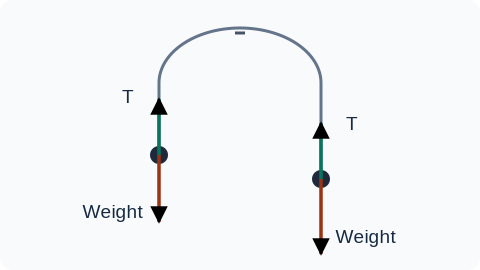
A smooth pulley redirects the taut string. As one side lengthens, the other shortens by the same amount. The two particles therefore have equal speeds and acceleration magnitudes, while their physical directions can be opposite.

The lighter mass on the left has its tension upwards and weight downwards. The heavier mass on the right has the same upward tension and its own larger weight downwards.

Take upwards as positive for the lighter mass and downwards for the heavier mass. Both accelerations have the same magnitude.

Worked example

Use matching acceleration magnitudes

Masses 3 kg3\, \mathrm{kg} and 7 kg7\, \mathrm{kg} hang on the two ends of a light inextensible string over a smooth fixed pulley. Use g=10 m s−2g=10\, \mathrm{m\,s^{-2}} and take downwards for the hanging 77 kg mass. Give the common acceleration magnitude and tension.

  1. Use a separate positive axis for each object. Take downwards for the second mass and upwards for the lighter mass.

  2. The second equation is 70−T=7a70-T=7a. The first is T−30=3aT-30=3a.

  3. Adding cancels the tension. It gives 40=10a40=10a, hence a=4 m s−2a=4\, \mathrm{m\,s^{-2}}.

  4. Substitute that acceleration into one particle's equation. This gives T=42 NT=42\, \mathrm N.

Your turn

Masses 5 kg5\, \mathrm{kg} and 9 kg9\, \mathrm{kg} hang on the two ends of a light inextensible string over a smooth fixed pulley. Use g=10 m s−2g=10\, \mathrm{m\,s^{-2}} and take downwards for the hanging 99 kg mass. Give the common acceleration magnitude and tension.

Enter an exact value or round to 3 significant figures.

Enter an exact value or round to 3 significant figures.

Section 2 of 5 · Core · about 7 min

How can I find two unknowns from the force diagrams?

A light string over a smooth pulley has the same tension on both sides in this model. For the heavier mass, weight acts in its positive direction. For the lighter mass, the upward tension acts in its positive direction.

Worked example

Find the tension after removing it from the combined equation

Masses 4 kg4\, \mathrm{kg} and 6 kg6\, \mathrm{kg} hang on the two ends of a light inextensible string over a smooth fixed pulley. Use g=10 m s−2g=10\, \mathrm{m\,s^{-2}} and take downwards for the hanging 66 kg mass. Give the common acceleration magnitude and tension.

  1. Use a separate positive axis for each object. Take downwards for the second mass and upwards for the lighter mass.

  2. The second equation is 60−T=6a60-T=6a. The first is T−40=4aT-40=4a.

  3. Adding cancels the tension. It gives 20=10a20=10a, hence a=2 m s−2a=2\, \mathrm{m\,s^{-2}}.

  4. Substitute that acceleration into one particle's equation. This gives T=48 NT=48\, \mathrm N.

Worked example

Use fractional masses in a paired calculation

Masses 72 kg\frac{7}{2}\, \mathrm{kg} and 132 kg\frac{13}{2}\, \mathrm{kg} hang on the two ends of a light inextensible string over a smooth fixed pulley. Use g=10 m s−2g=10\, \mathrm{m\,s^{-2}} and take downwards for the hanging 132\frac{13}{2} kg mass. Give the common acceleration magnitude and tension.

Try it on paper first.

  1. Use a separate positive axis for each object. Take downwards for the second mass and upwards for the lighter mass.

  2. The second equation is 65−T=132a65-T=\frac{13}{2}a. The first is T−35=72aT-35=\frac{7}{2}a.

  3. Adding cancels the tension. It gives 30=10a30=10a, hence a=3 m s−2a=3\, \mathrm{m\,s^{-2}}.

  4. Substitute that acceleration into one particle's equation. This gives T=912 NT=\frac{91}{2}\, \mathrm N.

Your turn

Masses 8 kg8\, \mathrm{kg} and 12 kg12\, \mathrm{kg} hang on the two ends of a light inextensible string over a smooth fixed pulley. Use g=10 m s−2g=10\, \mathrm{m\,s^{-2}} and take downwards for the hanging 1212 kg mass. Give the common acceleration magnitude and tension.

Enter an exact number, for example 3/2 or 2-sqrt(3).

Enter an exact number, for example 3/2 or 2-sqrt(3).

Section 3 of 5 · Core · about 8 min

How does a table change one of the equations?

For a box moving on a level table, only the horizontal forces enter its along-table equation. The box weight balances its normal reaction vertically. The hanging object's weight drives its downward motion.

Worked example

Let the hanging mass pull a box along a rough table

A 9 kg9\, \mathrm{kg} box is on a horizontal table. A light inextensible string runs horizontally from it over a smooth pulley to a hanging 6 kg6\, \mathrm{kg} mass. The resistance to sliding of the box is 15 N15\, \mathrm N. The string is taut and the box moves towards the pulley. Use g=10 m s−2g=10\, \mathrm{m\,s^{-2}} and take downwards for the hanging 66 kg mass. Give the common acceleration magnitude and tension.

  1. Use a separate positive axis for each object. Take downwards for the second mass and towards the pulley for the box.

  2. The second equation is 60−T=6a60-T=6a. The first is T−15=9aT-15=9a.

  3. Adding cancels the tension. It gives 45=15a45=15a, hence a=3 m s−2a=3\, \mathrm{m\,s^{-2}}.

  4. Substitute that acceleration into one particle's equation. This gives T=42 NT=42\, \mathrm N.

Your turn

A 12 kg12\, \mathrm{kg} box is on a horizontal table. A light inextensible string runs horizontally from it over a smooth pulley to a hanging 8 kg8\, \mathrm{kg} mass. The resistance to sliding of the box is 20 N20\, \mathrm N. The string is taut and the box moves towards the pulley. Use g=10 m s−2g=10\, \mathrm{m\,s^{-2}} and take downwards for the hanging 88 kg mass. Give the common acceleration magnitude and tension.

Enter an exact number, for example 3/2 or 2-sqrt(3).

Enter an exact number, for example 3/2 or 2-sqrt(3).

Section 4 of 5 · Core · about 7 min

How do I check that a result is physically possible?

For two hanging particles with one descending, the lighter one rising requires tension greater than its weight. The heavier one descending requires tension smaller than its weight. These inequalities are a useful quick check.

Worked example

Calculate the force on a second two-mass system

Masses 7 kg7\, \mathrm{kg} and 13 kg13\, \mathrm{kg} hang on the two ends of a light inextensible string over a smooth fixed pulley. Use g=10 m s−2g=10\, \mathrm{m\,s^{-2}} and take downwards for the hanging 1313 kg mass. Give the common acceleration magnitude and tension.

  1. Use a separate positive axis for each object. Take downwards for the second mass and upwards for the lighter mass.

  2. The second equation is 130−T=13a130-T=13a. The first is T−70=7aT-70=7a.

  3. Adding cancels the tension. It gives 60=20a60=20a, hence a=3 m s−2a=3\, \mathrm{m\,s^{-2}}.

  4. Substitute that acceleration into one particle's equation. This gives T=91 NT=91\, \mathrm N.

Your turn

Masses 6 kg6\, \mathrm{kg} and 10 kg10\, \mathrm{kg} hang on the two ends of a light inextensible string over a smooth fixed pulley. Use g=10 m s−2g=10\, \mathrm{m\,s^{-2}} and take downwards for the hanging 1010 kg mass. Give the common acceleration magnitude and tension.

Enter an exact value or round to 3 significant figures.

Enter an exact number, for example 3/2 or 2-sqrt(3).

Section 5 of 5 · Core · about 8 min

Which equations stop applying when the string slackens?

A hanging mass hitting a support can end the common acceleration. If the string slackens, it exerts no tension. An object still moving can start its next stage with a nonzero initial velocity.

Worked example

Find the extra travel after the string slackens

A 6 kg6\, \mathrm{kg} block moves on a level rough table and is connected by a light taut inextensible string over a smooth pulley to a hanging 4 kg4\, \mathrm{kg} mass. Set g=10 m s−2g=10\, \mathrm{m\,s^{-2}}. The block starts from rest, and the hanging mass is 2 m2\, \mathrm m above the floor. The constant resistance on the moving block is 15 N15\, \mathrm N. After the mass reaches the floor the string becomes slack and the block continues without reaching the pulley. Give the first acceleration magnitude, the signed acceleration after slackening (towards the pulley positive), and the extra distance until the block stops.

  1. (m1+m2)a=m2g−R(m_1+m_2)a=m_2g-R for the constrained stage, so a=52 m s−2a=\frac{5}{2}\, \mathrm{m\,s^{-2}}.

  2. As the hanging mass travels to the floor, the block advances the same distance. Use v2=2a(2)=10v^2=2a\left(2\right)=10 in SI units.

  3. Once the string goes slack, tension no longer acts on the block. Its new signed acceleration is a2=−52 m s−2a_2=-\frac{5}{2}\, \mathrm{m\,s^{-2}}.

  4. Apply 0=v2+2a2s0=v^2+2a_2s to the stopping stage. Its extra distance is s=2 ms=2\, \mathrm m.

Worked example

Rebuild a different force model after impact

A 8 kg8\, \mathrm{kg} block moves on a level rough table and is connected by a light taut inextensible string over a smooth pulley to a hanging 4 kg4\, \mathrm{kg} mass. Set g=10 m s−2g=10\, \mathrm{m\,s^{-2}}. The block starts from rest, and the hanging mass is 3 m3\, \mathrm m above the floor. The constant resistance on the moving block is 22 N22\, \mathrm N. After the mass reaches the floor the string becomes slack and the block continues without reaching the pulley. Give the first acceleration magnitude, the signed acceleration after slackening (towards the pulley positive), and the extra distance until the block stops.

Try it on paper first.

  1. (m1+m2)a=m2g−R(m_1+m_2)a=m_2g-R for the constrained stage, so a=32 m s−2a=\frac{3}{2}\, \mathrm{m\,s^{-2}}.

  2. As the hanging mass travels to the floor, the block advances the same distance. Use v2=2a(3)=9v^2=2a\left(3\right)=9 in SI units.

  3. Once the string goes slack, tension no longer acts on the block. Its new signed acceleration is a2=−114 m s−2a_2=-\frac{11}{4}\, \mathrm{m\,s^{-2}}.

  4. Apply 0=v2+2a2s0=v^2+2a_2s to the stopping stage. Its extra distance is s=1811 ms=\frac{18}{11}\, \mathrm m.

Your turn

A 10 kg10\, \mathrm{kg} block moves on a level rough table and is connected by a light taut inextensible string over a smooth pulley to a hanging 5 kg5\, \mathrm{kg} mass. Set g=10 m s−2g=10\, \mathrm{m\,s^{-2}}. The block starts from rest, and the hanging mass is 2 m2\, \mathrm m above the floor. The constant resistance on the moving block is 25 N25\, \mathrm N. After the mass reaches the floor the string becomes slack and the block continues without reaching the pulley. Give the first acceleration magnitude, the signed acceleration after slackening (towards the pulley positive), and the extra distance until the block stops.

Enter an exact value or round to 3 significant figures.

Enter an exact value or round to 3 significant figures.

Enter an exact value or round to 3 significant figures.

Worked examples

Practise the method

Core practice

Question 1 of 4

0 / 4 checked in this collection

Question list

Core practice

Fresh variants

Exam-style

Find acceleration from the two weights

2 marks

Masses 5 kg5\, \mathrm{kg} and 7 kg7\, \mathrm{kg} hang on the two ends of a light inextensible string over a smooth fixed pulley. Use g=10 m s−2g=10\, \mathrm{m\,s^{-2}} and take downwards for the hanging 77 kg mass. Give the common acceleration magnitude and tension.

Enter an exact value or round to 3 significant figures.

Enter an exact value or round to 3 significant figures.

Full answer-format guide

Exact numbers: 3/2, sqrt(5), 2-sqrt(3), pi/6, 3*pi/2. Sets: {1,4}. Intervals: (3,5]; a round bracket excludes the endpoint. Infinity: inf; union: U; no solutions: empty. Separate coordinate pairs or triples with semicolons. Expressions: 2x^2+3x-1; equations: x^2=3x+1 or the polynomial equal to zero. Factors: x-1 ; x+2. Parameter fraction: numerator ; denominator. List integer answers individually.

Review the method

Progress stays in this browser. Create an account to save it or sign in.

Extra practice from this lesson

Use exact masses and a smooth pulley

Masses 4 kg4\, \mathrm{kg} and 9 kg9\, \mathrm{kg} hang on the two ends of a light inextensible string over a smooth fixed pulley. Use g=10 m s−2g=10\, \mathrm{m\,s^{-2}} and take downwards for the hanging 99 kg mass. Give the common acceleration magnitude and tension.

Enter an exact value or round to 3 significant figures.

Enter an exact value or round to 3 significant figures.

Check a different tension

Masses 5 kg5\, \mathrm{kg} and 11 kg11\, \mathrm{kg} hang on the two ends of a light inextensible string over a smooth fixed pulley. Use g=10 m s−2g=10\, \mathrm{m\,s^{-2}} and take downwards for the hanging 1111 kg mass. Give the common acceleration magnitude and tension.

Enter an exact value or round to 3 significant figures.

Enter an exact value or round to 3 significant figures.

Resolve a table system with specified resistance

A 12 kg12\, \mathrm{kg} box is on a horizontal table. A light inextensible string runs horizontally from it over a smooth pulley to a hanging 7 kg7\, \mathrm{kg} mass. The resistance to sliding of the box is 14 N14\, \mathrm N. The string is taut and the box moves towards the pulley. Use g=10 m s−2g=10\, \mathrm{m\,s^{-2}} and take downwards for the hanging 77 kg mass. Give the common acceleration magnitude and tension.

Enter an exact value or round to 3 significant figures.

Enter an exact value or round to 3 significant figures.

Compare the descending acceleration with gravity

Masses 7 kg7\, \mathrm{kg} and 16 kg16\, \mathrm{kg} hang on the two ends of a light inextensible string over a smooth fixed pulley. Use g=10 m s−2g=10\, \mathrm{m\,s^{-2}} and take downwards for the hanging 1616 kg mass. Give the common acceleration magnitude and tension.

Enter an exact value or round to 3 significant figures.

Enter an exact value or round to 3 significant figures.

Investigate a different ending in slack string

A 9 kg9\, \mathrm{kg} block moves on a level rough table and is connected by a light taut inextensible string over a smooth pulley to a hanging 6 kg6\, \mathrm{kg} mass. Set g=10 m s−2g=10\, \mathrm{m\,s^{-2}}. The block starts from rest, and the hanging mass is 2 m2\, \mathrm m above the floor. The constant resistance on the moving block is 30 N30\, \mathrm N. After the mass reaches the floor the string becomes slack and the block continues without reaching the pulley. Give the first acceleration magnitude, the signed acceleration after slackening (towards the pulley positive), and the extra distance until the block stops.

Enter an exact number, for example 3/2 or 2-sqrt(3).

Enter an exact value or round to 3 significant figures.

Enter an exact value or round to 3 significant figures.

Recover the extra displacement for a new load

A 15 kg15\, \mathrm{kg} block moves on a level rough table and is connected by a light taut inextensible string over a smooth pulley to a hanging 7 kg7\, \mathrm{kg} mass. Set g=10 m s−2g=10\, \mathrm{m\,s^{-2}}. The block starts from rest, and the hanging mass is 1 m1\, \mathrm m above the floor. The constant resistance on the moving block is 37 N37\, \mathrm N. After the mass reaches the floor the string becomes slack and the block continues without reaching the pulley. Give the first acceleration magnitude, the signed acceleration after slackening (towards the pulley positive), and the extra distance until the block stops.

Enter an exact value or round to 3 significant figures.

Enter an exact value or round to 3 significant figures.

Enter an exact value or round to 3 significant figures.

Apply it · original exam-style problems

Show your working on paper and compare it with the worked solution and marking guidance.

Come back to what needs practice

Quick revision sheet (A4)

Your review plan starts after your first check.