Maths4UBETA

Natural logarithms and substitutions

Simplify inverse operations to base e and find intersections by replacing ln x with a new variable.

Try the quick check →
Lesson 6 of 10

Section 1 of 3 · Lesson · about 8 min

How do e and ln undo each other?

The natural logarithm is the logarithm to base e. It takes a positive value back to its exponent.
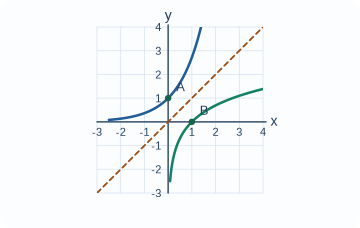
Increasing exponential and logarithmic curves reflected about the diagonal.

The two shapes exchange input and output across y=xy=x. The marked points are exchanged too.

Worked example

Cancel the natural logarithm and the exponential

Simplify ln⁡(e 2x−3)\ln(e^{\,2x-3}) and solve ln⁡(e 2x−3)=5\ln(e^{\,2x-3})=5.

  1. For every real uu, ln⁡(eu)=u\ln(e^u)=u. Here u=2x−3u=2x-3, so the simplified expression is 2x−32x-3.

  2. 2x−3=52x-3=5 means 2x=82x=8, giving x=4x=4.

  3. The original argument at this value is e5>0e^5>0.

Your turn

A reading satisfies e11x+3=e6e^{11x+3}=e^{6}.

Find x exactly.

Enter one number. Fractions and decimals are accepted.

Worked example

Apply the inverse identity to an expression

Solve eln⁡(3−x)=5e^{\ln(3-x)}=5, stating the domain of the left side.

Try it on paper first.

  1. The logarithm inside the exponential needs 3−x>03-x>0, so x<3x<3.

  2. On this domain, eln⁡(3−x)=3−xe^{\ln(3-x)}=3-x. Thus 3−x=53-x=5, giving x=−2x=-2.

  3. −2-2 is in the original domain and eln⁡5=5e^{\ln 5}=5.

Your turn

A reading satisfies e11x+3=e8e^{11x+3}=e^{8}.

Find x exactly.

Enter one number. Fractions and decimals are accepted.

Section 2 of 3 · Lesson · about 8 min

What happens to a constant multiplying an exponential?

The product of a positive constant and an exponential becomes a sum after taking logarithms.

Worked example

Keep the log of a constant as a separate term

Simplify ln⁡(4e3x)\ln(4e^{3x}), then solve ln⁡(4e3x)=ln⁡4+6\ln(4e^{3x})=\ln 4+6.

  1. The factors 44 and e3xe^{3x} are both positive. Apply the product law: ln⁡(4e3x)=ln⁡4+ln⁡(e3x)=ln⁡4+3x\ln(4e^{3x})=\ln 4+\ln(e^{3x})=\ln 4+3x.

  2. Subtract ln⁡4\ln 4 from the two equal sides. Now 3x=63x=6 and x=2x=2.

  3. The logarithmic constant cancels only because it appears on both sides.

Your turn

For real x, define F(x)=ln⁡(2e4x)−ln⁡(2)F(x)=\ln\left(2e^{4x}\right)-\ln\left(2\right).

Find the exact solution to F(x)=7F(x)=7.

Enter one number. Fractions and decimals are accepted.

Worked example

Subtract two logs with a common factor

Simplify ln⁡(6ex)−ln⁡(2e3x)\ln(6e^{x})-\ln(2e^{3x}), then solve when its value is ln⁡3+4\ln 3+4.

Try it on paper first.

  1. Both arguments are positive for every real xx. Combining them gives ln⁡ ⁣(6ex2e3x)=ln⁡(3e−2x)\ln\!\left(\frac{6e^x}{2e^{3x}}\right)=\ln(3e^{-2x}).

  2. The product rule now gives ln⁡3−2x\ln 3-2x. Set this equal to ln⁡3+4\ln 3+4.

  3. Cancel ln⁡3\ln 3, so −2x=4-2x=4 and x=−2x=-2.

Your turn

Find xx if ln⁡(9e−2x)=ln⁡9+4\ln(9e^{-2x})=\ln9+4.

Enter one number. Fractions and decimals are accepted.

Section 3 of 3 · Lesson · about 8 min

Can I find an intersection with a log substitution?

At an intersection the y-values agree. If the algebra uses repeated powers of ln x, work with a single new variable.

Worked example

Recover both coordinates after a log substitution

For x>0x>0, find the intersections of y=2ln⁡xy=2\ln x and y=(ln⁡x)2−3y=(\ln x)^2-3.

  1. At an intersection the yy-values agree. Put t=ln⁡xt=\ln x, so 2t=t2−32t=t^2-3.

  2. Then t2−2t−3=(t−3)(t+1)=0t^2-2t-3=(t-3)(t+1)=0, giving t=3t=3 or t=−1t=-1. Both are valid because ln⁡x\ln x can be any real number.

  3. Recover x=etx=e^t and substitute into y=2ty=2t. The points are (e3,6)(e^3,6) and (e−1,−2)(e^{-1},-2).

Your turn

For x>0x>0, the two curves are y=6ln⁡xy=6\ln x and y=(ln⁡x)2−8ln⁡x+48y=(\ln x)^2-8\ln x+48.

At the intersections, find both values of ln x.

Give the complete set: {1, 4} for separate values, (1, 5] for an interval, U for union or empty for no real solutions. Use sqrt(...) for exact roots.

Worked example

Recognise one intersection from a repeated root

For x>0x>0, find the only intersection of y=4ln⁡x−4y=4\ln x-4 and y=(ln⁡x)2y=(\ln x)^2.

Try it on paper first.

  1. Put t=ln⁡xt=\ln x and equate the two yy-values: 4t−4=t24t-4=t^2.

  2. Rearrange to t2−4t+4=(t−2)2=0t^2-4t+4=(t-2)^2=0. This gives the single value t=2t=2.

  3. x=e2x=e^2 and y=t2=4y=t^2=4, so the curves meet at (e2,4)(e^2,4).

Your turn

For x>0x>0, the two curves are y=6ln⁡xy=6\ln x and y=(ln⁡x)2−ln⁡x+10y=(\ln x)^2-\ln x+10.

At the intersections, find both values of ln x.

Give the complete set: {1, 4} for separate values, (1, 5] for an interval, U for union or empty for no real solutions. Use sqrt(...) for exact roots.

Worked examples

Practise the method

Core practice

Question 1 of 5

0 / 5 checked in this collection

Question list

Core practice

Fresh variants

Exam-style

Undo a natural exponential without approximating e

1 mark

A reading satisfies e8x+5=e9e^{8x+5}=e^{9}.

Find x exactly.

Enter one number. Fractions and decimals are accepted.

Full answer-format guide

Exact numbers: 3/2, sqrt(5), 2-sqrt(3), pi/6, 3*pi/2. Sets: {1,4}. Intervals: (3,5]; a round bracket excludes the endpoint. Infinity: inf; union: U; no solutions: empty. Separate coordinate pairs or triples with semicolons. Expressions: 2x^2+3x-1; equations: x^2=3x+1 or the polynomial equal to zero. Factors: x-1 ; x+2. Parameter fraction: numerator ; denominator. List integer answers individually.

Review the method

Progress stays in this browser. Create an account to save it or sign in.

Extra practice from this lesson

A reading satisfies e2x+4=e6e^{2x+4}=e^{6}.

Find x exactly.

Enter one number. Fractions and decimals are accepted.

A reading satisfies e2x+4=e7e^{2x+4}=e^{7}.

Find x exactly.

Enter one number. Fractions and decimals are accepted.

Solve ln⁡(6e3x)−ln⁡(2ex)=ln⁡3+3\ln(6e^{3x})-\ln(2e^x)=\ln3+3 exactly.

Enter an exact value or round to 3 significant figures.

For real x, define F(x)=ln⁡(2e5x)−ln⁡(2)F(x)=\ln\left(2e^{5x}\right)-\ln\left(2\right).

Find the exact solution to F(x)=7F(x)=7.

Enter one number. Fractions and decimals are accepted.

For x>0x>0, the two curves are y=6ln⁡xy=6\ln x and y=(ln⁡x)2−2ln⁡x+12y=(\ln x)^2-2\ln x+12.

At the intersections, find both values of ln x.

Give the complete set: {1, 4} for separate values, (1, 5] for an interval, U for union or empty for no real solutions. Use sqrt(...) for exact roots.

For x>0x>0, the two curves are y=6ln⁡xy=6\ln x and y=(ln⁡x)2−4ln⁡x+21y=(\ln x)^2-4\ln x+21.

At the intersections, find both values of ln x.

Give the complete set: {1, 4} for separate values, (1, 5] for an interval, U for union or empty for no real solutions. Use sqrt(...) for exact roots.

Previous checkpoints

For real x, define F(x)=ln⁡(4e4x)−ln⁡(4)F(x)=\ln\left(4e^{4x}\right)-\ln\left(4\right).

Find the exact solution to F(x)=7F(x)=7.

Enter one number. Fractions and decimals are accepted.

For real x, define F(x)=ln⁡(10e4x)−ln⁡(10)F(x)=\ln\left(10e^{4x}\right)-\ln\left(10\right).

Find the exact solution to F(x)=7F(x)=7.

Enter one number. Fractions and decimals are accepted.

Apply it · original exam-style problems

Show your working on paper and compare it with the worked solution and marking guidance.

Come back to what needs practice

Quick revision sheet (A4)

Your review plan starts after your first check.