Maths4UBETA

Inverse logarithmic and exponential functions

Find inverse rules and exchange domain with range.

Try the quick check →
Lesson 10 of 10

Section 1 of 3 · Lesson · about 8 min

How do I invert a shifted exponential?

Name the output y, remove any translation and scale, take the logarithm and divide by the coefficient of x. Then use x as the inverse input.
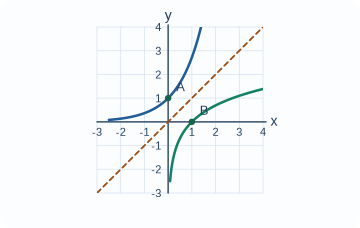
Increasing exponential and logarithmic curves reflected about the diagonal.

The two shapes exchange input and output across y=xy=x. The marked points are exchanged too.

Worked example

Undo a shift and scale in the right order

Find the inverse of f(x)=2e3x+1f(x)=2e^{3x}+1 and give its domain.

  1. Set y=2e3x+1y=2e^{3x}+1. Subtract 11, then divide by 22: e3x=y−12e^{3x}=\frac{y-1}{2}.

  2. Taking natural logs gives 3x=ln⁡ ⁣(y−12)3x=\ln\!\left(\frac{y-1}{2}\right). Rename the input to obtain f−1(x)=13ln⁡ ⁣(x−12)f^{-1}(x)=\frac13\ln\!\left(\frac{x-1}{2}\right).

  3. The original range is y>1y>1, so the inverse has domain x>1x>1.

Your turn

The function f(x)=3e7x+7f(x)=3e^{7x}+7 is defined for all real x.

Find f−1(x)f^{-1}(x).

Choose one answer

Worked example

Invert an exponential below its asymptote

Find the inverse of f(x)=5−3exf(x)=5-3e^x and explain its input restriction.

Try it on paper first.

  1. From y=5−3exy=5-3e^x, isolate the exponential: 3ex=5−y3e^x=5-y, so ex=5−y3e^x=\frac{5-y}{3}.

  2. For x=ln⁡ ⁣(5−y3)x=\ln\!\left(\frac{5-y}{3}\right) to exist, the argument must be positive, which requires y<5y<5.

  3. Thus f−1(x)=ln⁡ ⁣(5−x3)f^{-1}(x)=\ln\!\left(\frac{5-x}{3}\right) for x<5x<5. The original range is below the horizontal asymptote.

Your turn

The function f(x)=5e7x+7f(x)=5e^{7x}+7 is defined for all real x.

Find f−1(x)f^{-1}(x).

Choose one answer

Section 2 of 3 · Lesson · about 8 min

How do I invert a transformed logarithm?

Undo the outside scale first and apply the exponential. Solve the resulting linear equation for the original input.

Worked example

Undo a logarithm with a multiplier

Find the inverse of h(x)=2ln⁡(3x−6)h(x)=2\ln(3x-6) and state its domain and range.

  1. The original domain is x>2x>2. With y=2ln⁡(3x−6)y=2\ln(3x-6), divide by 22 and exponentiate: ey/2=3x−6e^{y/2}=3x-6.

  2. Adding 66 and dividing by 33 gives h−1(x)=ex/2+63h^{-1}(x)=\frac{e^{x/2}+6}{3}.

  3. The original logarithm has all real outputs, so every real number is an inverse input. The inverse outputs satisfy y>2y>2.

Your turn

Let h(x)=5ln⁡(6x−5)h(x)=5\ln\left(6x-5\right) on its natural domain.

Find h−1(x)h^{-1}(x).

Choose one answer

Worked example

Invert a logarithm with a decreasing argument

Find the inverse of h(x)=ln⁡(4−2x)h(x)=\ln(4-2x) and state its range.

Try it on paper first.

  1. The original domain is 4−2x>04-2x>0, or x<2x<2. Every real output is possible because the argument reaches every positive value.

  2. From y=ln⁡(4−2x)y=\ln(4-2x), exponentiate to get ey=4−2xe^y=4-2x. Rearrange to 2x=4−ey2x=4-e^y.

  3. The inverse is h−1(x)=4−ex2h^{-1}(x)=\frac{4-e^x}{2}, with range y<2y<2, since ex>0e^x>0.

Your turn

Let h(x)=5ln⁡(8x−5)h(x)=5\ln\left(8x-5\right) on its natural domain.

Find h−1(x)h^{-1}(x).

Choose one answer

Section 3 of 3 · Lesson · about 8 min

Can I evaluate the inverse without finding its whole rule?

An inverse value is the input that gave a specified output. Plug that output into the equation and solve for the input.

Worked example

Find one inverse value without a whole rule

Let f(x)=log⁡3(2x+1)f(x)=\log_3(2x+1) on its natural domain. Find f−1(2)f^{-1}(2).

  1. An inverse output is an original input. Solve f(u)=2f(u)=2 for that input uu.

  2. log⁡3(2u+1)=2\log_3(2u+1)=2 gives 2u+1=32=92u+1=3^2=9, so u=4u=4.

  3. The argument at 44 is 99, so the input is valid and f−1(2)=4f^{-1}(2)=4.

Your turn

The function is f(x)=log⁡2(9x−2)f(x)=\log_{2}\left(9x-2\right) on its natural domain.

Find the exact value of f−1(1)f^{-1}(1).

Enter one number. Fractions and decimals are accepted.

Worked example

Test whether the inverse value exists

Let g(x)=3+2exg(x)=3+2e^x. Find g−1(9)g^{-1}(9) and explain whether g−1(3)g^{-1}(3) exists.

Try it on paper first.

  1. Solve g(u)=9g(u)=9: 3+2eu=93+2e^u=9, giving eu=3e^u=3 and u=ln⁡3u=\ln3.

  2. Thus g−1(9)=ln⁡3g^{-1}(9)=\ln3. An original output of 33 would require eu=0e^u=0.

  3. The exponential is strictly positive, so 33 is outside the inverse domain and g−1(3)g^{-1}(3) is undefined.

Your turn

The function is f(x)=log⁡4(9x−2)f(x)=\log_{4}\left(9x-2\right) on its natural domain.

Find the exact value of f−1(1)f^{-1}(1).

Enter one number. Fractions and decimals are accepted.

Worked examples

Practise the method

Core practice

Question 1 of 5

0 / 5 checked in this collection

Question list

Core practice

Fresh variants

Exam-style

Invert a translated exponential

1 mark

The function f(x)=4e5x+5f(x)=4e^{5x}+5 is defined for all real x.

Find f−1(x)f^{-1}(x).

Choose one answer

Choose one option. Explain your reasoning on paper.

Review the method

Progress stays in this browser. Create an account to save it or sign in.

Extra practice from this lesson

The function f(x)=4ex+8f(x)=4e^{x}+8 is defined for all real x.

Find f−1(x)f^{-1}(x).

Choose one answer

The function f(x)=5ex+8f(x)=5e^{x}+8 is defined for all real x.

Find f−1(x)f^{-1}(x).

Choose one answer

Let h(x)=5ln⁡(6x−6)h(x)=5\ln\left(6x-6\right) on its natural domain.

Find h−1(x)h^{-1}(x).

Choose one answer

Let h(x)=5ln⁡(7x−6)h(x)=5\ln\left(7x-6\right) on its natural domain.

Find h−1(x)h^{-1}(x).

Choose one answer

Let f(x)=log⁡2(4x−3)f(x)=\log_2(4x-3) on its natural domain. Find f−1(2)f^{-1}(2) exactly.

Enter one number. Fractions and decimals are accepted.

The function is f(x)=log⁡4(9x−3)f(x)=\log_{4}\left(9x-3\right) on its natural domain.

Find the exact value of f−1(1)f^{-1}(1).

Enter one number. Fractions and decimals are accepted.

Previous checkpoints

The function is f(x)=log⁡3(9x−3)f(x)=\log_{3}\left(9x-3\right) on its natural domain.

Find the exact value of f−1(1)f^{-1}(1).

Enter one number. Fractions and decimals are accepted.

Apply it · original exam-style problems

Show your working on paper and compare it with the worked solution and marking guidance.

Come back to what needs practice

Quick revision sheet (A4)

Your review plan starts after your first check.