Maths4UBETA

Graphs of transformed logarithms

Use argument positivity, the boundary and both intercepts to sketch y = k ln(ax + b).

Try the quick check →
Lesson 9 of 10

Section 1 of 3 · Lesson · about 8 min

What fixes the position of a log graph?

First find the input where the argument would be zero. The graph is on the side where the argument is positive, even if that is to the left.

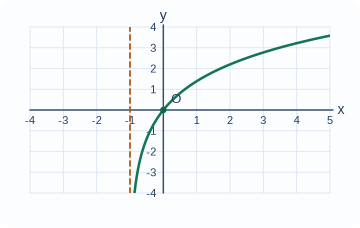
A logarithmic curve in the region to the right of a vertical dashed line.

The curve y=2ln⁡(x+1)y=2\ln(x+1) has its boundary at x=−1x=-1 and its intercept at the origin.

Worked example

Distinguish the asymptote from the crossing

For y=2ln⁡(3−x)y=2\ln(3-x), find the natural domain, vertical asymptote and xx-intercept.

  1. The argument is positive when 3−x>03-x>0, or x<3x<3. The boundary where the argument tends to zero is x=3x=3, the vertical asymptote.

  2. At an xx-intercept y=0y=0, so ln⁡(3−x)=0\ln(3-x)=0. The argument is then 11, giving 3−x=13-x=1 and x=2x=2.

  3. The point (2,0)(2,0) is on the permitted side x<3x<3.

Your turn

A curve has equation y=3ln⁡(−7x+12)y=3\ln\left(-7x+12\right).

State the natural domain.

Give the complete set: {1, 4} for separate values, (1, 5] for an interval, U for union or empty for no real solutions. Use sqrt(...) for exact roots.

Worked example

Read the graph on the right of the boundary

For y=ln⁡(2x+4)y=\ln(2x+4), find the domain and both intercepts.

Try it on paper first.

  1. The positive argument condition is 2x+4>02x+4>0, so x>−2x>-2. Thus x=−2x=-2 is the vertical asymptote.

  2. For y=0y=0, the argument must equal 11: 2x+4=12x+4=1 gives x=−32x=-\frac32.

  3. The value x=0x=0 is in the domain. The two intercepts are (−32,0)\left(-\frac32,0\right) and (0,ln⁡4)(0,\ln4).

Your turn

A curve has equation y=3ln⁡(3x+13)y=3\ln\left(3x+13\right).

State the natural domain.

Give the complete set: {1, 4} for separate values, (1, 5] for an interval, U for union or empty for no real solutions. Use sqrt(...) for exact roots.

Section 2 of 3 · Lesson · about 8 min

Why is the x-intercept found at argument 1?

A logarithm returns zero when the argument is the base raised to the power zero. That argument is one for every legal base.

Worked example

Recover the shift from an asymptote

The curve y=2ln⁡(3x+b)y=2\ln(3x+b) has asymptote x=−1x=-1. Find bb and the exact intercepts.

  1. The argument tends to zero at the asymptote. Solve 3(−1)+b=03(-1)+b=0, giving b=3b=3. The domain is x>−1x>-1.

  2. For y=0y=0, solve 3x+3=13x+3=1, giving x=−23x=-\frac23.

  3. x=0x=0 is allowed and the output there is 2ln⁡32\ln3. The intercepts are (−23,0)\left(-\frac23,0\right) and (0,2ln⁡3)(0,2\ln3).

Your turn

The graph of y=3ln⁡(4x+b)y=3\ln\left(4x+b\right) has vertical asymptote x=−8x=-8.

Find the value of b.

Enter one number. Fractions and decimals are accepted.

Worked example

Use the intercept to locate the asymptote

The graph y=ln⁡(2x+b)y=\ln(2x+b) crosses the xx-axis at x=2x=2. Find bb and explain whether there is a yy-intercept.

Try it on paper first.

  1. For the output to be zero, the argument must be one. Thus 2(2)+b=12(2)+b=1, giving b=−3b=-3.

  2. The domain is 2x−3>02x-3>0, or x>32x>\frac32. The boundary x=32x=\frac32 is the vertical asymptote.

  3. The yy-axis has x=0x=0, outside the domain, so there is no yy-intercept.

Your turn

The graph of y=3ln⁡(6x+b)y=3\ln\left(6x+b\right) has vertical asymptote x=−8x=-8.

Find the value of b.

Enter one number. Fractions and decimals are accepted.

Section 3 of 3 · Further practice · about 8 min

How do the signs change the shape?

A positive inner slope makes the argument grow as x increases. The logarithm grows with its argument, so the sign of the outside multiplier decides whether that direction is retained.

Worked example

Track two reflections

State the domain and direction of y=−2ln⁡(4−x)y=-2\ln(4-x). Find its xx-intercept.

  1. The domain is x<4x<4, found from 4−x>04-x>0. The asymptote is x=4x=4.

  2. As xx increases, 4−x4-x gets smaller and its logarithm decreases. Multiplication by −2-2 reverses that change, so yy increases.

  3. At y=0y=0, the log argument is 11. Thus 4−x=14-x=1, giving (3,0)(3,0).

Your turn

A curve has equation y=4ln⁡(−3x+9)y=4\ln\left(-3x+9\right).

State the natural domain.

Give the complete set: {1, 4} for separate values, (1, 5] for an interval, U for union or empty for no real solutions. Use sqrt(...) for exact roots.

Worked example

Track the direction on the valid side

Describe the monotonicity of y=−ln⁡(x+1)y=-\ln(x+1). State the asymptote and the side on which the graph lies.

Try it on paper first.

  1. The domain is x>−1x>-1. The asymptote is x=−1x=-1, and the curve is on its right.

  2. x+1x+1 grows as xx grows, so ln⁡(x+1)\ln(x+1) increases. Its negative therefore decreases.

  3. Close to the asymptote, the argument tends to 00 from above, so ln⁡(x+1)\ln(x+1) tends to negative infinity and yy tends to positive infinity.

Your turn

A curve has equation y=4ln⁡(−5x+9)y=4\ln\left(-5x+9\right).

State the natural domain.

Give the complete set: {1, 4} for separate values, (1, 5] for an interval, U for union or empty for no real solutions. Use sqrt(...) for exact roots.

Worked examples

Practise the method

Core practice

Question 1 of 5

0 / 5 checked in this collection

Question list

Core practice

Fresh variants

Exam-style

Locate the boundary and intercept of a logarithmic curve

1 mark

A curve has equation y=−3ln⁡(2x+2)y=-3\ln\left(2x+2\right).

State the natural domain.

Give the complete set: {1, 4} for separate values, (1, 5] for an interval, U for union or empty for no real solutions. Use sqrt(...) for exact roots.

Full answer-format guide

Exact numbers: 3/2, sqrt(5), 2-sqrt(3), pi/6, 3*pi/2. Sets: {1,4}. Intervals: (3,5]; a round bracket excludes the endpoint. Infinity: inf; union: U; no solutions: empty. Separate coordinate pairs or triples with semicolons. Expressions: 2x^2+3x-1; equations: x^2=3x+1 or the polynomial equal to zero. Factors: x-1 ; x+2. Parameter fraction: numerator ; denominator. List integer answers individually.

Review the method

Progress stays in this browser. Create an account to save it or sign in.

Extra practice from this lesson

A curve has equation y=3ln⁡(−3x+13)y=3\ln\left(-3x+13\right).

State the natural domain.

Give the complete set: {1, 4} for separate values, (1, 5] for an interval, U for union or empty for no real solutions. Use sqrt(...) for exact roots.

A curve has equation y=3ln⁡(−4x+13)y=3\ln\left(-4x+13\right).

State the natural domain.

Give the complete set: {1, 4} for separate values, (1, 5] for an interval, U for union or empty for no real solutions. Use sqrt(...) for exact roots.

The graph of y=3ln⁡(12x+b)y=3\ln\left(12x+b\right) has vertical asymptote x=−8x=-8.

Find the value of b.

Enter one number. Fractions and decimals are accepted.

The graph of y=3ln⁡(13x+b)y=3\ln\left(13x+b\right) has vertical asymptote x=−8x=-8.

Find the value of b.

Enter one number. Fractions and decimals are accepted.

A curve has equation y=4ln⁡(5x+10)y=4\ln\left(5x+10\right).

State the natural domain.

Give the complete set: {1, 4} for separate values, (1, 5] for an interval, U for union or empty for no real solutions. Use sqrt(...) for exact roots.

A curve has equation y=4ln⁡(6x+10)y=4\ln\left(6x+10\right).

State the natural domain.

Give the complete set: {1, 4} for separate values, (1, 5] for an interval, U for union or empty for no real solutions. Use sqrt(...) for exact roots.

Apply it · original exam-style problems

Show your working on paper and compare it with the worked solution and marking guidance.

Come back to what needs practice

Quick revision sheet (A4)

Your review plan starts after your first check.