Maths4UBETA

Read logarithms as powers

Convert between powers and logarithms. Use positive arguments, including fractional and negative powers.

Try the quick check →
Lesson 1 of 10

Section 1 of 3 · Lesson · about 8 min

What does a logarithm return?

Read a log statement as a question about an exponent. For a legal base, each positive argument has one corresponding power.
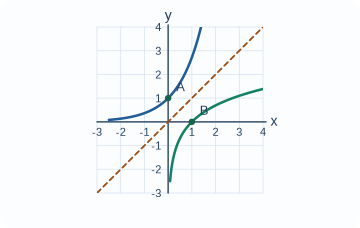
Increasing exponential and logarithmic curves reflected about the diagonal.

The two shapes exchange input and output across y=xy=x. The marked points are exchanged too.

Worked example

Read a fractional power

Evaluate log⁡48\log_4 8 exactly.

  1. Let u=log⁡48u=\log_4 8. The logarithm asks for the power uu such that 4u=84^u=8.

  2. Write both numbers in base 22: (22)u=23(2^2)^u=2^3, so 22u=232^{2u}=2^3. Equal powers of 22 have equal exponents.

  3. 2u=32u=3, hence u=32u=\frac32. To check, (4)3=23=8(\sqrt4)^3=2^3=8.

Your turn

A scale uses the base 2525.

Give the exact value of log⁡25(125)\log_{25}\left(125\right).

Enter one number. Fractions and decimals are accepted.

Worked example

Recognise a negative power

Evaluate log⁡27 ⁣(19)\log_{27}\!\left(\frac19\right) exactly.

Try it on paper first.

  1. The argument is below 11, while the base is above 11. The exponent must be negative.

  2. Put 27u=1927^u=\frac19. Then (33)u=3−2(3^3)^u=3^{-2} and 3u=−23u=-2.

  3. u=−23u=-\frac23. Taking a cube root of 2727 and then the reciprocal of its square gives 19\frac19.

Your turn

Find the exact value of log⁡8 ⁣(12)\log_8\!\left(\frac12\right).

Enter one number. Fractions and decimals are accepted.

Section 2 of 3 · Lesson · about 8 min

Can the base be the unknown?

Turn a logarithmic equation into an exponential equation. Undo the stated exponent to recover the base.

Worked example

Choose the legal square root

Find bb if log⁡b49=2\log_b 49=2. Explain why only one base works.

  1. Write b2=49b^2=49. The algebraic candidates are b=7b=7 and b=−7b=-7.

  2. A real logarithm requires a positive base other than 11. This leaves b=7b=7.

  3. Check: the exponent that takes 77 to 4949 is 22.

Your turn

Find the positive base bb in log⁡b ⁣(64)=2\log_b\!\left(64\right)=2.

Enter one number. Fractions and decimals are accepted.

Worked example

Recover a base below one

Find bb if log⁡b8=−3\log_b 8=-3.

Try it on paper first.

  1. Rewrite the equation as b−3=8b^{-3}=8. Reciprocate both sides to get b3=18b^3=\frac18.

  2. The positive cube root is b=12b=\frac12, which is a legal base.

  3. Check: (12)−3=23=8\left(\frac12\right)^{-3}=2^3=8.

Your turn

Find the positive base bb in log⁡b ⁣(16)=−2\log_b\!\left(16\right)=-2.

Enter an exact value or round to 3 significant figures.

Section 3 of 3 · Lesson · about 8 min

Which arguments are allowed?

A positive real base raised to any real power always gives a positive result. The inverse logarithm therefore needs its argument to be positive.

Worked example

Find the allowed inputs first

For g(x)=log⁡5(2x+1)g(x)=\log_5(2x+1), state the domain and solve g(x)=1g(x)=1.

  1. The entire argument must be positive: 2x+1>02x+1>0, so x>−12x>-\frac12.

  2. The target log value is 11, so 2x+1=52x+1=5. Subtracting 11 gives 2x=42x=4, hence x=2x=2.

  3. The input 22 is in the domain and g(2)=log⁡55=1g(2)=\log_5 5=1.

Your turn

Let g(x)=log⁡7(2x+3)g(x)=\log_{7}\left(2x+3\right) on its natural domain.

State the domain of gg, in interval notation or as an inequality.

Give the complete set: {1, 4} for separate values, (1, 5] for an interval, U for union or empty for no real solutions. Use sqrt(...) for exact roots.

Worked example

Reverse the boundary inequality

State the domain of h(x)=log⁡2(5−2x)h(x)=\log_2(5-2x). Then solve h(x)=0h(x)=0.

Try it on paper first.

  1. For the argument to be positive, 5−2x>05-2x>0. Adding 2x2x to both sides gives 5>2x5>2x, so x<52x<\frac52.

  2. At log value zero the argument is 20=12^0=1. Thus 5−2x=15-2x=1, so 2x=42x=4 and x=2x=2.

  3. The boundary x=52x=\frac52 gives argument zero. The root x=2x=2 gives argument one, so it is allowed.

Your turn

State the natural domain of g(x)=log⁡3(7−x)g(x)=\log_3(7-x).

Give the complete set: {1, 4} for separate values, (1, 5] for an interval, U for union or empty for no real solutions. Use sqrt(...) for exact roots.

Worked examples

Practise the method

Core practice

Question 1 of 5

0 / 5 checked in this collection

Question list

Core practice

Fresh variants

Exam-style

Read a logarithm as a power

1 mark

The logarithm has base 44.

Find log⁡4(14)\log_{4}\left(\frac{1}{4}\right) exactly.

Enter one number. Fractions and decimals are accepted.

Full answer-format guide

Exact numbers: 3/2, sqrt(5), 2-sqrt(3), pi/6, 3*pi/2. Sets: {1,4}. Intervals: (3,5]; a round bracket excludes the endpoint. Infinity: inf; union: U; no solutions: empty. Separate coordinate pairs or triples with semicolons. Expressions: 2x^2+3x-1; equations: x^2=3x+1 or the polynomial equal to zero. Factors: x-1 ; x+2. Parameter fraction: numerator ; denominator. List integer answers individually.

Review the method

Progress stays in this browser. Create an account to save it or sign in.

Extra practice from this lesson

A scale uses the base 216216.

Give the exact value of log⁡216(216)\log_{216}\left(216\right).

Enter one number. Fractions and decimals are accepted.

Find the exact value of log⁡279\log_{27} 9.

Enter one number. Fractions and decimals are accepted.

Find the positive base bb in log⁡b ⁣(27)=3\log_b\!\left(27\right)=3.

Enter one number. Fractions and decimals are accepted.

Find the positive base bb in log⁡b ⁣(925)=2\log_b\!\left(\frac{9}{25}\right)=2.

Enter an exact value or round to 3 significant figures.

State the natural domain of g(x)=log⁡3(3x−6)g(x)=\log_3(3x-6).

Give the complete set: {1, 4} for separate values, (1, 5] for an interval, U for union or empty for no real solutions. Use sqrt(...) for exact roots.

State the natural domain of g(x)=log⁡3(4−2x)g(x)=\log_3(4-2x).

Give the complete set: {1, 4} for separate values, (1, 5] for an interval, U for union or empty for no real solutions. Use sqrt(...) for exact roots.

Previous checkpoints

A scale uses the base 4949.

Give the exact value of log⁡49(343)\log_{49}\left(343\right).

Enter one number. Fractions and decimals are accepted.

A scale uses the base 343343.

Give the exact value of log⁡343(343)\log_{343}\left(343\right).

Enter one number. Fractions and decimals are accepted.

Let g(x)=log⁡9(2x+3)g(x)=\log_{9}\left(2x+3\right) on its natural domain.

State the domain of gg, in interval notation or as an inequality.

Give the complete set: {1, 4} for separate values, (1, 5] for an interval, U for union or empty for no real solutions. Use sqrt(...) for exact roots.

Let g(x)=log⁡5(2x+3)g(x)=\log_{5}\left(2x+3\right) on its natural domain.

State the domain of gg, in interval notation or as an inequality.

Give the complete set: {1, 4} for separate values, (1, 5] for an interval, U for union or empty for no real solutions. Use sqrt(...) for exact roots.

Let g(x)=log⁡6(2x+3)g(x)=\log_{6}\left(2x+3\right) on its natural domain.

State the domain of gg, in interval notation or as an inequality.

Give the complete set: {1, 4} for separate values, (1, 5] for an interval, U for union or empty for no real solutions. Use sqrt(...) for exact roots.

The base bb is a positive real number other than 1. The reading is log⁡b(256)=2\log_{b}\left(256\right)=2.

Find bb.

Enter one number. Fractions and decimals are accepted.

The base bb is a positive real number other than 1. The reading is log⁡b(1296)=2\log_{b}\left(1296\right)=2.

Find bb.

Enter one number. Fractions and decimals are accepted.

The base bb is a positive real number other than 1. The reading is log⁡b(20736)=2\log_{b}\left(20736\right)=2.

Find bb.

Enter one number. Fractions and decimals are accepted.

The base bb is a positive real number other than 1. The reading is log⁡b(28561)=2\log_{b}\left(28561\right)=2.

Find bb.

Enter one number. Fractions and decimals are accepted.

Apply it · original exam-style problems

Show your working on paper and compare it with the worked solution and marking guidance.

Come back to what needs practice

Quick revision sheet (A4)

Your review plan starts after your first check.