Maths4UBETA

Exponential growth and decay models

Use a multiplicative model to recover constants, predict readings and solve threshold questions.

Try the quick check →
Lesson 7 of 10

Section 1 of 3 · Lesson · about 8 min

How can I find a multiplier from two observations?

In a multiplicative model the same positive factor applies over equal time intervals. Divide the later observation by the earlier one to cancel the scale.

Worked example

Recover a multiplier from two readings

A culture grows by a fixed factor per hour. A model G(t)=AbtG(t)=Ab^t gives G(1)=24G(1)=24 and G(3)=54G(3)=54. Find bb and AA.

  1. The observations give Ab=24Ab=24 and Ab3=54Ab^3=54. Divide the second by the first: b2=5424=94b^2=\frac{54}{24}=\frac94. The gap is two hours.

  2. The multiplier is positive, so b=32b=\frac32. From the first reading, A=243/2=16A=\frac{24}{3/2}=16.

  3. Check both observations: 16⋅32=2416\cdot\frac32=24 and 16⋅278=5416\cdot\frac{27}{8}=54.

Your turn

A sensor reading follows R(t)=AbtR(t)=Ab^t, with A,b>0A,b>0. The readings are R(1)=20R(1)=20 and R(3)=45R(3)=45. Find the exact multiplier bb.

Enter one number. Fractions and decimals are accepted.

Worked example

Recover a model with a fractional multiplier

A filter has readings R(2)=32R(2)=32 and R(5)=4R(5)=4, where R(t)=AbtR(t)=Ab^t. Find bb and AA.

Try it on paper first.

  1. The later reading is smaller, so expect 0<b<10<b<1. Divide over the three-unit gap: b5−2=432=18b^{5-2}=\frac4{32}=\frac18.

  2. Take the positive cube root to obtain b=12b=\frac12. Since 32=A(12)232=A\left(\frac12\right)^2, A=128A=128.

  3. The model predicts 128(12)5=4128\left(\frac12\right)^5=4, as required.

Your turn

A sensor reading follows R(t)=AbtR(t)=Ab^t, with A,b>0A,b>0. The readings are R(3)=40R(3)=40 and R(5)=10R(5)=10. Find the exact multiplier bb.

Enter one number. Fractions and decimals are accepted.

Section 2 of 3 · Lesson · about 8 min

When does a decaying measurement reach a known level?

Find the time at which the reading equals its target. Isolate the exponential first. If the model approaches a non-zero background level, subtract that level before dividing.

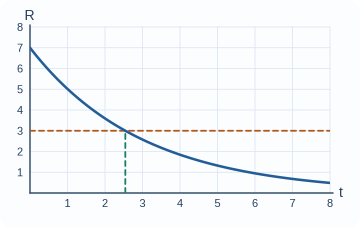
Decreasing exponential model crossing a horizontal alert line once.

Read from the threshold to the curve, then down to time. The logarithm gives the crossing without measuring the sketch.

Worked example

Find the time at which a reading reaches its target

A signal has strength R=60e−t4R=60e^{-\frac{t}{4}} after tt hours, where t≥0t\geq0.

  1. Find when the signal reaches 2525 units. Give your answer to 3 decimal places.

    [3]
  2. Explain why it reaches this strength exactly once.

    [1]
  1. (a) Set 60e−t4=2560e^{-\frac{t}{4}}=25. Dividing by 6060 gives e−t4=512e^{-\frac{t}{4}}=\dfrac{5}{12}.

  2. −t4=ln⁡512⟹t=4ln⁡125≈3.502 hours.-\frac{t}{4}=\ln\frac{5}{12}\qquad\Longrightarrow\qquad t=4\ln\frac{12}{5}\approx3.502\text{ hours}.
  3. (b) The strength decreases strictly from 6060 towards 00, passing 2525 once.

Your turn

A sensor records R=22e−15tR=22e^{-\frac{1}{5}t} for time t in hours. The alert level is 112\frac{11}{2}.

Find the time at which the reading reaches the alert level. Give your answer to 3 decimal places.

Round as requested in the label, or enter your calculator value. Decimal or fraction input is accepted.

Your turn

A signal has strength R=32e−t5R=32e^{-\frac{t}{5}} after tt hours. When does its strength become 1212 units? Give your answer in hours to 3 decimal places.

Round as requested in the label, or enter your calculator value. Decimal or fraction input is accepted.

Worked example

Take the temperature above room level first

A mug of tea has temperature T=20+60e−3t10T=20+60e^{-\frac{3t}{10}} °C after t≥0t\geq0 minutes.

  1. Find when the tea first reaches 50 ∘C50\,^\circ\mathrm{C}. Give your answer to 3 decimal places.

    [3]
  2. According to this model, does it reach exactly 20 ∘C20\,^\circ\mathrm{C} in a finite time? Explain your answer.

    [1]

Try it on paper first.

  1. (a) The temperature is 30 ∘C30\,^\circ\mathrm{C} above room level at the target. Subtract 2020 from 5050, then divide by 6060, giving e−3t10=12e^{-\frac{3t}{10}}=\dfrac{1}{2}.

  2. t=103ln⁡2≈2.310 minutes.t=\frac{10}{3}\ln 2\approx2.310\text{ minutes}.
  3. (b) For finite tt, e−3t10>0e^{-\frac{3t}{10}}>0. The temperature stays above 20 ∘C20\,^\circ\mathrm{C} and approaches it as time increases.

Your turn

An indicator reads R=30e−t/4R=30e^{-t/4} units after tt hours. At what time does the reading reach 1010 units? Give your answer to 3 decimal places.

Round as requested in the label, or enter your calculator value. Decimal or fraction input is accepted.

Your turn

After tt minutes, a sensor reads R=18+40e−t6R=18+40e^{-\frac{t}{6}}. When is the reading 2828? Give your answer in minutes to 3 decimal places.

Round as requested in the label, or enter your calculator value. Decimal or fraction input is accepted.

Section 3 of 3 · Lesson · about 8 min

What does the model say before the reference reading?

A negative time means earlier than the chosen reference. It does not mean a negative measurement.

Worked example

Work back to before the reference time

A reading obeys R(t)=80(12)tR(t)=80\left(\frac12\right)^t, where tt counts weeks from a service date. Find the model readings one week before and two weeks after that date.

  1. One week before the service date is t=−1t=-1. Since (12)−1=2\left(\frac12\right)^{-1}=2, the model gives R(−1)=160R(-1)=160.

  2. Two weeks afterwards is t=2t=2. The reading is halved twice: R(2)=80(12)2=20R(2)=80\left(\frac12\right)^2=20.

  3. The negative input represents an earlier time. The reading itself remains positive.

Your turn

A reading obeys R(t)=A btR(t)=A\,b^t. At the reference time t=0t=0, it is 2121. Over the next 66 intervals it becomes 2121.

Find the exact value of bb.

Enter one number. Fractions and decimals are accepted.

Worked example

Tell the rate from the multiplier

A forecast uses N(t)=64(54)tN(t)=64\left(\frac54\right)^t in weeks. Find the percentage increase per week and the forecast change from week 0 to week 2.

Try it on paper first.

  1. Over one week the factor is 54=1.25\frac54=1.25, meaning an increase of 25%25\%.

  2. Over two weeks use the factor twice: N(2)=64(54)2=64⋅2516=100N(2)=64\left(\frac54\right)^2=64\cdot\frac{25}{16}=100.

  3. The change from 6464 to 100100 is 3636. The overall factor is 2516=1.5625\frac{25}{16}=1.5625, an increase of 56.25%56.25\%.

Your turn

A reading follows R(t)=AbtR(t)=Ab^t, with b>0b>0. It is 6060 at the reference time t=0t=0 and 120120 one hour before. Find bb.

Enter an exact value or round to 3 significant figures.

Worked examples

Practise the method

Core practice

Question 1 of 5

0 / 5 checked in this collection

Question list

Core practice

Fresh variants

Exam-style

Recover the scale and multiplier

1 mark

A measurement is modelled by G(t)=AbtG(t)=Ab^t, where A,b>0A,b>0. It is 1212 at time 11 and 33 at time 33.

Find the exact multiplier bb.

Enter one number. Fractions and decimals are accepted.

Full answer-format guide

Exact numbers: 3/2, sqrt(5), 2-sqrt(3), pi/6, 3*pi/2. Sets: {1,4}. Intervals: (3,5]; a round bracket excludes the endpoint. Infinity: inf; union: U; no solutions: empty. Separate coordinate pairs or triples with semicolons. Expressions: 2x^2+3x-1; equations: x^2=3x+1 or the polynomial equal to zero. Factors: x-1 ; x+2. Parameter fraction: numerator ; denominator. List integer answers individually.

Review the method

Progress stays in this browser. Create an account to save it or sign in.

Extra practice from this lesson

A sensor reading follows R(t)=AbtR(t)=Ab^t, with A,b>0A,b>0. The readings are R(2)=12R(2)=12 and R(5)=96R(5)=96. Find the exact multiplier bb.

Enter one number. Fractions and decimals are accepted.

A sensor reading follows R(t)=AbtR(t)=Ab^t, with A,b>0A,b>0. The readings are R(2)=16R(2)=16 and R(4)=9R(4)=9. Find the exact multiplier bb.

Enter one number. Fractions and decimals are accepted.

Over tt days a tank leaks according to V=72(0.8)tV=72(0.8)^t litres. Find when 3030 litres remain. Give your answer in days to 3 decimal places.

Round as requested in the label, or enter your calculator value. Decimal or fraction input is accepted.

Over tt days, a model predicts that the number of visits is 120(1.08)t120(1.08)^t. Find when the model reaches 180180 visits. Give your answer in days to 3 decimal places.

Round as requested in the label, or enter your calculator value. Decimal or fraction input is accepted.

A detector reads S=12+45e−t/2S=12+45e^{-t/2}, where tt is in hours. When does SS reach 2121? Give your answer to 3 decimal places.

Round as requested in the label, or enter your calculator value. Decimal or fraction input is accepted.

After tt hours a model predicts N=24(32)tN=24\left(\frac32\right)^t. When does it reach 7272? Give your answer to 3 decimal places.

Round as requested in the label, or enter your calculator value. Decimal or fraction input is accepted.

A reading obeys R(t)=50(58)tR(t)=50\left(\frac58\right)^t. Find R(−1)R(-1).

Enter one number. Fractions and decimals are accepted.

A model predicts R(t)=A(32)tR(t)=A\left(\frac32\right)^t. Find the exact ratio of the reading one interval after the reference time to the reading one interval before it.

Enter one number. Fractions and decimals are accepted.

Previous checkpoints

A controlled simulation reports G=AbtG=Ab^t with positive constants. The readings are G(1)=1325G(1)=\frac{132}{5} and G(5)=27371523125G(5)=\frac{2737152}{3125}.

TimeReading
111325\frac{132}{5}
5527371523125\frac{2737152}{3125}

Find the growth multiplier bb exactly.

Enter one number. Fractions and decimals are accepted.

A controlled simulation reports G=AbtG=Ab^t with positive constants. The readings are G(1)=1565G(1)=\frac{156}{5} and G(5)=32348163125G(5)=\frac{3234816}{3125}.

TimeReading
111565\frac{156}{5}
5532348163125\frac{3234816}{3125}

Find the growth multiplier bb exactly.

Enter one number. Fractions and decimals are accepted.

A controlled simulation reports G=AbtG=Ab^t with positive constants. The readings are G(1)=425G(1)=\frac{42}{5} and G(6)=32659215625G(6)=\frac{326592}{15625}.

TimeReading
11425\frac{42}{5}
6632659215625\frac{326592}{15625}

Find the growth multiplier bb exactly.

Enter one number. Fractions and decimals are accepted.

A controlled simulation reports G=AbtG=Ab^t with positive constants. The readings are G(1)=485G(1)=\frac{48}{5} and G(6)=37324815625G(6)=\frac{373248}{15625}.

TimeReading
11485\frac{48}{5}
6637324815625\frac{373248}{15625}

Find the growth multiplier bb exactly.

Enter one number. Fractions and decimals are accepted.

A sensor records R=24e−15tR=24e^{-\frac{1}{5}t} for time t in hours. The alert level is 66.

Find the time at which the reading reaches the alert level. Give your answer to 3 decimal places.

Round as requested in the label, or enter your calculator value. Decimal or fraction input is accepted.

A sensor records R=30e−15tR=30e^{-\frac{1}{5}t} for time t in hours. The alert level is 152\frac{15}{2}.

Find the time at which the reading reaches the alert level. Give your answer to 3 decimal places.

Round as requested in the label, or enter your calculator value. Decimal or fraction input is accepted.

A sensor records R=31e−15tR=31e^{-\frac{1}{5}t} for time t in hours. The alert level is 314\frac{31}{4}.

Find the time at which the reading reaches the alert level. Give your answer to 3 decimal places.

Round as requested in the label, or enter your calculator value. Decimal or fraction input is accepted.

A reading obeys R(t)=A btR(t)=A\,b^t. At the reference time t=0t=0, it is 2323. Over the next 66 intervals it becomes 2323.

Find the exact value of bb.

Enter one number. Fractions and decimals are accepted.

A reading obeys R(t)=A btR(t)=A\,b^t. At the reference time t=0t=0, it is 1010. Over the next 77 intervals it becomes 1010.

Find the exact value of bb.

Enter one number. Fractions and decimals are accepted.

A reading obeys R(t)=A btR(t)=A\,b^t. At the reference time t=0t=0, it is 1111. Over the next 77 intervals it becomes 1111.

Find the exact value of bb.

Enter one number. Fractions and decimals are accepted.

Apply it · original exam-style problems

Show your working on paper and compare it with the worked solution and marking guidance.

Come back to what needs practice

Quick revision sheet (A4)

Your review plan starts after your first check.