Maths4UBETA

Use position vectors, routes and ratios

Extended: use arrows through the origin and express midpoints and internal divisions in terms of two vector directions.

Try the quick check →
Lesson 9 of 10

Section 1 of 3 · Extension · about 8 min

Which arrows start at the origin?

Practise the method

Use end position minus start position. This combines the backwards journey to the origin with the forward journey to the end point.

On the grid, a point names a location. An arrow between distinct points shows the movement from its tail to its head.

Worked example

Distinguish a position from a displacement

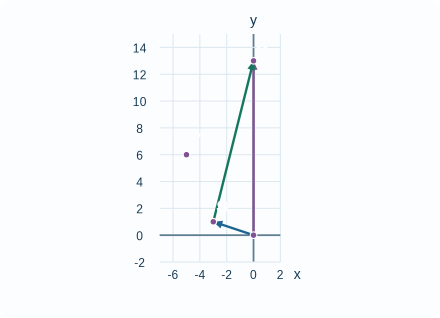
Points S, T and U have position vectors (−31)\begin{pmatrix}-3\\1\end{pmatrix}, (−56)\begin{pmatrix}-5\\6\end{pmatrix} and (013)\begin{pmatrix}0\\13\end{pmatrix} respectively. Find the directed displacement SU→\overrightarrow{SU}.

Coordinate grid with labelled axes. O at (0,0). S at (-3,1). T at (-5,6). U at (0,13). Arrowheads indicate the directions.

  1. A position vector starts at the origin. The displacement starts at S, so subtract the position of S from the position of U.

  2. The column vector is (312)\begin{pmatrix}3\\12\end{pmatrix}.

Your turn

Points S, T and U have position vectors (−47)\begin{pmatrix}-4\\7\end{pmatrix}, (28)\begin{pmatrix}2\\8\end{pmatrix} and (−11)\begin{pmatrix}-1\\1\end{pmatrix} respectively. Find the directed displacement SU→\overrightarrow{SU}.

Coordinate grid with labelled axes. O at (0,0). S at (-4,7). T at (2,8). U at (-1,1). Arrowheads indicate the directions.

Enter a point as (1, 2) or x = 1, y = 2. Separate complete pairs with commas or semicolons.

Worked example

Use a route through the origin

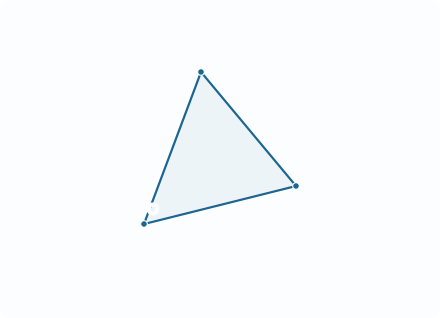
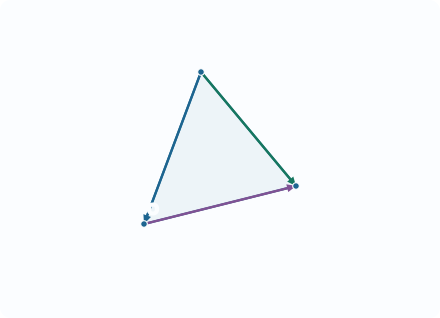
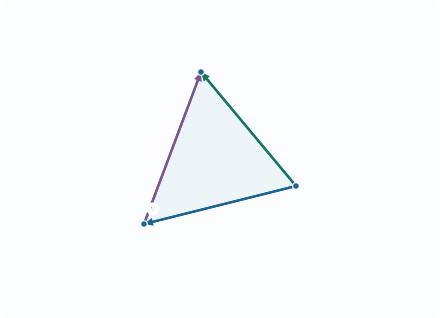
In triangle OAB, OA→=a\overrightarrow{OA}=\mathbf a and OB→=b\overrightarrow{OB}=\mathbf b. Start at B, go to O, then to A. Express 5BA→5\overrightarrow{BA} in terms of a\mathbf a and b\mathbf b.

Schematic vector diagram. O. A. B.

Try it on paper first.

  1. The journey to O is the reverse of the position vector of B.

  2. Add the position vector of A and scale the whole displacement by 5.

  3. The vector is 5a−5b5\mathbf{a}-5\mathbf{b}.

  4. Schematic vector diagram. O. A. B. Arrowheads indicate the directions.

Your turn

In triangle OAB, OA→=a\overrightarrow{OA}=\mathbf a and OB→=b\overrightarrow{OB}=\mathbf b. Start at A, go to O, then to B. Express 6AB→6\overrightarrow{AB} in terms of a\mathbf a and b\mathbf b.

Schematic vector diagram. O. A. B.

Enter an expression in a, b; use ^ for powers and / for fractions.

Section 2 of 3 · Extension · about 8 min

How do I write a route using two directions?

Practise the method

If OA→=a\overrightarrow{OA}=\mathbf a and OB→=b\overrightarrow{OB}=\mathbf b, then AB→=b−a\overrightarrow{AB}=\mathbf b-\mathbf a.

Worked example

Use a route through the origin

In triangle OAB, OA→=a\overrightarrow{OA}=\mathbf a and OB→=b\overrightarrow{OB}=\mathbf b. Start at A, go to O, then to B. Express 14AB→14\overrightarrow{AB} in terms of a\mathbf a and b\mathbf b.

Schematic vector diagram. O. A. B.

  1. The journey to O is the reverse of the position vector of A.

  2. Add the position vector of B and scale the whole displacement by 14.

  3. The vector is −14a+14b-14\mathbf{a}+14\mathbf{b}.

  4. Schematic vector diagram. O. A. B. Arrowheads indicate the directions.

Your turn

In triangle OAB, OA→=a\overrightarrow{OA}=\mathbf a and OB→=b\overrightarrow{OB}=\mathbf b. Start at B, go to O, then to A. Express 2BA→2\overrightarrow{BA} in terms of a\mathbf a and b\mathbf b.

Schematic vector diagram. O. A. B.

Enter an expression in a, b; use ^ for powers and / for fractions.

Worked example

Find a midpoint position vector

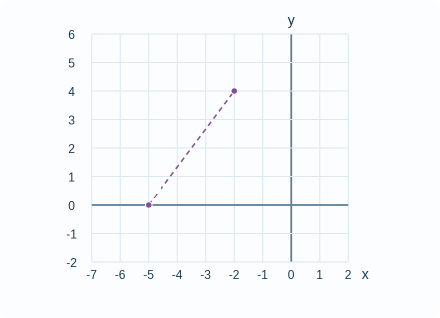
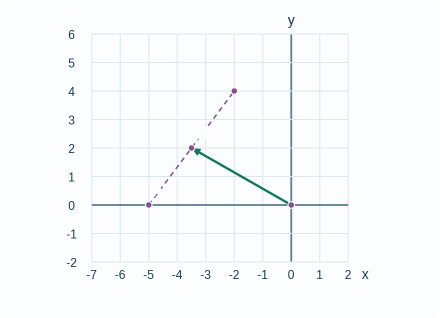
M is the midpoint of ABAB, where A(−5,0)A(-5,0) and B(−2,4)B(-2,4). Find its position vector.

Coordinate grid with labelled axes. A at (-5,0). B at (-2,4). Dashed lines show the construction guides.

Try it on paper first.

  1. Find the average of the two horizontal positions and the average of the two vertical positions.

  2. The position vector of M starts at the origin and ends at this midpoint.

  3. The column vector is (−722)\begin{pmatrix}-\frac{7}{2}\\2\end{pmatrix}.

  4. Coordinate grid with labelled axes. O at (0,0). A at (-5,0). B at (-2,4). M at (-7/2,2). Dashed lines show the construction guides. Arrowheads indicate the directions.

Your turn

M is the midpoint of ABAB, where A(−4,1)A(-4,1) and B(0,6)B(0,6). Find its position vector.

Coordinate grid with labelled axes. A at (-4,1). B at (0,6). Dashed lines show the construction guides.

Enter a point as (1, 2) or x = 1, y = 2. Separate complete pairs with commas or semicolons.

Section 3 of 3 · Extension · about 9 min

What part of the full segment do I travel?

Practise the method

To get a position vector, reach the first endpoint from the origin and then travel the required fraction of the full segment.

Worked example

Write the position vector of an internal point

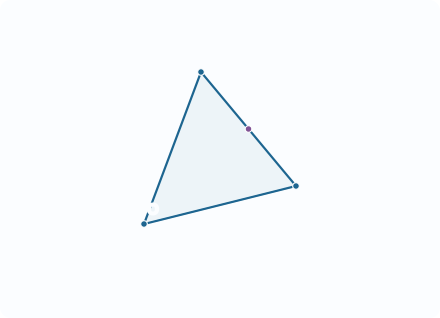
In triangle OAB, OA→=a\overrightarrow{OA}=\mathbf a and OB→=b\overrightarrow{OB}=\mathbf b. M divides AB internally with AM:MB=3:3AM:MB=3:3. Find OM→\overrightarrow{OM} in terms of a,b\mathbf a,\mathbf b.

Schematic vector diagram. O. A. B. M.

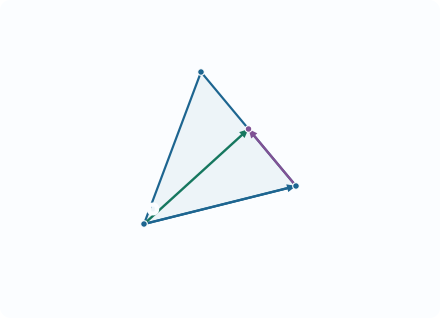
  1. The full segment has 6 equal ratio parts. So AM→=12AB→\overrightarrow{AM}=\frac{1}{2}\overrightarrow{AB}.

  2. Start at O, travel to A, then add 12\frac{1}{2} of b−a\mathbf b-\mathbf a. Collect the coefficients.

  3. The vector is 12a+12b\frac{1}{2}\mathbf{a}+\frac{1}{2}\mathbf{b}.

  4. Schematic vector diagram. O. A. B. M. Arrowheads indicate the directions.

Your turn

In triangle OAB, OA→=a\overrightarrow{OA}=\mathbf a and OB→=b\overrightarrow{OB}=\mathbf b. M divides AB internally with AM:MB=4:3AM:MB=4:3. Find OM→\overrightarrow{OM} in terms of a,b\mathbf a,\mathbf b.

Schematic vector diagram. O. A. B. M.

Enter an expression in a, b; use ^ for powers and / for fractions.

Worked example

Find a midpoint position vector

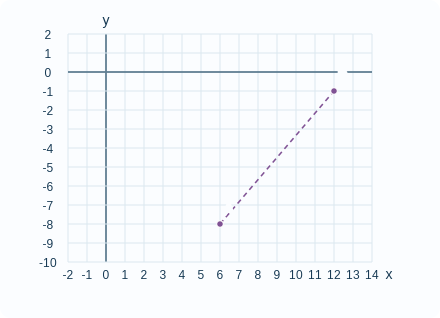
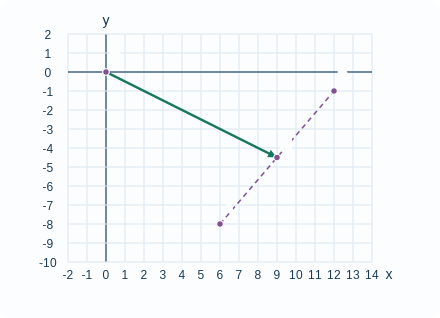
M is the midpoint of ABAB, where A(6,−8)A(6,-8) and B(12,−1)B(12,-1). Find its position vector.

Coordinate grid with labelled axes. A at (6,-8). B at (12,-1). Dashed lines show the construction guides.

Try it on paper first.

  1. Find the average of the two horizontal positions and the average of the two vertical positions.

  2. The position vector of M starts at the origin and ends at this midpoint.

  3. The column vector is (9−92)\begin{pmatrix}9\\-\frac{9}{2}\end{pmatrix}.

  4. Coordinate grid with labelled axes. O at (0,0). A at (6,-8). B at (12,-1). M at (9,-9/2). Dashed lines show the construction guides. Arrowheads indicate the directions.

Your turn

M is the midpoint of ABAB, where A(−6,−7)A(-6,-7) and B(1,1)B(1,1). Find its position vector.

Coordinate grid with labelled axes. A at (-6,-7). B at (1,1). Dashed lines show the construction guides.

Enter a point as (1, 2) or x = 1, y = 2. Separate complete pairs with commas or semicolons.

Worked examples

Practise the method

Core practice

Question 1 of 5

0 / 5 checked in this collection

Question list

Core practice

Fresh variants

Exam-style

Distinguish a position from a displacement

1 mark

Points S, T and U have position vectors (4−5)\begin{pmatrix}4\\-5\end{pmatrix}, (21)\begin{pmatrix}2\\1\end{pmatrix} and (128)\begin{pmatrix}12\\8\end{pmatrix} respectively. Find the directed displacement SU→\overrightarrow{SU}.

Coordinate grid. O at (0,0). S at (4,-5). T at (2,1). U at (12,8). Arrowheads mark the directed movements.

Enter a point as (1, 2) or x = 1, y = 2. Separate complete pairs with commas or semicolons.

Full answer-format guide

Exact numbers: 3/2, sqrt(5), 2-sqrt(3), pi/6, 3*pi/2. Sets: {1,4}. Intervals: (3,5]; a round bracket excludes the endpoint. Infinity: inf; union: U; no solutions: empty. Separate coordinate pairs or triples with semicolons. Expressions: 2x^2+3x-1; equations: x^2=3x+1 or the polynomial equal to zero. Factors: x-1 ; x+2. Parameter fraction: numerator ; denominator. List integer answers individually.

Review the method

Progress stays in this browser. Create an account to save it or sign in.

Extra practice from this lesson

Distinguish a position from a displacement

Points S, T and U have position vectors (0−8)\begin{pmatrix}0\\-8\end{pmatrix}, (10−3)\begin{pmatrix}10\\-3\end{pmatrix} and (2−18)\begin{pmatrix}2\\-18\end{pmatrix} respectively. Find the directed displacement SU→\overrightarrow{SU}.

Coordinate grid with labelled axes. O at (0,0). S at (0,-8). T at (10,-3). U at (2,-18). Arrowheads indicate the directions.

Enter a point as (1, 2) or x = 1, y = 2. Separate complete pairs with commas or semicolons.

Use a route through the origin

In triangle OAB, OA→=a\overrightarrow{OA}=\mathbf a and OB→=b\overrightarrow{OB}=\mathbf b. Start at B, go to O, then to A. Express 11BA→11\overrightarrow{BA} in terms of a\mathbf a and b\mathbf b.

Schematic vector diagram. O. A. B.

Enter an expression in a, b; use ^ for powers and / for fractions.

Use a route through the origin

In triangle OAB, OA→=a\overrightarrow{OA}=\mathbf a and OB→=b\overrightarrow{OB}=\mathbf b. Start at B, go to O, then to A. Express 6BA→6\overrightarrow{BA} in terms of a\mathbf a and b\mathbf b.

Schematic vector diagram. O. A. B.

Enter an expression in a, b; use ^ for powers and / for fractions.

Find a midpoint position vector

M is the midpoint of ABAB, where A(1,6)A(1,6) and B(10,16)B(10,16). Find its position vector.

Coordinate grid with labelled axes. A at (1,6). B at (10,16). Dashed lines show the construction guides.

Enter a point as (1, 2) or x = 1, y = 2. Separate complete pairs with commas or semicolons.

Write the position vector of an internal point

In triangle OAB, OA→=a\overrightarrow{OA}=\mathbf a and OB→=b\overrightarrow{OB}=\mathbf b. M divides AB internally with AM:MB=3:4AM:MB=3:4. Find OM→\overrightarrow{OM} in terms of a,b\mathbf a,\mathbf b.

Schematic vector diagram. O. A. B. M.

Enter an expression in a, b; use ^ for powers and / for fractions.

Find a midpoint position vector

M is the midpoint of ABAB, where A(−1,−2)A(-1,-2) and B(3,3)B(3,3). Find its position vector.

Coordinate grid with labelled axes. A at (-1,-2). B at (3,3). Dashed lines show the construction guides.

Enter a point as (1, 2) or x = 1, y = 2. Separate complete pairs with commas or semicolons.

Apply it · original exam-style problems

Show your working on paper and compare it with the worked solution and marking guidance.

Come back to what needs practice

Quick revision sheet (A4)

Your review plan starts after your first check.