Maths4UBETA

Prove parallel, collinear and similar relationships

Extended: use a scalar multiple and a shared point, recover ratios and compare the corresponding sides of similar triangles.

Try the quick check →
Lesson 10 of 10

Section 1 of 3 · Extension · about 8 min

How can I show that two vectors are parallel?

Practise the method

Find a multiplier from one nonzero component, then check it scales the other component too. For an expression in two independent vectors, compare both coefficients.

Worked example

Show how two vectors are parallel

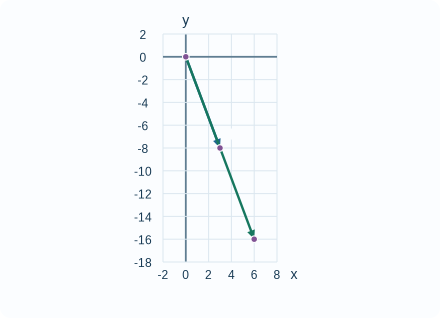
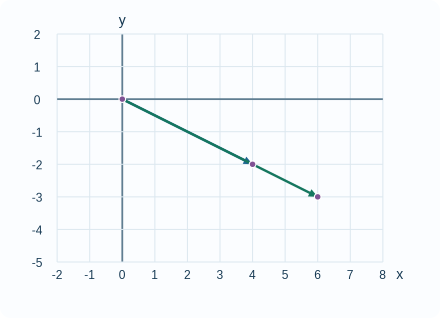
Given u=(3−8)\mathbf u=\begin{pmatrix}3\\-8\end{pmatrix} and v=(6−16)\mathbf v=\begin{pmatrix}6\\-16\end{pmatrix}, find the scalar kk for which v=ku\mathbf v=k\mathbf u.

Coordinate grid with labelled axes. O at (0,0). u at (3,-8). v at (6,-16). Arrowheads indicate the directions.

  1. Divide the horizontal component of v by the horizontal component of u.

  2. Check the vertical components give the same multiplier. The two vectors are parallel because both components scale by that number.

  3. The result is 22.

Your turn

Given u=(4−9)\mathbf u=\begin{pmatrix}4\\-9\end{pmatrix} and v=(−292)\mathbf v=\begin{pmatrix}-2\\\frac{9}{2}\end{pmatrix}, find the scalar kk for which v=ku\mathbf v=k\mathbf u.

Coordinate grid with labelled axes. O at (0,0). u at (4,-9). v at (-2,9/2). Arrowheads indicate the directions.

Enter an exact value or round to 3 significant figures.

Worked example

Check the scalar multiple and the common point

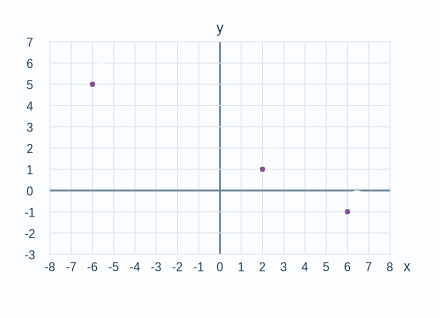
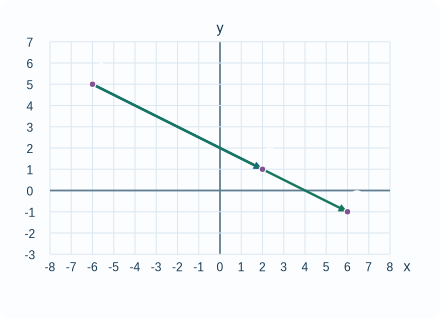
Let A(−6,5),B(2,1),C(6,−1)A(-6,5),\quad B(2,1),\quad C(6,-1). The vectors AB→\overrightarrow{AB} and AC→\overrightarrow{AC} share the starting point A. Which reason shows that A, B and C lie on one line?

  1. The points are collinear because AB→=AC→\overrightarrow{AB}=\overrightarrow{AC}.
  2. The points are collinear because two of them have the same x-coordinate.
  3. The points cannot be collinear because the two displacements differ in length.
  4. The points are collinear because AC→=32AB→\overrightarrow{AC}=\frac{3}{2}\overrightarrow{AB} and both start at A.

Coordinate grid with labelled axes. A at (-6,5). B at (2,1). C at (6,-1).

Try it on paper first.

  1. End minus start gives AB→=(8−4)\overrightarrow{AB}=\begin{pmatrix}8\\-4\end{pmatrix} and AC→=(12−6)\overrightarrow{AC}=\begin{pmatrix}12\\-6\end{pmatrix}.

  2. The second vector is 32\frac{3}{2} times the first. They share A, so A, B and C are on one straight line.

  3. Coordinate grid with labelled axes. A at (-6,5). B at (2,1). C at (6,-1). Arrowheads indicate the directions.

Your turn

Let A(−5,6),B(5,0),C(−25,18)A(-5,6),\quad B(5,0),\quad C(-25,18). The vectors AB→\overrightarrow{AB} and AC→\overrightarrow{AC} share the starting point A. Which reason shows that A, B and C lie on one line?

Coordinate grid with labelled axes. A at (-5,6). B at (5,0). C at (-25,18).

Choose one answer

Section 2 of 3 · Extension · about 9 min

What extra step proves that points are collinear?

Practise the method

For example, show that AC is a scalar multiple of AB and note that the two segments meet at A. The scalar can also locate C along that line.

Worked example

Check the scalar multiple and the common point

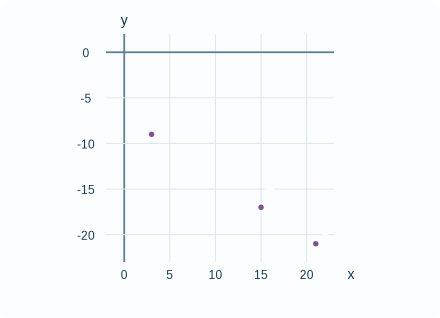
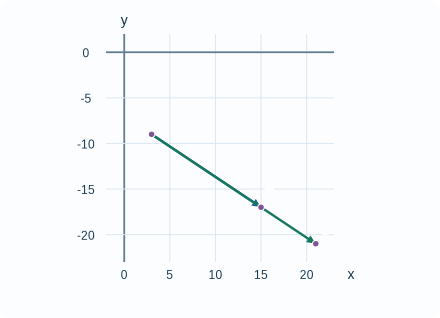
Let A(3,−9),B(15,−17),C(21,−21)A(3,-9),\quad B(15,-17),\quad C(21,-21). The vectors AB→\overrightarrow{AB} and AC→\overrightarrow{AC} share the starting point A. Which reason shows that A, B and C lie on one line?

  1. The points are collinear because AC→=32AB→\overrightarrow{AC}=\frac{3}{2}\overrightarrow{AB} and both start at A.
  2. The points are collinear because AB→=AC→\overrightarrow{AB}=\overrightarrow{AC}.
  3. The points are collinear because two of them have the same x-coordinate.
  4. The points cannot be collinear because the two displacements differ in length.

Coordinate grid with labelled axes. A at (3,-9). B at (15,-17). C at (21,-21).

  1. End minus start gives AB→=(12−8)\overrightarrow{AB}=\begin{pmatrix}12\\-8\end{pmatrix} and AC→=(18−12)\overrightarrow{AC}=\begin{pmatrix}18\\-12\end{pmatrix}.

  2. The second vector is 32\frac{3}{2} times the first. They share A, so A, B and C are on one straight line.

  3. Coordinate grid with labelled axes. A at (3,-9). B at (15,-17). C at (21,-21). Arrowheads indicate the directions.

Your turn

Let A(4,−8),B(18,−18),C(−24,12)A(4,-8),\quad B(18,-18),\quad C(-24,12). The vectors AB→\overrightarrow{AB} and AC→\overrightarrow{AC} share the starting point A. Which reason shows that A, B and C lie on one line?

Coordinate grid with labelled axes. A at (4,-8). B at (18,-18). C at (-24,12).

Choose one answer

Worked example

Recover a line ratio from a position vector

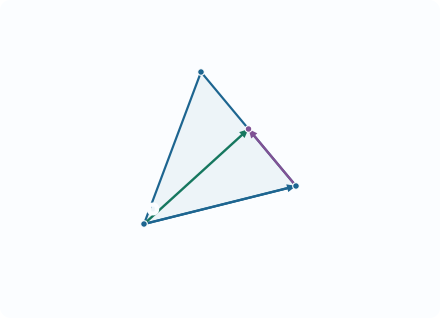
In triangle OAB, OA→=a\overrightarrow{OA}=\mathbf a and OB→=b\overrightarrow{OB}=\mathbf b. Point M has position vector OM→=12a+12b\overrightarrow{OM}=\frac{1}{2}\mathbf{a}+\frac{1}{2}\mathbf{b}. What is the simplified ratio AM : MB?

  1. 1:21:2
  2. 1:31:3
  3. 1:11:1
  4. 2:12:1

Try it on paper first.

  1. Subtract the position vector of A. Then AM→=12(b−a)\overrightarrow{AM}=\frac{1}{2}(\mathbf b-\mathbf a).

  2. This is a positive fraction of AB less than one, so M lies between A and B. Compare that starting fraction with the rest of the segment.

  3. Schematic vector diagram. O. A. B. M. Arrowheads indicate the directions.

Your turn

In triangle OAB, OA→=a\overrightarrow{OA}=\mathbf a and OB→=b\overrightarrow{OB}=\mathbf b. Point M has position vector OM→=25a+35b\overrightarrow{OM}=\frac{2}{5}\mathbf{a}+\frac{3}{5}\mathbf{b}. What is the simplified ratio AM : MB?

Choose one answer

Section 3 of 3 · Extension · about 9 min

How do I link a scalar and triangle similarity?

Practise the method

Subtract the two new position vectors to find the third side. Its scalar relationship to the old side gives the direction and the length ratio.

Worked example

Relate corresponding sides of similar triangles

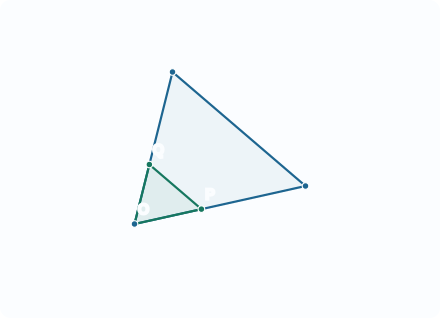
In triangle OAB, OA→=a\overrightarrow{OA}=\mathbf a and OB→=b\overrightarrow{OB}=\mathbf b. P lies on OA and Q lies on OB, with OPOA=OQOB=923\frac{OP}{OA}=\frac{OQ}{OB}=\frac{9}{23}. Express PQ→\overrightarrow{PQ} in terms of a,b\mathbf a,\mathbf b.

Schematic vector diagram. O. A. B. P. Q.

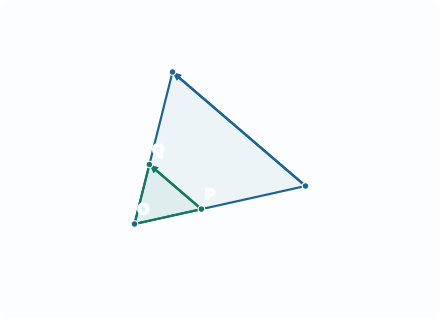
  1. The two position vectors are 923a\frac{9}{23}\mathbf a and 923b\frac{9}{23}\mathbf b. Use end minus start.

  2. The result is 923\frac{9}{23} times AB→\overrightarrow{AB}. The corresponding sides are parallel and the triangles are similar.

  3. The vector is −923a+923b-\frac{9}{23}\mathbf{a}+\frac{9}{23}\mathbf{b}.

  4. Schematic vector diagram. O. A. B. P. Q. Arrowheads indicate the directions.

Your turn

In triangle OAB, OA→=a\overrightarrow{OA}=\mathbf a and OB→=b\overrightarrow{OB}=\mathbf b. P lies on OA and Q lies on OB, with OPOA=OQOB=25\frac{OP}{OA}=\frac{OQ}{OB}=\frac{2}{5}. Express PQ→\overrightarrow{PQ} in terms of a,b\mathbf a,\mathbf b.

Schematic vector diagram. O. A. B. P. Q.

Enter an expression in a, b; use ^ for powers and / for fractions.

Worked example

Recover a line ratio from a position vector

In triangle OAB, OA→=a\overrightarrow{OA}=\mathbf a and OB→=b\overrightarrow{OB}=\mathbf b. Point M has position vector OM→=310a+710b\overrightarrow{OM}=\frac{3}{10}\mathbf{a}+\frac{7}{10}\mathbf{b}. What is the simplified ratio AM : MB?

  1. 7:107:10
  2. 1:111:11
  3. 7:37:3
  4. 10:710:7

Try it on paper first.

  1. Subtract the position vector of A. Then AM→=710(b−a)\overrightarrow{AM}=\frac{7}{10}(\mathbf b-\mathbf a).

  2. This is a positive fraction of AB less than one, so M lies between A and B. Compare that starting fraction with the rest of the segment.

  3. Schematic vector diagram. O. A. B. M. Arrowheads indicate the directions.

Your turn

In triangle OAB, OA→=a\overrightarrow{OA}=\mathbf a and OB→=b\overrightarrow{OB}=\mathbf b. Point M has position vector OM→=311a+811b\overrightarrow{OM}=\frac{3}{11}\mathbf{a}+\frac{8}{11}\mathbf{b}. What is the simplified ratio AM : MB?

Choose one answer

Worked examples

Practise the method

Core practice

Question 1 of 5

0 / 5 checked in this collection

Question list

Core practice

Fresh variants

Exam-style

Show how two vectors are parallel

1 mark

Given u=(4−2)\mathbf u=\begin{pmatrix}4\\-2\end{pmatrix} and v=(6−3)\mathbf v=\begin{pmatrix}6\\-3\end{pmatrix}, find the scalar kk for which v=ku\mathbf v=k\mathbf u.

Coordinate grid with labelled axes. O at (0,0). u at (4,-2). v at (6,-3). Arrowheads indicate the directions.

Enter an exact value or round to 3 significant figures.

Full answer-format guide

Exact numbers: 3/2, sqrt(5), 2-sqrt(3), pi/6, 3*pi/2. Sets: {1,4}. Intervals: (3,5]; a round bracket excludes the endpoint. Infinity: inf; union: U; no solutions: empty. Separate coordinate pairs or triples with semicolons. Expressions: 2x^2+3x-1; equations: x^2=3x+1 or the polynomial equal to zero. Factors: x-1 ; x+2. Parameter fraction: numerator ; denominator. List integer answers individually.

Review the method

Progress stays in this browser. Create an account to save it or sign in.

Extra practice from this lesson

Show how two vectors are parallel

Given u=(8−2)\mathbf u=\begin{pmatrix}8\\-2\end{pmatrix} and v=(−41)\mathbf v=\begin{pmatrix}-4\\1\end{pmatrix}, find the scalar kk for which v=ku\mathbf v=k\mathbf u.

Coordinate grid with labelled axes. O at (0,0). u at (8,-2). v at (-4,1). Arrowheads indicate the directions.

Enter an exact value or round to 3 significant figures.

Check the scalar multiple and the common point

Let A(0,−12),B(6,−14),C(9,−15)A(0,-12),\quad B(6,-14),\quad C(9,-15). The vectors AB→\overrightarrow{AB} and AC→\overrightarrow{AC} share the starting point A. Which reason shows that A, B and C lie on one line?

Coordinate grid with labelled axes. A at (0,-12). B at (6,-14). C at (9,-15).

Choose one answer

Check the scalar multiple and the common point

Let A(−5,−4),B(3,−8),C(15,−14)A(-5,-4),\quad B(3,-8),\quad C(15,-14). The vectors AB→\overrightarrow{AB} and AC→\overrightarrow{AC} share the starting point A. Which reason shows that A, B and C lie on one line?

Coordinate grid with labelled axes. A at (-5,-4). B at (3,-8). C at (15,-14).

Choose one answer

Recover a line ratio from a position vector

In triangle OAB, OA→=a\overrightarrow{OA}=\mathbf a and OB→=b\overrightarrow{OB}=\mathbf b. Point M has position vector OM→=15a+45b\overrightarrow{OM}=\frac{1}{5}\mathbf{a}+\frac{4}{5}\mathbf{b}. What is the simplified ratio AM : MB?

Choose one answer

Relate corresponding sides of similar triangles

In triangle OAB, OA→=a\overrightarrow{OA}=\mathbf a and OB→=b\overrightarrow{OB}=\mathbf b. P lies on OA and Q lies on OB, with OPOA=OQOB=23\frac{OP}{OA}=\frac{OQ}{OB}=\frac{2}{3}. Express PQ→\overrightarrow{PQ} in terms of a,b\mathbf a,\mathbf b.

Schematic vector diagram. O. A. B. P. Q.

Enter an expression in a, b; use ^ for powers and / for fractions.

Recover a line ratio from a position vector

In triangle OAB, OA→=a\overrightarrow{OA}=\mathbf a and OB→=b\overrightarrow{OB}=\mathbf b. Point M has position vector OM→=411a+711b\overrightarrow{OM}=\frac{4}{11}\mathbf{a}+\frac{7}{11}\mathbf{b}. What is the simplified ratio AM : MB?

Choose one answer

Apply it · original exam-style problems

Show your working on paper and compare it with the worked solution and marking guidance.

Come back to what needs practice

Quick revision sheet (A4)

Your review plan starts after your first check.