Maths4UBETA

Find vector magnitudes

Extended: use perpendicular components to find a vector length, including exact roots and a missing component.

Try the quick check →
Lesson 8 of 10

Section 1 of 3 · Extension · about 8 min

Why do I square the components?

Practise the method

Square each signed component with brackets, add the squares, then take the non-negative square root.

Worked example

Use Pythagoras for the magnitude

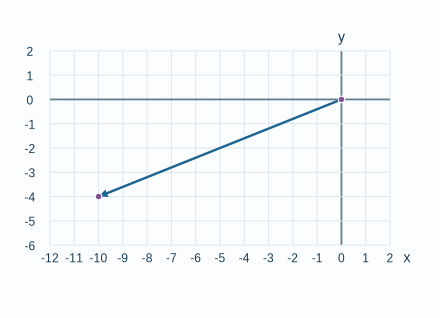
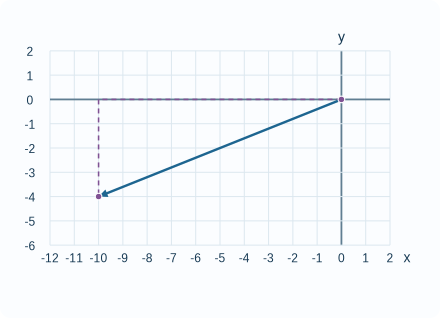
A vector has column form (−10−4)\begin{pmatrix}-10\\-4\end{pmatrix}. Find its exact magnitude.

Coordinate grid with labelled axes. O at (0,0). U at (-10,-4). Arrowheads indicate the directions.

  1. The horizontal and vertical components form perpendicular legs. Square both signed components and add the squares to get 116116.

  2. Take the non-negative square root of the sum.

  3. The result is 2292\sqrt{29}.

  4. Coordinate grid with labelled axes. O at (0,0). U at (-10,-4). Dashed lines show the construction guides. Arrowheads indicate the directions.

Your turn

A vector has column form (115)\begin{pmatrix}11\\5\end{pmatrix}. Find its exact magnitude.

Coordinate grid with labelled axes. O at (0,0). U at (11,5). Arrowheads indicate the directions.

Enter one number. Fractions and decimals are accepted.

Worked example

Find the length of a directed line segment

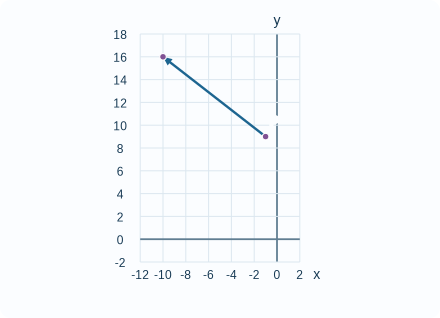
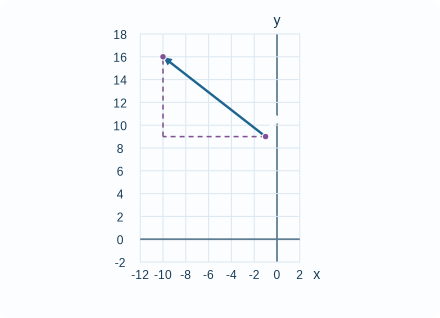
Given P(−1,9)P(-1,9) and Q(−10,16)Q(-10,16), work out ∣PQ→∣|\overrightarrow{PQ}| exactly.

Coordinate grid with labelled axes. P at (-1,9). Q at (-10,16). Arrowheads indicate the directions.

Try it on paper first.

  1. Subtract the coordinates of P from those of Q to get (−97)\begin{pmatrix}-9\\7\end{pmatrix}.

  2. Square the two components, add, then take the positive square root.

  3. The result is 130\sqrt{130}.

  4. Coordinate grid with labelled axes. P at (-1,9). Q at (-10,16). Dashed lines show the construction guides. Arrowheads indicate the directions.

Your turn

Given P(0,−9)P(0,-9) and Q(10,−17)Q(10,-17), work out ∣PQ→∣|\overrightarrow{PQ}| exactly.

Coordinate grid with labelled axes. P at (0,-9). Q at (10,-17). Arrowheads indicate the directions.

Enter an exact value or round to 3 significant figures.

Section 2 of 3 · Extension · about 8 min

How do I find the magnitude between two points?

Practise the method

Replacing a vector by a negative multiple can reverse its direction. Its length scales by the absolute value of that multiple.

Worked example

Find the length of a directed line segment

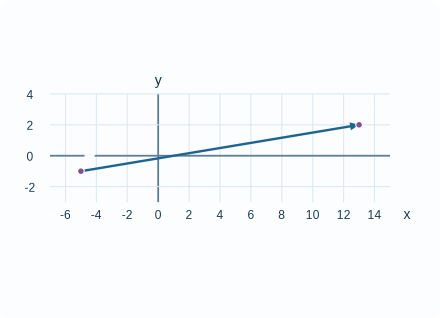
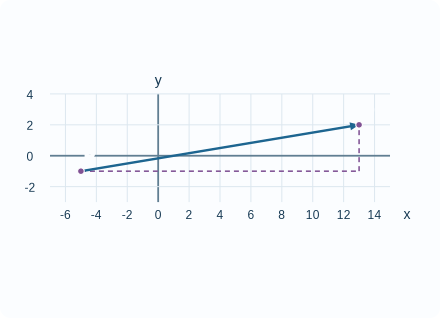
Given P(−5,−1)P(-5,-1) and Q(13,2)Q(13,2), work out ∣PQ→∣|\overrightarrow{PQ}| exactly.

Coordinate grid with labelled axes. P at (-5,-1). Q at (13,2). Arrowheads indicate the directions.

  1. Subtract the coordinates of P from those of Q to get (183)\begin{pmatrix}18\\3\end{pmatrix}.

  2. Square the two components, add, then take the positive square root.

  3. The result is 3373\sqrt{37}.

  4. Coordinate grid with labelled axes. P at (-5,-1). Q at (13,2). Dashed lines show the construction guides. Arrowheads indicate the directions.

Your turn

Given P(−4,0)P(-4,0) and Q(−6,−4)Q(-6,-4), work out ∣PQ→∣|\overrightarrow{PQ}| exactly.

Coordinate grid with labelled axes. P at (-4,0). Q at (-6,-4). Arrowheads indicate the directions.

Enter an exact value or round to 3 significant figures.

Worked example

Scale a magnitude with a negative scalar

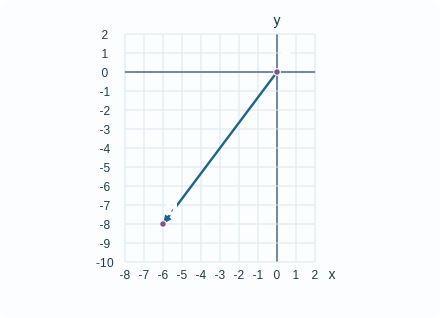
The column vector u=(−6−8)\mathbf u=\begin{pmatrix}-6\\-8\end{pmatrix} is multiplied by −5-5. Find ∣−5u∣|-5\mathbf u| exactly.

Coordinate grid with labelled axes. O at (0,0). U at (-6,-8). Arrowheads indicate the directions.

Try it on paper first.

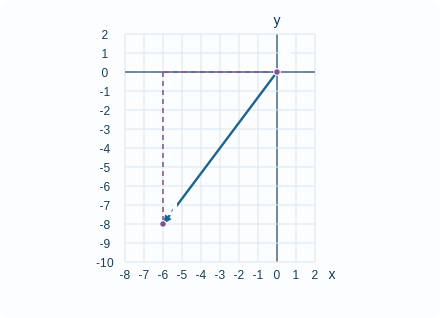
  1. Multiplying by −5-5 reverses direction and multiplies length by 55.

  2. The squared length is 25002500. Take its non-negative square root.

  3. The result is 5050.

  4. Coordinate grid with labelled axes. O at (0,0). U at (-6,-8). Dashed lines show the construction guides. Arrowheads indicate the directions.

Your turn

The column vector u=(79)\mathbf u=\begin{pmatrix}7\\9\end{pmatrix} is multiplied by −6-6. Find ∣−6u∣|-6\mathbf u| exactly.

Coordinate grid with labelled axes. O at (0,0). U at (7,9). Arrowheads indicate the directions.

Enter one number. Fractions and decimals are accepted.

Section 3 of 3 · Extension · about 8 min

How can I recover a missing component?

Practise the method

Use the required sign to choose a square root when the question states a direction or sign.

Worked example

Find a missing component from the magnitude

The vector (−15t)\begin{pmatrix}-15\\t\end{pmatrix} has magnitude 229\sqrt{229}. Given t>0t>0, find tt.

  1. Square the stated magnitude to get 229229. The first component contributes 225225.

  2. So t2=229−225=4t^2=229-225=4. The positive value is required.

  3. The result is 22.

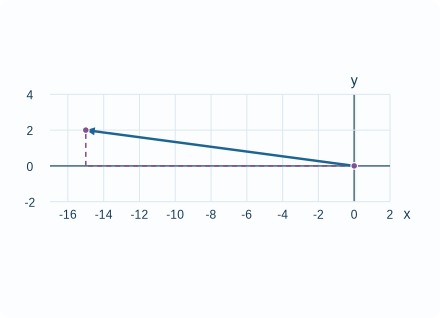
  4. Coordinate grid with labelled axes. O at (0,0). U at (-15,2). Dashed lines show the construction guides. Arrowheads indicate the directions.

Your turn

The vector (16t)\begin{pmatrix}16\\t\end{pmatrix} has magnitude 265\sqrt{265}. Given t>0t>0, find tt.

Enter one number. Fractions and decimals are accepted.

Worked example

Use Pythagoras for the magnitude

A vector has column form (−17−2)\begin{pmatrix}-17\\-2\end{pmatrix}. Find its exact magnitude.

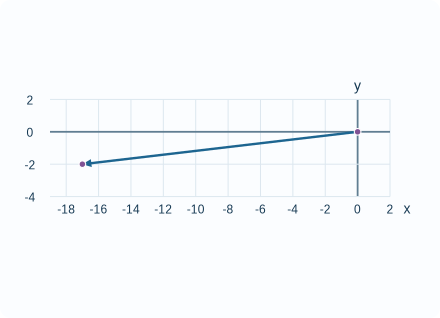
Coordinate grid with labelled axes. O at (0,0). U at (-17,-2). Arrowheads indicate the directions.

Try it on paper first.

  1. The horizontal and vertical components form perpendicular legs. Square both signed components and add the squares to get 293293.

  2. Take the non-negative square root of the sum.

  3. The result is 293\sqrt{293}.

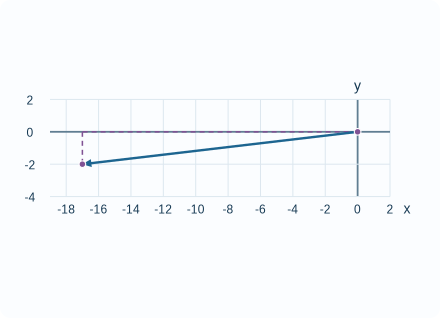
  4. Coordinate grid with labelled axes. O at (0,0). U at (-17,-2). Dashed lines show the construction guides. Arrowheads indicate the directions.

Your turn

A vector has column form (183)\begin{pmatrix}18\\3\end{pmatrix}. Find its exact magnitude.

Coordinate grid with labelled axes. O at (0,0). U at (18,3). Arrowheads indicate the directions.

Enter one number. Fractions and decimals are accepted.

Worked examples

Practise the method

Core practice

Question 1 of 5

0 / 5 checked in this collection

Question list

Core practice

Fresh variants

Exam-style

Use Pythagoras for the magnitude

1 mark

A vector has column form (−13−2)\begin{pmatrix}-13\\-2\end{pmatrix}. Find its exact magnitude.

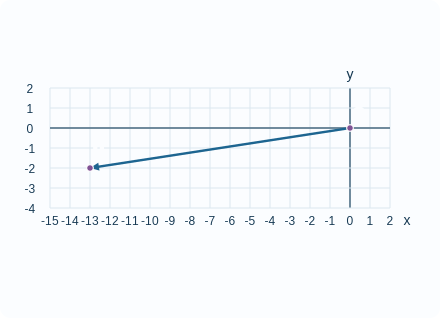
Coordinate grid with labelled axes. O at (0,0). U at (-13,-2). Arrowheads indicate the directions.

Enter one number. Fractions and decimals are accepted.

Full answer-format guide

Exact numbers: 3/2, sqrt(5), 2-sqrt(3), pi/6, 3*pi/2. Sets: {1,4}. Intervals: (3,5]; a round bracket excludes the endpoint. Infinity: inf; union: U; no solutions: empty. Separate coordinate pairs or triples with semicolons. Expressions: 2x^2+3x-1; equations: x^2=3x+1 or the polynomial equal to zero. Factors: x-1 ; x+2. Parameter fraction: numerator ; denominator. List integer answers individually.

Review the method

Progress stays in this browser. Create an account to save it or sign in.

Extra practice from this lesson

Use Pythagoras for the magnitude

A vector has column form (15−9)\begin{pmatrix}15\\-9\end{pmatrix}. Find its exact magnitude.

Coordinate grid with labelled axes. O at (0,0). U at (15,-9). Arrowheads indicate the directions.

Enter one number. Fractions and decimals are accepted.

Find the length of a directed line segment

Given P(5,−4)P(5,-4) and Q(−10,9)Q(-10,9), work out ∣PQ→∣|\overrightarrow{PQ}| exactly.

Coordinate grid with labelled axes. P at (5,-4). Q at (-10,9). Arrowheads indicate the directions.

Enter an exact value or round to 3 significant figures.

Find the length of a directed line segment

Given P(0,4)P(0,4) and Q(−6,−4)Q(-6,-4), work out ∣PQ→∣|\overrightarrow{PQ}| exactly.

Coordinate grid with labelled axes. P at (0,4). Q at (-6,-4). Arrowheads indicate the directions.

Enter one number. Fractions and decimals are accepted.

Scale a magnitude with a negative scalar

The column vector u=(−12−1)\mathbf u=\begin{pmatrix}-12\\-1\end{pmatrix} is multiplied by −4-4. Find ∣−4u∣|-4\mathbf u| exactly.

Coordinate grid with labelled axes. O at (0,0). U at (-12,-1). Arrowheads indicate the directions.

Enter one number. Fractions and decimals are accepted.

Find a missing component from the magnitude

The vector (3t)\begin{pmatrix}3\\t\end{pmatrix} has magnitude 58\sqrt{58}. Given t>0t>0, find tt.

Enter one number. Fractions and decimals are accepted.

Use Pythagoras for the magnitude

A vector has column form (−6−8)\begin{pmatrix}-6\\-8\end{pmatrix}. Find its exact magnitude.

Coordinate grid with labelled axes. O at (0,0). U at (-6,-8). Arrowheads indicate the directions.

Enter one number. Fractions and decimals are accepted.

Apply it · original exam-style problems

Show your working on paper and compare it with the worked solution and marking guidance.

Come back to what needs practice

Quick revision sheet (A4)

Your review plan starts after your first check.