Maths4UBETA

Translate shapes on a grid

Move every vertex by the same column vector, then describe or reverse the movement.

Try the quick check →
Lesson 1 of 10

Section 1 of 3 · Core · about 8 min

How do the two entries tell me where to go?

Practise the method

Move one vertex at a time, then join corresponding image vertices in the same order. A translation preserves the shape, size and orientation.

A vertex gives one location. The complete image needs every vertex and a straight edge between each matching pair.

Worked example

Translate a triangle

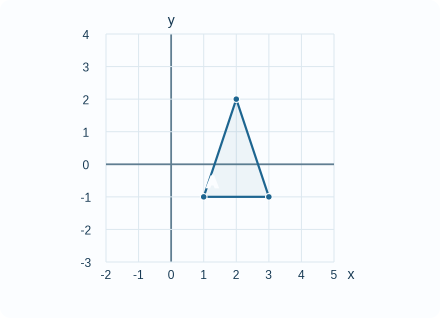
Triangle ABC has vertices A(1,−1),B(3,−1),C(2,2)A(1,-1),\quad B(3,-1),\quad C(2,2). Translate it by (66)\begin{pmatrix}6\\6\end{pmatrix}. Give all three image vertices.

Coordinate grid with labelled axes. A at (1,-1). B at (3,-1). C at (2,2).

  1. The horizontal move is 66 and the vertical move is 66.

  2. Make this same move from each vertex, then join the corresponding vertices in the original order.

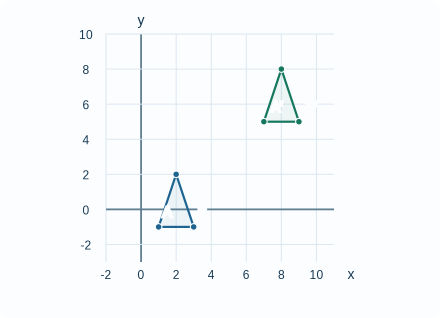
  3. The coordinates are (7,5),  (9,5),  (8,8)(7,5),\;(9,5),\;(8,8).

  4. Coordinate grid with labelled axes. A at (1,-1). B at (3,-1). C at (2,2). A′ at (7,5). B′ at (9,5). C′ at (8,8).

Your turn

Triangle ABC has vertices A(2,0),B(5,0),C(3,4)A(2,0),\quad B(5,0),\quad C(3,4). Translate it by (2−7)\begin{pmatrix}2\\-7\end{pmatrix}. Give all three image vertices.

Coordinate grid with labelled axes. A at (2,0). B at (5,0). C at (3,4).

Enter a point as (1, 2) or x = 1, y = 2. Separate complete pairs with commas or semicolons.

Worked example

Read the translation from corresponding points

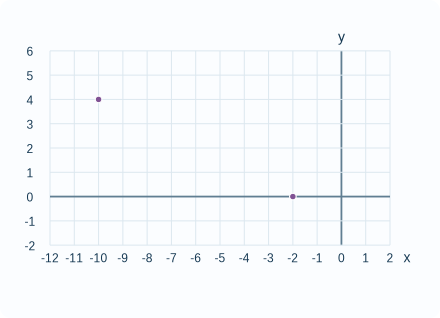
A translation takes P(−2,0)P(-2,0) to P′(−10,4)P'(-10,4). Find its column vector. Enter the components as an ordered pair.

Coordinate grid with labelled axes. P at (-2,0). P′ at (-10,4).

Try it on paper first.

  1. Subtract the original coordinates from the image coordinates. Use x first and y second.

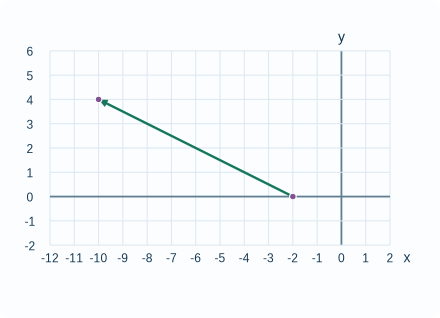
  2. The column vector is (−84)\begin{pmatrix}-8\\4\end{pmatrix}.

  3. Coordinate grid with labelled axes. P at (-2,0). P′ at (-10,4). Arrowheads indicate the directions.

Your turn

A translation takes P(−1,1)P(-1,1) to P′(−3,6)P'(-3,6). Find its column vector. Enter the components as an ordered pair.

Coordinate grid with labelled axes. P at (-1,1). P′ at (-3,6).

Enter a point as (1, 2) or x = 1, y = 2. Separate complete pairs with commas or semicolons.

Section 2 of 3 · Core · about 8 min

How do I find the vector from two corresponding points?

Practise the method

Subtract the old coordinate from the new coordinate in each direction. Check a second corresponding pair if both shapes are shown.

Worked example

Give a complete translation description

A single transformation takes triangle A(−2,−1),B(1,−1),C(−1,1)A(-2,-1),\quad B(1,-1),\quad C(-1,1) to A′(2,−9),B′(5,−9),C′(3,−7)A′(2,-9),\quad B′(5,-9),\quad C′(3,-7). Which description is correct?

  1. Translation by (−48)\begin{pmatrix}-4\\8\end{pmatrix}.
  2. Translation by (−84)\begin{pmatrix}-8\\4\end{pmatrix}.
  3. Reflection in the x-axis.
  4. Translation by (4−8)\begin{pmatrix}4\\-8\end{pmatrix}.

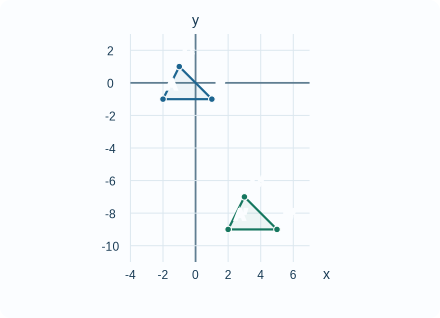
Coordinate grid with labelled axes. A at (-2,-1). B at (1,-1). C at (-1,1). A′ at (2,-9). B′ at (5,-9). C′ at (3,-7).

  1. The same directed move takes each original vertex to its image. That identifies a translation.

  2. Each horizontal change is 44 and each vertical change is −8-8.

Your turn

A single transformation takes triangle A(−1,0),B(1,0),C(0,3)A(-1,0),\quad B(1,0),\quad C(0,3) to A′(4,−9),B′(6,−9),C′(5,−6)A′(4,-9),\quad B′(6,-9),\quad C′(5,-6). Which description is correct?

Coordinate grid with labelled axes. A at (-1,0). B at (1,0). C at (0,3). A′ at (4,-9). B′ at (6,-9). C′ at (5,-6).

Choose one answer

Worked example

Read the translation from corresponding points

A translation takes P(−8,−2)P(-8,-2) to P′(−13,3)P'(-13,3). Find its column vector. Enter the components as an ordered pair.

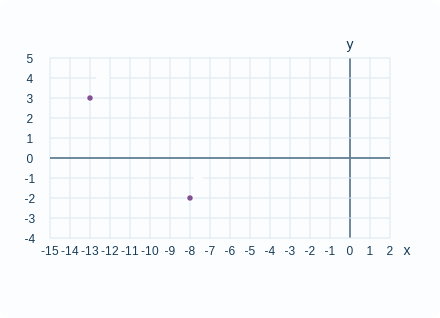
Coordinate grid with labelled axes. P at (-8,-2). P′ at (-13,3).

Try it on paper first.

  1. Subtract the original coordinates from the image coordinates. Use x first and y second.

  2. The column vector is (−55)\begin{pmatrix}-5\\5\end{pmatrix}.

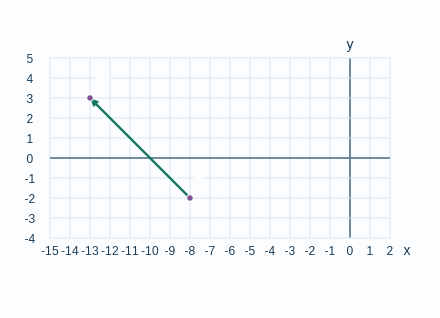
  3. Coordinate grid with labelled axes. P at (-8,-2). P′ at (-13,3). Arrowheads indicate the directions.

Your turn

A translation takes P(−7,−1)P(-7,-1) to P′(−13,5)P'(-13,5). Find its column vector. Enter the components as an ordered pair.

Coordinate grid with labelled axes. P at (-7,-1). P′ at (-13,5).

Enter a point as (1, 2) or x = 1, y = 2. Separate complete pairs with commas or semicolons.

Section 3 of 3 · Core · about 7 min

How can I undo a translation?

Practise the method

Subtract the original translation vector from the image coordinates. You can also translate by the vector with both signs changed.

Worked example

Find the point before a translation

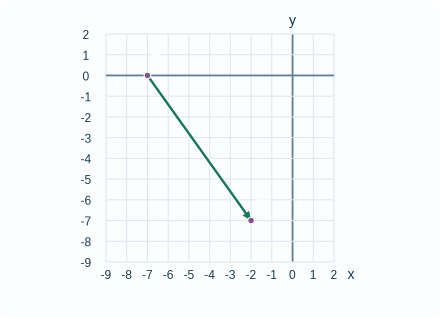
A translation by (5−7)\begin{pmatrix}5\\-7\end{pmatrix} takes a point to (−2,−7)(-2,-7). Find the original point.

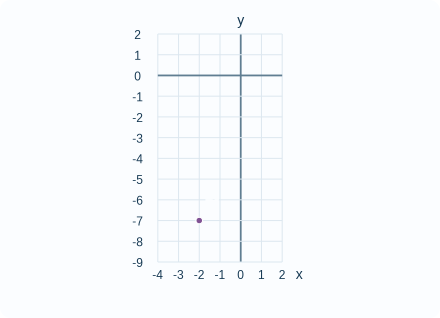
Coordinate grid with labelled axes. P′ at (-2,-7).

  1. Reverse both components of the movement. The reverse vector is (−57)\begin{pmatrix}-5\\7\end{pmatrix}.

  2. Apply that reverse movement to the image.

  3. The coordinates are (−7,0)(-7,0).

  4. Coordinate grid with labelled axes. P at (-7,0). P′ at (-2,-7). Arrowheads indicate the directions.

Your turn

A translation by (3−8)\begin{pmatrix}3\\-8\end{pmatrix} takes a point to (−1,−6)(-1,-6). Find the original point.

Coordinate grid with labelled axes. P′ at (-1,-6).

Enter a point as (1, 2) or x = 1, y = 2. Separate complete pairs with commas or semicolons.

Worked example

Read the translation from corresponding points

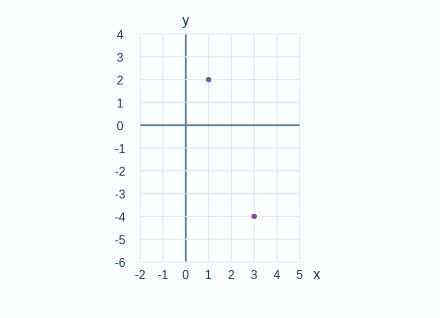
A translation takes P(3,−4)P(3,-4) to P′(1,2)P'(1,2). Find its column vector. Enter the components as an ordered pair.

Coordinate grid with labelled axes. P at (3,-4). P′ at (1,2).

Try it on paper first.

  1. Subtract the original coordinates from the image coordinates. Use x first and y second.

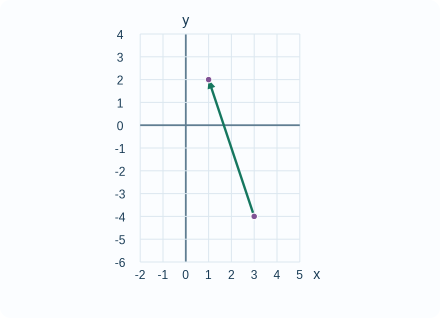
  2. The column vector is (−26)\begin{pmatrix}-2\\6\end{pmatrix}.

  3. Coordinate grid with labelled axes. P at (3,-4). P′ at (1,2). Arrowheads indicate the directions.

Your turn

A translation takes P(4,−3)P(4,-3) to P′(1,4)P'(1,4). Find its column vector. Enter the components as an ordered pair.

Coordinate grid with labelled axes. P at (4,-3). P′ at (1,4).

Enter a point as (1, 2) or x = 1, y = 2. Separate complete pairs with commas or semicolons.

Worked examples

Practise the method

Core practice

Question 1 of 5

0 / 5 checked in this collection

Question list

Core practice

Fresh variants

Exam-style

Translate a triangle

1 mark

Triangle ABC has vertices A(0,4),B(2,4),C(1,6)A(0,4),\quad B(2,4),\quad C(1,6). Translate it by (55)\begin{pmatrix}5\\5\end{pmatrix}. Give all three image vertices.

Coordinate grid. A at (0,4). B at (2,4). C at (1,6).

Enter a point as (1, 2) or x = 1, y = 2. Separate complete pairs with commas or semicolons.

Full answer-format guide

Exact numbers: 3/2, sqrt(5), 2-sqrt(3), pi/6, 3*pi/2. Sets: {1,4}. Intervals: (3,5]; a round bracket excludes the endpoint. Infinity: inf; union: U; no solutions: empty. Separate coordinate pairs or triples with semicolons. Expressions: 2x^2+3x-1; equations: x^2=3x+1 or the polynomial equal to zero. Factors: x-1 ; x+2. Parameter fraction: numerator ; denominator. List integer answers individually.

Review the method

Progress stays in this browser. Create an account to save it or sign in.

Extra practice from this lesson

Translate a triangle

Triangle ABC has vertices A(−1,4),B(2,4),C(0,6)A(-1,4),\quad B(2,4),\quad C(0,6). Translate it by (6−4)\begin{pmatrix}6\\-4\end{pmatrix}. Give all three image vertices.

Coordinate grid with labelled axes. A at (-1,4). B at (2,4). C at (0,6).

Enter a point as (1, 2) or x = 1, y = 2. Separate complete pairs with commas or semicolons.

Read the translation from corresponding points

A translation takes P(4,6)P(4,6) to P′(−3,11)P'(-3,11). Find its column vector. Enter the components as an ordered pair.

Coordinate grid with labelled axes. P at (4,6). P′ at (-3,11).

Enter a point as (1, 2) or x = 1, y = 2. Separate complete pairs with commas or semicolons.

Give a complete translation description

A single transformation takes triangle A(3,4),B(5,4),C(4,8)A(3,4),\quad B(5,4),\quad C(4,8) to A′(12,0),B′(14,0),C′(13,4)A′(12,0),\quad B′(14,0),\quad C′(13,4). Which description is correct?

Coordinate grid with labelled axes. A at (3,4). B at (5,4). C at (4,8). A′ at (12,0). B′ at (14,0). C′ at (13,4).

Choose one answer

Read the translation from corresponding points

A translation takes P(−2,4)P(-2,4) to P′(−6,10)P'(-6,10). Find its column vector. Enter the components as an ordered pair.

Coordinate grid with labelled axes. P at (-2,4). P′ at (-6,10).

Enter a point as (1, 2) or x = 1, y = 2. Separate complete pairs with commas or semicolons.

Find the point before a translation

A translation by (4−5)\begin{pmatrix}4\\-5\end{pmatrix} takes a point to (3,−2)(3,-2). Find the original point.

Coordinate grid with labelled axes. P′ at (3,-2).

Enter a point as (1, 2) or x = 1, y = 2. Separate complete pairs with commas or semicolons.

Read the translation from corresponding points

A translation takes P(−8,2)P(-8,2) to P′(−16,9)P'(-16,9). Find its column vector. Enter the components as an ordered pair.

Coordinate grid with labelled axes. P at (-8,2). P′ at (-16,9).

Enter a point as (1, 2) or x = 1, y = 2. Separate complete pairs with commas or semicolons.

Apply it · original exam-style problems

Show your working on paper and compare it with the worked solution and marking guidance.

Come back to what needs practice

Quick revision sheet (A4)

Your review plan starts after your first check.