Cambridge IGCSE Mathematics (0580) · Transformations and vectors · Quick revision
Translate shapes on a grid
How do the two entries tell me where to go?
The top entry of a column vector is the horizontal movement. The lower entry is the vertical movement. Positive means right or up, and negative means left or down.
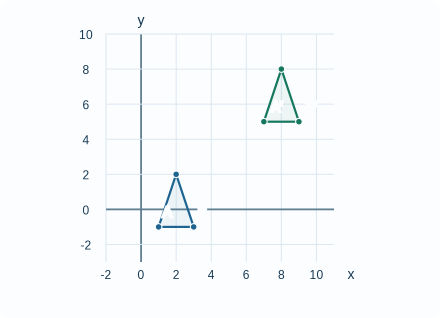
Move one vertex at a time, then join corresponding image vertices in the same order. A translation preserves the shape, size and orientation.
How do I find the vector from two corresponding points?
Choose matched points and compare their x-coordinates and y-coordinates from object to image.
Subtract the old coordinate from the new coordinate in each direction. Check a second corresponding pair if both shapes are shown.
How can I undo a translation?
To return to the original point, reverse the horizontal and the vertical movements.
Subtract the original translation vector from the image coordinates. You can also translate by the vector with both signs changed.
Quick worked example
Triangle ABC has vertices . Translate it by . Give all three image vertices.
The horizontal move is and the vertical move is .
Make this same move from each vertex, then join the corresponding vertices in the original order.
The coordinates are .