Cambridge IGCSE Mathematics (0580) · Transformations and vectors · Quick revision
Use position vectors, routes and ratios
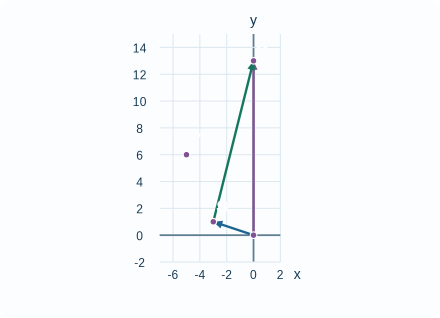
Which arrows start at the origin?
A position vector always starts at the origin. A displacement between two points starts at the named first point and may not touch the origin.
Use end position minus start position. This combines the backwards journey to the origin with the forward journey to the end point.
How do I write a route using two directions?
Follow a known route and add its movements. Reverse the sign of any vector used in the opposite direction.
If and , then .
What part of the full segment do I travel?
An internal ratio counts parts on both sides of the point. Add the two numbers to find the total parts.
To get a position vector, reach the first endpoint from the origin and then travel the required fraction of the full segment.
Quick worked example
Points S, T and U have position vectors , and respectively. Find the directed displacement .
A position vector starts at the origin. The displacement starts at S, so subtract the position of S from the position of U.
The column vector is .