Maths4UBETA

Limits of the sign-change test

Recognise touching roots, multiple crossings and discontinuities before interpreting a sign table.

Try the quick check →
Lesson 2 of 5

Section 1 of 5 · Core · about 6 min

How can a graph meet the axis without crossing?

The sign test detects a switch between positive and negative values. For a square factor the graph may instead come down to zero and return to the same side. Inspect the shape of the graph or consider how many times the same factor occurs.
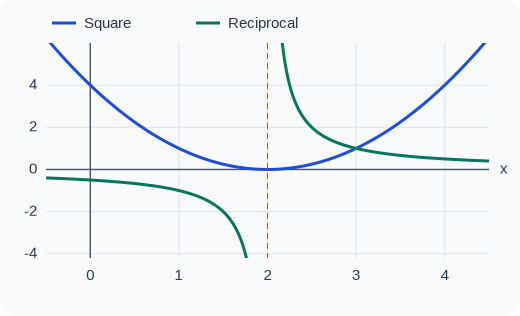
The square graph meets the axis at two without changing sign. The reciprocal graph changes sign across its vertical asymptote at two, where it is undefined.

At x=2x=2 the square reaches zero. The reciprocal has a gap in its domain and its values cannot be joined across the dashed line.

Worked example

A double root at a vertex

For f(x)=(x−3)2f(x)=(x-3)^2 on [1,5][1,5], give every root in the interval and choose the explanation that matches the graph.

  1. f(1)=4f(1)=4 and f(5)=4f(5)=4.

  2. The square is zero at x=3x=3 and positive on both sides. The graph meets the axis at the vertex.

  3. The root set is {3}\{3\}.

Your turn

For f(x)=(x+4)2f(x)=(x+4)^2 on [−6,−2][-6,-2], give every root in the interval and choose the explanation that matches the graph.

Give every root, for example x = 1 or x = 4, or 1, 4. Use sqrt(...) for exact roots, or empty if there are none.

Explanation

Section 2 of 5 · Core · about 7 min

Can an asymptote look like a zero?

The curve drawn on one side of a vertical asymptote does not connect to the curve on the other. A change from negative to positive over the gap therefore does not prove that a value of zero is reached.

Worked example

Opposite signs across a pole

For f(x)=1x−2f(x)=\frac{1}{x-2} on [0,4][0,4], give every root in the interval and choose the explanation that matches the graph.

  1. f(0)=−12f(0)=-\frac{1}{2} and f(4)=12f(4)=\frac{1}{2}.

  2. At x=2x=2 the denominator is zero and the function is undefined. Its nonzero numerator cannot make the fraction equal to zero.

  3. The root set is ∅\varnothing.

Worked example

An asymptote in a negative interval

For f(x)=1x+5f(x)=\frac{1}{x+5} on [−7,−3][-7,-3], give every root in the interval and choose the explanation that matches the graph.

Try it on paper first.

  1. f(−7)=−12f(-7)=-\frac{1}{2} and f(−3)=12f(-3)=\frac{1}{2}.

  2. At x=−5x=-5 the denominator is zero and the function is undefined. Its nonzero numerator cannot make the fraction equal to zero.

  3. The root set is ∅\varnothing.

Your turn

For f(x)=1x−5f(x)=\frac{1}{x-5} on [3,7][3,7], give every root in the interval and choose the explanation that matches the graph.

Give every root, for example x = 1 or x = 4, or 1, 4. Use sqrt(...) for exact roots, or empty if there are none.

Explanation

Section 3 of 5 · Core · about 7 min

Can the graph cross twice between tests?

If two simple roots lie between the test points, the sign can reverse at each root. Two reversals bring the value back to its starting sign. A sign table with a test point between the roots makes the two crossings visible.

Worked example

Two crossings leave equal signs

For f(x)=(x+2)(x−3)f(x)=(x+2)(x-3) on [−4,5][-4,5], give every root in the interval and choose the explanation that matches the graph.

  1. f(−4)=14f(-4)=14 and f(5)=14f(5)=14.

  2. Both factors give a root. Each simple root reverses the sign, so the graph finishes on the same side of the axis as it started.

  3. The root set is {−2,3}\{-2,3\}.

Your turn

For f(x)=(x+1)(x−2)f(x)=(x+1)(x-2) on [−3,4][-3,4], give every root in the interval and choose the explanation that matches the graph.

Give every root, for example x = 1 or x = 4, or 1, 4. Use sqrt(...) for exact roots, or empty if there are none.

Explanation

Section 4 of 5 · Core · about 7 min

Does cancellation fill in a missing input?

Cancelling a common factor is a valid simplification on the original domain of a fraction. An input that made the original denominator zero remains excluded. A simplified graph may look as though it contains a root where the original graph has a hole.

Worked example

A cancelled factor leaves a hole

For f(x)=(x+2)2x+2f(x)=\frac{(x+2)^2}{x+2} on [−4,0][-4,0], give every root in the interval and choose the explanation that matches the graph.

  1. f(−4)=−2f(-4)=-2 and f(0)=2f(0)=2.

  2. Cancellation gives x+2x+2 only when x≠−2x\ne-2. The only candidate is excluded from the original domain, so the graph has a hole instead of a zero.

  3. The root set is ∅\varnothing.

Your turn

For f(x)=(x−4)2x−4f(x)=\frac{(x-4)^2}{x-4} on [2,6][2,6], give every root in the interval and choose the explanation that matches the graph.

Give every root, for example x = 1 or x = 4, or 1, 4. Use sqrt(...) for exact roots, or empty if there are none.

Explanation

Section 5 of 5 · Core · about 6 min

What does multiplicity say about the sign?

Near a root of a polynomial, the factors that do not vanish keep their sign. The vanishing factor controls what happens as the input moves through the root. An odd power changes sign and an even power keeps its sign.

Worked example

An odd multiple root still crosses

For f(x)=(x−1)3f(x)=(x-1)^3 on [−1,3][-1,3], give every root in the interval and choose the explanation that matches the graph.

  1. f(−1)=−8f(-1)=-8 and f(3)=8f(3)=8.

  2. The factor keeps the sign of its base because the power is odd. It is zero at x=1x=1.

  3. The root set is {1}\{1\}.

Worked example

Locate two roots before making a claim

For f(x)=(x−1)(x−4)f(x)=(x-1)(x-4) on [−1,6][-1,6], give every root in the interval and choose the explanation that matches the graph.

Try it on paper first.

  1. f(−1)=10f(-1)=10 and f(6)=10f(6)=10.

  2. Both factors give a root. Each simple root reverses the sign, so the graph finishes on the same side of the axis as it started.

  3. The root set is {1,4}\{1,4\}.

Your turn

For f(x)=(x+3)3f(x)=(x+3)^3 on [−5,−1][-5,-1], give every root in the interval and choose the explanation that matches the graph.

Give every root, for example x = 1 or x = 4, or 1, 4. Use sqrt(...) for exact roots, or empty if there are none.

Explanation

Worked examples

Practise the method

Core practice

Question 1 of 4

0 / 4 checked in this collection

Question list

Core practice

Fresh variants

Exam-style

Identify a touching root

2 marks

For f(x)=(x−4)2f(x)=(x-4)^2 on [2,6][2,6], give every root in the interval and choose the explanation that matches the graph.

Give every root, for example x = 1 or x = 4, or 1, 4. Use sqrt(...) for exact roots, or empty if there are none.

Explanation

Choose one option. Explain your reasoning on paper.

Full answer-format guide

Exact numbers: 3/2, sqrt(5), 2-sqrt(3), pi/6, 3*pi/2. Sets: {1,4}. Intervals: (3,5]; a round bracket excludes the endpoint. Infinity: inf; union: U; no solutions: empty. Separate coordinate pairs or triples with semicolons. Expressions: 2x^2+3x-1; equations: x^2=3x+1 or the polynomial equal to zero. Factors: x-1 ; x+2. Parameter fraction: numerator ; denominator. List integer answers individually.

Review the method

Progress stays in this browser. Create an account to save it or sign in.

Extra practice from this lesson

Find a touching root at a positive input

For f(x)=(x−7)2f(x)=(x-7)^2 on [5,9][5,9], give every root in the interval and choose the explanation that matches the graph.

Give every root, for example x = 1 or x = 4, or 1, 4. Use sqrt(...) for exact roots, or empty if there are none.

Explanation

Separate signs at a negative pole

For f(x)=1x+4f(x)=\frac{1}{x+4} on [−6,−2][-6,-2], give every root in the interval and choose the explanation that matches the graph.

Give every root, for example x = 1 or x = 4, or 1, 4. Use sqrt(...) for exact roots, or empty if there are none.

Explanation

Give both roots from a product

For f(x)=(x−2)(x−6)f(x)=(x-2)(x-6) on [0,8][0,8], give every root in the interval and choose the explanation that matches the graph.

Give every root, for example x = 1 or x = 4, or 1, 4. Use sqrt(...) for exact roots, or empty if there are none.

Explanation

Exclude a hole at a negative input

For f(x)=(x+7)2x+7f(x)=\frac{(x+7)^2}{x+7} on [−9,−5][-9,-5], give every root in the interval and choose the explanation that matches the graph.

Give every root, for example x = 1 or x = 4, or 1, 4. Use sqrt(...) for exact roots, or empty if there are none.

Explanation

Classify a cubed factor

For f(x)=(x−5)3f(x)=(x-5)^3 on [3,7][3,7], give every root in the interval and choose the explanation that matches the graph.

Give every root, for example x = 1 or x = 4, or 1, 4. Use sqrt(...) for exact roots, or empty if there are none.

Explanation

Two real roots on different sides of zero

For f(x)=(x+5)(x−2)f(x)=(x+5)(x-2) on [−7,4][-7,4], give every root in the interval and choose the explanation that matches the graph.

Give every root, for example x = 1 or x = 4, or 1, 4. Use sqrt(...) for exact roots, or empty if there are none.

Explanation

Apply it · original exam-style problems

Show your working on paper and compare it with the worked solution and marking guidance.

Come back to what needs practice

Quick revision sheet (A4)

Your review plan starts after your first check.