Maths4UBETA

Rounding bounds and a root’s accuracy

Use a sign change at the rounding boundaries to justify requested final digits.

Try the quick check →
Lesson 3 of 5

Section 1 of 5 · Core · about 7 min

Which numbers round to the same answer?

A calculator approximation suggests which digits to write. To certify them, ask which nearby inputs would round to that same written value. The last digit determines the width of that window. For two decimal places, successive possible rounded values differ by 0.010.01.

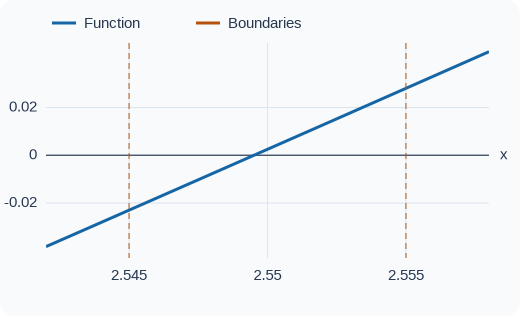
The square-minus-6.5 curve is negative at 2.545 and positive at 2.555. Both test inputs surround the numbers that round to 2.55.

A root strictly between 2.5452.545 and 2.5552.555 rounds to 2.552.55 to two decimal places.

Worked example

Place two boundaries around the rounded root

The positive root of x2−6.5=0x^2-6.5=0 is required to 2 decimal places. Give the rounded root and the two rounding boundaries, in increasing order.

  1. The rounded value is a candidate. Keep the whole window of inputs that round to the candidate. Its half-width is 0.0050.005.

  2. The rounding boundaries are 2.5452.545 and 2.5552.555. The quadratic is continuous and is increasing on the positive interval.

  3. BoundaryFunction valueSign
    2.5452.545−0.022975-0.022975Negative
    2.5552.5550.0280250.028025Positive
  4. The opposite signs locate the root between the two boundaries. Therefore 2.545<α<2.5552.545<\alpha<2.555 and α≈2.55\alpha\approx2.55 to 2 decimal places.

Your turn

The positive root of x2−7=0x^2-7=0 is required to 2 decimal places. Give the rounded root and the two rounding boundaries, in increasing order.

Enter an exact number, for example 3/2 or 2-sqrt(3).

Enter an exact number, for example 3/2 or 2-sqrt(3).

Enter an exact number, for example 3/2 or 2-sqrt(3).

Section 2 of 5 · Core · about 7 min

How do the signs prove the final digits?

After finding a candidate, evaluate the original function, once at each boundary. An iteration table alone gives evidence for a guess. If the boundary values have opposite signs and the function is continuous throughout, the sign test locates a root in the correct rounding window.

Worked example

Prove a cubic root to three decimal places

The positive root of x3−31=0x^3-31=0 is required to 3 decimal places. Give the rounded root and the two rounding boundaries, in increasing order.

  1. The rounded value is a candidate. Keep the whole window of inputs that round to the candidate. Its half-width is 0.00050.0005.

  2. The rounding boundaries are 3.14053.1405 and 3.14153.1415. The cubic is continuous and strictly increasing.

  3. BoundaryFunction valueSign
    3.14053.1405−0.026064244875-0.026064244875Negative
    3.14153.14150.0035333983750.003533398375Positive
  4. The opposite signs locate the root between the two boundaries. Therefore 3.1405<α<3.14153.1405<\alpha<3.1415 and α≈3.141\alpha\approx3.141 to 3 decimal places.

Worked example

Certify a value to one decimal place

The positive root of x2−18=0x^2-18=0 is required to 1 decimal places. Give the rounded root and the two rounding boundaries, in increasing order.

Try it on paper first.

  1. The rounded value is a candidate. Keep the whole window of inputs that round to the candidate. Its half-width is 0.050.05.

  2. The rounding boundaries are 4.154.15 and 4.254.25. The quadratic is continuous and is increasing on the positive interval.

  3. BoundaryFunction valueSign
    4.154.15−0.7775-0.7775Negative
    4.254.250.06250.0625Positive
  4. The opposite signs locate the root between the two boundaries. Therefore 4.15<α<4.254.15<\alpha<4.25 and α≈4.2\alpha\approx4.2 to 1 decimal places.

Your turn

The positive root of x3−19=0x^3-19=0 is required to 3 decimal places. Give the rounded root and the two rounding boundaries, in increasing order.

Enter an exact number, for example 3/2 or 2-sqrt(3).

Enter an exact number, for example 3/2 or 2-sqrt(3).

Enter an exact number, for example 3/2 or 2-sqrt(3).

Section 3 of 5 · Core · about 7 min

How does the place value change with scale?

Significant figures start at the first nonzero digit. The same count can mean tenths in one answer and ten-thousandths in a small answer. First identify the position of the last significant digit, then build the corresponding rounding window.

Worked example

Track the place value in a small measurement

The positive root of x2−0.0038=0x^2-0.0038=0 is required to 3 significant figures. Give the rounded root and the two rounding boundaries, in increasing order.

  1. The rounded value is a candidate. Keep the whole window of inputs that round to the candidate. Its half-width is 0.000050.00005.

  2. The rounding boundaries are 0.061550.06155 and 0.061650.06165. The quadratic is continuous and is increasing on the positive interval.

  3. BoundaryFunction valueSign
    0.061550.06155−0.0000115975-0.0000115975Negative
    0.061650.061650.00000072250.0000007225Positive
  4. The opposite signs locate the root between the two boundaries. Therefore 0.06155<α<0.061650.06155<\alpha<0.06165 and α≈0.0616\alpha\approx0.0616 to 3 significant figures.

Your turn

The positive root of x2−0.000024=0x^2-0.000024=0 is required to 3 significant figures. Give the rounded root and the two rounding boundaries, in increasing order.

Enter an exact number, for example 3/2 or 2-sqrt(3).

Enter an exact number, for example 3/2 or 2-sqrt(3).

Enter an exact number, for example 3/2 or 2-sqrt(3).

Section 4 of 5 · Core · about 6 min

What changes when the root is negative?

The lower boundary is always the smaller input and lies to the left on a number line. Around a negative candidate, stepping left means subtracting a positive half-step. The negative branch of a quadratic may have the opposite sign order to the positive branch.

Worked example

Keep negative boundaries in increasing order

The negative root of x2−11=0x^2-11=0 is required to 2 decimal places. Give the rounded root and the two rounding boundaries, in increasing order.

  1. The rounded value is a candidate. Keep the whole window of inputs that round to the candidate. Its half-width is 0.0050.005.

  2. The rounding boundaries are −3.325-3.325 and −3.315-3.315. The quadratic is continuous and is decreasing on the negative interval.

  3. BoundaryFunction valueSign
    −3.325-3.3250.0556250.055625Positive
    −3.315-3.315−0.010775-0.010775Negative
  4. The opposite signs locate the root between the two boundaries. Therefore −3.325<α<−3.315-3.325<\alpha<-3.315 and α≈−3.32\alpha\approx-3.32 to 2 decimal places.

Your turn

The negative root of x2−17=0x^2-17=0 is required to 2 decimal places. Give the rounded root and the two rounding boundaries, in increasing order.

Enter an exact number, for example 3/2 or 2-sqrt(3).

Enter an exact number, for example 3/2 or 2-sqrt(3).

Enter an exact number, for example 3/2 or 2-sqrt(3).

Section 5 of 5 · Core · about 6 min

What precision is the question actually asking for?

An instruction to give two decimal places is about the number of positions after the decimal point. An instruction to give three significant figures is about the number of significant positions. The two can happen to give the same number, but the proof checks the digits requested.

Worked example

Work to significant figures on a larger scale

The positive root of x2−1360=0x^2-1360=0 is required to 3 significant figures. Give the rounded root and the two rounding boundaries, in increasing order.

  1. The rounded value is a candidate. Keep the whole window of inputs that round to the candidate. Its half-width is 0.050.05.

  2. The rounding boundaries are 36.8536.85 and 36.9536.95. The quadratic is continuous and is increasing on the positive interval.

  3. BoundaryFunction valueSign
    36.8536.85−2.0775-2.0775Negative
    36.9536.955.30255.3025Positive
  4. The opposite signs locate the root between the two boundaries. Therefore 36.85<α<36.9536.85<\alpha<36.95 and α≈36.9\alpha\approx36.9 to 3 significant figures.

Worked example

Certify a small negative cubic root

The negative root of x3+0.045=0x^3+0.045=0 is required to 3 significant figures. Give the rounded root and the two rounding boundaries, in increasing order.

Try it on paper first.

  1. The rounded value is a candidate. Keep the whole window of inputs that round to the candidate. Its half-width is 0.00050.0005.

  2. The rounding boundaries are −0.3565-0.3565 and −0.3555-0.3555. The cubic is continuous and strictly increasing.

  3. BoundaryFunction valueSign
    −0.3565-0.3565−0.000308387125-0.000308387125Negative
    −0.3555-0.35550.0000718211250.000071821125Positive
  4. The opposite signs locate the root between the two boundaries. Therefore −0.3565<α<−0.3555-0.3565<\alpha<-0.3555 and α≈−0.356\alpha\approx-0.356 to 3 significant figures.

Your turn

The positive root of x2−2346=0x^2-2346=0 is required to 3 significant figures. Give the rounded root and the two rounding boundaries, in increasing order.

Enter an exact number, for example 3/2 or 2-sqrt(3).

Enter an exact number, for example 3/2 or 2-sqrt(3).

Enter an exact number, for example 3/2 or 2-sqrt(3).

Worked examples

Practise the method

Core practice

Question 1 of 4

0 / 4 checked in this collection

Question list

Core practice

Fresh variants

Exam-style

Find the half-step at two decimal places

3 marks

The positive root of x2−13=0x^2-13=0 is required to 2 decimal places. Give the rounded root and the two rounding boundaries, in increasing order.

Enter an exact number, for example 3/2 or 2-sqrt(3).

Enter an exact number, for example 3/2 or 2-sqrt(3).

Enter an exact number, for example 3/2 or 2-sqrt(3).

Full answer-format guide

Exact numbers: 3/2, sqrt(5), 2-sqrt(3), pi/6, 3*pi/2. Sets: {1,4}. Intervals: (3,5]; a round bracket excludes the endpoint. Infinity: inf; union: U; no solutions: empty. Separate coordinate pairs or triples with semicolons. Expressions: 2x^2+3x-1; equations: x^2=3x+1 or the polynomial equal to zero. Factors: x-1 ; x+2. Parameter fraction: numerator ; denominator. List integer answers individually.

Review the method

Progress stays in this browser. Create an account to save it or sign in.

Extra practice from this lesson

Round a square root to three places

The positive root of x2−14=0x^2-14=0 is required to 3 decimal places. Give the rounded root and the two rounding boundaries, in increasing order.

Enter an exact number, for example 3/2 or 2-sqrt(3).

Enter an exact number, for example 3/2 or 2-sqrt(3).

Enter an exact number, for example 3/2 or 2-sqrt(3).

Certify a positive cubic

The positive root of x3−55=0x^3-55=0 is required to 2 decimal places. Give the rounded root and the two rounding boundaries, in increasing order.

Enter an exact number, for example 3/2 or 2-sqrt(3).

Enter an exact number, for example 3/2 or 2-sqrt(3).

Enter an exact number, for example 3/2 or 2-sqrt(3).

Work with one decimal place

The negative root of x2−22=0x^2-22=0 is required to 1 decimal places. Give the rounded root and the two rounding boundaries, in increasing order.

Enter an exact number, for example 3/2 or 2-sqrt(3).

Enter an exact number, for example 3/2 or 2-sqrt(3).

Enter an exact number, for example 3/2 or 2-sqrt(3).

Read a large value to three significant figures

The positive root of x2−4205=0x^2-4205=0 is required to 3 significant figures. Give the rounded root and the two rounding boundaries, in increasing order.

Enter an exact number, for example 3/2 or 2-sqrt(3).

Enter an exact number, for example 3/2 or 2-sqrt(3).

Enter an exact number, for example 3/2 or 2-sqrt(3).

Distinguish the two boundaries around a small root

The positive root of x2−0.00043=0x^2-0.00043=0 is required to 3 significant figures. Give the rounded root and the two rounding boundaries, in increasing order.

Enter an exact number, for example 3/2 or 2-sqrt(3).

Enter an exact number, for example 3/2 or 2-sqrt(3).

Enter an exact number, for example 3/2 or 2-sqrt(3).

Keep the interval ordered for a negative cubic

The negative root of x3+0.075=0x^3+0.075=0 is required to 3 decimal places. Give the rounded root and the two rounding boundaries, in increasing order.

Enter an exact number, for example 3/2 or 2-sqrt(3).

Enter an exact number, for example 3/2 or 2-sqrt(3).

Enter an exact number, for example 3/2 or 2-sqrt(3).

Apply it · original exam-style problems

Show your working on paper and compare it with the worked solution and marking guidance.

Come back to what needs practice

Quick revision sheet (A4)

Your review plan starts after your first check.