Maths4UBETA

Fixed-point formulae and iteration

Relate an update to its original equation and compute successive approximations at full precision.

Try the quick check →
Lesson 4 of 5

Section 1 of 5 · Core · about 6 min

What do the two subscripts mean?

An iteration is a sequence of trial values generated by one update rule. The initial value x0x_0 is supplied or chosen as a starting estimate. The update takes the current trial value as its input and produces the next trial value.

Worked example

Feed the previous output back into the formula

Use xn+1=xn+53x_{n+1}=\frac{x_n+5}{3} with x0=1x_0=1. Calculate x1x_1, x2x_2, x3x_3, each to 4 decimal places.

  1. Start by entering the initial value and applying the update once. The resulting value, at calculator precision, is the next input.

  2. IndexStarting value for this rowRecorded approximation
    111.00000001.00000002.00002.0000
    222.00000002.00000002.33332.3333
    332.33333332.33333332.44442.4444
  3. The value in the final column is the rounded record of a step. Keep extra digits in the calculator for the next calculation.

  4. If the iterates settle at α\alpha, replace the input and output of the update by α\alpha. Multiply both sides of the fixed-point equation by the non-zero denominator, then collect the terms in the unknown.
Your turn

Use xn+1=xn+114x_{n+1}=\frac{x_n+11}{4} with x0=2x_0=2. Calculate x1x_1, x2x_2, x3x_3, each to 4 decimal places.

Enter an exact number, for example 3/2 or 2-sqrt(3).

Enter an exact number, for example 3/2 or 2-sqrt(3).

Enter an exact number, for example 3/2 or 2-sqrt(3).

Section 2 of 5 · Core · about 8 min

Why can the limit solve the original equation?

Suppose that nearby terms settle to one value and the update is continuous at that value. Both the inputs and the next outputs then tend to the same number. Substituting it into the update leaves it unchanged.

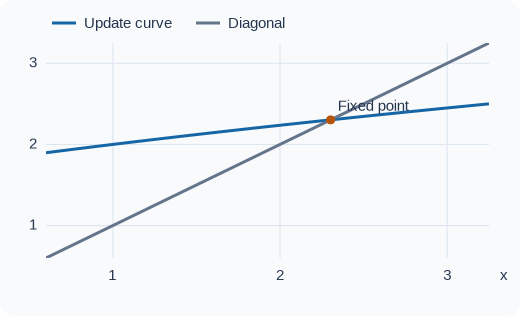
The line y equals x meets the positive square-root graph between 2 and 3. Its horizontal coordinate is the fixed point.

At the crossing x=x+3x=\sqrt{x+3}. The same number is both input and output.

Worked example

Relate a square-root update to a quadratic

The iteration xn+1=xn+5x_{n+1}=\sqrt{x_n+5} tends to a value in the domain of the update. Select an equivalent equation for that value and the restriction that belongs with the chosen rearrangement.

  1. At a limit the input and output are the same. Replace both by xx to obtain x=x+5x=\sqrt{x+5}.

  2. For a fixed point, both sides of the square-root equation are non-negative. Squaring is reversible when this restriction is kept.

  3. Solve x2−x−5=0x^2-x-5=0 with x≥0x\ge0.

Worked example

Find the equation behind a rational update

The iteration xn+1=3+4xnx_{n+1}=3+\frac{4}{x_n} tends to a value in the domain of the update. Select an equivalent equation for that value and the restriction that belongs with the chosen rearrangement.

Try it on paper first.

  1. At a limit the input and output are the same. Replace both by xx to obtain x=3+4xx=3+\frac{4}{x}.

  2. Multiply the fixed-point equation by the unknown only after recording that it cannot be zero.

  3. Solve x2−3x−4=0x^2-3x-4=0 with x≠0x\ne0.

Your turn

The iteration xn+1=xn+8x_{n+1}=\sqrt{x_n+8} tends to a value in the domain of the update. Select an equivalent equation for that value and the restriction that belongs with the chosen rearrangement.

Equation for the limit
Restriction from the rearrangement

Section 3 of 5 · Core · about 7 min

Which digits do I carry between iterations?

Separate the stored value from the value written in your working. The table communicates a rounded record at each index. Feeding those rounded records back into the calculator changes the process and can make the last few digits unreliable.

Worked example

Use the calculator's full precision

Use xn+1=xn+6x_{n+1}=\sqrt{x_n+6} with x0=1.8x_0=1.8. Calculate x1x_1, x2x_2, x3x_3, x4x_4, each to 4 decimal places.

  1. Start by entering the initial value and applying the update once. The resulting value, at calculator precision, is the next input.

  2. IndexStarting value for this rowRecorded approximation
    111.80000001.80000002.79282.7928
    222.79284802.79284802.96532.9653
    332.96527372.96527372.99422.9942
    442.99420672.99420672.99902.9990
  3. The value in the final column is the rounded record of a step. Keep extra digits in the calculator for the next calculation.

  4. If the iterates settle at α\alpha, replace the input and output of the update by α\alpha. For a fixed point, both sides of the square-root equation are non-negative. Squaring is reversible when this restriction is kept.

Your turn

Use xn+1=2+7xnx_{n+1}=2+\frac{7}{x_n} with x0=4x_0=4. Calculate x1x_1, x2x_2, x3x_3, x4x_4, each to 4 decimal places.

Enter an exact number, for example 3/2 or 2-sqrt(3).

Enter an exact number, for example 3/2 or 2-sqrt(3).

Enter an exact number, for example 3/2 or 2-sqrt(3).

Enter an exact number, for example 3/2 or 2-sqrt(3).

Section 4 of 5 · Core · about 7 min

Which rearrangement restrictions stay in force?

Some updates are defined only for part of the real line. A logarithm needs a positive argument, a real square root needs a non-negative argument, and a denominator must remain nonzero. A starting guess is useful only when the later inputs remain valid.

Worked example

Recover a logarithmic equation and its domain

The iteration xn+1=ln⁡(9−xn)x_{n+1}=\ln(9-x_n) tends to a value in the domain of the update. Select an equivalent equation for that value and the restriction that belongs with the chosen rearrangement.

  1. At a limit the input and output are the same. Replace both by xx to obtain x=ln⁡(9−x)x=\ln(9-x).

  2. Exponentiate both sides and add the unknown. The logarithmic argument must be positive in the original fixed-point equation.

  3. Solve ex+x=9\mathrm e^x+x=9 with x<9x<9.

Your turn

The iteration xn+1=ln⁡(12−xn)x_{n+1}=\ln(12-x_n) tends to a value in the domain of the update. Select an equivalent equation for that value and the restriction that belongs with the chosen rearrangement.

Equation for the limit
Restriction from the rearrangement

Section 5 of 5 · Core · about 8 min

How do I check the answer from the iteration?

The update rule provides a sequence and suggests a candidate root. For an exam question, report the requested terms and explain how a limiting value would satisfy the original equation. Then use a sign-change bracket if the final digits need a separate proof.

Worked example

Use a decreasing cube-root update

Use xn+1=14−xn3x_{n+1}=\sqrt[3]{14-x_n} with x0=3x_0=3. Calculate x1x_1, x2x_2, x3x_3, x4x_4, each to 4 decimal places.

  1. Start by entering the initial value and applying the update once. The resulting value, at calculator precision, is the next input.

  2. IndexStarting value for this rowRecorded approximation
    113.00000003.00000002.22402.2240
    222.22398012.22398012.27512.2751
    332.27509492.27509492.27182.2718
    442.27179832.27179832.27202.2720
  3. The value in the final column is the rounded record of a step. Keep extra digits in the calculator for the next calculation.

  4. If the iterates settle at α\alpha, replace the input and output of the update by α\alpha. Cubing both sides gives the original equation. The real cube root permits negative inputs as well as positive ones.

Worked example

Iterate a rearranged exponential equation

Use xn+1=ln⁡(8−xn)x_{n+1}=\ln(8-x_n) with x0=2x_0=2. Calculate x1x_1, x2x_2, x3x_3, x4x_4, each to 4 decimal places.

Try it on paper first.

  1. Start by entering the initial value and applying the update once. The resulting value, at calculator precision, is the next input.

  2. IndexStarting value for this rowRecorded approximation
    112.00000002.00000001.79181.7918
    221.79175951.79175951.82591.8259
    331.82587751.82587751.82041.8204
    441.82036681.82036681.82131.8213
  3. The value in the final column is the rounded record of a step. Keep extra digits in the calculator for the next calculation.

  4. If the iterates settle at α\alpha, replace the input and output of the update by α\alpha. Exponentiate both sides and add the unknown. The logarithmic argument must be positive in the original fixed-point equation.

Your turn

Use xn+1=21−xn3x_{n+1}=\sqrt[3]{21-x_n} with x0=3.5x_0=3.5. Calculate x1x_1, x2x_2, x3x_3, x4x_4, each to 4 decimal places.

Enter an exact number, for example 3/2 or 2-sqrt(3).

Enter an exact number, for example 3/2 or 2-sqrt(3).

Enter an exact number, for example 3/2 or 2-sqrt(3).

Enter an exact number, for example 3/2 or 2-sqrt(3).

Worked examples

Practise the method

Core practice

Question 1 of 4

0 / 4 checked in this collection

Question list

Core practice

Fresh variants

Exam-style

Calculate three affine approximations

3 marks

Use xn+1=xn+85x_{n+1}=\frac{x_n+8}{5} with x0=1x_0=1. Calculate x1x_1, x2x_2, x3x_3, each to 4 decimal places.

Enter an exact number, for example 3/2 or 2-sqrt(3).

Enter an exact number, for example 3/2 or 2-sqrt(3).

Enter an exact number, for example 3/2 or 2-sqrt(3).

Full answer-format guide

Exact numbers: 3/2, sqrt(5), 2-sqrt(3), pi/6, 3*pi/2. Sets: {1,4}. Intervals: (3,5]; a round bracket excludes the endpoint. Infinity: inf; union: U; no solutions: empty. Separate coordinate pairs or triples with semicolons. Expressions: 2x^2+3x-1; equations: x^2=3x+1 or the polynomial equal to zero. Factors: x-1 ; x+2. Parameter fraction: numerator ; denominator. List integer answers individually.

Review the method

Progress stays in this browser. Create an account to save it or sign in.

Extra practice from this lesson

Index a fractional update

Use xn+1=xn+74x_{n+1}=\frac{x_n+7}{4} with x0=0.8x_0=0.8. Calculate x1x_1, x2x_2, x3x_3, each to 4 decimal places.

Enter an exact number, for example 3/2 or 2-sqrt(3).

Enter an exact number, for example 3/2 or 2-sqrt(3).

Enter an exact number, for example 3/2 or 2-sqrt(3).

Reverse a new rational update

The iteration xn+1=4+1xnx_{n+1}=4+\frac{1}{x_n} tends to a value in the domain of the update. Select an equivalent equation for that value and the restriction that belongs with the chosen rearrangement.

Equation for the limit
Restriction from the rearrangement

Keep enough digits under a square root

Use xn+1=xn+10x_{n+1}=\sqrt{x_n+10} with x0=3x_0=3. Calculate x1x_1, x2x_2, x3x_3, x4x_4, each to 4 decimal places.

Enter an exact number, for example 3/2 or 2-sqrt(3).

Enter an exact number, for example 3/2 or 2-sqrt(3).

Enter an exact number, for example 3/2 or 2-sqrt(3).

Enter an exact number, for example 3/2 or 2-sqrt(3).

Check the original exponential balance

The iteration xn+1=3+e−xnx_{n+1}=3+\mathrm e^{-x_n} tends to a value in the domain of the update. Select an equivalent equation for that value and the restriction that belongs with the chosen rearrangement.

Equation for the limit
Restriction from the rearrangement

Use the real cube root at three steps

Use xn+1=42−xn3x_{n+1}=\sqrt[3]{42-x_n} with x0=4x_0=4. Calculate x1x_1, x2x_2, x3x_3, each to 4 decimal places.

Enter an exact number, for example 3/2 or 2-sqrt(3).

Enter an exact number, for example 3/2 or 2-sqrt(3).

Enter an exact number, for example 3/2 or 2-sqrt(3).

Run a logarithmic iteration

Use xn+1=ln⁡(10−xn)x_{n+1}=\ln(10-x_n) with x0=2.5x_0=2.5. Calculate x1x_1, x2x_2, x3x_3, x4x_4, each to 4 decimal places.

Enter an exact number, for example 3/2 or 2-sqrt(3).

Enter an exact number, for example 3/2 or 2-sqrt(3).

Enter an exact number, for example 3/2 or 2-sqrt(3).

Enter an exact number, for example 3/2 or 2-sqrt(3).

Apply it · original exam-style problems

Show your working on paper and compare it with the worked solution and marking guidance.

Come back to what needs practice

Quick revision sheet (A4)

Your review plan starts after your first check.