Maths4UBETA

Iteration diagrams and convergence

Read staircase and cobweb diagrams, recognise failure and verify the accuracy of a proposed root.

Try the quick check →
Lesson 5 of 5

Section 1 of 5 · Core · about 8 min

What do the vertical and horizontal steps do?

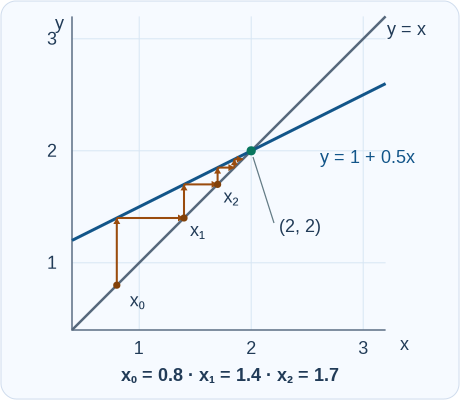
Draw the update and the diagonal on equal scales. On the diagonal the horizontal and vertical coordinates are the same. When you move vertically from the current diagonal point, the horizontal coordinate stays at the current input and the height becomes the next output.

Starting at 0.8, the first two updates give 1.4 and 1.7. Each vertical arrow goes to the update graph and each horizontal arrow returns to y = x. The fixed point is (2, 2).

For xn+1=1+12xnx_{n+1}=1+\tfrac12x_n, start at (x0,x0)(x_0,x_0) on y=xy=x. Move vertically to the update line, then horizontally back to y=xy=x. The numbers beneath the diagram are the first three inputs.

Worked example

An iteration that approaches from below

Start from x0=45x_0=\frac{4}{5} and use xn+1=2+(12)(xn−2)x_{n+1}=2+\left(\frac{1}{2}\right)\left(x_n-2\right). Give the fixed point and describe what happens to the sides visited and the distances from it.

  1. x=2+(12)(x−2)x=2+\left(\frac{1}{2}\right)(x-2) gives the fixed point 22.

  2. IndexApproximationSigned gap
    0045\frac{4}{5}−65-\frac{6}{5}
    1175\frac{7}{5}−35-\frac{3}{5}
    221710\frac{17}{10}−310-\frac{3}{10}
    333720\frac{37}{20}−320-\frac{3}{20}
  3. Each signed gap is multiplied by 12\frac{1}{2}. Same side of the fixed point. Distances decrease.

  4. The gap shrinks to zero, so the sequence converges.
Your turn

Start from x0=2x_0=2 and use xn+1=4+(12)(xn−4)x_{n+1}=4+\left(\frac{1}{2}\right)\left(x_n-4\right). Give the fixed point and describe what happens to the sides visited and the distances from it.

Enter an exact number, for example 3/2 or 2-sqrt(3).

Sides visited
Distances from the fixed point
Behaviour

Section 2 of 5 · Core · about 8 min

Can the approximations cross the root and still settle?

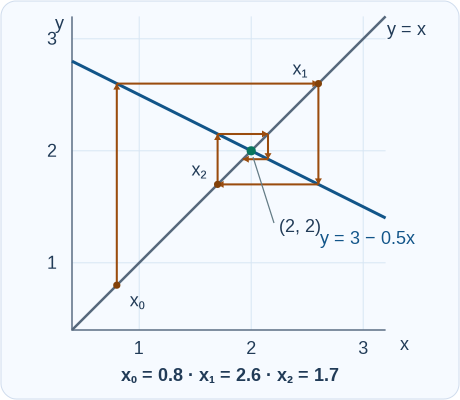
An update can send a value below the fixed point to the other side. If that overshoot becomes smaller each time, the terms can approach the same limit while alternating above and below it. The paths around the intersection are often called a cobweb.

Starting at 0.8, the first two updates give 2.6 and 1.7. Each vertical arrow goes to the update graph and each horizontal arrow returns to y = x. The fixed point is (2, 2).

For xn+1=3−12xnx_{n+1}=3-\tfrac12x_n, start at (x0,x0)(x_0,x_0) on y=xy=x. Move vertically to the update line, then horizontally back to y=xy=x. The numbers beneath the diagram are the first three inputs.

Worked example

A decreasing update crosses the same fixed point

Start from x0=45x_0=\frac{4}{5} and use xn+1=2+(−12)(xn−2)x_{n+1}=2+\left(-\frac{1}{2}\right)\left(x_n-2\right). Give the fixed point and describe what happens to the sides visited and the distances from it.

  1. x=2+(−12)(x−2)x=2+\left(-\frac{1}{2}\right)(x-2) gives the fixed point 22.

  2. IndexApproximationSigned gap
    0045\frac{4}{5}−65-\frac{6}{5}
    11135\frac{13}{5}35\frac{3}{5}
    221710\frac{17}{10}−310-\frac{3}{10}
    334320\frac{43}{20}320\frac{3}{20}
  3. Each signed gap is multiplied by −12-\frac{1}{2}. Opposite sides in turn. Distances decrease.

  4. The gap shrinks to zero, so the sequence converges.

Worked example

Same side with smaller positive steps

Start from x0=8x_0=8 and use xn+1=5+(13)(xn−5)x_{n+1}=5+\left(\frac{1}{3}\right)\left(x_n-5\right). Give the fixed point and describe what happens to the sides visited and the distances from it.

Try it on paper first.

  1. x=5+(13)(x−5)x=5+\left(\frac{1}{3}\right)(x-5) gives the fixed point 55.

  2. IndexApproximationSigned gap
    008833
    116611
    22163\frac{16}{3}13\frac{1}{3}
    33469\frac{46}{9}19\frac{1}{9}
  3. Each signed gap is multiplied by 13\frac{1}{3}. Same side of the fixed point. Distances decrease.

  4. The gap shrinks to zero, so the sequence converges.

Your turn

Start from x0=7x_0=7 and use xn+1=5+(−13)(xn−5)x_{n+1}=5+\left(-\frac{1}{3}\right)\left(x_n-5\right). Give the fixed point and describe what happens to the sides visited and the distances from it.

Enter an exact number, for example 3/2 or 2-sqrt(3).

Sides visited
Distances from the fixed point
Behaviour

Section 3 of 5 · Core · about 7 min

What does a sequence moving away look like?

Having a fixed point is a fact about the equation. Approaching it from the chosen starting value is a fact about the update. An update can produce terms that move farther from the intersection, so solving the fixed-point equation alone does not predict the calculation.

Worked example

Watch a gap grow without changing sign

Start from x0=72x_0=\frac{7}{2} and use xn+1=3+(32)(xn−3)x_{n+1}=3+\left(\frac{3}{2}\right)\left(x_n-3\right). Give the fixed point and describe what happens to the sides visited and the distances from it.

  1. x=3+(32)(x−3)x=3+\left(\frac{3}{2}\right)(x-3) gives the fixed point 33.

  2. IndexApproximationSigned gap
    0072\frac{7}{2}12\frac{1}{2}
    11154\frac{15}{4}34\frac{3}{4}
    22338\frac{33}{8}98\frac{9}{8}
    337516\frac{75}{16}2716\frac{27}{16}
  3. Each signed gap is multiplied by 32\frac{3}{2}. Same side of the fixed point. Distances increase.

  4. The gap does not shrink to zero, so these approximations do not converge to the fixed point.

Your turn

Start from x0=3x_0=3 and use xn+1=2+(32)(xn−2)x_{n+1}=2+\left(\frac{3}{2}\right)\left(x_n-2\right). Give the fixed point and describe what happens to the sides visited and the distances from it.

Enter an exact number, for example 3/2 or 2-sqrt(3).

Sides visited
Distances from the fixed point
Behaviour

Section 4 of 5 · Core · about 6 min

How is a cycle different from a convergent cobweb?

If two distinct values lead back to one another, the sequence repeats forever. They may appear symmetric around the fixed point, but the gap remains nonzero. A convergent sequence can also have a changing sign, with the difference that its gaps tend to zero.

Worked example

Identify a repeating pair of approximations

Start from x0=5x_0=5 and use xn+1=4+(−1)(xn−4)x_{n+1}=4+\left(-1\right)\left(x_n-4\right). Give the fixed point and describe what happens to the sides visited and the distances from it.

  1. x=4+(−1)(x−4)x=4+\left(-1\right)(x-4) gives the fixed point 44.

  2. IndexApproximationSigned gap
    005511
    1133−1-1
    225511
    3333−1-1
  3. Each signed gap is multiplied by −1-1. Opposite sides in turn. Distances are unchanged.

  4. The gap does not shrink to zero, so these approximations do not converge to the fixed point.

Your turn

Start from x0=8x_0=8 and use xn+1=6+(−1)(xn−6)x_{n+1}=6+\left(-1\right)\left(x_n-6\right). Give the fixed point and describe what happens to the sides visited and the distances from it.

Enter an exact number, for example 3/2 or 2-sqrt(3).

Sides visited
Distances from the fixed point
Behaviour

Section 5 of 5 · Core · about 7 min

What do I report when an iteration appears to settle?

Report the terms at the requested precision and identify the original equation. The picture or a table can suggest whether the chosen sequence settles. When the task asks you to show the final rounded digits, locate a zero of the original continuous function in the corresponding rounding window.

Worked example

Show a signed gap shrinks on each step

Start from x0=5x_0=5 and use xn+1=3+(−14)(xn−3)x_{n+1}=3+\left(-\frac{1}{4}\right)\left(x_n-3\right). Give the fixed point and describe what happens to the sides visited and the distances from it.

  1. x=3+(−14)(x−3)x=3+\left(-\frac{1}{4}\right)(x-3) gives the fixed point 33.

  2. IndexApproximationSigned gap
    005522
    1152\frac{5}{2}−12-\frac{1}{2}
    22258\frac{25}{8}18\frac{1}{8}
    339532\frac{95}{32}−132-\frac{1}{32}
  3. Each signed gap is multiplied by −14-\frac{1}{4}. Opposite sides in turn. Distances decrease.

  4. The gap shrinks to zero, so the sequence converges.

Worked example

A zigzag can move away from the root

Start from x0=174x_0=\frac{17}{4} and use xn+1=4+(−32)(xn−4)x_{n+1}=4+\left(-\frac{3}{2}\right)\left(x_n-4\right). Give the fixed point and describe what happens to the sides visited and the distances from it.

Try it on paper first.

  1. x=4+(−32)(x−4)x=4+\left(-\frac{3}{2}\right)(x-4) gives the fixed point 44.

  2. IndexApproximationSigned gap
    00174\frac{17}{4}14\frac{1}{4}
    11298\frac{29}{8}−38-\frac{3}{8}
    227316\frac{73}{16}916\frac{9}{16}
    3310132\frac{101}{32}−2732-\frac{27}{32}
  3. Each signed gap is multiplied by −32-\frac{3}{2}. Opposite sides in turn. Distances increase.

  4. The gap does not shrink to zero, so these approximations do not converge to the fixed point.

Your turn

Start from x0=1x_0=1 and use xn+1=3+(−12)(xn−3)x_{n+1}=3+\left(-\frac{1}{2}\right)\left(x_n-3\right). Give the fixed point and describe what happens to the sides visited and the distances from it.

Enter an exact number, for example 3/2 or 2-sqrt(3).

Sides visited
Distances from the fixed point
Behaviour

Worked examples

Practise the method

Core practice

Question 1 of 4

0 / 4 checked in this collection

Question list

Core practice

Fresh variants

Exam-style

Describe a staircase

4 marks

Start from x0=5x_0=5 and use xn+1=3+(12)(xn−3)x_{n+1}=3+\left(\frac{1}{2}\right)\left(x_n-3\right). Give the fixed point and describe what happens to the sides visited and the distances from it.

Enter an exact number, for example 3/2 or 2-sqrt(3).

Sides visited

Choose one option. Explain your reasoning on paper.

Distances from the fixed point

Choose one option. Explain your reasoning on paper.

Behaviour

Choose one option. Explain your reasoning on paper.

Full answer-format guide

Exact numbers: 3/2, sqrt(5), 2-sqrt(3), pi/6, 3*pi/2. Sets: {1,4}. Intervals: (3,5]; a round bracket excludes the endpoint. Infinity: inf; union: U; no solutions: empty. Separate coordinate pairs or triples with semicolons. Expressions: 2x^2+3x-1; equations: x^2=3x+1 or the polynomial equal to zero. Factors: x-1 ; x+2. Parameter fraction: numerator ; denominator. List integer answers individually.

Review the method

Progress stays in this browser. Create an account to save it or sign in.

Extra practice from this lesson

Approach from the right

Start from x0=9x_0=9 and use xn+1=7+(14)(xn−7)x_{n+1}=7+\left(\frac{1}{4}\right)\left(x_n-7\right). Give the fixed point and describe what happens to the sides visited and the distances from it.

Enter an exact number, for example 3/2 or 2-sqrt(3).

Sides visited
Distances from the fixed point
Behaviour

Alternate around another intersection

Start from x0=10x_0=10 and use xn+1=6+(−14)(xn−6)x_{n+1}=6+\left(-\frac{1}{4}\right)\left(x_n-6\right). Give the fixed point and describe what happens to the sides visited and the distances from it.

Enter an exact number, for example 3/2 or 2-sqrt(3).

Sides visited
Distances from the fixed point
Behaviour

Drift away on the same side

Start from x0=4x_0=4 and use xn+1=5+(2)(xn−5)x_{n+1}=5+\left(2\right)\left(x_n-5\right). Give the fixed point and describe what happens to the sides visited and the distances from it.

Enter an exact number, for example 3/2 or 2-sqrt(3).

Sides visited
Distances from the fixed point
Behaviour

Test a two-step repetition

Start from x0=2x_0=2 and use xn+1=3+(−1)(xn−3)x_{n+1}=3+\left(-1\right)\left(x_n-3\right). Give the fixed point and describe what happens to the sides visited and the distances from it.

Enter an exact number, for example 3/2 or 2-sqrt(3).

Sides visited
Distances from the fixed point
Behaviour

Move away on alternating sides

Start from x0=7x_0=7 and use xn+1=6+(−32)(xn−6)x_{n+1}=6+\left(-\frac{3}{2}\right)\left(x_n-6\right). Give the fixed point and describe what happens to the sides visited and the distances from it.

Enter an exact number, for example 3/2 or 2-sqrt(3).

Sides visited
Distances from the fixed point
Behaviour

Close slowly to a fixed point

Start from x0=1x_0=1 and use xn+1=4+(34)(xn−4)x_{n+1}=4+\left(\frac{3}{4}\right)\left(x_n-4\right). Give the fixed point and describe what happens to the sides visited and the distances from it.

Enter an exact number, for example 3/2 or 2-sqrt(3).

Sides visited
Distances from the fixed point
Behaviour

Apply it · original exam-style problems

Show your working on paper and compare it with the worked solution and marking guidance.

Come back to what needs practice

Quick revision sheet (A4)

Your review plan starts after your first check.