Maths4UBETA

Polar and exponential calculations

Choose a useful representation, multiply and divide with exact arguments, and find both square roots in polar or exponential form.

Try the quick check →
Lesson 4 of 5

Section 1 of 6 · Core · about 6 min

When is polar or exponential form shorter?

Cartesian form gives signed coordinates. Polar form gives distance and angle, so multiplication and division become shorter.

Worked example

Switch from Cartesian to polar form

Give the two parameters (modulus, argument in radians) of −5+53i-5 + 5 \sqrt{3} \mathrm{i} in polar form. Use −π<θ≤π-\pi<\theta\le\pi.

  1. Pythagoras gives the radius 1010 from the components −5-5 and 535 \sqrt{3}.

  2. The direction of the point from the origin gives angle 2π3\frac{2 \pi}{3} in the required interval.

  3. In polar form this is 10(cos⁡(2π3)+isin⁡(2π3))10\left(\cos\left(\frac{2 \pi}{3}\right)+\mathrm i\sin\left(\frac{2 \pi}{3}\right)\right).

Worked example

Switch from Cartesian to exponential form

Give the two parameters (modulus, argument in radians) of 42−42i4 \sqrt{2} - 4 \sqrt{2} \mathrm{i} in exponential form. Use −π<θ≤π-\pi<\theta\le\pi.

Try it on paper first.

  1. Pythagoras gives the radius 88 from the components 424 \sqrt{2} and −42- 4 \sqrt{2}.

  2. The direction of the point from the origin gives angle −π4- \frac{\pi}{4} in the required interval.

  3. In exponential form this is 8ei(−π4)8e^{\mathrm i\left(- \frac{\pi}{4}\right)}.

Your turn

Give the two parameters (modulus, argument in radians) of −33+3i- 3 \sqrt{3} + 3 \mathrm{i} in polar form. Use −π<θ≤π-\pi<\theta\le\pi.

Enter each pair in the order shown. Separate complete pairs with commas or semicolons.

Section 2 of 6 · Core · about 7 min

Why do product angles add?

A product combines radii multiplicatively and turns successively. In exponential form the exponent rule already expresses these two steps.

Worked example

Find the polar product

Take u=2ei(2π3)u=2e^{\mathrm i\left(\frac{2 \pi}{3}\right)} and v=3ei(3π4)v=3e^{\mathrm i\left(\frac{3 \pi}{4}\right)}. Give uvuv as the pair (modulus, argument in radians), with −π<θ≤π-\pi<\theta\le\pi.

  1. Multiply the moduli to obtain 66.

  2. Add the direction angles to obtain 17π12\frac{17 \pi}{12} before changing intervals.

  3. Reduce by whole turns if needed. The requested angle is −7π12- \frac{7 \pi}{12}, giving 6ei(−7π12)6e^{\mathrm i\left(- \frac{7 \pi}{12}\right)}.

Your turn

Take u=4ei(5π6)u=4e^{\mathrm i\left(\frac{5 \pi}{6}\right)} and v=3ei(π2)v=3e^{\mathrm i\left(\frac{\pi}{2}\right)}. Give uvuv as the pair (modulus, argument in radians), with −π<θ≤π-\pi<\theta\le\pi.

Enter each pair in the order shown. Separate complete pairs with commas or semicolons.

Section 3 of 6 · Core · about 7 min

Which angle comes first in a quotient?

Use numerator direction minus denominator direction. The modulus of the divisor must be positive.

Worked example

Find the polar quotient

Take u=12ei(−2π3)u=12e^{\mathrm i\left(- \frac{2 \pi}{3}\right)} and v=4ei(3π4)v=4e^{\mathrm i\left(\frac{3 \pi}{4}\right)}. Give uv\frac uv as the pair (modulus, argument in radians), with −π<θ≤π-\pi<\theta\le\pi.

  1. Divide the moduli to obtain 33.

  2. Subtract the direction angles to obtain −17π12- \frac{17 \pi}{12} before changing intervals.

  3. Reduce by whole turns if needed. The requested angle is 7π12\frac{7 \pi}{12}, giving 3ei(7π12)3e^{\mathrm i\left(\frac{7 \pi}{12}\right)}.

Your turn

Take u=18ei(−π6)u=18e^{\mathrm i\left(- \frac{\pi}{6}\right)} and v=6ei(2π3)v=6e^{\mathrm i\left(\frac{2 \pi}{3}\right)}. Give uv\frac uv as the pair (modulus, argument in radians), with 0≤θ<2π0\le\theta<2\pi.

Enter each pair in the order shown. Separate complete pairs with commas or semicolons.

Section 4 of 6 · Core · about 6 min

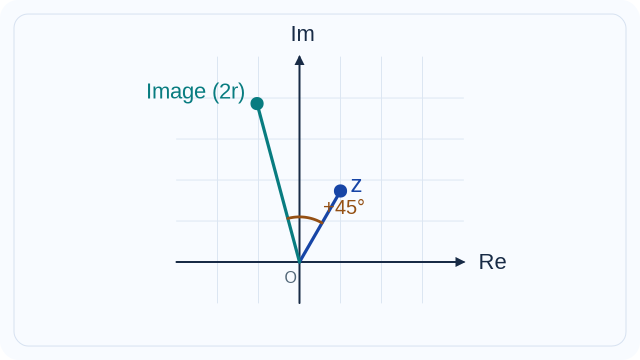
What does multiplication do to the diagram?

Multiplication by the same number changes the distance and angle of every point in the same way. Division uses the reciprocal change.

A shorter ray in quadrant I and a longer image ray in quadrant II, showing an anticlockwise rotation about the origin and an increase in radius.

Multiplication by a fixed non-zero complex number scales the radius and rotates about the origin.

Worked example

Identify the rotation and scale

The point for a non-zero zz is sent to the point for 2ei(π4)z2e^{\mathrm i\left(\frac{\pi}{4}\right)}z. Select the radius multiplier and signed rotation in (−π,π](-\pi,\pi].

  1. Multiplying by a fixed complex number scales every radius by 22.

  2. Add the argument of the fixed number. The corresponding rotation is π4\frac{\pi}{4} radians.

Your turn

The point for a non-zero zz is sent to the point for z3ei(−π6)\frac{z}{3e^{\mathrm i\left(- \frac{\pi}{6}\right)}}. Select the radius multiplier and signed rotation in (−π,π](-\pi,\pi].

Correct transformation

Section 5 of 6 · Core · about 8 min

Where does the second square root come from?

When a square is taken, many angles name the target. Use two target representatives a full turn apart before halving them.

Worked example

Find two square roots in exponential form

Find both square roots of 25ei(2π3)25e^{\mathrm i\left(\frac{2 \pi}{3}\right)}. Enter both (modulus, argument in radians) pairs with −π<θ≤π-\pi<\theta\le\pi.

  1. Squaring doubles the direction and squares the modulus. Each root has modulus 55.

  2. Doubling angles is modulo 2π2\pi, so first use 2π3\frac{2 \pi}{3} and 8π3\frac{8 \pi}{3} as target directions.

  3. Halve each angle and reduce to the stated interval. The two arguments are π3\frac{\pi}{3} and −2π3- \frac{2 \pi}{3}.

  4. The roots are opposite points on the Argand diagram.

Your turn

Find both square roots of 36ei(−π3)36e^{\mathrm i\left(- \frac{\pi}{3}\right)}. Enter both (modulus, argument in radians) pairs with −π<θ≤π-\pi<\theta\le\pi.

Enter each pair in the order shown. Separate complete pairs with commas or semicolons.

Section 6 of 6 · Extension · about 6 min

When is the other square-root method better?

Use Cartesian comparison when the Cartesian parts are simple and the question needs exact Cartesian roots. Polar form makes the two directions visible.

Worked example

Find two square roots in exponential form

Find both square roots of 49ei(π)49e^{\mathrm i\left(\pi\right)}. Enter both (modulus, argument in radians) pairs with 0≤θ<2π0\le\theta<2\pi.

  1. Squaring doubles the direction and squares the modulus. Each root has modulus 77.

  2. Doubling angles is modulo 2π2\pi, so first use π\pi and 3π3 \pi as target directions.

  3. Halve each angle and reduce to the stated interval. The two arguments are π2\frac{\pi}{2} and 3π2\frac{3 \pi}{2}.

  4. The roots are opposite points on the Argand diagram.

Your turn

Find both square roots of 8181. Enter both (modulus, argument in radians) pairs with 0≤θ<2π0\le\theta<2\pi.

Enter each pair in the order shown. Separate complete pairs with commas or semicolons.

Worked examples

Practise the method

Core practice

Question 1 of 4

0 / 4 checked in this collection

Question list

Core practice

Fresh variants

Exam-style

Switch from Cartesian to polar form

1 mark

Give the two parameters (modulus, argument in radians) of −62+62i- 6 \sqrt{2} + 6 \sqrt{2} \mathrm{i} in polar form. Use −π<θ≤π-\pi<\theta\le\pi.

Enter each pair in the order shown. Separate complete pairs with commas or semicolons.

Full answer-format guide

Exact numbers: 3/2, sqrt(5), 2-sqrt(3), pi/6, 3*pi/2. Sets: {1,4}. Intervals: (3,5]; a round bracket excludes the endpoint. Infinity: inf; union: U; no solutions: empty. Separate coordinate pairs or triples with semicolons. Expressions: 2x^2+3x-1; equations: x^2=3x+1 or the polynomial equal to zero. Factors: x-1 ; x+2. Parameter fraction: numerator ; denominator. List integer answers individually.

Review the method

Progress stays in this browser. Create an account to save it or sign in.

Extra practice from this lesson

Switch from Cartesian to exponential form

Give the two parameters (modulus, argument in radians) of 73−7i7 \sqrt{3} - 7 \mathrm{i} in exponential form. Use −π<θ≤π-\pi<\theta\le\pi.

Enter each pair in the order shown. Separate complete pairs with commas or semicolons.

Find the polar product

Take u=7ei(3π4)u=7e^{\mathrm i\left(\frac{3 \pi}{4}\right)} and v=2ei(π2)v=2e^{\mathrm i\left(\frac{\pi}{2}\right)}. Give uvuv as the pair (modulus, argument in radians), with −π<θ≤π-\pi<\theta\le\pi.

Enter each pair in the order shown. Separate complete pairs with commas or semicolons.

Find the polar quotient

Take u=20ei(π6)u=20e^{\mathrm i\left(\frac{\pi}{6}\right)} and v=5ei(−5π6)v=5e^{\mathrm i\left(- \frac{5 \pi}{6}\right)}. Give uv\frac uv as the pair (modulus, argument in radians), with −π<θ≤π-\pi<\theta\le\pi.

Enter each pair in the order shown. Separate complete pairs with commas or semicolons.

Identify the rotation and scale

The point for a non-zero zz is sent to the point for 4ei(π3)z4e^{\mathrm i\left(\frac{\pi}{3}\right)}z. Select the radius multiplier and signed rotation in (−π,π](-\pi,\pi].

Correct transformation

Find two square roots in exponential form

Find both square roots of 64ei(5π6)64e^{\mathrm i\left(\frac{5 \pi}{6}\right)}. Enter both (modulus, argument in radians) pairs with −π<θ≤π-\pi<\theta\le\pi.

Enter each pair in the order shown. Separate complete pairs with commas or semicolons.

Find two square roots in exponential form

Find both square roots of 9ei(−π2)9e^{\mathrm i\left(- \frac{\pi}{2}\right)}. Enter both (modulus, argument in radians) pairs with 0≤θ<2π0\le\theta<2\pi.

Enter each pair in the order shown. Separate complete pairs with commas or semicolons.

Apply it · original exam-style problems

Show your working on paper and compare it with the worked solution and marking guidance.

Come back to what needs practice

Quick revision sheet (A4)

Your review plan starts after your first check.